
Category: Royalty and License Payments

Royalty and license payments in transfer pricing concern the arm’s length pricing of contractual arrangements under which one group entity grants another the right to use intangible property — trademarks, patents, know-how, or proprietary technology — in exchange for a fee. The core legal question is whether the royalty rate, and the very existence of the payment obligation, reflects what independent parties would have agreed in comparable circumstances. The arm’s length standard, codified in Article 9 of the OECD Model Tax Convention and transposed into domestic legislation across jurisdictions, governs these transactions. Disputes arise both from the quantum of the royalty and from whether the underlying contractual arrangement itself has genuine economic substance.In practice, tax authorities challenge royalty arrangements on several distinct grounds. They may dispute the rate charged, as seen in the Netherlands Tobacco B.V. litigation involving multi-year assessments exceeding €2.8 billion annually. They may challenge the arrangement’s economic rationale entirely, alleging a sale-and-leaseback of intangibles lacks business purpose, as occurred in the Polish E S.A. and P.B. cases involving trademark transfers to related parties followed by licence-back agreements. Authorities also contest whether a purported royalty embedded within a product purchase price constitutes a genuine separate payment or constitutes a double charge, the issue at the heart of the Polish Cosmetics sp. z o.o. case. Taxpayers generally argue contractual allocation of rights, commercial rationale, and comparability to third-party licensing benchmarks.The OECD Transfer Pricing Guidelines address intangible-related payments primarily in Chapter VI (paragraphs 6.1–6.212 of the 2022 edition), which requires identification of the intangible, analysis of which entity performs DEMPE functions, and confirmation that legal ownership alone does not determine entitlement to returns. Chapter I’s guidance on accurately delineating the actual transaction is equally relevant, as illustrated by the Starbucks case, where the General Court scrutinised the allocation of roasting profits and the royalty paid to Alki LP. The Bundesfinanzhof’s Cutting Tech decision engages the question of whether a contract manufacturer using group-owned specifications should pay for their use.Courts and practitioners focus on functional and comparability analysis: which entity develops, maintains, and exploits the intangible; whether comparable uncontrolled royalty rates can be identified; and whether the contractual terms would be replicated between independent parties. The Procter & Gamble case (6th Cir. 1992) remains significant for its analysis of cost-sharing and the appropriate base on which royalties are calculated. Key contested questions include the deductibility of royalties under domestic anti-avoidance rules, the substance of holding structures, and the interaction between transfer pricing adjustments and withholding tax treaty relief.These cases collectively demonstrate that royalty arrangements remain among the highest-risk transfer pricing structures globally, requiring practitioners to align contractual form, functional substance, and benchmarking analysis with both OECD guidance and domestic rules.

McDonald’s has agreed to pay €1.25bn to settle a dispute with French authorities over excessive royalty payments to Luxembourg
McDonald’s has agreed to pay €1.25bn to settle a dispute with French authorities over excessive royalty payments to Luxembourg

On 16 June 2022 McDonald’s France entered into an settlement agreement according to which it will pay €1.245 billion in back taxes and fines to the French tax authorities. The settlement agreement resulted from investigations carried out by the French tax authorities in regards to abnormally high royalties transferred from McDonald’s France to McDonald’s Luxembourg following an intra group restructuring in 2009. McDonald’s France doubled its royalty payments from 5% to 10% of restaurant turnover, and instead of paying these royalties to McDonald’s HQ in the United States, going forward they paid them to a Swiss PE of a group company in Luxembourg, which was not taxable of the amounts. During the investigations it was discovered that McDonald’s royalty fees could vary substantially from one McDonald’s branch to the next without any justification other than tax savings for the group. This conclusion was further supported by statements of the managers of the various subsidiaries as well as documentation seized which showed that the 100% increase in the royalty rate was mainly explained by a higher profitability of McDonald’s in France and a corresponding increase in taxes due. The investigations led the French tax authorities to question the overall economic substance of the IP company in Luxembourg and the contractual arrangements setup by the McDonald’s group. After being presented with the findings of the investigations and charged with tax fraud etc. McDonald’s was offered a public interest settlement agreement (CJIP) under Article 41-1-2 of the French Code of Criminal Procedure. The final settlement agreement between McDonald’s and the French authorities was announced in a press release from the Financial Public Prosecutor (English translation below). On 16 June 2022, the President of the Paris Judicial Court validated the judicial public interest agreement (CJIP) concluded on 31 May 2022 by the Financial Public Prosecutor (PRF) and the companies MC DONALD’S FRANCE, MC DONALD’S SYSTEM OF FRANCE LLC and MCD LUXEMBOURG REAL ESTATE S.A.R.L pursuant to Article 41-1-2 of the Criminal Procedure Code. under Article 41-1-2 of the Code of Criminal Procedure. Under the terms of the CJIP, MC DONALD’S FRANCE, MC DONALD’S SYSTEM OF FRANCE LLC and MCD LUXEMBOURG REAL ESTATE S.A.R.L, undertake to pay the French Treasury a public interest fine totalling 508,482,964 euros. Several French companies of the MC DONALD’S group have also signed a global settlement with the tax authorities, putting an end to the administrative litigation. The sum of the duties and penalties due under the overall settlement and the public interest fine provided for under the CJIP amounts to a total of EUR 1,245,624,269. Subject to the payment of the public interest fine, the validation of the CJIP extinguishes the public prosecution against the signatory companies. This agreement follows a preliminary investigation initiated by the PNF on 4 January 2016 after the filing of a complaint by the works council of MC DONALD’S OUEST PARISIEN. Opened in particular on the charge of tax fraud, the investigation had been entrusted to the Central Office for Combating Corruption and Financial and Fiscal Offences (OCLCIFF). This is the 10ᵉ CJIP signed by the national financial prosecutor’s office. The Financial Public Prosecutor Jean-François Bohnert Validated Settlement Agreement of 16 June 2022 English translation of the Validated Settelment Agreement Preliminary Settlement Agreement of 31 May 2022 with statement of facts and resulting taxes and fines English translation of the Preliminary Settlement Agreement of 31 May 2022
South Africa vs SC (Pty) Ltd, April 2025, Tax Court, Case No 45840
South Africa vs SC (Pty) Ltd, April 2025, Tax Court, Case No 45840

SC (Pty) Ltd (SCL) received remuneration for activities performed for SIL, a related party resident in Mauritius. According to the company, SIL was responsible for trademarks, know-how, and related intangibles, as outlined in the franchise agreements with the non-RSA subsidiaries. Following a transfer pricing audit, the South African Revenue Service (SARS) concluded that it was evident from the conduct of both SIL and SCL, their respective employees and boards, and the general correspondence provided to SARS, that SCL had in fact determined the strategies with respect to the group’s expansion into the African market. SCL set the standard with regard to the development of marketing intangibles in non-RSA jurisdictions. SIL was only responsible for entering into the franchise agreements after they had been drafted and vetted by SCL employees. SARS therefore concluded that the remuneration received by SCL fell below the arm’s length range determined using the CUP method, and adjusted SCL’s taxable income accordingly. SCL objected to the assessment and subsequently appealed against it. They contended that the arrangements did not give rise to non-arm’s length revenue streams, and that the CUP method adopted by SARS was defective and inapplicable. The first issue that the Tax Court had to decide was whether SARS could submit an expert report in support of their assessment order. This was contested by SCL in their appeal. Decision The Tax Court dismissed the appeal of SCL and ruled in favour of SARS. Click here for other translation
Poland vs "Fertilizer TM S.A.", March 2025, Supreme Administrative Court, Case No II FSK 916/22

Poland vs “Fertilizer TM S.A.”, March 2025, Supreme Administrative Court, Case No II FSK 916/22

A Polish fertilizer manufacturer, “Fertilizer TM S.A.”, had transferred legal ownership of its trademarks to its subsidiary “B” and then paid substantial royalties for the use of the same trademarks. The tax authority considered B’s role to be merely “administrative” and recharacterised the licence agreement as a contract for trademark management services. On this basis, the tax deductions taken by “Fertilizer TM S.A.” were significantly reduced and an assessment of the resulting additional taxable income was issued. On appeal, the assessment was upheld by the Court of First Instance and the case was then brought before the Regional Administrative Court. In April 2022 the Regional Administrative Court concluded that, under the provisions of the Income Tax Act in force during the period under review (2013-2014), the tax authority could not lawfully disregard a valid licence agreement or replace it with another type of service agreement. Article 11 of the CIT Act, in its previous version, allowed the authorities to estimate income only if they could prove that the prices set between related entities deviated from arm’s length standards. However, it did not allow the authorities to reclassify legal transactions; such a power was introduced in 2019. The Court stressed that, if the ownership of the trademarks was effectively transferred to B and “Fertilizer TM S.A.” then needed a valid licence to continue using them, the central question was whether the licence fees themselves reflected market conditions. The Court held that, in order to assess whether the amount of the licence fee was at arm’s length, the authorities had to apply recognised transfer pricing methods – comparable uncontrolled price, cost-plus or resale price – and only if these methods could not be used should they resort to transactional profit methods. By relying on the 2017 OECD Guidelines (which significantly changed aspects of transfer pricing analysis and included concepts that had not been translated into Polish at the time of the transaction), the authorities improperly applied principles that were not legally binding in 2013-2014. The court ordered the tax authority to reconsider the matter and correctly assess “Fertilizer S.A”‘s income and allowable licensing costs by valuing the royalty payments under the appropriate transfer pricing methods, rather than rejecting them on the grounds that B was merely a “manager” of the trademarks. An appeal was then filed with the Supreme Administrative Court. Judgment The Supreme Administrative Court upheld the decision of the Regional Administrative Court. Click here for English Translation Click here for other translation
India vs Beam Global Spirits & Wine (India) Pvt.Ltd., March 2025, High Court of Delhi, ITA 155/2022
India vs Beam Global Spirits & Wine (India) Pvt.Ltd., March 2025, High Court of Delhi, ITA 155/2022

The core issue was whether Beam Global Spirits & Wine’s Advertisement, Marketing, and Promotion expenses for brand promotion constituted an “international transaction” under Section 92B of the Income Tax Act, thereby warranting a transfer pricing adjustment. The tax authorities had applied the Bright Line Test to determine that the AMP expenditure was excessive compared to comparable companies, inferring from this a presumed international transaction with the foreign associated enterprise and making an arm’s length price adjustment. On appeal, the Income Tax Appealante Tribunal overturned the tax authorities adjustment, holding that the existence of an international transaction must be established by tangible evidence—such as an agreement or arrangement—and not by inference from advertisement, marketing, and promotion spending alone. An appeal was then filed by the tax authorities with the High Court. Judgment The High Court dismissed the appeals and upheld the ITAT’s view, reiterating principles from previous rulings, especially Maruti Suzuki and Sony Ericsson. The Court emphasized that: A transfer pricing analysis under Chapter X of the Act can only be initiated if there is a demonstrable international transaction. The mere use of a foreign brand or incurrence of high advertisement, marketing, and promotion expenses does not, by itself, imply a transaction exists. The Bright Line Test is not a valid legal tool for inferring the existence of an international transaction or for computing arm’s length pricing. The retrospective clarification to Section 92B (via the 2012 Explanation) does not override the need for proving an actual agreement, understanding, or concerted action between associated enterprises. There is no statutory machinery in the Indian transfer pricing regime to permit quantitative adjustments based solely on advertisement, marketing, and promotion expenditure. Accordingly, the Court found no basis for the tax authorities benchmarking and transfer pricing adjustment in the absence of a proven international transaction, and dismissed the Revenue’s appeals. Click here for other translation
Greece vs "Dairy Distributor S.A.", February 2025, Administrative Tribunal, Case No 330/2025

Greece vs “Dairy Distributor S.A.”, February 2025, Administrative Tribunal, Case No 330/2025

“Dairy Distributor S.A.” produces a variety of dairy products and sells to consumers in the Greek market products produced in its own factory or by other Group companies. For the rights to use the trademarks and know-how for its production and sales activities, “Dairy Distributor S.A.” had entered into a trademark licence agreement and a know-how licence agreement with a related party in the Netherlands and until 2017 paid a royalty for the use of trademarks of 2% on net sales and a royalty for the use of know-how of 2% on net sales of locally produced products. In 2018, “Dairy Distributor S.A.” was changed from a limited risk distributor to a full risk distributor and was now also required to pay royalties for know-how on net sales of products that it did not produce itself. Following an audit for FY2018 – FY2022, the tax authorities disallowed deductions for these additional royalty payments, concluding that these did not comply with the arm’s length principle or qualify as payments for genuine know-how rights. The authorities also disallowed the deductions for these payments as intra-group services, as they found no evidence that these services conferred a distinct, additional benefit to the local entity – particularly as it already possessed the expertise needed to sell the products. “Dairy Distributor S.A.” appealed to the Directorate of Dispute Settlement. Decision The Directorate rejected the appeal and confirmed the tax assessment issued by the tax authorities. Click here for English translation Click here for other translation
Poland vs “I VAT Sp. z o.o.”, February 2025, Supreme Administrative Court, Case No I FSK 2452/21
Poland vs “I VAT Sp. z o.o.”, February 2025, Supreme Administrative Court, Case No I FSK 2452/21

“I VAT Sp. z o.o.” is a distributor of ERP software and is part of a multinational group. Under a group licence agreement, it paid monthly fees for software licences in such a way as to maintain a certain arm’s length target operating margin. To achieve this, corrective invoices were issued to adjust previous licence payments. If the operating margin fell below the target, it received compensatory payments, and if the margin was higher, it was charged additional fees. The tax authority partially accepted the monthly licence fees and certain corrective invoices. However, the tax authority concluded that the compensation payments received constituted payment for services subject to VAT. “I VAT Sp. z o.o.” appealed to the Administrative Court, challenging, inter alia, the VAT aspect of the assessment, arguing that the compensation payments were not related to a specific service provided by it. In September 2021 the Administrative Court found that the authority’s conclusion about treating the compensation payments as VAT-remuneration was incorrect but upheld other aspects of the assessment. An appeal was then filed by the tax authority with the Supreme Administrative Court. Judgment The Supreme Administrative Court dismissed the appeal and upheld the decision of the Administrative Court. Click here for English Translation Click here for other translation
Denmark vs Accenture A/S, January 2025, Supreme Court, Case No BS-49398/2023-HJR and BS-47473/2023-HJR (SKM2025.76.HR)
Denmark vs Accenture A/S, January 2025, Supreme Court, Case No BS-49398/2023-HJR and BS-47473/2023-HJR (SKM2025.76.HR)

Accenture A/S had been issued a tax assessment on two types of intra-group transactions – loan of employees (IAA) and royalty payments for access to and use of intangible assets. The loan of employees (IAA) were temporary intra-group loans of “idle” employees who were not in the process of or were about to perform specific tasks for the operating company in which they were employed. To a large extent, these were cross-border loans of employees. In the loan of employees, the borrowing operating company provided a consultancy service to a customer, and it was also the borrowing operating company that bore the business risk. The royalty payments related to Accenture A/S’ use of the Group’s intangible assets, which were reportedly owned by a Swiss company. In the case, it was stated that the Accenture Group’s operating companies’ intangible assets and future development and improvements of the same had been transferred to the Swiss company, and the other operating companies’ access to the use of the Group’s intangible assets was regulated in licence agreements entered into between the Swiss company and the operating companies. In a judgment issued in August 2023, the Court of Appeal ruled in favour of the tax authorities. An appeal was then filed by Accenture A/S with the Supreme Court. Judgment of the Supreme Court The Supreme Court overturned the decision of the Court of Appeal and decided in favour of Accenture A/S. According to the court the Ministry of Taxation had not demonstrated that Accenture’s global transfer pricing documentation for the income years 2005-2011 was deficient to such a significant extent that it could be equated with missing documentation. The Supreme Court noted that the transfer pricing documentation was based on the OECD’s transfer pricing guidelines and that it contained, among other things, a reasoned choice of method (the Cost Plus method), a functional and risk analysis and a comparability analysis made on an informed data basis. The fact that the Ministry of Taxation disagreed with the pricing method or the comparability analysis did not in itself render the documentation deficient. The Supreme Court found that Accenture A/S’ income regarding the costs of hiring employees under the IAA agreement for the income years 2005-2011 could not be assessed on a discretionary basis and that the Ministry of Taxation had not demonstrated that the profit margin was not at arm’s length. Regarding the royalty rate, the Supreme Court found that the Ministry of Taxation had not demonstrated that Accenture’s global transfer pricing documentation for the income year 2007 was deficient to such a significant extent that it could be equated with missing documentation. The Supreme Court noted that the transfer pricing documentation was based on the OECD’s transfer pricing guidelines and that it contained, among other things, a justified choice of method (the Residual Profit Split method), a functional and risk analysis and a comparability analysis made on an informed data basis. The fact that the Ministry of Taxation believed that insufficient consideration had been given to the fact that Accenture A/S’ contributed to the value of the intangible assets did not in itself render the transfer pricing documentation deficient. Accenture’s deductions regarding royalty payments could therefore not be assessed on a discretionary basis. Furthermore, the Ministry of Taxation had not demonstrated that the fixed royalty rate was not at arm’s length. Click here for English translation Click here for other translation
Pakistan vs Interquest Informatics, November 2024, Supreme Court, C.R.P. 988 to 1001/2023

Pakistan vs Interquest Informatics, November 2024, Supreme Court, C.R.P. 988 to 1001/2023

Interquest Informatics, a company incorporated in the Netherlands and thus a non-resident for income tax purposes in Pakistan, entered into two agreements with Schlumberger Seaco, Inc., a company operating in Pakistan. These agreements were titled the “Agreement for Lease of FLIC Tapes” and the “Software Rental Agreement”. Interquest Informatics, in its tax returns, declared the receipts under the Agreements as “business profits” and sought exemption from income tax in Pakistan under Article 7 of the tax treaty between the  Netherlands and Pakistan. The tax authorities concluded that the payments fell within the definition of “royalties” under paragraph 3(a) and (b) of Article 12 in the tax treaty and subjected them to income tax. An appeal was filed by the company that ended up in the Supreme Court. Judgment  The Supreme Court decided in favor of Interquest Informatics. Excerpts “As for ground (iv), it has been contended on behalf of the petitioner that, in the majority judgment, it escaped the notice of this Court that there is no significant difference in the definition of “royalties” provided in Article 12 of the UN MC and Article 12 of the OECD MC; therefore, the reference to Article 12 of the OECD MC, instead of Article 12 of the UN MC, by the High Court was inconsequential. This contention, we find, is supported by a plain reading of the two definitions. The only material difference between the definitions of “royalties” in the UN MC and the OECD MC is that the former includes payments received as consideration “for the use of, or the right to use, industrial, commercial or scientific equipment” in its definition. However, since neither the Income Tax Officer, the Commissioner (Appeals), the Tribunal, nor the respondent before this Court relied upon this clause of the definition of “royalties” as FLIC tapes containing computer software programs are admittedly not “equipment”, this difference was immaterial to the decision of the case.” “The minority judgment, after a detailed examination of all clauses of the definition of “royalties” that could possibly bring the receipts received by the petitioner within the scope of “royalties” and thereby taxable in Pakistan, concluded that the receipts received by the petitioner for the lease of FLIC tapes containing computer software programs fall neither within the clause “information concerning industrial, commercial or scientific experience” nor within any other clause of the definition of “royalties”. It is reiterated that if a payment is in respect of rights to use the copyrights in a program, (e.g. by reproducing it and distributing it) then such a payment would be considered as a royalty. Other payments, however, only give a user the right to operate the program, where a consumer pays for a copy of computer program to use, this is not royalty payment. “For the same reasons as recorded in the minority judgment, we hold that the Tribunal was not correct, and the High Court was correct, in determining that the receipts received by the petitioner for the lease of FLIC tapes containing computer software programs were not income from “royalties” but were “business profits”, as claimed by the petitioner in its tax returns.” “For the above reasons, we find that the majority judgment under review suffers from errors apparent on the face of the record.”
Australia vs Oracle Corporation Australia Pty Ltd, October 2024, Federal Court, Case No [2024] FCA 1262
Australia vs Oracle Corporation Australia Pty Ltd, October 2024, Federal Court, Case No [2024] FCA 1262

Oracle Australia purchases enterprise software and hardware from Oracle Ireland and distributes these products in Australia. The supply by Oracle Ireland to Oracle Australia is governed by complex contractual arrangements under which Oracle Australia made sublicence fee payments to Oracle Ireland. One bundle of rights which Oracle Australia obtained from Oracle Ireland related to Oracle Australia’s use of computer programs in which Oracle Ireland owned the copyright. The sublicence fee payments were made in the income years ending 31 May 2013 to 31 May 2018. If these sublicence fee payments are found to be ‘royalties’ within the meaning of Art 13(3) of the Agreement between the Government of Australia and the Government of Ireland for the Avoidance of Double Taxation, then Oracle Ireland will be liable to pay withholding tax on them. An assessment was issued by the tax authorities where they concluded that the payments were royalties and that withholding taxes should therefore be paid by Oracle Ireland. A MAP was then initiated by Oracle, and a Stay Application was filed with the Federal Court. Judgment The court assessed Oracle’s application by considering several legal factors, including the likelihood of success in the appeal, the balance of convenience, potential prejudice to either party, and broader implications for justice and public interest. Excerpts “The Court’s decision of whether to stay the proceedings is discretionary. The terms of the treaties show that, generally speaking, in a case where a taxpayer has been forced to commence domestic proceedings to meet a time limit, proceedings should be stayed to permit the mutual agreement procedure (including any arbitration) to proceed if that is what the taxpayer wishes. It is the taxpayer which, generally speaking, gets to choose whether to pursue domestic proceedings or to enliven the mutual agreement procedure between the competent authorities. Denying a stay in such cases would effectively result in the competent authority being able to force the taxpayer to abandon one process. Because this is not what the treaties contemplate, this is a powerful consideration favouring the grant of the stay sought. However, the question of what a royalty is under the various double taxation agreements and how it is to be applied to 15 different taxpayers is a question which subtends the position of the taxpayers in this case, as does the dispute with the United States. This larger consideration speaks powerfully to the need for there to be a final appellate judicial determination of the issue. Such a determination will provide guidance to the various competent authorities, to the other taxpayers, to arbitrators and to any other trading partners with whom the Commonwealth is presently in dispute about the nature of a royalty. This consideration strongly suggests that one case should proceed to final appellate determination for the guidance of all.” (…) “Were it not for the position of the 15 other taxpayers and the dispute with the United States, I would grant the stay sought. The balance of the other discretionary matters are outweighed by my impression of how these treaties are generally to operate in circumstances such as the present. 86 However, the need for a judicial determination of the royalties question for the benefit of others persuades me that a stay should not be granted for public interest reasons.” Click here for translation
India vs JCB India Ltd, October 2024, Income Tax Appellate Tribunal, ITA No.512/Del/2022
India vs JCB India Ltd, October 2024, Income Tax Appellate Tribunal, ITA No.512/Del/2022

RIn this case, JCB India Ltd. challenged the assessment order for the assessment year 2017–18, where the tax authorities made a transfer pricing adjustment of approximately ₹166 crores to the royalty payments made by the company to its associated enterprises (AEs). JCB argued that the arm’s length price for royalties should be 4%, in line with a Mutual Agreement Procedure (MAP) settled between Indian and UK tax authorities for previous years. The company further contended that similar royalty arrangements were consistent with those already accepted in earlier years, and that a recently signed Advance Pricing Agreement (APA) for assessment years 2018–19 to 2022–23, which set the royalty rate at 5%, should guide the treatment of the royalty payments in the current year as well. Decision The Tribunal noted that while the royalty arrangements with UK AEs were covered under the MAP and APA in other years, the current assessment year (2017–18) was not included. As a result, the Tribunal held that the MAP or APA terms could not automatically apply to royalty payments made to non-UK entities like those in the US and Germany. Referring to a similar decision for an earlier year, the Tribunal found merit in reassessing the royalty payments independently. Therefore, it remanded the issue back to the tax authorities for fresh determination of the arm’s length price, specifically for the transactions with non-UK AEs, while granting the company the opportunity to present its case again. All other grounds raised in the appeal became redundant or were dismissed as withdrawn or not pressed. Click here for other translation
Hungary vs "Nails KtF", October 2024, Supreme Administrative Court, Case No Kfv.35124/2024/7
Hungary vs “Nails KtF”, October 2024, Supreme Administrative Court, Case No Kfv.35124/2024/7

“NAILS KtF” is a member of a group engaged in the development, manufacture and sale of artificial nail materials. It sells products to related parties and pays a fee to a related party for the use of trademarks and know-how related to the products. It had also paid a related party in Cyprus for certain services. Following an audit, the tax authorities issued an assessment relating to the pricing of the royalty transaction, the sale of goods and penalties relating to tax evasion through reclassification and lack of documentation for the services. “Nails KtF” filed an appeal, which ended up in the Supreme Administrative Court. Among the arguments put forward by “Nails KtF” in the appeal was the fact that the tax authorities had used an external expert to determine the arm’s length royalty rate, which “Nails KtF” argued was a delegation of power in violation of administrative rules. Judgment The Supreme Administrative Court upheld parts of the first instance court’s decision to impose a 200% tax penalty for wilful tax evasion. It found that the company had falsely accounted for transactions, including fictitious invoices and disguised employment relationships, in order to obtain unjustified tax benefits. However, the Court annulled the part of the judgment relating to the appointment of experts by the tax authority during the administrative procedure. It found procedural irregularities, including insufficient justification for the use of experts and inadequate reasoning by the tax authority and the lower court. The court ordered the court of first instance to conduct a new procedure on this issue, clarifying the legality of the expert evidence and ensuring a proper consideration of the applicant’s arguments. Click here for English translation Click here for other translation
European Commission vs Apple and Ireland, September 2024, European Court of Justice, Case No C-465/20 P
European Commission vs Apple and Ireland, September 2024, European Court of Justice, Case No C-465/20 P

In 1991 and 2007, Ireland issued two tax rulings in relation to two companies of the Apple Group (Apple Sales International – ASI and Apple Operations Europe – AOE), incorporated under Irish law but not tax resident in Ireland. The rulings approved the method by which ASI and AOE proposed to determine their chargeable profits in Ireland deriving from the activity of their Irish branches. In 2016, the European Commission considered that the tax rulings, by excluding from the tax base the profits deriving from the use of intellectual property licences held by ASI and AOE, granted those companies, between 1991 and 2014, State aid that was unlawful and incompatible with the internal market and from which the Apple Group as a whole had benefitted, and ordered Ireland to recover that aid. In 2020, on the application of Ireland and ASI and AOE, the General Court of the European Union annulled the Commission’s decision, finding that the Commission had not shown that there was an advantage deriving from the adoption of the tax rulings. The Commission lodged an appeal with the Court of Justice, asking it to set aside the judgment of the General Court. Judgment of the ECJU The Court of Justice sets aside the judgment of the General Court and gives final judgment in the matter. According to the Court of Justice, the General Court erred when it ruled that the Commission had not proved sufficiently that the intellectual property licences held by ASI and AOE and related profits, generated by sales of Apple products outside the United States, should have been allocated, for tax purposes, to the Irish branches. In particular, the General Court erred when it ruled that the Commission’s primary line of reasoning was based on erroneous assessments of normal taxation under the Irish tax law applicable in the case, and when it upheld the complaints raised by Ireland and by ASI and AOE regarding the Commission’s factual assessments of the activities of the Irish branches of ASI and AOE and of activities outside those branches. After setting aside the judgment under appeal, the Court of Justice considers that the state of the proceedings is such that it may give final judgment in the actions, and that it should do so within the limits of the matter before it. In that context, the Court confirms in particular the Commission’s approach according to which, under the relevant provision of Irish law relating to the calculation of tax payable by non-resident companies, the activities of the branches of ASI and AOE in Ireland had to be compared not to activities of other Apple Group companies, for example a parent company in the United States, but to those of other entities of those companies, particularly their head offices outside Ireland.
Israel vs The Central Company for the Production of Soft Drinks Ltd., August 2024, Tel Aviv District Court, Case No AM 16567-07-17, AM 8148-02-18, etc
Israel vs The Central Company for the Production of Soft Drinks Ltd., August 2024, Tel Aviv District Court, Case No AM 16567-07-17, AM 8148-02-18, etc

The Central Company for the Production of Soft Drinks Ltd. holds exclusive rights to distribute Coca-Cola products in Israel. The dispute arose when the tax authorities classified part of the payments made by the company to Coca-Cola as royalties for the use of Coca-Cola’s trademarks and intellectual property, making them subject to withholding tax. The company appealed to the district court, arguing that no portion of the payments constituted royalties. Instead, they argued that the payments were solely for the concentrates utilized in the production of beverages and that the tax authority had not previously classified them as royalties. Judgment The court ruled that the payments involved the use of Coca-Cola’s intellectual property and were therefore correctly classified as royalties by the tax authorities. It dismissed the company’s appeals for the years 2010-2017 and upheld the tax assessments, requiring the company to pay the withholding taxes on the royalty payments. Excerpts in English “15. Moreover, even if I assume in favor of the appellant and Coca-Cola that Coca-Cola’s operating method with manufacturers and distributors in various countries, including Israel, is designed to reduce the need to transport large quantities of sugar and water to save on production costs of Coca-Cola beverages, this does not alter the conclusion that producing the final beverage from Coca-Cola concentrates and the additional ingredients required involves the operation of large-scale and significant machinery and workforce. 16. Support for my above conclusion can be found in the legal principle established in Civil Appeal 1960/90 Pesid Tax Assessor Tel Aviv 5 v. Re’ayonot Ltd. (published in Nevo), where the primary test for “manufacturing activity” is met when the taxpayer produces “one tangible item from another tangible item” (ibid., section 6). In our case, it appears that this test is met since the appellant produces various types of Coca-Cola beverages (tangible) from Coca-Cola concentrates and other ingredients (other tangible items). It should be emphasized that there is no doubt that the concentrates purchased by the appellant from Coca-Cola suppliers cannot be sold as Coca-Cola beverages without the production/mixing processes and additional actions carried out by the appellant at its factory, even before the marketing and distribution activities begin. Additionally, the test regarding the production of a tangible product is narrower than the “economic enhancement” test and the “extent of use of the final product” test, both of which are also intended to determine whether a manufacturing activity is involved. Given the circumstances described above, these tests are certainly met with regard to the appellant’s production of Coca-Cola beverages, both in terms of turning the concentrate into Coca-Cola and in terms of the large volume of Coca-Cola beverages produced and marketed by the appellant. Furthermore, the appellant itself acknowledges that it sells as a manufacturer according to various tax laws (see section 191 of the summaries), which further strengthens the conclusion that the appellant manufactures Coca-Cola beverages. 17. Considering all of this, I must reject the appellant’s claim that it purchases a finished product from Coca-Cola and conclude that the appellant manufactures Coca-Cola beverages in Israel, where the raw materials required for the production of Coca-Cola beverages are supplied by Coca-Cola or according to its instructions. 18. In light of my conclusion that the appellant manufactures Coca-Cola beverages in Israel and does not purchase a finished product, it necessarily follows that the marketing of the beverages manufactured by the appellant, while using the goodwill and trademarks of Coca-Cola — an economic asset of significant value — requires payment of royalties for the use of these assets. This is customary and standard practice when a brand owner grants a manufacturer and marketer a license to use its trademarks and goodwill for marketing and selling the product produced by the manufacturer.” … “43. The appellant’s claim that the assessment for the tax years 2010 and 2015 has expired due to alleged procedural flaws by the assessor during the extension of the assessment period does not justify the cancellation of the assessment for those years. A flaw in an action or decision by the tax assessor does not necessarily invalidate the action or decision. Instead, it requires examining the nature of the flaw and the harm caused to the taxpayer versus the harm to the public interest if the decision is canceled (relative nullification). In this case, even if I were to accept the appellant’s claim that there were flaws in extending the assessment period, this is a procedural matter that did not affect the appellant’s reliance, as it was aware of the respondent’s position that it should be liable for withholding tax on royalties, including the assessment discussion based on the Tax Authority expert’s opinion dated 29.12.2016 (Section 60 of the closing arguments). Considering the unique circumstances and the precedent of charging royalties in the transaction between the appellant and Coca-Cola, as well as the significant harm to the state’s coffers and the violation of the principle of equality among taxpayers, it seems that the balance leans towards not canceling the assessments for the tax years 2011-2010.” Click here for English translation
US vs Coca Cola, August 2024, US Tax Court, Docket No. 31183-15
US vs Coca Cola, August 2024, US Tax Court, Docket No. 31183-15

In TC opinion of November 18, 2020 and TC opinion of November 8, 2023, the US Tax Court agreed with the US tax authorities (IRS) that Coca-Cola’s US-based income should be increased by $9 billion in a dispute over royalties from its foreign-based licensees. The principal holding was that the Commissioner did not abuse his discretion in reallocating income to Coca-Cola using a “comparable profits method” (TNMM) that treated independent Coca-Cola bottlers as comparable parties. However, one question remained. Coca-Colas’s Brazilian subsidiary paid no actual royalties to Coca-Cola during 2007–2009. Rather, it compensated Coca-Cola for use of its intangibles by paying dividends of $886,823,232. The court held that the Brazilian subsidiary’s arm’s-length royalty obligation for 2007–2009 was actually about $1.768 billion, as determined by the IRS. But the court held that the dividends remitted in place of royalties should be deducted from that sum. This offset reduces the net transfer pricing adjustment to petitioner from the Brazilian supply point to about $882 million. Thus, the issue to be decided is whether this $882 million net transfer-pricing adjustment is barred by Brazilian law. During 2007–2009 Brazil capped the amounts of trademark royalties and technology transfer payments (collectively, royalties) that Brazilian companies could pay to foreign parent companies. Coca Cola contended that Brazilian law blocked the $882 million net transfer-pricing adjustment. IRS contended that the Brazilian legal restriction should be given no effect in determining the arm’s-length transfer price, relying on what is commonly called the “blocked income” regulation (Treas. Reg. § 1.482-1(h)(2)). According to tax authorities the “blocked income” regulation generally provides that foreign legal restrictions will be taken into account for transfer-pricing purposes only if four conditions are met, including the requirement that the restrictions must be “applicable to all similarly situated persons (both controlled and uncontrolled).” Judgment Pursuant to its previous opinions, the Court ordered and decided that there were deficiencies in income tax due from Coca-Cola for FY 2007, 2008, and 2009 in the amounts of $930,822,089; $865,202,130; and $932,972,594, respectively. An appeal has later been filed by Coca-Cola with the 11th US Circuit Court of Appeals.
India vs Samsung India Electronics Pvt. Ltd., July 2024, High Court of Delhi, Case No ITA 40/2018

India vs Samsung India Electronics Pvt. Ltd., July 2024, High Court of Delhi, Case No ITA 40/2018

Samsung India, a subsidiary of Samsung Korea, manufactures and sells mobile phones in India and overseas. Under a technology licence agreement Samsung India paid royalties of 8% to Samsung Korea. Following an audit, the tax authorities determined that Samsung India was a contract manufacturer and therefore the payment of royalties on its sales to group companies was not considered to be at arm’s length. Deductions for the royalty payments were disallowed and an assessment of additional taxable income was issued. Samsung India appealed to the Income Tax Appellate Tribunal, which overturned the assessment, finding that the royalty payments were at arm’s length as Samsung India was not acting as a contract manufacturer but rather as a full-fledged licensed manufacturer. The tax authorities then appealed to the High Court. Judgment The Delhi High Court upheld the ITAT’s decision and ruled in favour of Samsung India. The court found that the royalty payments were at arm’s length as the subsidiary was acting as a full-fledged licensed manufacturer rather than a contract manufacturer. It undertook the manufacturing activities on its own. Samsung Korea did not determine the volume of production or the terms of sale, and no assurances were given to Samsung India that its production would be purchased.

Chile vs CINTAC Chile S.A., July 2024, Court of Appeal, Case N° Rol: 379-2023
CINTAC Chile S.A. had reported an operating loss for FY2018, but later received an assessment of additional taxable income from the tax authorities. In the assessment, a royalty rate of 2% determined by CINTAC Chile for the provision of know-how to a related party was instead set at 5% by the tax authorities. The royalty in question was received by CINTAC Chile S.A. from a related party under a know-how agreement. CINTAC Chile S.A. appealed, arguing that the tax authorities had not explained how they had determined the 5% royalty rate or why they had rejected the 2% rate determined by the parties to the transaction, and that the tax authorities had confused the provision of services with a know-how contract. Judgment of the Court of Appeal The court rejected CINTAC Chile S.A.’s claim regarding the arm’s length royalty rate under the know-how contract. “10°) That the sentence in its twenty-sixth to thirty-ninth recitals analyses this Item 1, examining in particular the know-how contract with TUPEMESA (Peru) accompanied by the claimant, which shows that 2% of the annual net sales were agreed; and also the transfer pricing report carried out by Hill Consultores Ltda, which used information from 10 comparable contracts selected with qualitative and quantitative filters, i.e., type of industry and markets in which it is developed, object of the contract, royalty calculation basis, functions, assets and risks, concluding that some of them (5) did not meet the sufficient conditions of independence and comparability, with the Service correctly establishing a new market rate, according to the mathematical calculation that has not been objected to. 11°) That, in particular, regarding the associated cost structure, which given its non-existence would imply the lower percentage of 2% and which would make the most important difference, the truth is that the taxpayer does not explain how it would have accredited this aspect to be considered, especially because the accompanying contract -and its addendum- clearly state in clause one, point 1.3 that ‘[…] the LICENSEE has implemented the contract with the LICENSEE and the LICENSEE, in the first clause, point 1.2. the LICENSEE has successfully implemented various manufacturing processes for the production of cold-rolled, hot-rolled and galvanised pipes, as well as different types of profiles used in the most varied sectors of the economy […] that the LICENSEE is interested in using and applying in its production process in order to obtain greater efficiency and quality in its products. In the second stipulation, point 3.1 that ‘[t]he LICENSEE undertakes to provide the LICENSEE with the KNOW HOW and all information on the above mentioned processes and to communicate to the LICENSEE its experiences, as well as the methods it applies, including manufacturing secrets’. It is specified in points 3.2, 3.3, 3.4 and 3.5 that these obligations of the licensor include the delivery of manuals, catalogues and internal standards, timely communication of all complementary information, supervising the correct application and use of know-how until the manufacturing processes are implemented, instructing and training the licensee’s workers in its own facilities or from its offices, which is carried out by employees or other natural persons for up to 183 days in a period of twelve months. 12°) That from this description it follows that it is not only a question of the delivery of manuals or documents relating to the processes, but that, in effect, there is a direct supervision and through specialised personnel at the place of manufacture, with which the claimant’s thesis that minimises the execution of this contract must be refuted. Therefore, the appeal lodged by the complainant must be dismissed. Click here for English translation Click here for other translation
Mauritius vs Avago Technologies Trading Ltd, July 2024, Assessment Review Committee, Case No ARC/IT/602/15 ARC/IT/145-16 ARC/IT/265-17

Mauritius vs Avago Technologies Trading Ltd, July 2024, Assessment Review Committee, Case No ARC/IT/602/15 ARC/IT/145-16 ARC/IT/265-17

Avago Technologies Trading Ltd is active in the semiconductor industry and licenses intellectual property under a licence agreement with GEN IP, a related party in Singapore. This agreement allows Avago to sublicense the manufacture of Avago products to both related and unrelated parties. The issue was whether the royalty payments made by Avago to GEN IP were at arm’s length. The tax authorities determined that the payments were not at arm’s length and issued an assessment of additional taxable income. In order to determine the arm’s length royalty payments, the tax authorities disregarded the TNMM method used by Avago and instead used the CUP method. Avago filed an appeal with the Assessment Review Committee. Decision. The Assessment Review Committee upheld the tax assessment and dismissed Avago’s complaint. Click here for other translation
Australia vs PepsiCo, Inc., June 2024, Full Federal Court, Case No [2024] FCAFC 86
Australia vs PepsiCo, Inc., June 2024, Full Federal Court, Case No [2024] FCAFC 86

At issue was the “royalty-free” use of intangible assets under an agreement whereby PepsiCo’s Singapore affiliate sold concentrate to Schweppes Australia, which then bottled and sold PepsiCo soft drinks for the Australian market. As no royalties were paid under the agreement, no withholding tax was paid in Australia. The Australian Taxation Office (ATO) determined that the payments for “concentrate” from Schweppes to PepsiCo had been misclassified and were in part royalty for the use of PepsiCo’s intangibles (trademarks, branding etc.), and an assessment was issued for FY2018 and FY2019 where withholding tax was determined on that basis. The assessment was issued under the Australian diverted profits tax provisions. The assessment was appealed to the Federal Court, which in November 2023 found in favour of the tax authorities. PepsiCo then appealed to the Full Federal Court. Judgment In a split decision, the Full Federal Court overturned the decision of the Federal Court and found in favour of PepsiCo. Excerpts “In summary, we conclude that the payments made by the Bottler to the Seller were for concentrate alone and did not include any component which was a royalty for the use of PepsiCo/SVC’s intellectual property. The payments were in no part made in ‘consideration for’ the use of that intellectual property and they did not therefore include a ‘royalty’ within the definition of that term in s 6(1) of the ITAA 1936. Further, the payments were received by the Seller on its own account and they cannot be said to have been paid to PepsiCo/SVC. The Commissioner’s attempts to bring PepsiCo/SVC to tax under s 128B(2B) therefore fails for two interrelated reasons: there was no ‘royalty’ as required by s 128B(2B)(b) and the payments made to the Seller by the Bottler cannot constitute ‘income derived’ by PepsiCo/SVC within the meaning of s 128(2B)(a).” “PepsiCo/SVC’s appeals in the royalty withholding tax proceedings should be allowed, the orders made by the trial judge set aside and in lieu thereof there should be orders setting aside the notices of assessment for royalty withholding tax. The Commissioner’s appeals in the Part IVA proceedings should be dismissed. PepsiCo/SVC should have their costs in both sets of appeals as taxed, assessed or otherwise agreed. The parties should bring in a minute of order giving effect to these conclusions within 14 days.” Click here for translation
Colombia vs Omar, June 2024, Supreme Administrative Court, Case No. 11001-03-27-000-2020-00029-00 (25411)
Colombia vs Omar, June 2024, Supreme Administrative Court, Case No. 11001-03-27-000-2020-00029-00 (25411)

At issue was whether the Most Favoured Nation (MFN) clause in the DTAs with Spain, Switzerland, and Chile were activated by the DTA with the United Kingdom, which excluded payments for technical services, technical assistance, and consultancy from the definition of royalties, treating them instead as business profits. ​ Judgment The court concluded that the MFN clauses in the DTAs with Spain and Switzerland were conditional on Colombia agreeing to a lower tax rate with a third state, which did not occur with the United Kingdom DTA. ​Therefore, the treatment of these services as royalties remained unchanged. ​ For the DTA with Chile, the court determined that the MFN clause required an express agreement on an exemption or a lower rate, which was not met by the DTA with the United Kingdom. Consequently, the MFN clause was not activated, and the services continued to be treated as royalties. ​ The court upheld the decision of the tax authorities, denying the claims of the applicant and concluding that the entry into force of the DTA with the United Kingdom did not activate the MFN clauses in the DTAs with Spain, Switzerland, and Chile. ​ Click here for English translation Click here for other translation
Korea vs "No Royalty Corp" June 2024, Tax Tribunal, Case no 조심2023서9625
Korea vs “No Royalty Corp” June 2024, Tax Tribunal, Case no 조심2023서9625

“No Royalty Corp” had a trademark registered in its own name. The trademark was used by other companies in the group, but no royalties or licence payments were received. Following an audit, the tax authorities issued a notice of assessment in which royalties had been added to the taxable income of the company in accordance with the arm’s length principle. “No Royalty Corp” filed an appeal claiming that the trademark was developed and owned by all companies in the group and therefore no payments should be made for there use of the trademark. Decision The Court upheld the assessment issued by the tax authorities. According to the court, it lacked economic rationality for the owner of the trademark to allow other companies to use its trademark without receiving any compensation. Click here for English translation Click here for other translation
Portugal vs J... - GESTÃO DE EMPRESAS DE RETALHO SGPS. S.A., May 2024, Tribunal Central Administrativo Sul, Case 1169/09.4BELRS
Portugal vs J… – GESTÃO DE EMPRESAS DE RETALHO SGPS. S.A., May 2024, Tribunal Central Administrativo Sul, Case 1169/09.4BELRS

A tax assessment had been issued to J – G Retalho, SGPS, S.A., regarding an arrangement whereby ownership to intangibles had been transferred to an related party in Switzerland and subsequent royalty payments for use of the intangibles had been deducted in the taxable income. “With regard to the costs of royalties paid by the controlled companies F… and P… to the Swiss entity – J… – with which they are in a situation of special relations, as defined in article 58.4 of the IRC Code, it was found that the costs of royalties were not recognised. In the course of the general external inspections carried out on the accounts of each of these companies, it was concluded that the costs in question derive respectively from a contract for the use of the F… brand, sold to that entity for a period of no less than 30 years, and from a contract for the use of the P… brand, also sold to the same Swiss entity. brand, also sold to the same Swiss entity, for a period of no less than 30 years, with F… and P… continuing to deduct from their income, costs directly related to the management, promotion and development of the brands they transferred, as well as holding all the risks inherent to them. Given that F… and P… have transferred their brands, through an operation that could not be carried out between independent entities, and that they continue to bear the costs associated with managing and developing them, as well as all the risks inherent to them, while additionally bearing a royalty for the use of an asset that in practice remains theirs, we proceed under the terms of article 58 of the CIRC and Portaria do Brasil. Under the terms of article 58 of the CIRC and Ministerial Order 1446-C/2001 of 21 December, a positive adjustment is made to the taxable profit of the controlled company F… in the amount of €4,219,631.00 and a positive adjustment to the taxable profit of the controlled company P… in the amount of €5,383,761.00 (…)’.” The company filed an appeal with the Supreme Administrative Court against a 2023 decision of the Administrative Court of Appeal which upheld the assessment. This appeal was referred to the Administrative Court of Appeal. Judgment The appeal was dismissed by the court. The court first addressed the company’s claim that the judgment was invalid due to a lack of reasoning, concluding that mere insufficient justification does not constitute nullity; instead, an absolute lack of reasoning would be necessary to void the judgment. The court upheld the Tax Authority’s use of the profit split method to analyze the royalty payments, as it deemed this the appropriate method for calculating arm’s-length pricing when dealing with intangible assets. The court agreed with the Tax Authority that these payments were inconsistent with conditions that would have existed between independent parties and thus warranted corrections. Excerpt in English “With regard to determining the price that would be charged between non-bound entities for an operation with the exact contours of the one that was found, the inspection report stated (see page 801 of the instructor’s appendix): ‘The remuneration due by the user of an intangible asset to its holder, in order to ensure that values are obtained that safeguard the legitimate interests of both parties, in compliance with the Principle of Full Competition, is usually calculated using the Profit Split Method (MFL). This is considered the appropriate method whenever there are intangible assets whose value and specificity make it impossible to establish comparability with unrelated operations, as is the case here’. And after explaining the applicability of the method, the tax inspectorate concludes that ‘If the method described had been used in the situation in question, as would have been the case between independent entities, due to the lack of any other suitable method, there would never have been any royalty payable by P… to J…’. And it adjusted its profits accordingly. The profit splitting method is one of the methods for determining transfer prices in accordance with the arm’s length principle – which determines that the terms and conditions contracted in operations between related entities must be identical to those that would normally be practised between independent entities, thus reflecting market conditions – provided for in Ministerial Order no. 1446-C/2001, of 21 December, article 9.1 of which states: ‘The profit splitting method is used to apportion the overall profit derived from complex operations or series of linked operations carried out in an integrated manner between the intervening entities.’ And, in line with what the judgment under appeal states, as the AT rightly understood, in the case of intangible assets, the other methods provided for do not make it possible to obtain the most reliable measure of the terms and conditions that independent entities would normally agree to, accept or practise, as stipulated in the last part of paragraph b) of no. 3 of article 58 of the CIRC, considering the value and specificity of these assets, which make it impossible to establish comparability with linked operations. As stated in the Supreme Administrative Court judgment of 05/12/2021 in case 0766/11.2BEAVR, ‘The determination of the situation of special conditions, different from those that would normally be agreed between independent companies, may be made by the AT with a certain margin of technical discretion provided that it adopts a legitimate and duly substantiated method, and that such a situation falls within the concept of special relationships provided for in article 9(1)(b) of the OECD Model Convention’. To this extent, the choice of transfer pricing method in accordance with the arm’s length principle cannot be validly questioned, unless it is proven to be unreliable or that the method chosen by the taxable person is weak, which was not achieved in the case file by the appellant. Lastly, it should be noted that there is no inconsistency between the above statement that the circumstances of the business described as anomalous by the tax authorities
Korea vs "Fiber Corp" June 2024, High Court, Case no 조심 2024 서 2059
Korea vs “Fiber Corp” June 2024, High Court, Case no 조심 2024 서 2059

“Fiber Corp” was established on November 3, 1966, and engages in the manufacture, processing, sales, import, export, and agency services of chemical fiber products. The tax authoritieis conducted a comprehensive corporate tax audit from May 29, 2013, to October 10, 2013, and determined that: “Fiber Corb” did not collect royalties for use of its trademarks from domestic and overseas related parties for the fiscal years 2008 to 2012. “Fiber Corb” also did not collect royalties for technology/knowhow used by its overseas subsidiary in China for the fiscal years 2010 to 2012. Based on these findings, the tax authorities issued a tax assessments for the fiscal years 2003 to 2012 where an arm’s length royalty had been added to the taxable income of “Fiber Corp”. A complaint was filed that ended up in court. Decision The Court upheld the assessment issued by the tax authorities. According to the court, the affiliated companies benefited from using the trademarks, leading to increased revenue and profit and the claimant corporation did not present sufficient evidence to justify the non-collection of royalties. Click here for English translation Click here for other translation
Romania vs "A Manufacturing S.R.L.", April 2024, Supreme Administrative Court, Case No 2177/2024
Romania vs “A Manufacturing S.R.L.”, April 2024, Supreme Administrative Court, Case No 2177/2024

A Manufacturing S.R.L. manufactures lifting and handling equipment and pays royalties to its French parent company B for the use of the group’s intangible assets – trademarks, etc. The arm’s length nature of the royalty payment had been determined indirectly using the TNMM to demonstrate that, even after paying the royalties, its profit was comparable to that of independent comparable companies. At the request of the tax authority, A SRL then submitted an additional analysis using the CUP method, which involved identifying and comparing royalty rates from supposedly similar licence agreements in a commercial database. During the following audit, the tax authority rejected four of the licence agreements that A S.R.L. had used as comparables. According to the tax authority, the four agreements in question did not meet the comparability criteria for two main reasons. First, the industry covered by these agreements was different from A S.R.L’s core business of manufacturing lifting and handling equipment, so they did not reflect similar economic circumstances. Secondly, the basis for calculating the royalties in these agreements was different from that of A. S.R.L. (they used cash flow, purchase price or another revenue measure), whereas A. S.R.L. paid royalties calculated as a percentage of net turnover. As a result, the tax authority did not consider these contracts to be comparable for the purpose of establishing an arm’s length range. Based on the revised benchmark, the tax authorities determined that the royalties (9% and later 11%) paid by A S.R.L. to B SRL exceeded the arm’s length range and the royalty rate was adjusted and a tax assessment issued. A S.R.L. challenged the assessment and in September 2022 the Court of Appeal annulled the tax assessment. The tax authorities appealed to the Supreme Administrative Court, arguing that the first instance court had not fully addressed their objections and had relied almost exclusively on a court-appointed expert’s report, Judgment The Supreme Administrative Court set aside the decision of the Court of Appeal and ruled in favour of the tax authorities. According to the court, the first instance court did not engage in a detailed analysis of the core transfer pricing issues. Specifically, it did not thoroughly examine whether the royalties were truly arm’s length over the relevant years, nor did it address all the tax authorities’ defenses and objections. As a result, the High Court set aside the lower court’s judgment and sent the case back for a thorough rehearing. Click here for English translation Click here for other translation
Czech Republic vs Avon Cosmetics s.r.o., February 2024, Supreme Administrative Court, Case No 4 Afs 63/2022 - 48 (ECLI:CZ:NSS:2024:4.Afs.63.2022.48)

Czech Republic vs Avon Cosmetics s.r.o., February 2024, Supreme Administrative Court, Case No 4 Afs 63/2022 – 48 (ECLI:CZ:NSS:2024:4.Afs.63.2022.48)

Avon Cosmetics s.r.o. paid 6% of its net sales in royalties/licences for the use of intangible assets to a Group company in Ireland. The Irish company in turn was contractually obliged to pay 5.68% of Avon Cosmetics s.r.o.’s net sales as royalties to its US parent company. In the opinion of the tax authorities, the beneficial owner of the royalties was not the Irish company but the US parent and therefore the royalty payments were not exempt from withholding tax. An assessment of additional withholding tax was therefore issued. Decision of the Supreme Administrative Court The Supreme Administrative Court upheld the decision of the tax authorities and found that the US parent company was the beneficial owner of the royalties. Excerpt in English “[32] The interpretation of the concept of beneficial owner, including in the context of the OECD Model Tax Treaty relied on by the complainant, was dealt with by the Municipal court in the judgment referred to in N Luxembourg 1 and Others, which, although it dealt with preliminary questions relating to the exemption of interest from income tax, its conclusions can be applied without further ado to royalties, given the similarity of the legislation. In that judgment, the CJEU stated: “The concept of ‘beneficial owner of interest’ within the meaning of the Directive must therefore be interpreted as referring to the entity which actually benefits from the interest paid to it. Article 1(4) of the same directive supports this reference to economic reality by specifying that a company of a Member State is to be regarded as the beneficial owner of interest or royalties only if it receives them for itself and not for another person as an intermediary, such as an agent, trustee or principal. [paragraph 88] … It is clear from the development of the OECD Model Tax Treaty and the related commentaries, as described in paragraphs 4 to 6 of this judgment, that the concept of ‘beneficial owner’ excludes conduit companies and cannot be understood in a narrow and technical sense, but in a sense which makes it possible to avoid double taxation and prevent tax avoidance and evasion. [… Article 1(1) of Directive 2003/49, read in conjunction with Article 1(4) of that directive, must be interpreted as meaning that the exemption from any tax on interest provided for therein is reserved only to the beneficial owners of such interest, that is to say, to the entities which actually benefit economically from that interest and are therefore entitled to determine freely how it is used. [paragraph 122]’. [33] The Supreme Administrative Court reached similar conclusions in its judgment of 12 November 2019, no. 10 Afs 140/2018-32. In doing so, it also relied on the commentary to Article 12(4.3) of the OECD Model Tax Treaty cited by the complainant. In that judgment, the Supreme Administrative Court concluded that “the recipient of the (sub)royalties is the beneficial owner of the royalties only if it can use and enjoy them without restriction and is not obliged by law or contract to pass the payments on to another person”. In the present case, the Supreme Administrative Court finds no reason to depart from those conclusions in any way. [34] The answer to the question whether the complainant meets the statutory conditions for the exemption of royalty income from income tax therefore depends on an assessment of whether the complainant is the beneficial owner of the royalties, i.e. whether it actually benefits economically from them, is free to determine how they are used and is not obliged by law or contract to pass the payments on to another person. [35] At this point, the Supreme Administrative Court recalls that the administrative proceedings concerned the applicant’s application for a decision granting an exemption from the royalty income paid exclusively by ACS. The complainant attached to that application an extract from the commercial register, according to which she is the sole shareholder of ACS. In support of its application, the complainant attached a trademark and trade name use agreement dated 9 October 1993 between API and ACS, under which ACS, as licensee, is obliged to pay, as remuneration for the licensed rights (trademarks, trade names, copyrights and patents of AVON), a royalty of 6 % of the net sales of products, in US dollars, within 30 days of the last day of each calendar quarter of the term of the agreement. The Complainant also submitted a license agreement dated June 30, 2016, which it entered into with API and AIO as licensors. By this agreement, the Complainant licensed the use and exercise of API’s proprietary rights (API’s rights relating to technical information, patent rights and commercial rights – trademarks, industrial designs, trade names, copyrights) and the right to receive royalties under the current license agreements (including the aforementioned agreement with ACS) and agreed to pay a royalty of 5.68% of its and its sublicensees’ net sales, in U.S. dollars, within 60 days of the last day of each calendar quarter of the term of this agreement. These findings of fact were made by both the defendant and the municipal court. [36] It follows from the foregoing that the plaintiff, by entering into the agreement with API and AIO, acquired both the authority and the obligation to collect royalties from ACS, while contractually obligating itself to pay royalties to AIO for the same licensed rights. Thus, within 30 days of the end of each calendar quarter, the Complainant collects royalties from ACS at the rate of 6% of its net sales, and if it receives payment from ACS only on the last day, it then has 30 days to pay AIO royalties including an amount equal to 5.68% of ACS’s net sales. The complainant therefore pays 94.6667% of the royalties it collects from ACS to AIO. In essence, this is a contractual obligation to pass on the vast majority of the royalty payment received to another party. [37] The Supreme Administrative Court agrees with the Municipal court and the defendant that the
South Africa vs ABD Limited, February 2024, Tax Court, Case No IT 14302
South Africa vs ABD Limited, February 2024, Tax Court, Case No IT 14302

ABD Limited is a South African telecommunications company with subsidiaries worldwide. These subsidiaries are operating companies, with local shareholders, but having ABD as a significant shareholder. ABD licences its intellectual property to these operating companies (referred to as Opcos) in return for which they pay ABD a royalty. The present case involves the royalty payments made by fourteen of the Opcos to ABD during the periods 2009 to 2012. ABD charged all of them the same royalty rate of 1% for the right to use its intellectual property. In 2011 ABD retained the services of a consultancy to advise it on what royalty it should charge its various Opcos.The consultancy procured research on the subject and then, informed by that, came up with the recommendation that a royalty of 1% could be justified. The tax authorities (SARS) found that a 1% royalty rate was not at arms-length and issued an assessment where the royalty rate had instead been determined to be 3%. Judgment of the Court The Court ruled in favour of ABD Limited and set aside the assessment. Excerpt “I conclude that the Cyprus CUP serves as a comparable internal CUP. The royalty in that agreement was 1%. On that basis the royalty of 1% charged by ABD to the other Opcos constitutes a reasonable arm’s length royalty. That being the case there was no factual justification for the Commissioner to have adjusted the royalty in terms of the then section 31 of the Income Tax Act. The appeal succeeds. It is not necessary for this reason to consider the several other administrative law grounds and accounting issues raised by ABD in its appeal. I appreciate that the outcome of this case will be of great disappointment to SARS which put into it extensive resources to create a precedent in this seldom litigated field of tax law. But this not only meant it running contrary to the opinions and approach of its initial expert (which meant effectively dispensing with his views without explanation and engaging a new expert) but fighting a case where there appeared to be no rationale for the taxpayer to have any motive to shortchange the South African fiscus as I mentioned earlier in this decision.” Click here for translation
India vs Toyota Kirloskar Motor Pvt. Ltd., January 2024, Income Tax Appellate Tribunal - BANGALORE, Case No IT(TP)A No.863/Bang/2023

India vs Toyota Kirloskar Motor Pvt. Ltd., January 2024, Income Tax Appellate Tribunal – BANGALORE, Case No IT(TP)A No.863/Bang/2023

Toyota Kirloskar Motor Pvt. Ltd., challenged an assessment made by the tax authorities for FY 2018-19 regarding the separate benchmarking of royalty payments to its Associated Enterprises (AEs). The main issue related to whether royalty payments should be benchmarked separately or subsumed within the TNMM applied at the entity level. Toyota Kirloskar Motor Pvt. Ltd. argued that it had used TNMM at the entity level, which already took into account all international transactions, including royalty. It contended that royalty was part of integrated business operations and could not be evaluated in isolation. The tax authorities, however, rejected this approach, held that royalty was a separate transaction with a separate agreement, and adopted the CUP method instead. They benchmarked royalty by comparing it to similar expenses (royalty + R&D) incurred by comparable companies, concluding that the royalty paid by Toyota Kirloskar Motor Pvt. Ltd. exceeded the arm’s length standard, leading to a TP adjustment of Rs. 279.84 crores. The Commissioner of Income Tax upheld the tax authoritie’s decision, ruling that the Technical Assistance Agreement and the nature of the expenses demonstrated that the royalty was not so integrated with other transactions as to justify aggregation. He also found that some R&D and technical fees were directly linked to the know-how received from the AE and therefore appropriately included in the royalty benchmarking. However, the Commissioner of Income Tax directed exclusion of unrelated software and miscellaneous training/travel costs from the royalty computation. Judgment The Income Tax Appellate Tribunal overturned the the Commissioner of Income Tax’s approach, relying on its own prior rulings in Toyota Kirloskar Motor Pvt. Ltd.’s cases for earlier years (AY 2007-08, 2012-13, 2014-15, 2015-16, 2016-17), where it had consistently held that once TNMM at the entity level was accepted, separate benchmarking of royalty was unwarranted. The Tribunal reiterated that the overall margins of Toyota Kirloskar Motor Pvt. Ltd. were above those of comparables even after including royalty, and that benchmarking royalty separately was not required. Thus, the royalty-related grounds were allowed, and the adjustment was deleted. Other grounds concerning the method of benchmarking, choice of comparables (including the exclusion of Tata Motors and Mahindra & Mahindra), and inclusion of technical fees and R&D expenses became academic and were not adjudicated. On the separate issue of Dividend Distribution Tax (DDT), Toyota Kirloskar Motor Pvt. Ltd. claimed that under the India-Japan DTAA, the applicable rate should be 10%, and the excess DDT paid should be refunded. This was rejected based on the Special Bench decision in Total Oil India Pvt. Ltd., which held that the DDT rate under section 115-O applies regardless of the DTAA provisions. The Tribunal followed this and dismissed the ground. Finally, the ground regarding interest under sections 234B and 234C was held to be consequential in nature and thus not separately adjudicated. The appeal was partly allowed in favour of Toyota Kirloskar Motor Pvt. Ltd. Click here for other translation

France vs SASU Alchimedics, January 2024, CAA de Lyon, Case No. 21PA04452

Since 2012, the French company SASU Alchimedics has been owned by Sinomed Holding Ltd, the holding company of a group of the same name set up by a Chinese resident domiciled in the British Virgin Islands. SASU Alchimedics was engaged in the manufacture and marketing of products using electro-grafting technology for biomedical applications and the licensing and assignment of patents in the field of electro-grafting technologies. SASU Alchimedics was subject to an audit for the financial years 2014 and 2015, as a result of which the tax authorities increased its income for the financial years ended 31 December 2013, 2014 and 2015 by the price of services not invoiced to Sinomed Holding Ltd. In addition, the non-invoicing of these services was considered to be a transfer of profits abroad within the meaning of Article 57 of the French General Tax Code and the amounts were therefore also subject to withholding tax. The tax authorities considered that SASU Alchimedics had committed an abnormal act of management by not re-invoicing to its parent company the services provided in connection with the “development and defence of patents”. The price of the services reintegrated as an indirect transfer of profits was determined by applying to the amount of the expenses recorded a cost plus 5%, considered to be a normal margin. These amounts were used as the basis for calculating the withholding tax, which is the only issue in this case. SASU Alchimedics appealed against the assessment and, by judgment of 2 December 2002, the Administrative Court rejected its application for a refund of the withholding tax. An appeal was then lodged with the Administrative Court of Appeal. Judgment of the Court The Administratibe Court of Appeal set aside the decision of the Administrative Court and decided in favor of SASU Alchimedics. Excerpts in English “… 6. In order to justify the existence of an advantage to the company, constituting an indirect transfer of profits, granted to Sinomed Holding Ltd, the tax authorities note that SASU Alchimedics is the owner of patents attached to a business acquired in 2007, and of an exclusive licence on patents and other intangible rights acquired, the same year, from the French Atomic Energy Commission (CEA) and that it entered into an agreement, on 1 June 2007, with Sinomed Holding Ltd, which will become its parent company, and Beijing Sun Technologie Inc, a company incorporated under Chinese law, owned by Sinomed Holding Ltd, which will become its sister company, a patent licence and sub-licence agreement granting them a perpetual licence for the techniques developed by Sinomed Holding Ltd in return for a one-off payment of 9,530,000 euros. The French tax authorities argued that it was not normal for SASU Alchimedics, following the technology transfer agreement of 1 April 2007, to bear the cost of registering and maintaining the patents and licences alone, without any “financial guarantee in the event of successful marketing of the related products, particularly on the European and American markets”, whereas Sinomed Holding Ltd, which now controls the strategy of the companies it owns, stands to benefit from any future successes and is in a position to prevent it from transferring its assets to a third party. It deduced that by not re-invoicing its parent company, Sinomed Holding Ltd, for services provided in relation to “the development and defence of patents”, despite the fact that it had always been in a loss-making position, SASU Alchimedics had granted an undue advantage to its parent company, constituting an abnormal management practice and an indirect transfer of profits abroad. 7. However, the tax authorities do not dispute that, as SASU Alchimedics points out on appeal, the costs of maintaining and protecting the patents, which were expensed, were its responsibility under the terms of the contract entered into in 2007, which it does not claim was no longer in force. Nor does it dispute that the research expenses invoiced by Beyond and Université Paris-Diderot, and the overheads deducted as expenses, were incurred in the interests of SASU Alchimedics. The fact that this company has a chronic deficit does not, in itself, justify the increase in operating income, nor does the fact that an asset is insufficiently profitable constitute, in itself, an abnormal act of management. The tax authorities have failed to identify the “patent valuation and defence” service that they claim to have identified for the benefit of Sinomed Holding Ltd and the exact nature of the advantage that they intend to impose, and have failed to demonstrate under what obligation SASU Alchimedics should have re-invoiced this company for these expenses. The fact that SASU Alchimedics does not have control over its strategy is not, in itself, a decisive argument proving the reality of services provided for the benefit of Sinomed Holding Ltd. Moreover, the contract concluded with this company and with the company that was to become its sister company was signed in 2007 at a time when it is not alleged that SASU Alchimedics was dependent on Sinomed Holding Ltd, and the investigation shows that SASU Alchimedics did in fact benefit from the patent concessions and sub-concessions, which were remunerated in the form of a single payment in 2007. Lastly, although the French tax authorities invoke the prospect of marketing in Europe and the United States the products already developed by the Sinomed group, and in particular by the Chinese company Sino Medical, under the contract concluded in 2007, during the period in dispute there was nothing to require SASU Alchimedics to have signed a contract with its parent company to have the latter bear the costs of maintaining, registering and defending the patents and licences of which it remained the owner and which are not yet used on its continents, where they were not registered. 8. In these circumstances, the French tax authorities have not established the existence of an advantage granted by SASU Alchimedics to Sinomed Holding Ltd and, consequently, of a practice falling within the scope of Article 57 of the French General Tax Code.

France vs SA Compagnie Gervais Danone, December 2023, Conseil d’État, Case No. 455810

SA Compagnie Gervais Danone was the subject of an tax audit at the end of which the tax authorities questioned, among other things, the deduction of a compensation payment of 88 million Turkish lira (39,148,346 euros) granted to the Turkish company Danone Tikvesli, in which the french company holds a minority stake. The tax authorities considered that the payment constituted an indirect transfer of profits abroad within the meaning of Article 57 of the General Tax Code and should be considered as distributed income within the meaning of Article 109(1) of the Code, subject to the withholding tax provided for in Article 119a of the Code, at the conventional rate of 15%. SA Compagnie Gervais Danone brought the tax assessment to the Administrative Court and in a decision issued 9 July 2019 the Court discharged SA Compagnie Gervais Danone from the taxes in dispute. This decision was appealed by the tax authorities and in June 2021 the Administrative Court of Appeal set aside the decision of the administrative court and decided in favor of the tax authorities. An appeal was then filed by SA Compagnie Gervais Danone with the Supreme Court. Judgment of the Conseil d’État The Supreme Court set aside the decision of the Administrative Court of Appeal and decided in favor of SA Compagnie Gervais Danone. Excerpts from the Judgment “3. It is apparent from the documents in the files submitted to the trial judges that Compagnie Gervais Danone entered into an agreement with Danone Tikvesli, a company incorporated under Turkish law, granting the latter the right to use Groupe Danone’s dairy product trademarks, patents and know-how, of which it is the owner, in order to manufacture and sell dairy products on the Turkish market. In order to deal with the net loss of nearly 40 million euros recorded by Danone Tikvesli at the end of the 2010 financial year, which, according to the undisputed claims of the companies before the trial judges, should have led, under Turkish law, to the cessation of its business, Danone Tikvesli was granted the right to use Groupe Danone’s dairy product brands, patents and know-how, Compagnie Gervais Danone paid it a subsidy of EUR 39,148,346 in 2011, which the tax authorities allowed to be deducted only in proportion to its 22.58% stake in Danone Tikvesli. In order to justify the existence of a commercial interest such as to allow the deduction of the aid thus granted to its subsidiary, Compagnie Gervais Danone argued before the lower courts, on the one hand, the strategic importance of maintaining its presence on the Turkish dairy products market and, on the other hand, the prospect of growth in the products that it was to receive from its Turkish subsidiary by way of royalties for the exploitation of the trademarks and intangible rights that it holds. 4. On the one hand, it is clear from the statements in the judgments under appeal that, in ruling out the existence of a commercial interest on the part of Compagnie Gervais Danone in paying aid to its subsidiary, the Court relied on the fact that Danone Hayat Icecek, majority shareholder in Danone Tikvesli, also had a financial interest in preserving the reputation of the brand, which prevented Compagnie Gervais Danone from bearing the entire cost of refinancing Danone Tikvesli. In inferring that Compagnie Gervais Danone had no commercial interest from the mere existence of a financial interest on the part of Danone Tikvesli’s main shareholder in refinancing the company, the Court erred in law. 5. Secondly, it is clear from the statements in the contested judgments that, in denying that Compagnie Gervais Danone had its own commercial interest in paying aid to its subsidiary, the Court also relied on the fact that the evidence produced by that company did not make it possible to take as established the alleged prospects for growth of its products, which were contradicted by the fact that no royalties had been paid to it before 2017 by the Turkish company as remuneration for the right to exploit the trade marks and intangible rights which it held. In so ruling, the Court erred in law, whereas the fact that aid is motivated by the development of an activity which, at the date it is granted, has not resulted in any turnover or, as in the present case, in the payment of any royalties as remuneration for the grant of the right to exploit intangible assets, is nevertheless capable of conferring on such aid a commercial character where the prospects for the development of that activity do not appear, at that same date, to be purely hypothetical.” Click here for English translation Click here for other translation

India vs Hyatt International-Southwest Asia Ltd., December 2023, High Court of Delhi, Case No ITA 216/2020 & CM Nos. 32643/2020 & 56179/2022

A sales, marketing and management service agreement entered into in 1993 between Asian Hotels Limited and Hyatt International-Southwest Asia Limited had been replaced by various separate agreements – a Strategic Oversight Services Agreements, a Technical Services Agreement, a Hotel Operation Agreement with Hyatt India, and trademark license agreements pursuant to which Asian Hotels Limited was permitted to use Hyatt’s trademark in connection with the hotel’s operation. In 2012, the tax authorities issued assessment orders for FY 2009-2010 to FY 2017-2018, qualifying a portion of the service payments received by Hyatt as royalty and finding that Hyatt had a PE in India. Hyatt appealed the assessment orders to the Income Tax Appellate Tribunal, which later upheld the order of the tax authorities. Aggrieved with the decision, Hyatt filed appeals before the High Court. Judgment of the High Court The High Court set aside in part and upheld in part the decision of the Tribunal. The court set aside the decision of the Tribunal in regards of qualifying the service payments as royalty. The court found that the strategic and incentive fee received by Hyatt International was not a consideration for the use of or the right to use any process or for information of commercial or scientific experience. Instead, these fees were in consideration of the services as set out in SOSA. The fact that the extensive services rendered by Hyatt in terms of the agreement also included access to written knowledge, processes, and commercial information in furtherance of the services could not lead to the conclusion that the fee was royalty as defined under Article 12 of the DTAA. The court upheld the findings of the Tribunal that Hyatt had a permanent establishment in India. According to the court “It is apparent from the plain reading of the SOSA that the Assessee exercised control in respect of all activities at the Hotel, inter alia, by framing the policies to be followed by the Hotel in respect of each and every activity, and by further exercising apposite control to ensure that the said policies are duly implemented. The assessee’s affiliate (Hyatt India) was placed in control of the hotel’s day-to-day operations in terms of the HOSA. This further ensured that the policies and the diktats by the Assessee in regard to the operations of the Hotel were duly implemented without recourse to the Owner. As noted above, the assessee had the discretion to send its employees at its will without concurrence of either Hyatt India or the Owner. This clearly indicates that the Assessee exercised control over the premises of the Hotel for the purposes of its business. Thus, the condition that a fixed place (Hotel Premises) was at the disposal of the Assessee for carrying on its business, was duly satisfied. There is also little doubt that the Assessee had carried out its business activities through the Hotel premises. Admittedly, the Assessee also performed an oversight function in respect of the Hotel. This function was also carried out, at least partially if not entirely, at the Hotel premises.” The Court also confirmed the direction of the Tribunal asking Hyatt to submit the working regarding apportionment of revenue, losses etc. on a financial year basis so that profit attributable to the PE can be determined judicially. According to the High Court profits attributable to a PE are required to be determined considering the permanent establishment as an independent taxable entity, and prima facie taxpayers would be liable to pay tax in India due to profits earned by the permanent establishment notwithstanding the losses suffered in the other jurisdictions. This matter was to be decided later by a larger bench of the Court.

Netherlands vs “Tobacco B.V.”, December 2023, North Holland District Court, Case No AWB – 20_4350 (ECLI:NL:RBNHO: 2023:12635)
A Dutch company “Tobacco B.V.” belonging to an internationally operating tobacco group was subjected to (additional assessment) corporate income tax assessments according to taxable amounts of €2,850,670,712 (2013), €2,849,204,122 (2014), €2,933,077,258 (2015) and €3,067,630,743 (2016), and to penalty fines for the year 2014 of €1,614,709, for the year 2015 of €363,205 and for the year 2016 of €125,175,082. In each case, the dispute focuses on whether the fees charged by various group companies for supplies and services can be regarded as business-related. Also in dispute is whether transfer profit should have been recognised in connection with a cessation of business activities. One of the group companies provided factoring services to “Tobacco B.V.”. The factoring fee charged annually for this includes a risk fee to cover the default risk and an annual fee for other services. The court concluded that the risk was actually significantly lower than the risk assumed in determining the risk fee, that the other services were routine in nature and that the factoring fee as a whole should be qualified as impractical. “Tobacco B.V.” has not rebutted the presumption that the disadvantage caused to it by paying the factoring fees was due to the affiliation between it and the service provider. In 2016, a reorganisation took place within the tobacco group in which several agreements concluded between group companies were terminated. The court concluded that there had been a coherent set of legal acts, whereby a Dutch group company transferred its business activities in the field of exporting tobacco products, including the functions carried out therein, the risks assumed therein and the entire profit potential associated therewith, to a group company in the UK. For the adjustment related to the transfer profit, the court relies on the projected cash flows from the business and information known at the time the decision to transfer was taken. The conclusions regarding factoring and the termination of business activities in the Netherlands lead to a deficiency in the tax return for each of the years 2014 to 2016. For these years, “Tobacco B.V.” filed returns to negative taxable amounts. For the years 2014 and 2016, a substantial amount of tax due arises after correction, even if the corrections established by application of reversal and aggravation are disregarded. For the year 2015, the tax due remains zero even after correction. Had the return been followed, this would have resulted in “Tobacco B.V.” being able to achieve, through loss relief, that substantially less tax would be due than the actual tax due. At the time the returns were filed, “Tobacco B.V.” knew that this would result in a substantial amount of tax due not being levied in each of these years and the court did not find a pleading position in this regard. The burden of proof is therefore reversed and aggravated. For the year 2013, this follows from the court’s decision of 17 October 2022, ECLI:NL:RBNHO:2022:8937. To finance their activities, the group companies issued listed bonds under the tobacco group’s so-called EMTN Programme, which were guaranteed by the UK parent company. A subsidiary of “Tobacco B.V.” joined in a tax group paid an annual guarantee fee to the UK parent company for this purpose. The court ruled that: – the guarantee fees are not expenses originating from the subsidiary’s acceptance of liability for debts of an affiliated company; – the EMTN Programme is not a credit arrangement within the meaning of the Umbrella Credit Judgment(ECLI:NL:HR:2013:BW6520); – “Tobacco B.V.” has made it clear that a not-for-profit fee can be determined at which an independent third party would have been willing to accept the same liability on otherwise the same terms and conditions; – “Tobacco B.V.” failed to show that in the years in which the guarantee fees were provided, credit assessments did not have to take implied guarantee into account; – “Tobacco B.V.” failed to show that its subsidiary was not of such strategic importance to the group that its derivative rating did not match the group rating, so that the guarantee fees paid are not at arm’s length due to the effect of implied guarantee in their entirety; – “Tobacco B.V.” did not put forward any contentions that could rebut the objectified presumption of awareness that follows from the size of the adjustments (the entire guarantee fee), that the disadvantage suffered by the plaintiff as a result of the payment of the guarantee fees is due to its affiliation with its parent company. A group company charges the claimant, inter alia, a fee corresponding to a percentage of “Tobacco B.V.”‘s profits (profit split) for activities on behalf of the tobacco group that result in cost savings for “Tobacco B.V.”. The court ruled that “Tobacco B.V.” failed to prove that the group company made a unique contribution to the tobacco group that could justify the agreed profit split. The group company also charges “Tobacco B.V.” a fee equivalent to a 12% mark-up on costs for services relating to the manufacture of cigarettes. The court ruled that, in the context of the reversal and aggravation of the burden of proof, it was not sufficient for “Tobacco B.V.” to refer to the functional analysis, as it was based on the incorrect premise that the group company could be compared to a manufacturer. Finally, since April 2012, “Tobacco B.V.” has been paying the group company a 10% fee on the costs excluding raw materials for the production of cigarettes as toll manufacturer, where previously the basis of this fee also included the costs of raw materials. The court noted that the flow of goods remained the same and that “Tobacco B.V.” remained operationally responsible for the production process. The court ruled that it was up to “Tobacco B.V.” to establish and prove facts from which it follows that it was businesslike to change the basis of remuneration, which it did not do sufficiently. Regarding an adjustment made by the tax authorities in relation to reorganisation costs, the court finds that the adjustment was made in error.
European Commission vs Amazon and Luxembourg, December 2023, European Court of Justice, Case No  C‑457/21 P

European Commission vs Amazon and Luxembourg, December 2023, European Court of Justice, Case No C‑457/21 P
In 2017 the European Commission concluded that Luxembourg had granted undue tax benefits to Amazon of around €250 million. According to the Commission, a tax ruling issued by Luxembourg in 2003 – and prolonged in 2011 – lowered the tax paid by Amazon in Luxembourg without any valid justification. The tax ruling enabled Amazon to shift the vast majority of its profits from an Amazon group company that is subject to tax in Luxembourg (Amazon EU) to a company which is not subject to tax (Amazon Europe Holding Technologies). In particular, the tax ruling endorsed the payment of a royalty from Amazon EU to Amazon Europe Holding Technologies, which significantly reduced Amazon EU’s taxable profits. This decision was brought before the European Courts by Luxembourg and Amazon, and in May 2021 the General Court found that Luxembourg’s tax treatment of Amazon was not illegal under EU State aid rules. An appeal was then filed by the European Commission with the European Court of Justice. Judgment of the Court The European Court of Justice upheld the decision of the General Court and annulled the decision of the European Commission. However, it did so for different reasons. According to the Court of Justice, the OECD Transfer Pricing Guidelines were not part of the legal framework against which a selective advantage should be assessed, since Luxembourg had not implemented these guidelines. Thus, although the General Court relied on an incorrect legal framework, it had reached the correct result. Click here for other translation
Ireland vs "Tech Ltd", December 2023, Tax Appeals Commission, Case No 47TACD2024
Ireland vs “Tech Ltd”, December 2023, Tax Appeals Commission, Case No 47TACD2024

“Tech Ltd” received royalty payments from selling licences to its customers. In many of the countries where the customers were registered, withholding taxes had been levied on the royalty payments to “Tech Ltd” and “Tech Ltd” had deducted these amounts (approximately €27 million) from its taxable income. The tax authorities disallowed the deduction and issued an assessment of additional taxable income for FY2010 to FY2016 equal to the amount of withholding tax that had been deducted. The tax authorities disagreed that the royalty withholding tax deducted from royalty income in the source state was an expense wholly and exclusively incurred in the course of trade. A complaint was lodged with the Tax Appeals Commission by “Tech Ltd”, explaining that royalty withholding tax is a cost of doing business incurred by the company when selling licences to its customers resident in certain countries where royalty withholding tax is applied. Decision The Tax Appeals Commission ruled in favour of Tech Ltd and overturned the tax authorities’ assessment. Excerpt “The Commissioner is satisfied that it was not possible for the Appellant to trade in those jurisdictions imposing RWHT without incurring the imposition of the RWHT. The Commissioner considers that the factual situation is akin to that in Harrods. In addition, as is evident from the decisions in Harrods and the Hong Kong decision, there is a distinction to be made between taxes calculated before and after profits have been ascertained. As such, RWHT was incurred by the Appellant irrespective of whether the Appellant generated any profits. RWHT was applied to the gross income of the Appellant (save and except the RWHT incurred in Argentina). Therefore, the Commissioner is satisfied that the RWHT incurred by the Appellant in all jurisdictions save and except for Argentina can be treated as a cost incurred for the purpose of earning the Appellant’s profits. Having carefully considered all of the evidence, case law and legal submissions advanced by Counsel for both parties, in addition to the written submissions of the parties including, both parties statement of case and outline of arguments and the material findings of fact, the Commissioner has taken her decision on the basis of clear and convincing evidence and submissions in this appeal. The Commissioner determines that the Appellant has shown on the balance of probabilities that it meets the test for deductibility as outlined by Lord Davey in the decision in Strong & Co and affirmed in the decision in Harrods. The principles were also upheld in the Irish decision MacAonghusa. In the context of the facts of this appeal, the Commissioner is satisfied that, the following factors entitle it to treat RWHT suffered, as a final cost of doing business in those jurisdictions; (i) The tax is calculated prior to the ascertainment of profit; (ii) The tax is calculated irrespective of whether the Appellant makes a profit or a loss; (iii) There is a nexus between the expense of RWHT and the earning of profits for deductibility. The Appellant suffered RWHT, for the purpose of enabling it to carry on and earn profits in the trade (as per Lord Davey in Strong & Co.); (iv) The sequencing or the timing of when the liability is incurred is irrelevant, as is the absence of volition, to the test for deductibility under section 81 of the TCA1997.”
Poland vs S. spółka z o.o., December 2023, Supreme Administrative Court, Case No I FSK 925/22
Poland vs S. spółka z o.o., December 2023, Supreme Administrative Court, Case No I FSK 925/22

S. spółka z o.o. had deducted licence fees paid for the use of a trademark owned by a related party. Following an audit, the tax authority issued an assessment where these deductions had been disallowed. An appeal was filed with the Administrative Court which later upheld the tax assessment, and S. spółka z o.o. then filed an appeal with the Supreme Administrative Court. Judgment of the Supreme Administrative Court The Court ruled in favour of S. spółka z o.o. and set aside the decision of the Administrative Court and the tax assessment. Excerpt “In the present case, it should have been considered that the tax authorities created their own clause, assessing the case on the basis of the entirety of the acts performed between the applicant and its controlled companies – going beyond the scope of Article 11(1)-(4) of the u.p.d.o.p. Indeed, in the legal state of affairs in 2015, there was no legal basis for assessing legal acts and deriving negative tax consequences for the applicant. Therefore, the view of the Court of First Instance indicating the broad application of Article 11 of the u.p.d.o.p., allowing the reclassification of legal actions, is incorrect. In view of the obvious personal links between the parties to the transaction, the authority could only question the amount of the price of that transaction, i.e. the amount of the fee for granting the licence, and to that extent apply a price adjustment using the appropriate method. On the other hand, on the basis of Article 11(1) of the u.p.d.o.p., it was not competent to recognise that in fact the parties had entered into a completely different contract, i.e. a contract for the administration of intangible assets, and to make an adjustment to the Company’s income based on the valuation of this contract. Consequently, the Supreme Administrative Court considered as legitimate the charges of the cassation appeal which concern the infringement of substantive law – Article 11(1)-(4) u.p.d.o.p. in conjunction with Article 2a O.p. The remaining allegations raised in the cassation appeal are unfounded or are of secondary nature only and may be considered legitimate as a consequence of the infringement of Article 11(1)-(4) of the A.p.d.o.p. found. It should be emphasised that Article 11(1) of the A.p.d.o.p. could not constitute a self-contained basis for “redefining” the disputed transaction. Challenging the scheme of operation applied by the applicant must have a clear legal basis. The tax authorities may not apply other provisions as a solution equivalent to an anti-circumvention clause, and therefore could not apply the referenced regulation of the Minister of Finance on transfer pricing in the case. In view of the inclusion of the most significant allegation concerning the violation of substantive law, it is necessary to refer to the allegations of procedural law only to the extent necessary for the consideration of the dispute. First and foremost, the allegation of infringement by the Court of First Instance of Article 141(4) p.p.s.a. is unfounded. The statement of reasons of the contested judgment fulfils the essential formal requirements resulting from this provision, makes it possible to reconstruct the motives for the decision and to carry out an instance control, and thus there are no grounds for holding that this provision was infringed by the Court to a degree which could have a significant impact on the outcome of the case. In view of the multiplicity of allegations in the complaint, the Court referred to them to the extent necessary to carry out a review of the appealed decision. The Supreme Administrative Court also found no grounds to declare the proceedings null and void in connection with hearing the case in closed session under the simplified procedure, in a situation where the Court of First Instance was obliged to hear the case at a hearing, which resulted in a flagrant breach of the principle of the right to a court and a fair trial and the principle of openness of court proceedings. In this regard, it should be emphasised that the applicant was notified of the authority’s request to hear the case in closed session by being served with the response to the complaint, which included the request. Within 14 days of the notification, the applicant did not take a position by requesting an oral hearing, nor did she object to the hearing of the case in closed session. Therefore, if the applicant did not object to the absence of an oral hearing, as requested by the authority in the response to the application served on the applicant, the Tribunal considered the case in closed session under the simplified procedure. On the other hand, it should have been inferred from the wording of the authority’s request that the authority was seeking a hearing on the merits of the case and not a consideration of formal issues. The plea in law of the cassation appeal concerning the infringement by the Court of First Instance of Article 145 § 1(2) and § 2 of p.p.s.a. is also unfounded, because, in the absence of the reasons set out in Article 247 § 1 item 3 O.p., it had no grounds to apply the control measure provided for in that provision, i.e. the annulment of the decision, due to the violation of Art. 127 in connection with Article 122 in connection with Article 187 § 1 in connection with Article 191 in connection with Article 220 § 1 in connection with Article 235 in connection with Article 233 § 1 point 1 of the P.C. in connection with Article 94 para. 2 of the KAS Act in connection with Article 221a § 1 of the P.C. It should be recalled that in accordance with the principle of two-instance proceedings, the appellate body is obliged to re-examine and resolve the case settled by the decision of the body of first instance. Therefore, it cannot limit itself to reviewing the decision of the first instance body. Because of this principle, as soon as the proceedings before the second instance authority are
Poland vs P.B., December 2023, Supreme Administrative Court, Case No II FSK 456/22

Poland vs P.B., December 2023, Supreme Administrative Court, Case No II FSK 456/22

P.B. had deducted licence fees paid for the use of the trademark “B” which was owned by a related party. Following an audit, the tax authority issued an assessment where deductions for the fees had been disallowed. The tax authority stated that the transactions carried out by the P.B. in 2015 concerning the trademark, both in terms of the disposal of this asset and in terms of the subsequent acquisition of the right to use it, escape the notion of rational management and that these activities occurred under conditions that were clearly different from market conditions. According to the authority, their undoubted result was an unjustified transfer of income to the related entity B. sp. z o.o. An appeal was filed with the Administrative Court which later upheld the tax assessment, and P.B. then filed an appeal with the Supreme Administrative Court. Judgment of the Supreme Administrative Court The Court ruled in favour of P.B. by setting aside the decision of the administrative Court and the tax assessment. Excerpt “It follows from the case file that the authority did not question the effectiveness of the concluded agreements related to the right to use the trademark, but only questioned their tax consequences. There is no doubt that the Company used the trademarks and the expenses incurred in the form of licence fees were necessary to obtain revenue. Since the transaction of disposal of the right to the “B.” trademark was legally effective (the validity of these agreements was not challenged), it means that there was a transfer of ownership of these rights to another entity. The trademark licence agreement concluded between the Company and B. sp. z o.o. should be assessed similarly. In such circumstances, the licence fee documented by the invoice of […] December 2015 was charged to deductible costs and understated the Company’s income and thus the complainant’s tax base in 2015. It is undisputed that, in light of the accepted facts, the exclusive holder of the rights to use the trademark “B.” was the trademark company, and under the undisputed licence agreement, the Company was obliged to pay royalties. Moreover, it is undisputed that it used the right to the trademark in its operations, even in the form of a licence, and therefore the prerequisites for including this expense as a deductible cost were met. The provision of Article 25(1) u.p.d.o.p. authorised the authorities to determine only the conditions (prices) of these activities differently – and thus to replace the prices specified in the parties’ agreements (transactions) with prices that would correspond to hypothetical conditions (prices) agreed by unrelated parties. The occurrence of the prerequisites referred to in Article 25(1) of the u.p.d.o.p. provided the basis for estimating the Company’s income by possibly reducing the amount of its tax costs. However, this provision cannot be used to disregard the tax consequences of the legal actions performed between related parties in 2015, the effectiveness of which was not questioned by the tax authority. In this provision, the legislator exposed the arm’s length principle, which requires that prices in transactions between related parties be determined as if the companies were operating as independent entities, operating at arm’s length. However, in the facts of the case under consideration, the tax authorities and, following him, also the Court of First Instance, relying on the content of Article 25(1) of the u.p.d.o.p., critically assessed the legal transactions performed by related entities, undermining not only their economic sense (with which the Supreme Administrative Court agrees), but also, in essence, reclassified the legal transaction performed, in the form of a valid licence agreement, into an agreement for the provision of low-value services . In the opinion of the Supreme Administrative Court, Article 25(1) of the u.p.d.o.p. could not constitute a self-contained basis for “redefining” the disputed transaction. Challenging the scheme of operation applied by related parties must have a clear legal basis. Tax authorities may not use other provisions as a solution equivalent to a circumvention clause (cf. the NSA judgment of 8 May 2019, ref. II FSK 2711/18). The tax authorities, as well as the Court of first instance, did not present argumentation from which it would follow, by applying what rules of interpretation, they came to the conclusion that such a manner of application of Article 25(1) u.p.d.o.p. is legally possible and justified in the case under consideration. This provision, in fine, provides for the determination of income and tax due without ‘(…) taking into account the conditions resulting from these connections’, and does not allow for the substitution of one legal transaction (trademark licence agreement) for another transaction (provision of low-value services) and deriving from this second transaction legal consequences in terms of determining the amount of tax liability. It should be emphasised that the statutory determination of the subject of taxation, resulting from Article 217 of the Constitution of the Republic of Poland, is unquestionable. Therefore, the provisions from which the powers of tax authorities to change (reclassify) the subject of taxation are derived should be approached with great caution. The transfer pricing regulations (chapter 4b of the u.p.d.o.p.), introduced by the amending act of 23 October 2018 and effective as of 1 January 2019, constitute in some aspects a significant novelty. Although the content of Article 25(1) corresponds to the content of Article 23o(2), the regulations contained in Article 23o(4) u.p.d.o.p. do not find their counterpart in the previous provisions. The provision of Article 23o Paragraph 4 contains the wording “(…) without taking into account the controlled transaction, and where justified, determines the income (loss) of the taxpayer from the transaction relevant to the controlled transaction”. This is the explicitly expressed competence of the tax authorities to carry out the so-called recharacterisation (reclassification), i.e. reclassification of the transaction, which is what the tax authorities actually did in the present case. Even more so, such powers were not granted to the authorities by the Transfer Pricing Ordinance. Pursuant to Paragraph 9(2) of this regulation, the terms and conditions of the agreement

Poland vs “E. K.”, November 2023, Administrative Court, Case No I SA/Po 25/23

On 1 February 2010, E.K. and its subsidiary, E. S.A, concluded an agreement on the transfer of E.K.’s trade marks to E. S.A. Following the transfer (on the same day), E.K. concluded with E. S.A. an agreement to grant a licence for the use of the marks in return for payment to the licensor (E. S.A.) of a monthly remuneration. In 2011, E.K. recognised as a deductible expense the royalties paid to E. S.A. According to the tax authorities this resulted in E.K. understating its corporate income tax liability for 2011. According to the tax authorities, E. S.A. did not participate in any way in the creation of revenue, with the result that the profits generated by E.K. were ‘passed on’ in the form of royalties to a related company – E. S.A. The remuneration payable to the legal owner of the trademarks did not take into account the very limited functions performed by that entity in creating the value of the trademarks. The only function performed by E. S.A. in 2011 was to manage the legal protection of the trade marks, for which it would be entitled to a limited remuneration appropriate to its function. After receiving the resulting assessment of additional taxable income, a complaint was then filed by E.K. with the Director of the Tax Chamber which was later dismissed. An appeal was then filed by E.K. with the Administrative Court. Judgment of the Administrative Court. The Administrative Court set aside the Decision of the Tax Chamber and referred the case back to the Tax Chamber. Excerpts “… In the Court’s view, the faulty application of Article 11(1) and (4) of the u.p.d.o.p. affected the manner in which the applicant’s income was estimated and the estimation method adopted by the authorities, based on the erroneous assumption that the transaction analysed by the authorities consisted in the provision of trade mark administration services on behalf of the economic owner of those trade marks. In making that assumption, the authorities applied the net transaction margin method in order to determine the market level of the remuneration payable to the company for its trade mark administration functions. Meanwhile, the applicant provided the tax authority with the data that formed the basis for the calculation of the royalties, as well as the licence agreement. In view of the repetitive nature of such transactions on the market, the applicant used the comparable uncontrolled price method as the correct approach. The Court notes that the estimation of income by the methods indicated in Article 11(2) of the u.p.d.o.p. (comparable uncontrolled price method, reasonable margin method, selling price method) should be considered first, and only when it is not possible to apply these methods, the methods indicated in Article 11(3) of that Act (net transaction margin method, profit sharing method) will be applied. Furthermore, the applicant reasonably pointed out that in the comparability analysis the authorities should have taken into account the fact that intangible assets of significant value (trademarks) were involved in the examined transaction, being the only significant asset analysed by the parties to the examined transaction. As a result, the authorities incorrectly conducted the comparability analysis of the transaction involving the licence for the use of trademarks granted to the applicant by the limited partnership, which prejudges the validity of the allegation of a breach of Article 11(1)-(3) of the u.p.d.o.p. in conjunction with § 3, § 7, § 8, § 10 and § 11 of the MF Regulation. In the opinion of the Court, the basis for the decision in this case was not the provision of Article 11c(4) of the u.p.d.o.p. in the 2019 wording, hence the allegation of violation of this provision contained in the complaint does not merit consideration. In the opinion of the Court, the evidence gathered in the case allowed it to be resolved and, in this respect, the authorities did not fail to comply with Article 122 in conjunction with Article 187 § 1 of the Tax Ordinance. On the other hand, the allegation of a breach of Article 191 of the Tax Ordinance, consisting in the authorities’ faulty assessment of the market nature of the examined legal transactions, is justified. In the context of this allegation, however, it should be stipulated that the reclassification of a legal action by the authorities is not so much the result of a defective assessment of the evidence gathered, but results from the interpretation and manner of application of substantive law provisions adopted by the authorities (Article 11(1) and (4) of the u.p.d.o.p.). As aptly pointed out in the case law, in such a situation the state of facts was not so much established, but adopted by the tax authority. This is because the tax authority determines the factual state not on the basis of established circumstances, but reconstructs it, taking as a directional guideline the taxpayer’s intention to achieve the intended fiscal goal (unauthorised tax benefit). Thus, the state of facts adopted by the tax authorities does not so much result from the evidence gathered in the case, but from the assumption that if the taxpayer was guided only by economic and economic rationale and not by the intention to achieve an unauthorised tax benefit, it is precisely in the way the tax authority wants him to arrange his relations (judgment of the NSA of 8 May 2019, II FSK 2711/18). On the other hand, the consequence of the violation of substantive law is the legitimacy of the allegations of violation of Articles 120 and 121 § 1 of the Tax Ordinance by the authorities. On the other hand, due to the voluminous nature of the complaint, the Court referred to the allegations contained therein and their justification to the extent necessary to conduct a review of the appealed decisions (judgment of the Supreme Administrative Court of 26 May 2017, I FSK 1660/15). When re-examining the case, the authority will take into account the legal assessment presented above as to the interpretation and application, in the

Australia vs PepsiCo, Inc., November 2023, Federal Court 2023, Case No [2023] FCA 1490
At issue was the “royalty-free” use of intangible assets under an agreement whereby PepsiCo’s Singapore affiliate sold concentrate to Schweppes Australia, which then bottled and sold PepsiCo soft drinks for the Australian market. As no royalties were paid under the agreement, no withholding tax was paid in Australia. The Australian Taxation Office (ATO) determined that the payments for “concentrate” from Schweppes to PepsiCo had been misclassified and were in part royalty for the use of PepsiCo’s intangibles (trademarks, branding etc.), and an assessment was issued for FY2018 and FY2019 where withholding tax was determined on that basis. The assessment was issued under the Australian diverted profits tax provisions. The assessment was appealed to the Federal Court in February 2022. Judgment of the Court The Federal Court ruled in favor of the tax authorities. Following the decision of the Court, the ATO issued an announcement concerning the case. According to the announcement it welcomes the decision. “This decision confirms PepsiCo, Inc. (Pepsi) is liable for royalty withholding tax and, in the alternative, diverted profits tax would apply. This is the first time a Court has considered the diverted profits tax – a new tool to ensure multinationals pay the right amount of tax. Deputy Commissioner Rebecca Saint said this is a landmark decision as it confirms that the diverted profits tax can be an effective tool in the ATO’s arsenal to tackle multinational tax avoidance. However, the decision may be subject to appeal and therefore, may be subject to further consideration by the Courts in the event of an appeal. The Tax Avoidance Taskforce has for a number of years been targeting arrangements where royalty withholding tax has not been paid because payments have been mischaracterised, particularly payments for the use of intangible assets, such as trademarks. The ATO has issued Taxpayer Alert 2018/2 which outlines and puts multinationals on notice about our concerns. “The Pepsi matter is a lead case for our strategy to target arrangements where royalty withholding tax should have been paid. Whilst there may still be more to play out in this matter, it sends strong signals to other businesses that have similar arrangements to review and consider their tax outcomes.”
European Commission vs Apple and Ireland, November 2023, European Court of Justice, AG-Opinion, Case No C-465/20 P
European Commission vs Apple and Ireland, November 2023, European Court of Justice, AG-Opinion, Case No C-465/20 P

In 1991 and 2007, Ireland issued two tax rulings in relation to two companies of the Apple Group (Apple Sales International – ASI and Apple Operations Europe – AOE), incorporated under Irish law but not tax resident in Ireland. The rulings approved the method by which ASI and AOE proposed to determine their chargeable profits in Ireland deriving from the activity of their Irish branches. In 2016, the European Commission considered that the tax rulings, by excluding from the tax base the profits deriving from the use of intellectual property licences held by ASI and AOE, granted those companies, between 1991 and 2014, State aid that was unlawful and incompatible with the internal market and from which the Apple Group as a whole had benefitted, and ordered Ireland to recover that aid. In 2020, on the application of Ireland and ASI and AOE, the General Court of the European Union annulled the Commission’s decision, finding that the Commission had not shown that there was an advantage deriving from the adoption of the tax rulings. The Commission lodged an appeal with the Court of Justice, asking it to set aside the judgment of the General Court. Opinion of the AG In his Opinion, Advocate General Giovanni Pitruzzella proposes that the Court set aside the judgment and refer the case back to the General Court for a new decision on the merits. According to the Advocate General, the General Court committed a series of errors in law when it ruled that the Commission had not shown to the requisite legal standard that the intellectual property licences held by ASI and AOE and related profits, generated by the sales of Apple products outside the USA, had to be attributed for tax purposes to the Irish branches. The Advocate General is also of the view that the General Court failed to assess correctly the substance and consequences of certain methodological errors that, according to the Commission decision, vitiated the tax rulings. In the Advocate General’s opinion, it is therefore necessary for the General Court to carry out a new assessment.
India vs Herbalife International India, November 2023, Income Tax Appellate Tribunal - “A’’ BENCH,  IT(TP)A No.1406/Bang/2010

India vs Herbalife International India, November 2023, Income Tax Appellate Tribunal – “A’’ BENCH, IT(TP)A No.1406/Bang/2010

Herbalife International India is a subsidiary of HLI Inc., USA. It is engaged in the business of dealing in weight management, food and dietary supplements and personal care products. The return of income for the assessment year 2006-07 was filed declaring Nil income. The Indian company had paid royalties and management fees to its US parent and sought to justify the consideration paid to be at arm’s length. In the transfer pricing documentation the Transactional Net Margin Method (TNMM) had been selected as the most appropriate method for the purpose of bench marking the transactions. The case was selected for scrutiny by the tax authorities and following an audit, deductions for administrative services were denied and royalty payments were reduced. Disagreeing with the assessment Herbalife filed an appeal which was later dismissed by the Tax Appellate Tribunal. An appeal was then filed with the High Court, which remaned the case for a reexamination by the Tax Appellate Tribunal, holding that “….the finding of the Tribunal that no evidence was filed to be unsustainable (order dated 11.07.2023 in ITA No. 629/2017 para 8). In this regard, the ld. A.R. submitted that it is apparent from the material on record that the Assessee has received the administrative services as well as technical knowhow. Except for AY 2006-07, the issue of TP adjustment pertaining to administrative services has not arisen in any of the subsequent assessment years.” Judgment by the Tax Appelate Tribunal on reexamination “The ld. AO while passing giving effect to above Tribunal order, he has not sustained any TP adjustment u/s 92CA of the Act for the AY 2008-09. Being so, in our opinion, if there is no TP adjustment in earlier year or subsequent assessment year on these issues, there cannot be any TP adjustment on these two issues in Assessment year 2006-07 and payment for technical know-how in assessment year 2007-08. With these observations, we remit the entire disputed issue/issues to the file of ld. AO for fresh consideration. “

US vs Coca Cola, November 2023, US Tax Court, T.C. Memo. 2023-135

In TC opinion of 18 November 2020 the US Tax Court agreed with the US tax authorities (IRS) that Coca-Cola’s US-based income should be increased by $9 billion in a dispute over royalties from its foreign-based licensees. The principal holding was that the Commissioner did not abuse his discretion in reallocating income to Coca-Cola using a “comparable profits method” (TNMM) that treated independent Coca-Cola bottlers as comparable parties. However, one question remained. Coca-Colas’s Brazilian subsidiary paid no actual royalties to Coca-Cola during 2007–2009. Rather, it compensated Coca-Cola for use of its intangibles by paying dividends of $886,823,232. The court held that the Brazilian subsidiary’s arm’s-length royalty obligation for 2007–2009 was actually about $1.768 billion, as determined by the IRS. But the court held that the dividends remitted in place of royalties should be deducted from that sum. This offset reduces the net transfer pricing adjustment to petitioner from the Brazilian supply point to about $882 million. Thus, the issue to be decided is whether this $882 million net transfer-pricing adjustment is barred by Brazilian law. During 2007–2009 Brazil capped the amounts of trademark royalties and technology transfer payments (collectively, royalties) that Brazilian companies could pay to foreign parent companies. Coca Cola contended that Brazilian law blocked the $882 million net transfer-pricing adjustment. IRS contended that the Brazilian legal restriction should be given no effect in determining the arm’s-length transfer price, relying on what is commonly called the “blocked income” regulation (Treas. Reg. § 1.482-1(h)(2)). According to tax authorities the “blocked income” regulation generally provides that foreign legal restrictions will be taken into account for transfer-pricing purposes only if four conditions are met, including the requirement that the restrictions must be “applicable to all similarly situated persons (both controlled and uncontrolled).” Judgment of the tax court The Tax Court sustained the transfer pricing adjustment in full. Excerpts “Allocation of Value Between Grandfathered Intangibles and Those Not Grandfathered Petitioner has shown that eight of TCCC’s trademarks were li-censed to the supply point before November 17, 1985. Those are the only intangibles in commercial use during 2007–2009 that were covered by the grandfather clause. We find that petitioner has failed to carry its burden of proving what portion of the Commissioner’s adjustment is at-tributable to income derived from this (relatively small) subset of the licensed intangibles. And the record does not contain data from which we could make a reliable estimate of that percentage.” “Because the supply point sold concentrate to preordained buyers, it had no occasion to use TCCC’s trademarks for economically significant marketing purposes. By contrast, the bottlers and service companies were much heavier users of TCCC’s trademarks. The bottlers placed those trademarks on every bottle and can they manufactured and on every delivery truck in their fleet. See id. at 264. And the service com-panies, which arranged consumer marketing, continuously exploited the trademarks in television, print, and social media advertising. See id. at 240, 263–64.” “We conclude that all non-trademark IP exploited by the Brazilian supply point was outside the scope of the grandfather clause. The blocked income regulation thus applies to that portion of the transfer-pricing adjustment attributable to exploitation of those intangible as-sets. We further find that this non-trademark IP represented the bulk of the value that the Brazilian supply point derived from use of TCCC’s intangibles generally. Petitioner has supplied no evidence that would enable us to determine, or even to guess, what percentage of the overall value was attributable to the residual intangible assets, i.e., the trademarks.” “In sum, petitioner has failed to satisfy its burden of proof in two major respects. It has offered no evidence that would enable us to determine what portion of the transfer-pricing adjustment is attributable to exploitation of the non-trademark IP, which we have found be the most valuable segment of the intangibles from the Brazilian supply point’s economic perspective. And petitioner has offered insufficient evidence to enable us to determine what portion of the transfer-pricing adjustment is attributable to exploitation of the 8 original core-product trademarks, as opposed to the 60 other core-product trademarks and the entire universe of non-core-product trademarks. Because petitioner has failed to establish what portion of the aggregate transfer-pricing adjustment might be attributable to exploitation of the eight grandfathered trademarks, we have no alternative but to sustain that adjustment in full.”

Poland vs “K.P.”, October 2023, Provincial Administrative Court, Case No I SA/Po 475/23
K.P. is active in retail sale of computers, peripheral equipment and software. In December 2013 it had transfered valuable trademarks to its subsidiary and in the years following the transfer incurred costs in form of licence fees for using the trademarks. According to the tax authorities the arrangement was commercially irrationel and had therfore been recharacterised. Not satisfied with the assessment an appeal was filed. Judgment of the Provincial Administrative Court. The Court decided in favor of K.P.  According to the Court recharacterization of controlled transactions was not possible under the Polish arm’s length provisions in force until the end of 2018. Click here for English translation Click here for other translation
Korea vs "IP-owner Corp" September 2023, Seoul Appeals Commission, Case no  2023-0250

Korea vs “IP-owner Corp” September 2023, Seoul Appeals Commission, Case no 2023-0250

“IP-owner Corp” had subsidiaries which used its intangibles in their distribution and manufacturing activities. The subsidiaries did not paid royalty. The tax authorities considered that they should have paid for use of the intangibles and added an arm’s length royalty to the taxable income of “IP-owner Corp”. An appeal was filed with the Seoul Appeals Commission. Decision The Appeals Commission dismisse the appeal and upheld the tax assessment issued by the authorities. Excerpt in English “1) Issue 1 a) A trademark holder has the exclusive and unrestricted right to use a trademark, and therefore, unless the trademark is economically worthless, the use of another’s registered trademark is considered to be an economic benefit in itself. It is economically reasonable for a trademark holder to receive consideration for allowing the use of its trademark, and it is an abnormal trade practice that lacks reasonableness to allow the use of a trademark without consideration. b) The applicant corporation is 20○○.○. After applying and registering the trademark, it has been registered as the sole trademark holder of the trademark in question. However, although it was necessary to collect royalties for the use of the trademark, the applicant corporation refused to collect royalties without economic rationality, which is subject to adjustment of normal price taxation under Article 4(1) of the International Taxation Adjustment Act or denial of calculation of wrongful acts under Article 52(1) of the Corporate Tax Act. c) Accordingly, we find no error in the original decision of the HMRC to deny the applicant a corporate tax credit. 2) Regarding Issue 2 a) The applicant company argues that the technical fees at issue should not be disallowed to the applicant company. b) The manufacturing technology of ○○○○, which the Applicant has developed for a long period of time by establishing a research and development team, constitutes non-public technical information, and the head of the research and development team and then the factory manager of the Chinese subsidiary stated that the research and development team’s findings played an important role for the Chinese subsidiary. The internally drafted contract stipulates the provision of drawings, etc. as technical information, and the amount of royalties to be received from the PRC corporation was considered to be about 3 to 4 per cent of the PRC corporation’s sales. c)The fact that the applicant transferred technical information and technical know-how related to the ○○○○ product to the PRC corporation and did not receive royalties in return is subject to taxation adjustment under Article 4(1) of the Law on International Taxation Adjustment, and the arm’s length price was reasonably calculated in light of the substance and practice of the transaction. d) Accordingly, we find no error in the original decision of the tax authorities to deny the claim for corporate tax credit to the applicant.” Click here for English translation“ Click here for other translation

France vs SAS Arrow Génériques, September 2023, Court of Administrative Appeal, Case No 22LY00087

SAS Arrow Génériques is in the business of distributing generic medicinal products mainly to the pharmacy market, but also to the hospital market in France. It is 82.22% owned by its Danish parent company, Arrow Groupe ApS, which is itself a wholly-owned subsidiary of the Maltese company Arrow International Limited. In 2010 and 2011, SAS Arrow Génériques paid royalties to its Danish parent, Arrow Group ApS, and to a related party in the UK, Breath Ltd. According to the French tax authorities, the royalties constituted a benefit in kind granted to Arrow Group ApS and Breath Ltd, since SAS Arrow Génériques had not demonstrated the reality and nature of the services rendered and had therefore failed to justify the existence and value of the consideration that it would have received from the payment of these royalties, which constitutes an indirect transfer of profits to related companies. On appeal, the Administrative Court decided in favour of SAS Arrow Génériques. The tax authorities appealed the decision to the Court of Administrative Appeal. Judgment of the Court The Court of Appeal dismissed the appeal of the tax authorities and upheld the decision of the first instance court in favour of SAS Arrow Génériques. Excerpt 5. It is common ground that SAS Arrow Génériques is not dealing at arm’s length with Arrow group ApS, a Danish company that held 82.22% of its shares during the period under review, and the UK company Breath Ltd, which is also 100% owned by Arrow group ApS. The proposed rectifications of 26 December 2013 and 19 December 2014 addressed to SAS Arrow Génériques for the years 2010 and 2011 show that during the period under review it paid royalties of 5% of net sales to Arrow group ApS for the sub-licensing of intellectual property rights relating to the technical files used to file marketing authorisations in France, which were themselves licensed to Arrow group ApS by its parent company, Arrow International Limited, a company incorporated under Maltese law. SAS Arrow Génériques also paid royalties, on similar terms, to the UK company Breath Ltd. In order to challenge the full amount of the royalties paid by SAS Arrow Génériques to Arrow Group ApS and Breath Ltd, the tax authorities took the view that the royalties in question constituted a benefit in kind granted to Arrow Group ApS and Breath Ltd, since the audited company had not demonstrated the reality and nature of the services rendered and had therefore failed to justify the existence and value of the consideration that it would have received from the payment of these royalties, which constitutes an indirect transfer of profits to related companies. However, it is clear from the investigation, as the Court held, that the royalties in question were in return for Arrow Group ApS and Breath Ltd making available to the applicant the technical files necessary for the submission of marketing authorisation applications for its business. Contrary to what the Minister maintains on appeal, the investigation did not show that SAS Arrow Génériques had the material and human resources necessary to produce these technical files itself, which required the assistance of various professionals and the performance of clinical tests, or that it used subcontractors to do so. The fact noted by the authorities that certain molecules for which the technical files essential to the company’s business had been compiled were not held in any capacity whatsoever by Arrow International Limited, Arrow group ApS or Breath Ltd, and in particular that certain molecules were not included in their list of intangible assets, is not sufficient in itself to call into question the existence of these technical files and the services rendered by Arrow group ApS or Breath Ltd, given that this entry may fall into another category of expenditure or may be the result of an error in the entry in the accounts of these molecules and the related technical files. In addition, SAS Arrow Génériques argues, without being contradicted, that the rights attached to certain files were not acquired but leased or subleased from third parties by Arrow International Limited before being licensed and then sub-licensed. Finally, if the Minister maintains that the added value created by SAS Arrow Génériques is based on the development of its commercial network and that the royalties paid deprive it of the return on investment to which it would be entitled as a result of the activity it undertakes, such an argument does not call into question the existence of services rendered by Arrow Group ApS or Breath Ltd in return for the royalties at issue but, where applicable, only the excessive nature of the royalties paid, which therefore do not constitute an advantage in kind granted by a company established in France to a company established outside France. In addition, the Minister did not produce any evidence in his defence comparing the prices charged by the said affiliated companies with those charged by similar companies operating normally in order to establish whether the amount of the royalties paid was excessive. It follows that the Minister for the Economy, Finance and Recovery is not entitled to argue that, in the judgment under appeal, the Administrative Court of Lyon wrongly held that the payment of the royalties at issue by SAS Arrow Génériques could not be regarded as an advantage in kind granted by a company established in France to a company established outside France and that the full amount of the royalties could not therefore be reintegrated into its taxable profits on the basis of the provisions of Article 57 of the General Tax Code. 6. It follows from the foregoing that the Minister for the Economy, Finance and Recovery is not entitled to maintain that it was wrongly that, by Articles 1 to 7 of the contested judgment the Lyon Administrative Court reduced the taxable income of SAS Arrow Génériques for corporation tax purposes by an amount of 4,865,767 euros in respect of the 2010 financial year and consequently discharged SAS Arrow Génériques in
Denmark vs Maersk Oil and Gas A/S (TotalEnergies EP Danmark A/S), September 2023, Supreme Court, Case No BS-15265/2022-HJR and BS-16812/2022-HJR
Denmark vs Maersk Oil and Gas A/S (TotalEnergies EP Danmark A/S), September 2023, Supreme Court, Case No BS-15265/2022-HJR and BS-16812/2022-HJR

Maersk Oil and Gas A/S (later TotalEnergies EP Danmark A/S) continued to make operating losses, although the group’s combined oil and gas operations were highly profitable. Following an audit of Maersk Oil, the tax authorities considered that three items did not comply with the arm’s length principle. Maersk Oil incurred all the expenses for preliminary studies of where oil and gas could be found, but the results of these investigations and discoveries were handed over to the newly established subsidiaries free of charge. Licence agreements were signed with Qatar and Algeria for oil extraction. These agreements were entered into with the subsidiaries as contracting parties, but it was Maersk Oil that guaranteed that the subsidiaries could fulfil their obligations and committed to make the required technology and know-how available. Expert assistance (time writing) was provided to the subsidiaries, but these services were remunerated at cost with no profit to Maersk Oil. An assessment was issued where additional taxable income was determined on an aggregated basis as a share of profits from the activities – corresponding to a royalty of approximately 1,7 % of the turnover in the two subsidiaries. In 2018, the Tax Court upheld the decision and Maersk Oil and Gas A/S subsequently appealed to the High Court. In 2022, the High Court held that the subsidiaries in Algeria and Qatar owned the licences for oil extraction, both formally and in fact. In this regard, there was therefore no transaction. Furthermore the explorations studies in question were not completed until the 1990s and Maersk Oil and Gas A/S had not incurred any costs for the subsequent phases of the oil extraction. These studies therefore did not constitute controlled transactions. The Court therefore found no basis for an annual remuneration in the form of royalties or profit shares from the subsidiaries in Algeria and Qatar. On the other hand, the Regional Court found that Maersk Oil and Gas A/S’ so-called performance guarantees for the subsidiaries in Algeria and Qatar were controlled transactions and should therefore be priced at arm’s length. In addition, the Court found that technical and administrative assistance (so-called time writing) to the subsidiaries in Algeria and Qatar at cost was not in line with what could have been obtained if the transactions had been concluded between independent parties. These transactions should therefore also be priced at arm’s length. The High Court referred the cases back to the tax authorities for reconsideration. An appeal was then filed by the tax authorities with the Supreme Court. Judgment of the Supreme Court The Supreme Court decided in favour of the tax authorities and upheld the original assessment. The court stated that the preliminary exploration phases in connection with oil exploration and performance guarantees and the related know-how had an economic value for the subsidiaries, for which an independent party would require ongoing payment in the form of profit share, royalty or the like. They therefore constituted controlled transactions. Furthermore, the court stated that Maersk Oil and Gas A/S’ delivery of timewriting at cost price was outside the scope of what could have been achieved if the agreement had been entered into at arm’s length. Finally, the transactions were considered to be so closely related that they had to be assessed and priced on an aggregated basis and Maersk Oil and Gas A/S had not provided any basis for overturning the tax authorities’ assessment. Click here for English translation Click here for other translation
Denmark vs "Consulting A/S", August 2023, Court of Appeal, Case No B-0956-16 and BS-52532/2019-OLR (SKM2023.628.ØLR)

Denmark vs “Consulting A/S”, August 2023, Court of Appeal, Case No B-0956-16 and BS-52532/2019-OLR (SKM2023.628.ØLR)

These cases concerned whether the tax authorities had been entitled to exercise an assessment of two types of intra-group transactions made between H1 A/S and a number of group companies. The cases also concerned whether, if so, the tax authorities’ estimated assessment could be set aside. The two types of controlled transactions were employee loans (IAA) and royalty payments for access to and use of intangible assets. The employee loans (IAA) were temporary intra-group loans of “idle” employees who were not in the process of or were about to perform specific tasks for the operating company in which they were employed. To a large extent, these were cross-border employee loans. In the employee loans, the borrowing operating company provided a consultancy service to a customer, and it was also the borrowing operating company that bore the business risk. The TP documentation stated that the lending operating company did not provide a consultancy service and that the earnings on a consultancy service were therefore too high in relation to the functions and risks assumed by the lending company in the internal lending of employees. Regardless of this, H1 A/S had, when valuing the employee loans, compared the lending service with services from other consultancy companies. It was also stated in the TP documentation that the valuation was based on accounting data from the 16 operating companies in the H1 group, which accounted for the majority of the income regarding intra-group employee loans. As it was reportedly not possible to isolate the specific costs and income associated with the employee loans, the valuation was based on the companies’ combined income statements. The royalty payments related to H1 A/S’ use of the Group’s intangible assets, which were reportedly owned by a Y1 country operating company, G1 company. In the case, it was stated that the H1 Group’s operating companies’ intangible assets and future development and improvements of the same had been transferred to the G1 company, and the other operating companies’ access to the use of the Group’s intangible assets was regulated in licence agreements entered into between the G1 company and the operating companies. The Y1-country company G1 company had 9-11 employees who primarily had administrative and coordinating functions, and they did not make unique contributions to the development of the intangible assets. The parties agreed that the development of the intangible assets took place in the group’s operating companies, and it was also agreed that H1 A/S, like the other operating companies in the group, possessed local intangible assets, e.g. in the form of customer relations, a highly specialised workforce and goodwill, which had an impact on the company’s results. Regarding the royalty payments, it appeared from the TP documentation that the valuation was based on a residual profit split method, and that it was G1 companies – as the owner of all economic rights to the group’s intangible rights – should receive the entire residual profit, while H1 A/S should only receive a routine remuneration. Judgment of the Court of Appeal The Court of Appeal found that the TP documentation for the employee loans (IAA) was deficient, including, among other things, that it did not contain a comparability analysis explaining how the adjusted accounting figures for the selected comparable consultancy companies should show the market price for the internal employee loans. The Court of Appeal found that the TP documentation was deficient to such an extent that it had to be equated with a lack of documentation. The tax authorities had therefore been entitled to assess H1 A/S’ taxable income on a discretionary basis in the income years in question. As regards the royalty payments, the Court of Appeal found it established that H1 A/S had not acted in accordance with what independent parties would have accepted (the arm’s length principle) when making the intra-group royalty payments. In its assessment, the Court of Appeal emphasised, among other things, that it had not been established that the 9-11 employees in the G1 company had the necessary functional and competence capacity to make significant decisions regarding the development work in the group, which is why it was not in accordance with the arm’s length principle that the G1 company should receive the entire residual profit according to the residual profit split method. The tax authorities were therefore entitled to assess H1 A/S’ deduction for royalty payments on a discretionary basis. The Court of Appeal found no basis to set aside the tax authorities’ estimate (neither for the employee loan nor for the royalty payments), as H1 A/S had not demonstrated that the estimate had been exercised on an incorrect or deficient basis or that the estimate had led to a manifestly unreasonable result. Click here for English translation Click here for other translation

Germany vs “Cutting Tech GMBH”, August 2023, Bundesfinanzhof, Case No I R 54/19 (ECLI:DE:BFH:2023:U.090823.IR54.19.0)

Due to the economic situation of automotive suppliers in Germany in 2006, “Cutting Tech GMBH” established a subsidiary (CB) in Bosnien-Herzegovina which going forward functioned as a contract manufacturer. CB did not develop the products itself, but manufactured them according to specifications provided by “Cutting Tech GMBH”. The majority of “Cutting Tech GMBH”‘s sales articles were subject to multi-stage production, which could include various combinations of production processes. In particular, “Cutting Tech GMBH” was no longer competitive in the labour-intensive manufacturing processes (cut-off grinding, turning, milling) due to the high wage level in Germany. Good contribution margins from the high-tech processes (adiabatic cutting, double face grinding) increasingly had to subsidise the losses of the labour-intensive processes. Individual production stages, however, could not be outsourced to external producers for reasons of certification and secrecy. In addition, if the production had been outsourced, there would have been a great danger that a third company would have siphoned off “Cutting Tech GMBH”‘s know-how and then taken over the business with “Cutting Tech GMBH”‘s customer. This could have led to large losses in turnover for “Cutting Tech GMBH”. Furthermore, some of the labour-intensive work also had to cover one or more finishing stages of the high-tech processes, so that this business was also at risk if it was outsourced. For these reasons, the decision was made to outsource the labour-intensive production processes to Bosnia-Herzegovina in order to become profitable again and to remain competitive in the future. There, there were German-speaking staff with the necessary expertise, low customs duties and a low exchange rate risk. CB functioned as a contract manufacturer with the processes of production, quality assurance and a small administrative unit. Cost advantages existed not only in personnel costs, but also in electricity costs. CB prevented the plaintiff’s good earnings from the high-tech processes in Germany from having to continue to be used to subsidise the low-tech processes. “Cutting Tech GMBH” supplied CB with the material needed for production. The deliveries were processed as sales of materials. “Cutting Tech GMBH” received as purchase prices its cost prices without offsetting profit mark-ups or handling fees/commissions. The material was purchased and supplied to CB by “Cutting Tech GMBH”, which was able to obtain more favourable purchase prices than CB due to the quantities it purchased. The work commissioned by “Cutting Tech GMBH” was carried out by CB with the purchased material and its personnel. CB then sold the products to “Cutting Tech GMBH”. In part, they were delivered directly by CB to the end customers, in part the products were further processed by “Cutting Tech GMBH” or by third-party companies. “Cutting Tech GMBH” determined the transfer prices for the products it purchased using a “contribution margin calculation”. Until 2012, “Cutting Tech GMBH” purchased all products manufactured by CB in Bosnia and Herzegovina. From 2013 onwards, CB generated its own sales with the external company P. This was a former customer of “Cutting Tech GMBH”. Since “Cutting Tech GMBH” could not offer competitive prices to the customer P in the case of production in Germany, CB took over the latter’s orders and supplied P with the products it manufactured in accordance with the contracts concluded. CB did not have its own distribution in the years in dispute. The tax audit of FY 2011 – 2013 The auditor assumed that the transfer of functions and risks to CB in 2007/2008 basically fulfilled the facts of a transfer of functions. However, since only a routine function had been transferred, “Cutting Tech GMBH” had rightly carried out the transfer of functions without paying any special remuneration. Due to CB’s limited exposure to risks, the auditor considered that the cost-plus method should be used for transfer pricing. In adjusting the transfer prices, the auditor assumed a mark-up rate of 12%. The material invoiced by “Cutting Tech GMBH” and the scrap proceeds was not included in the cost basis used in the assessment. For 2013, the auditor took into account that the customer P had agreed contracts exclusively with CB and reduced the costs by the costs of the products sold to P. Furthermore, the auditor took the legal view that the entire audit period should be considered uniformly. Therefore, it was appropriate to deduct an amount of €64,897 in 2011, which had been calculated in favour of “Cutting Tech GMBH” in 2010 and not taken into account in the tax assessment notices, in order to correct the error. The auditor did not consider it justified to determine the transfer prices for “Cutting Tech GMBH”‘s purchases of goods by means of a so-called contribution margin calculation. Based on the functional and risk analysis, the auditor concluded that CB was a contract manufacturer. On the grounds that this profit of CB was remuneration for a routine function, the auditor refrained from recognising a vGA because of the transfer of client P from the applicant to CB. However, he stated that according to arm’s length royalty rates, values between 1% and 3% could be recognised as royalty “according to general practical experience.” “Cutting Tech GMBH” filed an appeal against the assessment in 2015 and in November 2019 the Tax Court parcially allowed the appeal of “Cutting Tech GMBH” and adjusted the assessment issued by the tax authorities. An appeal and cross appeal against the decision of the Tax Court was then filed with the Federal Tax Court (BFH). Judgment of the BFH The Federal Tax Court overturned the decision of the Tax Court and referred the case back to the Tax Court for another hearing and decision. “The appeals of the plaintiff and the FA are well-founded. They lead to the previous decision being set aside and the matter being referred back to the Fiscal Court for a different hearing and decision (§ 126 Para. 3 Sentence 1 No. 2 FGO). The arm’s length comparison carried out by the lower court to determine the transfer prices for the acquisition of processed products from C by the Plaintiff is not free of legal

Poland vs “K. S.A.”, July 2023, Supreme Administrative Court, Case No II FSK 1352/22 – Wyrok
K. S.A. had made an in-kind contribution to a subsidiary (a partnership) in the form of previously created or acquired and depreciated trademark protection rights for individual beer brands. The partnership in return granted K. S.A. a licence to use these trademarks (K. S.A. was the only user of the trademarks). The partnership made depreciations on these intangible assets, which – due to the lack of legal personality of the partnership – were recognised as tax deductible costs directly by K. S.A. According to the tax authorities the role of the partnership was limited to the administration of trademark rights, it was not capable of exercising any rights and obligations arising from the licence agreements. Therefore the prerequisites listed in Article 11(1) of the u.p.d.o.p. were met, allowing K. S.A.’s income to be determined without regard to the conditions arising from those agreements. The assessment issued by the tax authorities was later set aside by the Provincial Administrative Court. An appeal and cross appeal was then filed with the Supreme Administrative Court. Judgment of the Supreme Administrative Court. The Supreme Administrative Court upheld the decisions of the Provincial Administrative Court and dismissed both appeals as neither of them had justified grounds. The Provincial Administrative Court had correctly deduced that Article 11(1) of the u.p.d.o.p. authorises only adjustment of the amount of licence fees, but not the nature of the controlled transactions by recognising that instead of a licence agreement for the use of the rights to trademarks, an agreement was concluded for the provision of services for the administration of these trademarks. Excerpts “The tax authorities, in finding that the applicant had not in fact made an in-kind contribution of trademark rights to the limited partnership, but had merely entrusted that partnership with the duty to administer the marks, referred to Article 11(1) of the u.p.d.o.p. (as expressed in the 2011 consolidated text. ), by virtue of which the tax authorities could determine the taxpayer’s income and the tax due without taking into account the conditions established or imposed as a result of the links between the contracting entities, with the income to be determined by way of an estimate, using the methods described in paragraphs 2 and 3 of Article 11 u.p.d.o.p. However, these are not provisions creating abuse of rights or anti-avoidance clauses, as they only allow for a different determination of transaction (transfer) prices. The notion of ‘transaction price’ is legally defined in Article 3(10) of the I.P.C., which, in the wording relevant to the tax period examined in the case, stipulated that it is the price of the subject of a transaction concluded between related parties. Thus, the essence of the legal institution regulated in Article 11 of the u.p.d.o.p. is not the omission of the legal effects of legal transactions performed by the taxpayer or a different legal definition of those transactions, but the determination of their economic effect expressed in the transaction price, with the omission of the impact of institutional links between counterparties”  “For the same reasons, the parallel plea alleging infringement of Articles 191, 120 and 121(1) of the P.C.P. by annulling the tax authority’s legal rulings on the grounds of a breach of the aforementioned rules of evidence in conjunction with Articles 11(1) and 11(4) of the u.p.d.o.p. and holding that the tax authority did not correct the amount of royalties and the marketability of the transaction, but reclassified the legal relationship on the basis of which the entity incurred the expenditure, is also inappropriate. In fact, the assessment of the Provincial Administrative Court that such a construction of the tax authority’s decision corresponds to the hypothesis of the 2019 standard of Article 11c(4) of the u.p.d.o.p. is correct, but there was no adequate legal basis for applying it to 2012/2013 and based on Article 11(1) and (4) of the u.p.d.o.p. in its then wording. Failure to take into account a transaction undertaken by related parties deemed economically irrational by the tax authority violated, in these circumstances, the provisions constituting the cassation grounds of the plea, as the Provincial Administrative Court reasonably found.” “Contrary to the assumption highlighted in the grounds of the applicant’s cassation appeal, in the individual interpretations issued at its request, the applicant did not obtain confirmation of the legality of the entire optimisation construction, but only of the individual legal and factual actions constituting this construction, presented in isolation from the entire – at that time – planned future event. Such a fragmentation of the description of the future event does not comply with the obligation under Article 14b § 3 of the Code of Civil Procedure to provide an exhaustive account of the actual state of affairs or future event, and therefore – as a consequence – the applicant cannot rely on the legal protection provided under Article 14k § 1 or Article 14m § 1, § 2 (1) and § 3 of the Code of Civil Procedure.” Click here for English translation Click here for other translation
Poland vs "Sport O.B. SA", July 2023, Supreme Administrative Court, Case No II FSK 654/22

Poland vs “Sport O.B. SA”, July 2023, Supreme Administrative Court, Case No II FSK 654/22

Following a business restructuring, rights in a trademark developed and used by O.B SA was transferred to a related party “A”. The newly established company A had no employees and all functions in the company was performed by O.B. SA. Anyhow, going forward O.B SA would now pay a license fee to A for using the trademark. The payments from O.B SA were the only source of income for “A” (apart from interest). According to the O.B. group placement of the trademark into a separate entity was motivated by a desire to increase recognition and creditworthiness of the group, which was a normal practice for business entities at the time. In 2014 and 2015 O.B. SA deducted license fees paid to A of PLN 6 647 596.19 and PLN 7 206 578.24. The tax authorities opened an audited of Sport O.B. SA and determined that the license fees paid to A were excessive. To establish an arm’s length remuneration of A the tax authorities applied the TNMM method with ROTC as PLI. The market range of costs to profits for similar activities was between 2.78% and 19.55%. For the estimation of income attributable to “A”, the upper quartile, i.e. 19.55 %, was used. The arm’s length remuneration of A in 2014 and 2015 was determined to be PLN 158,888.53 and PLN 111,609.73. On that basis the tax authorities concluded that O.B. SA had overstated its costs in 2014 and 2015 by a total amount of PLN 13 583 676.17 and an assessment of additional taxable income was issued. A complaint was filed by Sport O.B. SA which was dismissed by the Administraive Court. An appeal was then filed with the Supreme Administrative Court. Judgment The Supreme Administrative Court overturned the decision and the case was referred back for reconsideration to the Administrative Court. Click here for English Translation Click here for other translation
Poland vs "E S.A.", June 2023, Provincial Administrative Court, Case No I SA/Po 53/23

Poland vs “E S.A.”, June 2023, Provincial Administrative Court, Case No I SA/Po 53/23

In 2010, E S.A. transferred the legal ownership of a trademark to subsidiary S and subsequently entered into an agreement with S for the “licensing of the use of the trademarks”. In 2013, the same trademark was transferred back to E. S.A. As a result of these transactions, E. S.A., between 2010 and 2013, recognised the licence fees paid to S as tax costs, and then, as a result of the re-purchase of those trademarks in 2013 – it again made depreciation write-offs on them, recognising them as tax costs. The tax authority found that E S.A. had reported income lower than what would have been reported had the relationships not existed. E S.A. had  overestimated the tax deductible costs by PLN […] for the depreciation of trademarks, which is a consequence of the overestimation for tax purposes of the initial value of the trademarks repurchased from S – 27 December 2013 – by the amount of PLN […]. The function performed by S between 2010 and 2013 was limited to re-registration of the trademarks with the change of legal ownership. In the tax authority’s view, the expenses incurred by E S.A. for the reverse acquisition of the trademarks did not reflect the transactions that unrelated parties would have entered into, as they do not take into account the functions that E S.A. performed in relation to the trademarks. A tax assessment was issued where – for tax purposes – the transaction had instead been treated as a service contract, where S had provided protection and registration services to E S.A. A complaint was filed by E S.A. Judgment of the Court The Court found that there was no legal basis for re-characterisation in Poland for the years in question and that the issue should instead be resolved by applying the Polish anti-avoidance provision. On that basis, the case was referred back for further consideration. Excerpts “In principle, the tax authorities did not present any argumentation showing from which rules of interpretation they came to the conclusion that such an application of the above-mentioned provisions is legally possible and justified in the present case. It should be noted in this regard that Article 11(1) in fine speaks of the determination of income and tax due without – ‘[…] taking into account the conditions arising from the relationship…’, but does not allow for the substitution of one legal act (a licence agreement) for another act (an agreement for the provision of administration services), and deriving from the latter the legal consequences for the determination of the amount of the tax liability. There should be no doubt in this case that, in fact, the authorities made an unjustified reclassification of the legal act performed in the form of the conclusion of a valid licensing contract, when they concluded (referring to the OECD Guidelines – Annex to Chapter VI – Illustrative Examples of Recommendations on Intangible Assets, example 1, point 4) that the transactions carried out by E. and S. in fact constitute, for the purposes of assessing remuneration, a contract for the provision of trademark administration services and the market price in such a case should be determined for administration services. As the applicant rightly argued, such a possibility exists as of 1 January 2019, since Article 11c(4) uses the expression – “[…] without taking into account the controlled transaction, and where justified, determines the income (loss) of the taxpayer from the transaction appropriate to the controlled transaction”. This is what is meant by the so-called recharacterisation, i.e. the reclassification of the transaction, which is what the tax authorities actually did in the present case. At the same time, the Court does not share the view expressed in the jurisprudence of administrative courts, referring to the content of the justification of the draft amending act, according to which, the solutions introduced in 2019 were of a clarifying rather than normative nature (cf. the judgment of the WSA in Rzeszów of 20 October 2022, I SA/Rz 434/22). The applicant rightly argues in this regard that the new regulation is undoubtedly law-making in nature and that the provisions in force until the end of 2018 did not give the tax authorities such powers. It is necessary to agree with the view expressed in the literature that a linguistic interpretation of Article 11(1) of the A.p.d.o.p. and Article 11c of the A.p.d.o.p. proves that Article 11c of that Act is a normative novelty, as the concepts and premises it regulates cannot be derived in any way from the wording of Art. 11(1) u.p.d.o.p. (cf. H. Litwińczuk, Reclassification (non-recognition) of a transaction made between related parties in the light of transfer pricing regulations before and after 1.01.2019, “Tax Review” of 2019, no. 3).” “It follows from the justification of the contested decisions that, in applying Article 11(1) and (4) of the TAX Act to the facts of this case, the tax authorities referred to the OECD Guidelines, inter alia, to the example provided therein (Anex to Chapter VI – Illustrative Examples of Recommendations on Intangible Assets, example 1, point 4), from which, according to the authorities, it follows that the transactions carried out by E. S.A. and S. for the purposes of assessing remuneration constitute, in fact, a contract for the provision of trademark administration services and, in that case, the market price should be determined for such services. In this context, it should be clarified that the OECD Guidelines (as well as other documents of this organisation), in the light of the provisions of Article 87 of the Constitution of the Republic of Poland, do not constitute a source of universally binding law. Neither can they determine in a binding manner the basic structural elements of a tax, since the constitutional legislator in Article 217 of the Basic Law has subjected this sphere exclusively to statutory regulations. Since these guidelines do not constitute a source of law, they can therefore neither lead to an extension of the powers of the tax authorities nor of the
Portugal vs R... Cash & C..., S.A., June 2023, Tribunal Central Administrativo Sul, Case 2579/16.6 BELRS

Portugal vs R… Cash & C…, S.A., June 2023, Tribunal Central Administrativo Sul, Case 2579/16.6 BELRS
The tax authorities had issued a notice of assessment which disallowed tax deductions for royalties paid by R…Cash & C…, S.A. to its Polish parent company, O…Mark Sp. Z.o.o. R… Cash & C…, S.A. appealed to the Administrative Court, which later annulled the assessment. The tax authorities then filed an appeal with the Administrative Court of Appeal. Judgment of the Court The Court of Appeal revoked the judgment issued by the administrative court and decided in favour of the tax authorities. Extracts “It is clear from the evidence in the case file that the applicant has succeeded in demonstrating that the agreement to transfer rights is not based on effective competition, in the context of identical operations carried out by independent entities. The studies presented by the challenger do not succeed in overturning this assertion, since, as is clear from the evidence (12), they relate to operations and market segments other than the one at issue in the case. The provision for the payment of royalties for the transfer of the brands, together with the unpaid provision of management and promotion services for the brands in question by the applicant, prove that there has been a situation that deviates from full competition, with the allocation of income in a tax jurisdiction other than the State of source, without any apparent justification. The application of the profit splitting method (Article 9 of Ministerial Order 1446-C/2001 of 21 December 2001) does not deserve censure. Intangible assets are at stake, so invoking the comparability of transactions, in cases such as the present one, does not make it possible to understand the relationships established between the companies involved. It should also be noted that the Polish company receiving the royalties has minimal staff costs, and that brand amortisation costs account for 97.72% of its operating costs. As a result, the obligations arising for the defendant from the licence agreement in question are unjustified. In view of the demonstration of the deviation from the terms of an arm’s length transaction, it can be seen that the taxpayer’s declaratory obligations (articles 13 to 16 of Ministerial Order 1446-C/2001, of 21.12.200) have not been complied with, as there is a lack of elements that would justify the necessary adjustment. Therefore, the correction under examination does not deserve to be repaired and should be confirmed in the legal order. By ruling differently, the judgment under appeal was an error of judgment and should therefore be replaced by a decision dismissing the challenge.” Click here for English translation. Click here for other translation
Spain vs Institute of International Research España S.L., June 2023, Audiencia Nacional, Case No SAN 3426/2023 - ECLI:EN:AN:2023:3426

Spain vs Institute of International Research España S.L., June 2023, Audiencia Nacional, Case No SAN 3426/2023 – ECLI:EN:AN:2023:3426
Institute of International Research España S.L. belongs to the international group Informa Group Brand, of which Informa PLC, a company listed on the London Stock Exchange, is the parent company. In 2006 it had entered into a licence agreement (“for the use of the Licensed Property, Copyright, Additional Property Derived Alwork, the Mark and Name of the Licensor for the sale of Research and Dissemination Services”) under which it paid 6.5% of its gross turnover to a related party in the Netherlands – Institute of International Research BV. Furthermore, in 2007 it also entered into a “Central Support Services Agreement” with its parent Informa PLC according to which it paid cost + 5% for centralised support services: management, finance, accounting, legal, financial, fiscal, audit, human resources, IT, insurance, consultancy and special services. Following an audit, the tax authorities issued assessments of additional income for the FY 2007 and 2008 in which deductions of the licence payments and cost of intra-group services had been disallowed. Not satisfied with the assessment, Institute of International Research España S.L. filed an appeal. Judgment of the Audiencia Nacional The Court decided in favor of Institute of International Research España S.L. and annulled the assessment issued by the tax authorities. Excerpts “The paid nature of the assignment of the use of the trademark in a case such as the one at hand is something that, in the opinion of the Chamber, does not offer special interpretative difficulties. We refer, for example, to the Resolution of the Central Economic-Administrative Court of 3 October 2013 (R.G.: 2296/2012), in which the presumption of onerousness contained in art. 12. 2 of Royal Legislative Decree 5/2004, of 5 March, approving the revised text of the Non-Resident Income Tax Law, to a case of assignment of the use of certain trademarks made in the framework of a complex services contract by a non-resident entity to an entity resident in Spain and in which the reviewing body declared that: “the importance of the trademark is such (and more so the ones we are now dealing with) that it would be difficult to understand in the opinion of the Inspectorate a purely “instrumental” transfer of use of the same and much less free of charge, as the claimant claims”. The differences found by the contested decision, between the case analysed in that decision and the case at issue here, do not affect the above statement. As the complaint states in this respect, ‘it is clear that this rejection of the entire cost of the use of the trademark and the other items included in the licence agreement is not market-based because the IIR group would simply not allow any third party to benefit from using its trademark to provide services without any consideration in return’. Finally, the fact that the appellant did not pay any amount for the assignment of the use of the trademark to the trademark proprietor until the licence agreement does not justify that it should not have paid it, referring on this point to what has just been reasoned. Nor can the signing of the licence agreement be considered sufficient proof, in the manner of the precise and direct link according to the rules of the human standard of proof of presumptions (art. 386.1 of Law 1/2000, of 7 January, on Civil Procedure), that by that circumstance alone it should be ruled out outright that the licence agreement has not brought any benefit or advantage to IIR España or improved its position and prestige with respect to the previous situation.” “It remains, finally, to examine the effective accreditation (or not) of the reality of these complementary services related to the assignment of the use of the trademark. Following the reasoning of the contested decision, in general terms, there would be four reasons why the justification of the reality of those services cannot be admitted. First, the invoices issued by IIR BV refer to the services provided by the parent company in a very generic manner, which makes it impossible to know the benefit or utility received in each case by the Spanish company. Moreover, the way in which these services are valued -simply referring to the turnover of the subsidiaries- does not take into account any rational criteria. Secondly, IIR España has not substantiated the nature of the alleged services received from its Dutch parent company and their differentiation from management support costs. Thirdly, IIR Spain had already been using the brand name ‘IIR’ since its acquisition by the group in 1987 without it being established that it paid a fee for this. Lastly, the Transfer Pricing Report does not serve as evidence of the nature of the costs and their valuation.” “In the Chamber’s view, we are faced with a question of proof. The tax authorities have not considered the reality of the complementary services to be proven (but not the transfer of the use of the trademark, as explained above) and the plaintiff considers that this evidentiary assessment is erroneous in light of the documents submitted to the proceedings. The Board’s assessment of the evidence adduced by the appellant (both in administrative proceedings and in the application) is favourable to the appellant’s arguments, i.e. that it is sufficient evidence to prove the reality of the ancillary services arising from the licence agreement.” “In the light of this documentation, we consider that the reality of the services ancillary to the assignment of the use of the trademark deriving from the licence agreement is sufficiently justified. It is true that, as the Administration basically states in its response, the intensity or completeness of the different services provided in relation to what is set out in the licence agreement can be discussed, but this debate is not exactly the same as the one we are dealing with here, which consists of deciding whether the additional services in question were actually provided or not. In the Board’s view, the documentary evidence cited above proves that they were and that the licence agreement
Czech Republic vs YOLT Services s.r.o., April 2023, Regional Court, Case No 29 Af 62/2018-214

Czech Republic vs YOLT Services s.r.o., April 2023, Regional Court, Case No 29 Af 62/2018-214

YOLT Services s.r.o. is active in distribution of TV programmes and paid royalties/license for use of these programmes to its parent company in Romania and subsidiaries in Hungary and Slovakia. These companies were contractually obliged to pay royalties received on to the producers of the programmes. According to the tax authorites, the beneficial owners of the royalties were not the group companies, but rather the producers of the programmes. On that basis the royalty payments were not excempt from withholding taxes. An assessment of additional taxes was issued where withholding taxes had been calculated as 15% of the royalties paid by YOLT services. Judgment of the Regional Court The court upheld the decision of the tax authorities in regards of the producers – and not the group companies – beeing the beneficial owners of the royalties. But the court referred the case back to the to the tax authorities in regards of the withholding tax percentages applied, as these followed from the Double Tax Treaties entered with the relevant jurisdictions of the producers. Excerpt “It follows from the above that the mere forwarding of royalties through an intermediary entity does not imply the impossibility of applying the FTAA concluded by the Czech Republic with the country of tax residence of the beneficial owner of the income. Provided that other conditions are met, the tax authorities may not only apply the international treaty to the matter covered by the treaty, but are obliged to apply such treaty (Article 37 of the Tax Code in the relevant wording; see also the judgment of the Supreme Administrative Court of 25 May 2013, No. 9 Afs 38/2012-40).” Click here for English Translation Click here for other translation

Poland vs “Cosmetics sp. z o.o.”, March 2023, Supreme Administrative Court, Case No II FSK 2034/20

“Cosmetics sp. z o.o.” is a Polish distributor of cosmetics. It purchases the goods from a related foreign company. The contract concluded between “Cosmetics sp. z o.o.” and the foreign company contained a provision according to which 3% of the price of the goods purchased was to be paid (in the form of royalties) for the right to use the trademarks for the promotion, advertising and sale of the products. However, the invoices issued by the foreign company for the sale of the goods in question did not show the amount paid for the right to use the trademarks as a separate item. The invoices simply stated the price of the goods purchased. “Cosmetics sp. z o.o. requested an “individual interpretation” from the tax authorities as to whether the royalty payments included in the price of the goods were subject to withholding tax in Poland. According to Cosmetics sp. z o.o., the answer should be no, as the “royalty” element was an ancillary part of the main transaction – the purchase of the goods. The tax authority disagreed. According to the authorities, the payment of royalties for the right to use trademarks was not an ancillary element of the main transaction and its importance was not insignificant. Under the CIT Act and the relevant double tax treaty (DTT), the payment of royalties would be subject to withholding tax. Dismissing an appeal filed by Cosmetics sp. z o.o., the Administrative Court held that there were two separate transactions – one for the acquisition of goods and one for the acquisition of the right to use the trademark. Therefore, the tax authority’s interpretation was correct. Judgment of the Supreme Administrative Court. The Supreme Administrative Court upheld the decision of the Administrative Court and dismissed the appeal of “Cosmetics sp. z o.o.”. According to the court, it was clear from the agreement that the fee consisted of two transactions, one of which was a licence fee (royalty). Therefore, the claim that the tax authority was trying to separate this payment from the payment for the goods was not justified. Excerpt “The issue in dispute in the case is the taxation withholding tax on the amount paid by the Appellant to a foreign entity on account of the right to use trademarks, included in the agreement on the purchase of goods from that entity. Instead, the resolution of the above problem depends on whether the fee for the use of trademarks remains an ancillary element of the main consideration – the purchase of goods – and should then share the tax fate of that consideration, or whether it constitutes a separate element of the contract, which is subject to a separate method of taxation. The author of the cassation appeal argued that the elements comprising the subject matter of the contract and making up the price paid should be qualified together, as a single consideration. In the opinion of the Company’s attorney, a transaction transferring the right to use trademarks should not be treated as generating a licence fee, since the right is related only to the possibility of further resale of goods, and thus “the scope of the licence granted to the Applicant was significantly limited”. In support of the above argumentation, the attorney referred to the opinion of a representative of international tax doctrine, Professor Michelle Markham. Referring to the excerpt from the publication quoted on p. 6 of the cassation complaint concerning the issue analysed in the case, the panel finds that it is not relevant to the case at hand. Firstly, it is clear from the full context of the quoted sentence that these are considerations on the basis of US tax law regulations. Secondly, the quoted passage refers specifically to such contracts, the subject of which are at least two services (including one intangible service) covered by a single price, where it could be unreasonable to try to separate them for tax purposes. However, we do not face such a situation in the case, as the Company’s agreement with the Establishment clearly separates the remuneration for the right to use trademarks in the amount of 3% of the value of the purchased goods – even if the above amount is not specified on the invoices. Above all, however, the Supreme Administrative Court draws attention to the introduction in the agreement of a provision concerning the granting of a paid licence for the use of trademarks within the scope presented in the application, which is of fundamental importance in the case under consideration. Pursuant to Article 155 of the Act of 30 June 2000. – Industrial Property Law (Journal of Laws of 2019, item 2309; hereinafter: ‘p.w.p.’), the right of protection for a trademark suffers a significant limitation as a result of the exhaustion of the right to market the goods. “Pursuant to Article 155(1) p.w.p., the right of protection for a trademark does not extend to acts concerning goods with the trademark, consisting in particular in offering them for sale or further marketing of goods bearing the trademark, if the goods have been placed on the market in the territory of Poland by the authorised entity or with its consent. (…) By the act of placing the marked goods on the market, by the rightsholder or a third party acting with his consent, the rightsholder’s competence to use the trade mark in such a manner as to further distribute the goods is deemed to be exhausted. Therefore, the purchaser – as the owner of the goods – may continue to resell the goods and, in doing so, to advertise using the holder’s mark. Exhaustion, however, covers only one exclusive competence of the right holder, which is the right to put the marked goods on the market, and concerns only normal distribution processes of the marked goods, understood as a whole, which do not threaten the loss of connection with the goods.” (U. Promińska, Industrial Property Law, 5th edition, LexisNexis 2011, p. 340). Transferring the above considerations to the grounds
Portugal vs "N...S.A.", March 2023, Tribunal Central Administrativo Sul, Case 762/09.0BESNT
Portugal vs “N…S.A.”, March 2023, Tribunal Central Administrativo Sul, Case 762/09.0BESNT

The tax authorities had issued a notice of assessment which, among other adjustments, disallowed a bad debt loss and certain costs as tax deductible. In addition, royalties paid to the parent company were adjusted on the basis of the arm’s length principle. N…S.A. appealed to the Administrative Court, which partially annulled the assessment. Both the tax authorities and N…S.A. then appealed to the Administrative Court of Appeal. Judgment of the Court The Administrative Court of Appeal partially upheld the assessment of the tax authorities, but dismissed the appeal in respect of the royalty payments. According to the Court, a transfer pricing adjustment requires a reference to the terms of the comparable transaction between independent entities and a justification of the comparability factors. Extracts from the judgment related to the controlled royalty payment. “2.2.2.2 Regarding the correction for ‘transfer pricing’, the applicant submits that the Judgment erred in annulling the correction in question since the defendant calculated the royalty payable to the mother company in a manner that deviated from similar transactions between independent entities. It censures the fact that the rappel discount was not included in the computation of net sales for the purposes of computing the royalty under review. “[S]ince rappel is a discount resulting from the permanent nature of the contractual relationship between the supplier and the customer, (in the case of the Defendant, set at one year) constituting a reduction in the customer’s pecuniary benefit structurally linked to the volume of goods purchased, it can hardly be argued that it has a temporary nature, in the sense of ‘momentary’ or of ‘short duration'”; “(…) by excluding the rappel of rebates deductible from the gross value of sales, for the purposes of determining the net value of sales pursuant to Clause 32 of the Licence Agreement, the Tribunal a quo erred in fact”; “[that] on the transfer pricing regime, the AT demonstrated, by the reasoning of fact and law contained in the final inspection report that the existence of special relations between the Defendant and SPN led to the establishment of different contractual conditions, in the calculation of the royalties payable, had they been established, between independent persons”. In this regard, it was written in the contested judgment as follows: “(…) // In fact, the exceptions provided for in clause 32 of the Licence Agreement, which have a broad content, allow the framing of the so-called rappel situations, contracted by the Impugnant with its clients for a determined period of time and subject to periodic review, given their temporary nature. // Which means that, as to the form of calculation of the tax basis of the royalties payable to SPN, no violation of the provisions of the Licence Agreement has occurred. // For this reason, one cannot accept the conclusion of the Tax Authority in the inspection report, that such discounts do not fall within the group of those which, as they have a limited timeframe for their validity, should not be considered as a negative component of the sales for the purposes of calculation of the royalties, in accordance with the contract entered into between the Impugnant and SPN. // In addition, the Tax Authority failed to demonstrate in the inspection report to what extent the conditions practiced in the calculation of the royalties payable by the Impugnant to SPN diverge from the conditions that would be practiced by independent entities, not having been observed the provisions of article 77, no. 3, of the General Tax Law (LGT)”. Assessment. The grounds for the correction under examination appear in item “III.1.1.6 Transfer prices: € 780,318.77” of the Inspection Report. The relevant regulatory framework is as follows: i) “In commercial transactions, including, namely, transactions or series of transactions on goods, rights or services, as well as in financial transactions, carried out between a taxable person and any other entity, subject to IRC or not, with which it is in a situation of special relations, substantially identical terms or conditions must be contracted, accepted and practiced to those that would normally be contracted, accepted and practiced between independent entities in comparable transactions”(12). (ii) ‘When the Directorate-General for Taxation makes corrections necessary for the determination of the taxable profit by virtue of special relations with another taxpayer subject to corporation tax or personal income tax, in the determination of the taxable profit of the latter the appropriate adjustments reflecting the corrections made in the determination of the taxable profit of the former shall be made’.) (iii) “The taxable person shall, in determining the terms and conditions that would normally be agreed, accepted or carried out between independent entities, adopt the method or methods that would ensure the highest degree of comparability between his transactions or series of transactions and other transactions that are substantially the same under normal market conditions or in the absence of special relations…”.) (iv) “The most appropriate method for each transaction or series of transactions is that which is capable of providing the best and most reliable estimate of the terms and conditions that would normally be agreed, accepted or practised at arm’s length, the method which is the most appropriate to achieve the highest degree of comparability between the tied and untied transactions and between the entities selected for the comparison, which has the highest quality and the most extensive amount of information available to justify its adequate justification and application, and which involves the smallest number of adjustments to eliminate differences between comparable facts and situations”. (v) ‘Two transactions meet the conditions for comparable transactions if they are substantially the same, meaning that their relevant economic and financial characteristics are identical or sufficiently similar, so that the differences between the transactions or between the undertakings involved in them are not such as to significantly affect the terms and conditions which would prevail in a normal market situation, or, if they do, so that the necessary adjustments can be made to eliminate the material effects of the differences found’ (16). (vi) “In the case of operations
US vs Skechers USA Inc., February 2023, Wisconsin Tax Appeals Commission, Nos. 10-I-171 AND 10-I-172

US vs Skechers USA Inc., February 2023, Wisconsin Tax Appeals Commission, Nos. 10-I-171 AND 10-I-172

Skechers US Inc. had formed a related party entity, SKII, in 1999 and transferred IP and $18 million in cash to the entity in exchange for 100 percent of the stock. Skechers then licensed the IP back from SKII and claimed a franchise tax deduction for the royalties and also deductions for management fees and interest expenses on the unpaid balance of royalty fees. The Wisconsin tax authorities held that these were sham transaction lacking business purpose and disallowed the deductions. Judgment of the Tax Appeals Commission The Tax Appeals Commission ruled in favor of the tax authorities. Excerpt “(…) The burden of proof is on Petitioner to prove that the Department’s assessment is incorrect by clear and satisfactory evidence. In this case, Petitioner must prove that it had a valid nontax business purpose for entering into the licensing transaction that generated the royalty deductions claimed on its Wisconsin tax returns and that the licensing transaction had economic substance. Both are required. Petitioner did not present persuasive evidence or testimony of either requirement being met. Therefore, the Department’s assessments are upheld. CONCLUSIONS OF LAW Petitioner did not have a valid nontax business purpose for the creation of SKII. Petitioner did not have a valid nontax business purpose for entering into the licensing transactions between Skechers and SKII that generated the royalty deductions claimed on its Wisconsin tax returns. Petitioner’s licensing transactions between Skechers and SKII did not have economic substance. (…)”
Portugal vs J... - GESTÃO DE EMPRESAS DE RETALHO SGPS. S.A., February 2023, Administrative Court of Appeal, Case 657/07.1 BELSB
Portugal vs J… – GESTÃO DE EMPRESAS DE RETALHO SGPS. S.A., February 2023, Administrative Court of Appeal, Case 657/07.1 BELSB

The tax authorities had issued a notice of assessment in which royalty payments had been adjusted on the basis of the arm’s length principle. “I_ 3.1.8 – 9,027,469.67 euros – Transfer prices – Royalties After verifying all documentation submitted by dependent companies F…Hipermercados, SA and P…Distribuição Alimentar, SA, at the request of the Tax Administration during external inspections of a general scope carried out on the books of each of the said companies, relative to royalty costs paid by them to a Swiss entity – J… -, it was possible to conclude that the costs in question derived respectively from a contract for the use of the F. . to that entity for a period of no less than 30 years and of a usage contract of the trademark P… to the same Swiss entity, for a period of no less than 30 years, with F…and P…continuing to deduct from their income, charges directly related with the management, promotion and development of the trademarks assigned by them, as well as bearing all the inherent risks. Due to the fact that F…and P.. have assigned their brands, by means of an operation that could not be carried out between independent entities, and continue to bear the costs associated with the management and development of these brands, as well as all the inherent risks, additionally bearing a royalty for the use of an asset that in practice continues to be theirs, a positive adjustment is made to the taxable profit of the subsidiary F.. Hipermercados, SA, to the amount of 4,116,392.00 euros and to a positive adjustment of the taxable profit of the subsidiary P… – Distribuição Alimentar, SA, to the amount of 4,911,077.67 euros (cf. item 111-1.8 of this document).” An appeal was filed by the company and the assessment was later annulled in the Tax Court. The tax authorities then filed an appeal with the Administrative Court of Appeal claiming that the decision of the Tax Court should be annulled due to lack of reasoning. Judgment of the Court The Administrative Court of Appeal upheld the appeal brought by tax authorities and declared the nullity of the judgment appealed against for failure to specify the factual grounds of the decision. The case was remanded to the Court of First Instance for a new decision to be issued therein, including the grounds of fact, proven and unproven, as well as an analysis of the evidence produced. Extracts from the judgment “Having examined the case-file, it can be seen that some of the listed witnesses were questioned (cf. minutes on pages 9036 and 9043) and that, with regard to the remaining witnesses, use was made of the witness evidence provided in another case (nº 137/08), which involved the same RIT and the same corrections, but with regard to the 2003 financial year (cf. order on pages 8997). It is also noted, from the content of the minutes of the examination of the witnesses in the present case-file, that they replied as to the matter contained in points 130 to 169 and 716 to 719 of the legal document. And, as to the evidence used in case nº 137/08, the witnesses therein responded as to the matter identified in the request on pages 8994 of the records. However, a careful reading of the contested decision shows that the evidence contains no reference to the statements of the witnesses examined. It is not even mentioned that the witnesses were questioned, nor is there any reference to the reasons for not taking their statements into consideration. In addition to the above, there is the circumstance that the sentence mentions, in the assessment of the law, that the Impugner joined to the file various documents relating to the expenses under analysis, which it claims support the effectuation of the expenses in question. However, the list of evidence does not make any reference to these documents and the facts on which they are based. The sentence further mentions that the documentation was corroborated by testimonial evidence. Further on, the sentence mentions that the inquired witnesses demonstrated to have knowledge of the way the Impugner operates, having highlighted some specific statements. Moreover, also in the assessment of the law, the sentence bases its understanding on documents whose existence was not proven, such as, among others, the trademark assignment contract, the Licence Agreement and the study that establishes the comparison with independent entities. The vicissitudes described above lead this Court to conclude that, in effect, the sentence appealed against suffers from the nullity found against it.” “With this appeal, the appellant claims that this Court should decide on the validity of the request formulated by her but, in order for this to happen, it is essential that the decision appealed against should state the reasons why it was decided not to take into account the testimonial evidence produced on the same matter that is now considered relevant. The CPC has the power to change the factual decision made by the “a quo” court provided that the prerequisites set out in Article 712(1) of the CPC (now 662) are met, and it is therefore incumbent on the CPC to re-examine the evidence on which the contested decision which is the object of the controversy was based, as well as to assess, of its own motion, other evidential elements which have served as a basis for the decision on the disputed factual points? Going back to what we have been saying above about the extent of the appellate court’s powers of cognition on the matter of fact, we note that these do not imply a new trial of fact, since, on the one hand, this possibility of cognition is confined to the points of fact that the appellant considers to have been incorrectly judged and provided that he meets the requirements set out in Article 690-A nos. 1 and 2 of the Civil Procedure Code. On the other hand, the control of fact, on appeal, based on the recording and/or transcription
Royalty and License Payments
US vs 3M Company And Subsidiaries, February 2023, US Tax Court, 160 T.C. No. 3 (Docket No. 5816-13)
US vs 3M Company And Subsidiaries, February 2023, US Tax Court, 160 T.C. No. 3 (Docket No. 5816-13)

“3M Parent” is the parent company of the 3M Group and owns the Group’s trademarks. Other intellectual property, including patents and unpatented technology, is owned by “3M Sub-parent”, a second-tier wholly owned US subsidiary of 3M Parent. “3M Brazil” has used trademarks owned by 3M US in its business operations. 3M Brazil’s use of these trademarks was governed by three trademark licences entered into by 3M Parent and 3M Brazil in 1998. Each licence covered a separate set of trademarks. Under the terms of the licences, 3M Brazil paid 3M Parent a royalty equal to 1% of its sales of the trademarked products. Some products sold by 3M Brazil were covered by trademarks covered by more than one of the three trademark licences. For such products, 3M Brazil and 3M Parent calculated the trademark royalties using a stacking principle whereby, for example, if a particular product used trademarks covered by all three trademark licences, the royalties would be 3% of the sales of that product. By calculating royalties using this stacking principle, 3M Brazil paid trademark royalties to 3M Parent in 2006. 3M Brazil also used patents and unpatented technology owned by 3M Sub-parent in its operations. 3M Brazil paid no patent royalties and made no technology transfer payments to 3M Sub-parent. There was no patent licence or technology transfer agreement between 3M Sub-parent and 3M Brazil. On its 2006 consolidated federal income tax return, 3M Parent reported as income the trademark royalties paid by 3M Brazil to 3M Parent in 2006. In the notice of deficiency, the IRS determined that the income of the 3M Parent consolidated group under I.R.C. sec. 482 to reflect 3M Brazil’s use of intellectual property owned by 3M Parent and 3M Sub-parent. The increase in income determined in the notice of deficiency represents an arm’s length compensation for the intellectual property used by 3M Brazil. 3M Parent’s position was that the I.R.C. sec. 482 allocation should be the maximum amount 3M Brazil could have paid for the intellectual property in question under Brazilian law, less related expenses. 3M Parent also contended that the entire regulation was invalid because income could not be allocated to a taxpayer that did not receive income and could not legally receive the income. The IRS’s position was that the I.R.C. sec. 482 adjustment does not take into account the effect of the Brazilian statutory restrictions unless certain conditions are met, and that the Brazilian statutory restrictions did not meet those conditions. The blocked income rules in section 1.482-1(h)(2) require, among other things, that the foreign law restriction apply equally to controlled and uncontrolled parties, be publicly announced, and prevent the payment or receipt of an arm’s length amount in any form. Tax Court opinion The US Tax Court agreed with the IRS that 3M’s US income should be increased by royalties from 3M Brazil’s use of its trademarks and other intellectual property – without regard to the legal restrictions on related party royalty payments in Brazil.
Italy vs Dolce & Gabbana S.R.L., November 2022, Supreme Court, Case no 02599/2023
Italy vs Dolce & Gabbana S.R.L., November 2022, Supreme Court, Case no 02599/2023

Italien fashion group, Dolce & Gabbana s.r.l. (hereinafter DG s.r.l.), the licensee of the Dolce&Gabbana trademark, entered into a sub-licensing agreement with its subsidiary Dolce&Gabbana Industria (hereinafter DG Industria or Industria) whereby the former granted to the latter the right to produce, distribute and sell products bearing the well-known trademark throughout the world and undertook to carry out promotion and marketing activities in return for royalties. DG s.r.l., in order to carry out promotion and marketing activities in the U.S.A., made use of the company Dolce&Gabbana Usa Inc. (hereinafter DG Usa) with contracts in force since 2002; in particular, on March 16, 2005, it entered into a service agreement whereby DG Usa undertook to provide the aforesaid services in return for an annual fee payable by DG s.r.l.; this consideration is determined on the basis of the costs analytically attributable to the provision of the agreed services in addition to a mark up, i.e. a mark-up, determined in a variable percentage based on the amount of the cost. In order to verify the fairness of the consideration, the parties have provided for the obligation of analytical reporting as well as an amicable settlement procedure through an auditing company. Lastly, DG s.r.l., DG Usa and DG Industria entered into another agreement, supply agreement, whereby DG Industria appointed DG Usa as its distributor for the USA in mono-brand shops, DG Usa committed to DG s.r.l. to adapt the shops to its high quality standards functional to increasing brand awareness, and DG s.r.l. committed to pay a service fee. The service contribution was recognised in relation to the costs exceeding a percentage of the turnover realised through the mono-brand sales outlets. In the course of an audit, the Italian Revenue Agency made the following findings in relation to the tax year 1 April 2004 to 31 March 2005: first, it denied the deductibility from the taxable income for IRES and IRAP purposes of part of the fees paid by DG s.r.l. to DG USA under the service contract and precisely: a) of the costs of certain services (in particular, it recognised the costs for commercial sales, executive consultant, advertising Madison sales, advertising all others and not the others), because, provided that these were generic services, falling within the normal activity of the reseller of goods, remunerated by the resale margin, and that the reimbursable costs were defined generically, without provision of a ceiling, a reporting method and prior approval by DG s.r.l., it pointed out that it could only recognise the costs rendered in the interest >>also of the parent company<<; b) the portion corresponding to the chargeback of the mark-up, referring to Revenue Agency Circular No. 32/80 on intra-group services, where it provides that the mark-up in favour of the service provider is recognisable only where the services constitute the typical activity of the service provider and not for those services rendered by the parent company that have no market value or are attributable to the general management or administrative activity of the parent company; secondly, it denied the deductibility of the consideration paid by DG s.r.l. to DG Usa under the supply agreement, pointing out that the costs to be considered for the purposes of the contribution would be generically identified, there would be no obligation of adequate reporting or prior approval, which would in fact transfer to DG s.r.l. the risk of substantial inefficiencies of DG Usa, a risk that no independent third party would have assumed, and that the party had not adequately demonstrated that the costs corresponded to the normal value of the costs inasmuch as the documentation produced, relating to other fashion groups, concerned persons who were also owners of the mark, directly interested in its development and promotion. DG s.r.l. brought an appeal before the Provincial Tax Commission of Milan, which rejected it. An appeal was then brought before the Regional Tax Commission of Lombardy which was likewise rejected. In particular, the Regional Tax Commission, for what is relevant herein rejected the preliminary objections (failure to contest the recovery by means of a report; insufficiency and contradictory motivation); reconstructed the subject matter of the dispute, pointing out that the Agency had contested some costs of the service agreement, excluding their inherent nature; for the costs deemed inherent, it had recalculated the amount, excluding the mark-up; for the supply agreement, it had re-taxed the costs, excluding their deductibility due to lack of inherent nature in relation to the service agreement, it confirmed that the costs for the excluded services were not inherent, because: a) DG Usa also carried out activities pertaining to the retailer DG Industria, distributor of Dolce&Gabbana branded products in the U.S. and the costs were connected to this marketing activity; b) the correlation deducted by the company between the costs recharged to DG s.r.l. and the revenues that the latter obtains as a result of the royalties paid by DG Industria, because the costs connected to services intended to increase sales are those of the retailer and not of the licensee of the trademark, to which are inherent only the costs intended to increase the prestige of the trademark itself; c) the costs incurred in the interest of both DG s.r.l. and DG Usa is not relevant and the only cost items recognisable in favour of the former are those pertaining exclusively to its relevance; d) for the purpose of proving congruity, the expert’s report by Prof. Lorenzo Pozza and the certification by Mahoney Cohen & company were irrelevant, since they were mere opinions that were not binding on the administration; (e) the mark up was not deductible since the services rendered by DG USA were rendered in the interest of both DG s.r.l., licensee of the mark, and DG Industria, reseller, and it was not possible to take into consideration the actions of the latter in favour of Itierre s.p.a., reseller and therefore different from DG s.r.l.; (f) the recharging of costs to DG s.r.l. was formally obligatory in the antero but largely
Italy vs Arditi S.p.A., December 2022, Supreme Administrative Court, Case No 37437/2022

Italy vs Arditi S.p.A., December 2022, Supreme Administrative Court, Case No 37437/2022

Arditi S.p.A. is an Italian group in the lighting industry. It has a subsidiary in Hong Kong which in turn holds the shares in a Chinese subsidiary where products are manufactured. Following an audit the tax authorities held that the entities in Hong Kong and China had used the trademark owned by the Italian parent without paying royalties, and on the basis of the arm’s length principle a 5% royalty was added to the taxable income of Arditi S.p.A. Arditi appealed against this assessment alleging that it had never received any remuneration for the use of its trademark by the subsidiary, and in any case that the tax authorities had not determined the royalty in accordance with the arm’s length principle. The Court of first instance upheld the appeal of Arditi and set aside the assessment. An appeal was then filed by the tax authorities. The Court of Appeal set aside the decision of the Court of first instance finding the assessment issued by the tax authorities regarding royalties well-founded. An appeal was then filed by Arditi with the Supreme Administrative Court. Judgment of the Court The Supreme Administrative Court dismissed the appeal of Arditi and upheld the decision of the Court of Appeal and thus the assessment of additional royalty income issued by the tax authorities. Excerpts “1.1. The plea is unfounded. In fact, it should be recalled that “On the subject of the determination of business income, the rules set forth in Article 110, paragraph 7, Presidential Decree no. 917 of 1986, aimed at repressing the economic phenomenon of “transfer pricing”, i.e. the shifting of taxable income as a result of transactions between companies belonging to the same group and subject to different national regulations, does not require the administration to prove the elusive function, but only the existence of “transactions” between related companies at a price apparently lower than the normal price, while it is the taxpayer’s burden, by virtue of the principle of proximity of proof pursuant to art. 2697 of the Civil Code and on the subject of tax deductions, the onus is on the taxpayer to prove that such ‘transactions’ took place for market values to be considered normal within the meaning of Art. 9, paragraph 3, of the same decree, such being the prices of goods and services practiced in conditions of free competition, at the same stage of marketing, at the time and place where the goods and services were purchased or rendered and, failing that, at the nearest time and place and with reference, as far as possible, to price lists and rates in use, thus not excluding the usability of other means of proof” (Cass. 19/05/2021, n. 13571). Now, the use of a trade mark must be presumed not to have a normal value of zero, which can also be expressed, as the judgment under appeal does, by the exceptionality of the relative gratuitousness. This places the onus on the taxpayer to prove that such gratuitousness corresponds to the normal value, that is, to the normality of the fact that such use takes place without consideration.” (…) “3. The third plea alleges failure to examine a decisive fact, in relation to Article 360(1)(5) of the Code of Civil Procedure, since the appeal judges failed to assess the circumstance that a large part of the production of the Chinese subsidiary was absorbed by the Italian parent company. 3.1. This plea is inadmissible, since with it the taxpayer tends to bring under this profile the examination of the exceptional nature of the gratuitousness of the use of the mark, held by the CTR. In fact, the latter was well aware of the null value of the consideration for the use of the trade mark, while the fact that the trade mark itself was the subject of co-use was expressly taken into consideration by the appellate court, and the fact that its transfer free of charge in any case corresponded to a ‘valid economic reason’, constitutes a mere deduction, whereas the failure to mention the circumstance that the majority of the Chinese company’s transactions were directed to another subsidiary (this time a Brazilian one), without entering into the merits of its relevance, constitutes at most an aspect concerning the assessment of a single element of the investigation, which cannot be denounced under the profile under examination (Cass. 24/06/2020, n. 12387).” Click here for English translation Click here for other translation
Spain vs Universal Pictures International Spain SL, December 2022, Audiencia Nacional, Case No SAN 5855/2022 - ECLI:EN:AN:2022:5855

Spain vs Universal Pictures International Spain SL, December 2022, Audiencia Nacional, Case No SAN 5855/2022 – ECLI:EN:AN:2022:5855

Universal Pictures International Spain SL is a distributor of films on the Spanish Market. It distributes films both from related parties (Universal Pictures) and from unrelated parties. Following an audit, the Spanish tax authorities issued an assessment where the remuneration received for distribution of films from related parties had been compared to the remuneration received from distribution of films from unrelated parties and where the pricing of the controlled transactions had been adjusted accordingly . Not satisfied with the assessment of additional income a complaint was filed by Universal Pictures International Spain SL. Judgment of the Court The Court predominantly held in favor of Universal Pictures International Spain SL. The distribution activities performed in regards of films from related parties were limited risk whereas the activities performed in regards of distribution of films from unrelated parties were fully fledged. Hence the pricing of the controlled and uncontrolled transactions was not comparable. However, the comparables in the benchmark analysis on which Universal Pictures International Spain SL had based the pricing of controlled transactions was not all considered sufficiently comparable by the court and on that basis the case was referred back for reconsideration. Click here for English translation Click here for other translation
Korea vs "TM Corp" October 2022, Appeals Commission, Case no 2021-중-2806
Korea vs “TM Corp” October 2022, Appeals Commission, Case no 2021-중-2806

For use of a trademark “TM Corp” paid the trademark owner a royalty of 0.2 per cent of its consolidated sales plus additional royalties on sales of its overseas subsidiaries. However, no royalty was received from the overseas sales subsidiaries for their use of the trademark. The tax authorities issued an assessment, where royalties had been added to the taxable income of “TM Corp”. Not satisfied with the assessment, an appeal was filed with the Seoul Appeals Commission. In its appeal, TM Corp stated (a) Under the transfer pricing policy of “TM Corp”, the overseas sales subsidiary is only compensated for the price within the normal profit margin, and all excess profits related to overseas business are attributed to the claimant, so the economic benefits of using the trademark are also attributed to the claimant. (b) The Overseas Sales Entity is acting as a mere distributor, purchasing and selling the Products from “TM Corp” under the control and direction of “TM Corp” , while maintaining margins within the normal profitability range, and all major functions, including product research and development, purchasing, production and marketing strategy formulation, are performed by “TM Corp”. (c) Trademark royalties are paid in exchange for the economic benefits of using the trademark, and in practice, the trademark royalty rate is calculated based on the present value of the brand attributable portion of the future excess profits of the trademark (d) It is reasonable that “TM Corp” that enjoys excess profits should bear the trademark royalty rate in light of this method of calculating the trademark royalty rate. Decision The Appeals Commission was of the opinion that “TM Corp”‘s overseas sales subsidiaries are not mere distributors, but general wholesalers, and that “TM Corp” should receive royalties from the overseas sales subsidiaries for the use of the trademark rights at issue. In view of the fact that the personnel composition of “TM Corp”‘s overseas sales subsidiaries is relatively small, ranging from 6 (OOO subsidiary) to 21 (OOO subsidiary), making it difficult to consider them as general wholesalers, and that the transfer pricing reports of the OOO group alone do not indicate that “TM Corp”‘s overseas sales subsidiaries are in the same position as the overseas production subsidiaries that pay “TM Corp” the royalties for the use of the trademark in question, the decision to deduct the OOO on the grounds that the claimant did not receive the royalties for the use of the trademark in question from the overseas sales subsidiaries is erroneous.” In its decision reference was made to the paragraphs in the OECD TPG para 6.4, 6.10, 6.11, 6.13 and para. 41 in the annex to chapter 6. Click here for English translation Click here for other translation
Spain vs "XZ Insurance SA", October 2022, Tribunal Economic-Administrative Central  (TEAC), Case No Rec. 00/03631/2020/00/00

Spain vs “XZ Insurance SA”, October 2022, Tribunal Economic-Administrative Central (TEAC), Case No Rec. 00/03631/2020/00/00
“XZ Insurance SA” is the parent company in a group engaged in insurance activities in its various branches, both life and non-life, finance, investment property and services. An audit was conducted for FY 2013-2016 and in 2020 an assessment was issued in relation to both controlled transactions and other transactions. Among outher issued the tax authorities determined that “XZ Insurance SA” did not receive any royalty income from the use of the XZ trademark by to other entities of the group, both domestic and foreign. In the assessment the tax authorities determined the arm’s length royalty percentage for use of the trademarks to be on average ~0,5%. “In order to estimate the market royalty, the first aspect to be studied is the existence of an internal comparable or comparable trademark assignment contracts. And we have already stated that the absence of valid internal and external comparables has led us to resort to the use of other generally accepted valuation methods and techniques. In this respect, it should be noted that this situation is frequent when valuing transactions related to intangibles, and the Guidelines have expressly echoed this situation (in particular, in paragraphs 6.138, 6.153, 6.156, 6.157 and 6.162, which are transcribed in section 6.2 of this Report).” A complaint was filed by “XZ Insurance SA” Judgment of the TEAC The TEAC dismissed the complaint of “XZ Insurance SA” and upheld the tax assessment. Excerpts from the decision concerning the assessment of income for use of the trademarks by other group companies “On this issue, it is worth pointing out an idea that the complainant uses recurrently in its written submissions. The complainant considers that if there is no growth in the number of policies and premiums, it should not be argued that the use of the XZ brand generates a profit in the subsidiaries. However, as the Inspectorate has already replied, it is not possible to identify the increase in the profit of the brand with the increase in premiums, nor that the growth, in certain countries, of the entities is exclusively due to the value of the brand. Logically, increases and decreases in premiums are due to multiple factors, including the disposable income of the inhabitants of each country, tax regulations, civil liability legislation, among others, and we cannot share the complainant’s view that the brand does not generate a profit in the event of a decrease in premiums in the market. Furthermore, insofar as the enforceability of the royalty is conditioned by the fact that the assignment produces a profit for the company using the brand, there is greater evidence as to the usefulness of the brand in the main markets in which the group operates and in which it is most relevant: Spain, COUNTRY_1, Latin American countries, COUNTRY_2, COUNTRY_3, COUNTRY_4 and COUNTRY_5. Finally, one aspect that draws the attention of this TEAC is the contrast between what the complainant demands that the administration should do and the attitude of the administration in the inspection procedure. On the one hand, it demands that the administration carry out a detailed analysis of the valuation of the profit generated by the trademark for the group, but, on the other hand, there is a total lack of contribution on the part of the entity in providing specific information on the valuation of the trademark that could facilitate the task it demands of the administration. In fact, this information was requested by the Inspectorate, to which it replied that “there are no studies available on the value or awareness and relevance of the XZ brand in the years under inspection” (…) “It follows from the above that it has not been proven that the different entities of the group made direct contributions or contributions that would determine that, effectively, the economic ownership of the trademark should be shared. Therefore, this TEAC must consider, given the existing evidence, that both the legal and economic ownership of the trademark corresponds to the entity XZ ESPAÑA. In short, it is clear from the facts set out above that certain entities of the group used, and use, for the marketing of their services and products, a relevant and internationally established trademark, the “XZ” trademark, which gives them a prestige in the market that directly and undoubtedly has an impact on their sales figures, with the consequent increase in their economic profit. It is clear from the above that there was, in the years audited, a transfer of use of an established, international brand, valued by independent third parties (according to the ONFI report, according to …, between … and …. million euros in the years under review) and maintained from a maintenance point of view (relevant advertising and promotional expenses). Therefore, it is reasonable to conclude, as does the Inspectorate, that, in a transaction of this type – the assignment of the “XZ” trademark – carried out at arm’s length, a payment for the use of the intangible asset would have been made to its owner, without prejudice to the fact that the value assigned to the assignment of use of the aforementioned trademark may be disputed; but what seems clear, and this is what the TEAC states, is that it is an intangible asset whose assignment of use has value. In conclusion, the TEAC considers that the entity owning the trademark (XZ SPAIN) had an intangible asset and transferred its use, for which it should receive income; by transferring the use of the asset to group entities, both domiciled in Spain and abroad, it is appropriate to calculate that income for XZ SPAIN by applying the regime for related-party transactions.” (…) “In section 6 of the report, as we have already analysed, ONFI attempts to find external comparables, insofar as there are no internal comparables within the group, reaching the conclusion that they cannot be identified in the market analysed. Consequently, it proceeds to estimate the royalty that XZ Spain should receive, by applying other methodologies that allow an approximation to the arm’s length price, based
India vs Google India Private Limited, Oct. 2022, Income Tax Appellate Tribunal, 1513/Bang/2013, 1514/Bang/2013, 1515/Bang/2013, 1516/Bang/2013
India vs Google India Private Limited, Oct. 2022, Income Tax Appellate Tribunal, 1513/Bang/2013, 1514/Bang/2013, 1515/Bang/2013, 1516/Bang/2013

Google Ireland licenses Google AdWords technology to its subsidiary in India and several other countries across the world. The Tax Tribunal in India found that despite the duty of Google India to withhold tax at the time of payment to Google Ireland, no tax was withheld. This was considered tax evasion, and Google was ordered to pay USD 224 million. The case was appealed by Google to the High Court, where the case was remanded to the Income Tax Appellate Authority for re-examination. Judgment of the ITAT After re-examining the matter on the orders of the Karnataka High Court, the Income Tax Appellate Authority concluded that the payments made by the Google India to Google Ireland between 2007-08 and 2012-13 was not royalties and therefore not subject to withholding tax. Excerpts “30. On a consideration of all the above agreements and the facts on record, we find that none of the rights as per section 14(a)/(b) and section 30 of the Copyright Act, 1957 have been transferred by Google Ireland to the assessee in the present case. As held by the Hon’ble Apex Court in the case of Engineering Analysis Centre of Excellence Private Limited v. CIT & Anr. (supra), mere use of or right to use a computer program without any transfer of underlying copyright in it as per section 14(a)/(b) or section 30 of the Copyright Act, 1957 will not be satisfying the definition of Royalty under the Act / DTAA. Similarly, use of confidential information, software technology, training documents and others are all ‘literary work’ with copyrights in it owned by the foreign entity and there was no transfer or license of copyrights in favour of the assessee company. Hence, the impugned payments cannot be characterised as ‘Royalty’ under the DTAA. 31. The lower authorities have held that the assessee has been granted the use of or right to use trademarks, other brand features and the process owned by Google Ireland for the purpose of distribution of Adwords program and consequently the sums payable to Google Ireland are royalty. As per Article 12 of India – Ireland DTAA, consideration for the use of or right to use any patent, trade mark, design or model, plan, secret formula or process is regarded as royalty. In the present case, as per the distribution agreement, “Google Brand Features” means the Google trade names, trademarks, service marks, logos, domain names, and other distinctive brand features, with some but not all examples at “http://www.google.com/permissions/trademarks.html” (or such other URL that Google may provide from time to time), and such other trade names, trademarks, service marks, logos, domain names, or other distinctive brand features that Google may provide to Distributor for use solely under this Agreement. As per para 6 of the distribution agreement, each party shall own all right, title and interest, including without limitation all Intellectual Property Rights, relating to its Brand Features and Google Irland grants to the assessee / distributor nonexclusive and nonsublicensable licence during the Term to display Google Brand Features solely for the purpose of distributor’s marketing and distribution of AdWords Program under the terms and subject to the conditions set forth in this Agreement. It is thus evident that the trademark and other brand features are not used independently or de hors the distribution agreement but they are incidental or ancillary for the purpose of carrying out the marketing and distribution of Adword program. The Delhi High Court in DIT v Sheraton International Inc [2009] 313 ITR 267 held that when the use of trade mark, trade name etc are incidental to the main service of advertisement, publicity and sales promotion and further when there is no consideration payable for such use of trade mark, trade name etc, the consideration cannot be characterised as royalty. Applying the said principle, in the present case, use of Google Brand Features etc are de hors any consideration payable to Google Ireland and further they are incidental and ancillary for achieving the main purpose of marketing and distributing the Google Adwords Program. Hence, the lower authorities were not right in treating the payments as Royalty. 32. As regards the applicability of ‘use of or right to use industrial, commercial or scientific equipment” the CIT(A) held that the assessee cannot be said to have gained right to use any scientific equipment, since, Google Ireland has not parted with the copyright it holds in the Adwords program and hence it cannot be said that any kind of technical knowhow has been transferred to the assessee company. The CIT(A) was not in agreement with the AO on the above issue without prejudice to his view in holding that the remitted amount is royalty on different grounds. The revenue has not challenged the said finding of CIT(A). Hence, the impugned payments cannot be regarded as made for ‘use of or right to use industrial, commercial or scientific equipment’. The remaining portion of definition of ‘Royalty’ under the India – Ireland DT AA is consideration for information concerning industrial, commercial or scientific experience. The AO has not characterised the impugned payments as a consideration for the above. In any case, CIT(A) has given a finding that it cannot be said that any kind of technical knowhow has been transferred to the assessee company. This has not been challenged by the revenue. 33. Thus on an overall analysis of the entire facts on record, we hold that the impugned payments cannot be regarded as royalty under the India – Ireland DTAA. It is true that the Google Adword program was commercially and profitably exploited in a commercial sense and profitable manner in India to generate revenues from Indian customers or advertisers. This is the business or commercial aspect of the transaction. However, the stand of the lower authorities that the impugned payments are in the nature of Royalty cannot be upheld especially under Article 12 of the India – Ireland DTAA merely because the marketing, distribution and ITES activities are carried out in India and revenues are
Switzerland vs "TM licensee AG", October 2022 , Federal Supreme Court, Case No 2C_824/2021, 2C_825/2021

Switzerland vs “TM licensee AG”, October 2022 , Federal Supreme Court, Case No 2C_824/2021, 2C_825/2021

“TM Licensee AG” was active in the marketing, sale and financing of luxury real estate in Switzerland and abroad. In 2015, an agreement was made whereby “TM Licensee AG” would pay a licence fee equalling 10% of its net sales for the use of trademarks owned by a group company in Liechtenstein. The tax authority increased “TM Licensee AG”‘s taxable profit by CHF 655,228, asserting the existence of a deemed dividend for the excessive part of the licence payments. An appeal was filed by “TM Licensee AG”, but it was rejected by the district court, and a further appeal was then filed with the Federal Supreme Court. Judgment The Federal Supreme Court dismissed the appeal of “TM Licensee AG” and ruled in favour of the tax authorities. The court stated that the burden of proof rests with the tax authorities. However, if the tax authorities prove disproportionate conduct, it is up to the taxpayer to prove that the transaction was at arm’s length. According to the court,”TM Licensee AG” failed to prove that the royalty payments were at arm’s length. Click here for English translation Click here for other translation
India vs Amway India Enterprises Pvt. Ltd., September 2022, High Court of Delhi, Case No ITA 313/2022
India vs Amway India Enterprises Pvt. Ltd., September 2022, High Court of Delhi, Case No ITA 313/2022

Amway India is engaged in the business of direct selling of consumer products through multi-level marketing. For FY 2013-2014 Amway paid royalties to a foreign Amway group company. Following an audit, an assessment was issued by the tax authorities where the royalty had been reduced based on a benchmark study resulting in additional taxable income. An appeal was filed by Amway India with the Income Tax Tribunal where the assessment was set aside. An appeal was then filed by the tax authorities with the High Court. In the appeal the tax authorities stated that the Tribunal had failed to appreciate the fact that the royalty payments were excessive considering the Advertisement, Marketing and Promotion (‘AMP’) expenses incurred by Amway India for the benefit of the group’s trademark and brand. According to the tax authorities Amway India created marketing intangibles for the group and should be compensated with a payment from the group rather than having to pay huge royalties. Judgment of the High Court The Court ruled in favor of Amway India. Excerpts “9. A perusal of the above order reveals that the ITAT and CIT (A), both fact finding authorities have concurrently held that the rejection of the two comparables by the TPO is based on conjectures and surmises and thus, deleted the addition made on account of transfer pricing adjustment for transaction related to royalty. Learned Counsel for the appellant concedes that if the rejected two comparables are taken into consideration, the payment made by the assessee to its AEs towards royalty would be at arm’s length and no adjustment would be merited. He also concedes that the said two comparables comply with all the filters prescribed by the TPO. In this view of the matter, we therefore find that the reliance placed by CIT(A) and ITAT on the judgment of this Court in Chrys Capital Investment (supra), was correct. The relevant portion of the said judgment reads as follows, “44. In light of the above findings, this Court concludes as follows: (a) The mere fact that an entity makes high/extremely high profits/losses does not, ipso facto, lead to its exclusion from the list of comparables for the purposes of determination of ALP. In such circumstances, an enquiry under Rule 10B(3) ought to be carried out, to determine as to whether the material differences between the assessee and the said entity can be eliminated. Unless such differences cannot be eliminated, the entity should be included as a comparable. …………………..”    (Emphasis Supplied) 10. In this view of the matter, no substantial questions of law arise for consideration and accordingly, the appeal is dismissed”
US vs Medtronic, August 2022, U.S. Tax Court, T.C. Memo. 2022-84
US vs Medtronic, August 2022, U.S. Tax Court, T.C. Memo. 2022-84

Medtronic had used the comparable uncontrolled transactions (CUT) method to determine the arm’s length royalty rates received from its manufacturing subsidiary in Puerto Rico for use of IP under an inter-group license agreement. The tax authorities found that Medtronic left too much profit in Puerto Rico. Using a “modified CPM” the IRS concluded that at arm’s length 90 percent of Medtronic’s “devices and leads” profit should have been allocated to the US parent and only 10 percent to the operations in Puerto Rico. Medtronic brought the case to the Tax Court. The Tax Court applied its own analysis and concluded that the Pacesetter agreement was the best CUT to calculate the arm’s length result for license payments. This decision from the Tax Court was then appealed by the IRS to the Court of Appeals. In 2018, the Court of Appeal found that the Tax Court’s factual findings had been insufficient. The Court of Appeals stated taht: “The Tax Court determined that the Pacesetter agreement was an appropriate comparable uncontrolled transaction (CUT) because it involved similar intangible property and had similar circumstances regarding licensing. We conclude that the Tax Court’s factual findings are insufficient to enable us to conduct an evaluation of that determination.” The Tax Court did not provide (1) sufficient detail as to whether the circumstances between Siemens Pacesetter, Inc. (Pacesetter), and Medtronic US were comparable to the licensing agreement between Medtronic US and Medtronic Puerto Rico (MPROC) and whether the Pacesetter agreement was one created in the ordinary course of business; (2) an analysis of the degree of comparability of the Pacesetter agreement’s contractual terms and those of the MPROC’s licensing agreement; (3) an evaluation of how the different treatment of intangibles affected the comparability of the Pacesetter agreement and the MPROC licensing agreement; and (4) the amount of risk and product liability expense that should be allocated between Medtronic US and MPROC. According to the Court of Appeal these findings were “… essential to its review of the Tax Court’s determination that the Pacesetter agreement was a CUT, as well as necessary to its determination whether the Tax Court applied the best transfer pricing method for calculating an arm’s length result or whether it made proper adjustments under its chosen method“. Hence, the case was remanded to the Tax Court for further considerations. Opinion of the US Tax Court Following the re-trial, the Tax Court concluded that the taxpayer did not meet its burden to show that its allocation under the CUT method and its proposed unspecified method satisfied the arm’s length standard. “Increasing the wholesale royalty rate to 48.8% results in an overall profit split of 68.72% to Medtronic US/Med USA and 31.28% profit split to MPROC and a R&D profits split of 62.34% to Medtronic US and 37.66% to MPROC. The resulting profit split reflects the importance of the patents as well as the role played by MPROC. The profit split is more reasonable than the profit split of 56.8% to Medtronic US/Med USA and 43.2% to MPROC resulting from petitioner’s unspecified method with a 50–50 allocation. According to respondent’s expert Becker, MPROC had incurred costs of 14.8% of retail prices. The evidence does not support a profit split which allocates 43.2% of the profits to MPROC when it has only 14.8% of the operating cost.” “We conclude that wholesale royalty rate is 48.8% for both leads and devices, and the royalty rate is the same for both years in issue. According to the regulations an unspecified method will not be applied unless it provides the most reliable measure of an arm’s-length result under the principles of the best method rule. Treas. Reg. § 1.482-4(d). Under the best method rule, the arm’s-length result of a controlled transaction must be determined under the method that, under the facts and circumstances, provides the most reliable method of getting an arm’s-length result. Id. § 1.482-1(c)(1). We have concluded previously that petitioner’s CUT method, petitioner’s proposed unspecified method, the Court’s adjusted CUT method in Medtronic I, respondent’s CPM, and respondent’s modified CPM do not result in an arm’s-length royalty rate and are not the best method. Only petitioner suggested a new method, its proposed unspecified method; however, for reasons previously explained, that method needed adjustment for the result to be arm’s length. “Our adjustments consider that the MPROC licenses are valuable and earn higher profits than the licenses covered by the Pacesetter agreement. We also looked at the ROA in the Heimert analysis and from the evidence cannot determine what the proper ROA should be. The criticisms each party had of the other’s methods were factored into our adjustment. Respondent’s expert Becker testified that you may not like the logic of a method but ultimately the answer is fine. Because neither petitioner’s proposed CUT method nor respondent’s modified CPM was the best method, our goal was to find the right answer. The facts in this case are unique because of the complexity of the devices and leads, and we believe that our adjustment is necessary for us to bridge the gap between the parties’ methods. A wholesale royalty rate of 48.8% for both devices significantly bridges the gap between the parties. Petitioner’s expert witness Putnam proposed a CUT which resulted in a blended wholesale royalty rate of 21.8%; whereas respondent’s expert Heimert’s original CPM analysis resulted in a blended wholesale royalty rate of 67.7%. In Medtronic I we concluded that the blended wholesale royalty rate was 38%, and after further trial, we conclude that the wholesale royalty rate is 48.8%, which we believe is the right answer.” Click here for other translation
Korea vs "IP developer", June 2022, Tax Court, Case No 2022-0014
Korea vs “IP developer”, June 2022, Tax Court, Case No 2022-0014

The issue was whether “technical fees” received after a purported “transfer of patent rights” instead constituted business income – royalties – earned from continuous and recurring activities for profit and therefore subject to a higher income tax and VAT. During an audit, the tax authority found that “IP developer” had entered into a “technology transfer agreement” with a related party to transfer patent rights on four occasions between 2008 and 2020. Upon entering into the agreement, “IP developer” was to receive a “technology fee” of 5% of the annual sales of the subject technology. “IP developer” had registered a total of 78 patents, 8 design rights and 15 trademark rights, and had also entered license agreements with third parties and received income from these agreements in the form of royalty. On that basis the tax authorities considered that “IP developer” was engaged in the continuous and repeated act of licensing patent rights, and therefore the “technical fees” in question constituted business income, and the contract in question, although given the form of a transfer of patent rights, should instead be regarded as license agreement for use of patent rights. The “technical fees” received was therefore in fact royalties subject to higher tax and VAT. Judgment of the Court The Court found it reasonable to conclude that the technical fees received in exchange for the assignment of the patent rights constituted business income derived from activities carried on continuously and repeatedly, and that the payments were therefore subject to comprehensive income tax and VAT. “…In view of the above, it is difficult to conclude that it is unreasonable to expect the Claimant to declare and pay comprehensive income tax and VAT on the transfer of the patent rights at issue as business income, or that there is any justifiable reason to blame the Claimant for failing to comply with its obligations (see, e.g., Seoul Administrative Court’s judgment of 8 February 2022, 2021 No. 52112). (2) Therefore, we find no error in the decision to impose additional tax on the claimant’s failure to declare the income from the technical fee as business income and to pay the relevant comprehensive income tax and VAT.” Click here for English Translation Click here for other translation
France vs Accor (Hotels), June 2022, CAA de Versailles, Case No. 20VE02607
France vs Accor (Hotels), June 2022, CAA de Versailles, Case No. 20VE02607

The French Accor hotel group was the subject of an tax audit related to FY 2010, during which the tax authorities found that Accor had not invoiced a fee for the use of its trademarks by its Brazilian subsidiary, Hotelaria Accor Brasil, in an amount of 8,839,047. The amount not invoiced was considered a deemed distribution of profits and the tax authorities applied a withholding tax rate of 25% to the amount which resulted in withholding taxes in an amount of EUR 2.815.153. An appeal was filed by Accor with the Administrative Court. In a judgment of 7 July 2020, the Administrative Court partially discharged Accor from the withholding tax up to the amount of the application of the conventional reduced rate of 15% (related to dividends), and rejected the remainder of the claim. The Administrative Court considered that income deemed to be distributed did not fall within the definition of dividends under article 10 of the tax treaty with Brazil and could not, in principle, benefit from the reduced rate. However in comments of an administrative instruction from 1972 (BOI 14-B-17-73, reproduced in BOI-INT-CVB-BRA, 12 August 2015) relating to the Franco-Brazilian tax treaty, it was stated, that the definition of dividends used by the agreement covers “on the French side, all products considered as distributed income within the meaning of the CGI”. The Administrative Court noted that such a definition would necessarily include distributed income within the meaning of the provisions of Article 109 of the CGI”. The tax authorities appealed against this judgment. Judgment of the Administrative Court of Appeal The Court allowed the appeal of the tax authorities and set aside the judgment in which the Administrative Court had partially discharged Accor from the withholding tax to which it was subject in respect of the year 2010. “Under the terms of Article 10 of the tax treaty concluded between the French Republic and the Federative Republic of Brazil on 10 September 1971: “1. Dividends paid by a company which is a resident of a Contracting State to a resident of the other Contracting State may be taxed in that other State. / 2. However, dividends may be taxed in the State in which the company paying the dividends has its tax domicile and according to the laws of that State, but the tax so charged shall not exceed 15 per cent of the gross amount of the dividends / (…) 5. (a) The term “dividend” as used in this Article means income from shares, “jouissance” shares or “jouissance” warrants, mining shares, founders’ shares or other rights, not being debt-claims, participating in profits, as well as income from other corporate units which is assimilated to income from shares by the taxation law of the State of which the company making the distribution is resident. (…) “. It follows from these stipulations that the dividends mentioned in Article 10 of the Franco-Brazilian Convention must be defined as the income distributed by a company to its members by virtue of a decision taken by the general meeting of its shareholders or unit holders under the conditions provided for by the law of 24 July 1966, as amended, on commercial companies, which does not include income deemed to be distributed within the meaning of Article 109(1) of the French General Tax Code. Neither these stipulations, nor any other clause of the Franco-Brazilian agreement, prevent the taxation in France of income considered as distributed to Hotelaria Accor Brasil by Accor, according to French tax law, at the common law rate set, at the date of the taxation in dispute, at 25% of this income by Article 187 of the General Tax Code.” “The Accor company claims, on the basis of Article L. 80 A of the Book of Tax Procedures, of the instruction of 8 December 1972 referenced BOI n° 14-B-17-72 relating to the tax treaty concluded between France and Brazil on 10 September 1971, which provides that: “According to paragraph 5 of Article 10, the term dividends means income from shares, jouissance shares or warrants, mining shares, founders’ shares or other profit shares with the exception of debt claims and, in general, income assimilated to income from shares by the tax legislation of the State of which the distributing company is resident. / This definition covers, on the French side, all income considered as distributed income within the meaning of the Code général des Impôts (art. 10, paragraph 5b). “However, this interpretation was brought back by an instruction referenced 4 J-2-91 of July 2, 1991, published in the Bulletin officiel des impôts n° 133 of July 11, 1991, relating to the impact of international treaties on the withholding tax applicable to income distributed outside France, according to which: “the advantages which benefit [the partners and the persons having close links with the partners] and which are considered as distributed income in domestic law retain this character in treaty law when the applicable treaty refers to dividends and gives a definition similar to that of the OECD model. On the other hand, when they benefit persons other than the partners, these benefits are subject to the treaty provisions relating to “undesignated” income, i.e. income that does not fall into any of the categories expressly defined by the applicable treaty”. Annex 1 to this instruction specifically states, with regard to Brazil, that income paid to a beneficiary who is not a shareholder of the distributing company is subject to withholding tax at the ordinary law rate of 25%. These statements must be regarded as having reported, on this particular point, the administrative interpretation contained in paragraph 2351 of the instruction of 8 December 1972. In this respect, it is irrelevant that the instruction of 8 December 1972 was fully reproduced and published by the BOFIP on 12 September 2012 under the reference BOI-INT-CVB-BRA, after the tax year in question. It follows that Accor cannot claim the benefit of the reduced conventional tax rate.” Click here for English translation Click here for other translation
France vs Société Planet, May 2022, Conseil d'État, Case No 444451

France vs Société Planet, May 2022, Conseil d’État, Case No 444451
In view of its purpose and the comments made on Article 12 of the OECD Model Convention, the Conseil d’État found that Article 12(2) of the Franco-New Zealand tax treaty was applicable to French source royalties whose beneficial owner resided in New Zealand, even if the royalties had been paid to an intermediary company established in a third country. The Supreme Court thus set aside the previous 2020 Judgment of the Administrative Court of Appeal. The question of whether the company in New Zealand actually qualified as the beneficial owner of the royalties for the years in question was referred to the Court of Appeal. Excerpt “1. It is clear from the documents in the file submitted to the judges of the court of first instance that the company Planet, which carries on the business of distributing sports programmes to fitness clubs, was subject to reminders of withholding tax in respect of sums described as royalties paid to the companies Les Mills Belgium SPRL and Les Mills Euromed Limited, established in Belgium and Malta respectively, in respect of the financial years 2011 to 2014 in consideration of the sub-distribution of collective fitness programmes developed by the company Les Mills International LTD, established in New Zealand. The Planet company is appealing to the Court of Cassation against the judgment of 15 July 2020 by which the Marseille Administrative Court of Appeal, on appeal by the Minister for Public Action and Accounts, annulled the judgment of 18 May 2018 of the Marseille Administrative Court insofar as it had discharged it from these reminders and reinstated these taxes. 2. If a bilateral agreement concluded with a view to avoiding double taxation can, by virtue of Article 55 of the Constitution, lead to the setting aside, on such and such a point, of national tax law, it cannot, by itself, directly serve as a legal basis for a decision relating to taxation. Consequently, it is up to the tax judge, when he is seized of a challenge relating to such a convention, to look first at the national tax law in order to determine whether, on this basis, the challenged taxation has been validly established and, if so, on the basis of what qualification. It is then up to the court, if necessary, by comparing this classification with the provisions of the convention, to determine – on the basis of the arguments put forward before it or even, if it is a question of determining the scope of the law, of its own motion – whether or not this convention is an obstacle to the application of the tax law. 3. Under Article 12 of the Convention of 30 November 1979 between France and New Zealand for the avoidance of double taxation and the prevention of fiscal evasion with respect to taxes on income: “1. Royalties arising in a State and paid to a resident of the other State may be taxed in that other State / 2. However, such royalties may also be taxed in the State in which they arise and according to the laws of that State, but if the person receiving the royalties is the beneficial owner the tax so charged shall not exceed 10 per cent of the gross amount of the royalties / 3. The term “royalties” as used in this Article means payments of any kind received as a consideration for the use of, or the right to use, any copyright of literary, artistic or scientific work, including cinematograph films and works recorded for radio or television broadcasting, any patent a trademark, a design or model, a secret plan, formula or process, as well as for the use of or the right to use industrial, commercial or scientific equipment and for information concerning industrial, commercial or scientific experience. In view of their purpose, and as clarified by the comments of the Tax Committee of the Organisation for Economic Co-operation and Development (OECD) on Article 12 of the Model Convention drawn up by that organisation, published on 11 April 1977, and as is also clear from the same comments published on 23 October 1997, 28 January 2003 and 15 July 2014 and most recently on 21 November 2017, the provisions of Article 12(2) of the Franco-New Zealand tax treaty are applicable to French source royalties whose beneficial owner resides in New Zealand, even if they have been paid to an intermediary established in a third country. 4. It is clear from the statements in the judgment under appeal that, in order to determine whether the sums in question constituted royalties, the court examined the classification of the sums paid by the company Planet to the Belgian company Les Mills Belgium SPRL in 2011 and to the Maltese company Les Mills Euromed Limited from 2012 to 2014, in the light of the stipulations of the Franco-New Zealand tax convention of 30 November 1979 alone. In limiting itself, in holding that this agreement was applicable to the dispute, to noting that the tax authorities maintained that the New Zealand company Les Mills International LTD should, pursuant to an agency agreement signed on 2 December 1998 between that company and the company Planet, be regarded as the actual beneficiary of the sums in dispute paid by the French company to the Belgian and Maltese companies, without itself ruling on its status as the actual beneficiary of the said sums for the four years in dispute, the court erred in law.” Click here for English translation Click here for other translation
Poland vs "Fertilizer Licence SA", April 2022, Provincial Administrative Court, Case No I SA/Po 788/21

Poland vs “Fertilizer Licence SA”, April 2022, Provincial Administrative Court, Case No I SA/Po 788/21
“Fertilizer Licence SA” (“A”) transferred its trademarks to “B” in 2013, previously financed the transfer through a cash contribution, and then, following the transfer, paid royalties to “A” in exchange for the ability to use the assets. According to the tax authorities, a situation where an entity transfers its assets to another entity, finances the transfer and then pays for access to use those assets does not reflect the conditions that unrelated parties would establish. An unrelated party, in order to obtain such licence fees from another unrelated party, would first have to incur the costs of manufacturing or acquiring the trademarks and to finance these costs itself without the involvement of the licensee. An independent entity which has finances the creation or purchase of an intangible asset, should not incur further costs for the use of that asset. Furthermore, in determining the licence fee to “B” for the use of trademarks, “A” relied on formal legal ownership, granting “B” a share in the revenues generated by “A” despite the fact that “B” did not take any part in the creation of these revenues. As a result, almost all the profits of “A” were transferred as royalties to company “B”. According to the authority, such an approach is inconsistent with the arm’s length principle. The remuneration of “B” (the legal owner of trademarks) did not take into account the functions performed by entities in creating the value of trademarks nor the risks and assets involved in the creation. The authority concluded that “B” was not entitled to share in the profit of “A”, because “B” was only the legal owner of internally created trademarks in the group and performed no significant DEMPE functions, had not used significant assets nor borne significant risks. This role of “B” entitled only to reimbursement of the costs incurred for the registration and legal protection of trademarks added a arm’s length margin for this type of services. As a result of the findings, the authority of first instance concluded that “A” had overstated tax deductible costs in connection with the disclosure of trademark licence fees as costs. “A” had reported income lower than it would have expected if the above-mentioned relationships had not existed. In the opinion of the authority of the second instance, an independent entity would not have entered, on the terms and conditions set by the company and its affiliates, into transactions leading to the divestment of ownership of valuable assets necessary for its operations, additionally financing their acquisition by another company, taking up shares in return with a nominal value significantly lower than the value of the lost assets (subsequently not receiving any dividends therefrom), and additionally being forced to incur additional costs as a result of the need to pay licence fees for the use of the trademarks held earlier. An appeal was filed by “A”. Judgment of the Court Excerpts “What is important in the case, however, is the conclusion of the authorities that in fact the legal relationship justifying the incurrence of expenses recognised as tax deductible costs is a contract for the provision of services consisting only in the administration of trademarks. The Court notes, however, that this conclusion is in conflict with the position of the authorities, which did not question the validity of the legal transactions resulting in the transfer of the rights to the trade marks to company ‘B’ and thus to another entity. As the applicant rightly submits, it cannot be disregarded in this case that the applicant was not the owner of the trade marks but acquired the right to use them on the basis of a licence agreement, for which it should pay remuneration to company ‘B’ (page […] of the application). In principle, the authorities did not present any arguments showing which interpretation rules they applied to reach the conclusion that this manner of applying the abovementioned provisions is legally possible and justified in the present case. It should be pointed out here that Article 11(1) in fine speaks of the determination of income and tax due without – ‘[…] taking into account the conditions resulting from the link …’, but does not permit the substitution of one legal transaction (a licence agreement) for another (an agreement for the provision of administration services) and the derivation of legal effects from the latter in terms of determining the amount of the tax liability. As the applicant rightly argued, such a possibility exists from 1 January 2019, since Article 11c(4) uses the expression- “[…] without taking into account the controlled transaction, and where it is justified, it determines the income (loss) of the taxpayer from the transaction relevant to the controlled transaction”. This is the so-called recharacterisation, i.e. reclassification of transactions, which was actually done by the tax authorities in this case. The company’s claims that the transfer of the trade mark into a separate entity was motivated by a desire to increase the company’s recognition and creditworthiness, which was a normal practice for business entities at the time, are unconvincing. On that point, it should be noted that, operating under the GKO with the same name, the applicant’s recognition and the name under which it operated were already sufficiently well established. As regards the increase in the creditworthiness or market power of the users of the trade mark, the applicant’s contentions on this point too are empty. Moreover, even if it were to be accepted, at least in the context of the activities of ‘A’, that the creditworthiness of ‘A’ had been increased, the advantage which the applicant derives from such an operation would appear to be of little significance. In fact, it obtained this benefit to a significant extent from the formation of relations with “A”, as a result of which the value of its income taxable income, and thus its tax liability in 2015, was significantly reduced. The benefits, mainly tax ones, are also indirectly pointed out by the applicant herself, indicating, inter alia, that there were no grounds
India vs Adidas India Marketing Pvt. Ltd., April 2022, Income Tax Appellate Tribunal Delhi, ITA No.487/Del/2021
India vs Adidas India Marketing Pvt. Ltd., April 2022, Income Tax Appellate Tribunal Delhi, ITA No.487/Del/2021

Adidas India Marketing Pvt. Ltd. is engaged in distribution and marketing of a range of Adidas and tailor made branded athletic and lifestyle products. Following an audit for FY 2016-2017, an assessment had been issued by the tax authorities where adjustments had been made to (1) advertising, promotion and marketing activities in Adidas India which was considered to have benefitted related parties in the Adidas group, (2) royalty/license payments to the group which was considered excessive and (3) fees paid by Adidas India to related parties which was considered “fees for technical services” (FTS) subjekt to Indian withholding tax. Following an unfavorable decision on the first complaint, an appeal was filed by Adidas with the Income Tax Appellate Tribunal. Judgment of the ITAT The Tribunal decided predominantly in favor of Adidas. Issues 1 and 2 was restored back to the tax authorities for a new decision in accordance with the directions given by the Tribunal, and issue 3 was set aside.
Poland vs "Sport O.B. SA", March 2022, Provincial Administrative Court, Case No I SA/Rz 4/22

Poland vs “Sport O.B. SA”, March 2022, Provincial Administrative Court, Case No I SA/Rz 4/22

Following a business restructuring, rights in a trademark developed and used by O.B SA was transferred to a related party “A”. The newly established company A had no employees and all functions in the company was performed by O.B. SA. Anyhow, going forward O.B SA would now pay a license fee to A for using the trademark. The payments from O.B SA were the only source of income for “A” (apart from interest). According to the O.B. group placement of the trademark into a separate entity was motivated by a desire to increase recognition and creditworthiness of the group, which was a normal practice for business entities at the time. In 2014 and 2015 O.B. SA deducted license fees paid to A of PLN 6 647 596.19 and PLN 7 206 578.24. The tax authorities opened an audited of O.B. SA and determined that the license fees paid to A were excessive. To establish an arm’s length remuneration of A the tax authorities applied the TNMM method with ROTC as PLI. The market range of costs to profits for similar activities was between 2.78% and 19.55%. For the estimation of income attributable to “A”, the upper quartile, i.e. 19.55 %, was used. The arm’s length remuneration of A in 2014 and 2015 was determined to be PLN 158,888.53 and PLN 111,609.73. On that basis the tax authorities concluded that O.B. SA had overstated its costs in 2014 and 2015 by a total amount of PLN 13 583 676.17 and an assessment of additional taxable income was issued. A complaint was filed by O.B. SA. Judgment of the Court The Court dismissed the complaint of OB SA and upheld the decision of the tax authorities Excerpts “….the dependence of “A” on the applicant cannot be in any doubt. Nor can it be disputed that the abovementioned dependence – the relationship between ‘A’ and the applicant as described above – influenced the terms agreed between the parties to the licence agreement. Invoices issued by “A” to the company for this purpose amounted to multi-million amounts, and all this took place in conditions in which “A” did not employ any workers, and performed only uncomplicated administrative activities related to monitoring of possible use of the trademark by other, unauthorised entities. All this took place in conditions in which licence fees were, in principle, the main and only source of revenue for “A” (apart from interest), while the trade mark itself in fact originated from the applicant. It was also to it that the mark eventually came in 2017, after the incorporation of “A”. The company’s claims that the hive-off of the trade mark into a separate entity was motivated by a desire to increase the company’s recognition and creditworthiness, which was a normal practice for business entities at the time, are unconvincing. On that point, it should be noted that, operating under the GKO with the same name, the applicant’s recognition and the name under which it operated were already sufficiently well established. As regards the increase in the creditworthiness or market power of the users of the trade mark, the applicant’s contentions on this point too are empty. Moreover, even if it were to be accepted, at least in the context of the activities of ‘A’, that the creditworthiness of ‘A’ had been increased, the advantage which the applicant derives from such an operation would appear to be of little significance. In fact, it obtained this benefit to a significant extent from the formation of relations with “A”, as a result of which the value of its income taxable income, and thus its tax liability in 2015, was significantly reduced. The benefits, mainly tax ones, are also indirectly pointed out by the applicant herself, indicating, inter alia, that there were no grounds for the authorities to question the tax optimisations, prior to 15 July 2016. This only confirms the position of the authority in the discussed scope.” “The authority carefully selected appropriate comparative material, relying on reliable data concerning a similar category of entrepreneurs. Contrary to the applicant’s submissions, the authority analysed the terms and conditions of the cooperation between the applicant and ‘A’ when it embarked on the analysis of the appropriate estimation method in the circumstances of the case. In doing so, it took into account both the specific subject-matter of the cooperation and the overall context of the cooperation between the two entities. As for the method itself, the authority correctly found that “A” carried out simple administrative activities, and therefore took into account the general costs of management performed by this entity. In this respect it should be noted that the Head of the Customs and Tax Office accepted the maximum calculated indicator of transaction margin amounting to 19.55%. The applied method, which should be emphasised, is an estimation method, which allows only for obtaining approximate values by means of it. Moreover, it is based on comparative data obtained independently of the circumstances of the case, therefore it is not possible to adjust the results obtained on the basis of its principles by the costs of depreciation, as suggested by the applicant, alleging, inter alia, that § 18(1) of the Regulation was infringed by the authority. Moreover, the costs of depreciation of the trade mark by ‘A’ related strictly to its business and therefore did not affect its relations with the applicant. The company also unjustifiably alleges that the authority breached Article 23(3) of the Regulation by failing to take account of the economic reasons for the restructuring of its business in the context of the GKO’s general principles of operation. For, as already noted above, there is no rational basis for accepting the legitimacy of carrying out such restructuring, both in 2015 and thereafter. And the fact of the return of the trademark right to the Applicant only supports this kind of conclusion. Nor can there be any doubt as to the availability to the applicant, in 2015, of an adequate range of data relating to aspects
Denmark vs Maersk Oil and Gas A/S, March 2022, Regional Court, Case No BS-41574/2018 and BS-41577/2018

Denmark vs Maersk Oil and Gas A/S, March 2022, Regional Court, Case No BS-41574/2018 and BS-41577/2018

A Danish parent in the Maersk group’s oil and gas segment, Maersk Oil and Gas A/S (Mogas), had operating losses for FY 1986 to 2010, although the combined segment was highly profitable. The reoccurring losses was explained by the tax authorities as being a result of the group’s transfer pricing setup. “Mogas and its subsidiaries and branches are covered by the definition of persons in Article 2(1) of the Tax Act, which concerns group companies and permanent establishments abroad, it being irrelevant whether the subsidiaries and branches form part of local joint ventures. Mogas bears the costs of exploration and studies into the possibility of obtaining mining licences. The expenditure is incurred in the course of the company’s business of exploring for oil and gas deposits. The company is entitled to deduct the costs in accordance with Section 8B(2) of the Danish Income Tax Act. Mogas is responsible for negotiating licences and the terms thereof and for bearing the costs incurred in this connection. If a licence is obtained, subsequent expenditure is borne by a subsidiary or branch thereof, and this company or branch receives all revenue from extraction. Mogas shall ensure that the obligations under the licence right towards the State concerned (or a company established by the State for this purpose) and the contract with the independent joint venture participants are fulfilled by the local Mogas subsidiary or permanent establishment. Mogas has revenues from services provided to the subsidiaries, etc. These services are remunerated at cost. This business model means that Mogas will never make a profit from its operations. It must be assumed that the company would not enter into such a business model with independent parties. It should be noted that dividend income is not considered to be business income.” According to the tax authorities Mogas had provided know-how etc. to the subsidiaries in Algeria and Qatar and had also incurred expenses in years prior to the establishment of these subsidiaries. This constituted controlled transactions covered by the danish arm’s length provisions. Hence an estimated assessment was issued in which the additional income corresponded to a royalty rate of approximately 1,7 % of the turnover in the two subsidiaries. In 2018, the Tax Court upheld the decisions and Mogas subsequently appealed to the regional courts. Judgment of the Regional Court The Regional Court held that the subsidiaries in Algeria and Qatar owned the licences for oil extraction, both formally and in fact. In this regard, there was therefore no transaction. Furthermore the explorations studies in question were not completed until the 1990s and Mogas had not incurred any costs for the subsequent phases of the oil extraction. These studies therefore did not constitute controlled transactions. The Court therefore found no basis for an annual remuneration in the form of royalties or profit shares from the subsidiaries in Algeria and Qatar. On the other hand, the Regional Court found that Mogas’s so-called performance guarantees for the subsidiaries in Algeria and Qatar were controlled transactions and should therefore be priced at arm’s length. In addition, the Court found that technical and administrative assistance (so-called time writing) to the subsidiaries in Algeria and Qatar at cost was not in line with what could have been obtained if the transactions had been concluded between independent parties. These transactions should therefore also be priced at arm’s length. As a result, the Court referred the cases back to the tax authorities for reconsideration. Excerpts “It can be assumed that MOGAS’s profit before financial items and tax in the period 1986-2010 has essentially been negative, including in the income years in question 2006-2008, whereas MOGAS’s profit including financial items, including dividends, in the same period has been positive, and the Regional Court accepts that income from dividends cannot be regarded as business income in the sense that dividends received by MOGAS as owner do not constitute payment for transactions covered by section 2 of the Tax Act. However, the Regional Court considers that the fact that MOGAS’s profit before financial items and tax for the period 1986-2010 has been essentially negative cannot in itself justify allowing the tax authorities to make a discretionary assessment.” “As stated above, the performance guarantees provided by MOGAS and the technical and administrative assistance (timewriting) provided by MOGAS constitute controlled transactions covered by Article 2 of the Tax Code. The performance guarantees, which are provided free of charge to the benefit of the subsidiaries, are not mentioned in the transfer pricing documentation, and the Regional Court considers that this provides grounds for MOGAS’s income relating to the performance guarantees to be assessed on a discretionary basis pursuant to Section 3 B(8) of the Tax Control Act currently in force, cf. Section 5(3).” “Already because MOGAS neither participates in a joint venture nor acts as an operator in relation to oil extraction in Algeria and Qatar, the Court considers that MOGAS’ provision of technical and administrative assistance to the subsidiaries is not comparable to the stated industry practice or MOGAS’ provision of services to DUC, where MOGAS acts as an operator. Against this background, the Regional Court considers that the Ministry of Taxation has established that MOGAS’ provision of technical and administrative assistance (timewriting) to the subsidiaries at cost price is outside the scope of what could have been obtained if the agreement had been concluded between independent parties, cf. tax act Section 2 (1).” Only part of the decision have been published. Click here for English translation Click here for other translation
Poland vs "X-TM" sp. z o.o., March 2022, Administrative Court, SA/PO 1058/21
Poland vs “X-TM” sp. z o.o., March 2022, Administrative Court, SA/PO 1058/21

On 30 November 2012, X sold its trademarks to subsidiary C which in turn sold the trademarks to subsidiary D. X and D then entered into a trademark license agreement according to which X would pay license fees to D. These license fees were deducted by X in its 2013 tax return. The tax authorities claimed that X had understated its taxabel income as the license fees paid by X to D for the use of trademarks were not related to obtaining or securing a source of revenue. The decision stated that in the light of the principles of logic and experience, the actions taken by the taxpayer made no sense and were not aimed at achieving the revenue in question, but instead at generating costs artificially – only for tax purposes. An appeal was filed by X. Judgment of the Administrative Court The court set aside the assessment of the tax authorities and decided in favor of X. According to the court taxpayers are not obliged to conduct their business in such a way as to pay the highest possible taxes, and gaining benefits from so-called tax optimization not prohibited by law, was allowed in 2013. The Polish anti-avoidance clause has only been in force since 15 July 2016. Furthermore, although it may have been possible to set aside legal effects of the transactions under the previous provision in Article 24b § 1 of the C.C.P., the Constitutional Tribunal in its verdict of 11 May 2004, declared this provision to be inconsistent with the Constitution of the Republic of Poland. Excerpts “In the Court’s view, the authorities’ findings fail to comply with the provisions applied in the case, including in particular Article 15 of the CIT Act. The legal transactions described in the appealed decision indeed constitute an optimisation mechanism. However, the realised transaction scheme is not potentially devoid of economic as well as tax rationales. The actions performed were undoubtedly also undertaken in order to achieve the intended tax result, i.e. optimisation of taxation. It should be strongly emphasised that none of the actions taken were ostensible. All of the applicant’s actions were as real as possible. Noticing the obvious reality of the above transactions, the tax authorities did not even attempt to apply the institution regulated in Article 199a of the CIT Act. The omission of legal effects of the transactions performed would probably have been possible in the former legal order, under Article 24b § 1 of the C.C.P., but this provision is no longer in force. The Constitutional Tribunal in its verdict of 11 May 2004, ref. no. K 4/03 (Journal of Laws of 2004, no. 122, item 1288) declared this provision to be inconsistent with the Constitution of the Republic of Poland. On the other hand, the anti-avoidance clause introduced by the Act of 13 May 2016 amending the Tax Ordinance Act and certain other acts (Journal of Laws 2016, item 846) has been in force only since 15 July 2016. Pursuant to the amended Article 119a § 1 o.p. – an act performed primarily for the purpose of obtaining a tax benefit, contradictory in given circumstances to the object and purpose of the provision of the tax act, does not result in obtaining a tax benefit if the manner of action was artificial (tax avoidance). Issues related to the application of the provisions of this clause in time are regulated by Article 7 of the Amending Act, according to which the provisions of Articles 119a-119f of the Act amended in Article 1 apply to the tax advantage obtained after the date of entry into force of this Act. Thus, the anti-avoidance clause applies to tax benefits obtained after the date of entry into force of the amending law, i.e. from 15 July 2016, which, moreover, was not in dispute in the present case. Considering the above, it should be pointed out that the tax authorities in the case at hand had no authority to use such argumentation as if the anti-avoidance clause applied. In the legal state in force in 2013. (applicable in the present case) the general anti-avoidance clause was not in force. This state of affairs amounts to a prohibition on the tax authorities disregarding the tax consequences of legal transactions carried out primarily for the purpose of obtaining a tax advantage.” Click here for English translation. Click here for other translation
Japan vs. "NGK-Insulators", March 2022, Tokyo High Court, Case No 令和3(行コ)25 - 2021/3 (Goko) 25

Japan vs. “NGK-Insulators”, March 2022, Tokyo High Court, Case No 令和3(行コ)25 – 2021/3 (Goko) 25
“NGK-Insulators” is engaged in manufacturing and selling parts to the automotive industry (Diesel Particulate Filters or DPF’s) and had entered into an agreement with a group company in Poland granting it licenses to use intangibles (know-how and technology) in return for license/royalty payments. The tax authorities found that the amount of the consideration paid to “NGK-Insulators” for the licenses had not been at arm’s length and issued an assessment of additional taxes. “NGK-Insulators” filed a complaint and the district court set aside the assessment in a Judgment issued in November 2020. An appeal was then filed by the authorities with the Tokyo High Court. Judgment of the Court The Court found that the original judgment from the Tokyo District Court was appropriate and largely dismissed the appeal of the tax authorities. Excerpt (in English) “On the other hand, in this case, as already mentioned above, it is recognised that the important intangible assets and other factors overlap as multiple profit-generating factors and that excess profit (residual profit) was generated in unison while mutually influencing each other, and such circumstances, including the content of the profit-generating factors, do not apply to the comparable corporation in this case. Such circumstances, including the content of the profit-generating factors, do not apply to the comparable corporation in this case, and these profit-generating factors cannot be taken into account in the calculation of basic profit, so the Honda case should also be regarded as a different case. According to the selection criteria in this case, in selecting the comparable corporation in this case, practically, only the fact that it is an EU member state company listed in ORBIS, its industry code (automotive parts and accessories manufacturing industry), its turnover (business scale), its location, the fact that intangible assets have not been formed, etc. are taken into consideration. However, this does not mean that the comparable corporations in this case do not have comparability in the calculation of basic profit. The above argument of the respondent cannot be adopted either. (d) Therefore, without going into the rest of the points, there is no reason for the respondent’s supplementary allegation (2). … 4 Conclusion According to the above, the amount of corporation tax and the amount of additional tax for under-declaration to be paid by the appellant for each of the fiscal years in question is as shown in Appendix 7 of the original judgment, and each part of the dispositions in excess of these amounts is illegal, so the appellant’s claims are justified to this extent and the dispositions in question should be revoked to this extent, and the original judgment to the same effect is appropriate. The original judgment is appropriate, and as there is no reason for this appeal and this supplementary appeal, they are dismissed and the judgment is given in the main text.” Click here for English Translation Click here for other translation
Bulgaria vs CBS, March 2022, Supreme Administrative Court, Case No 3012

Bulgaria vs CBS, March 2022, Supreme Administrative Court, Case No 3012

By judgment of 22 May 2020, the Administrative Court set aside a tax assessment in which CBS International Netherlands B.V. had been denied reimbursement of withholding tax in the amount of BGN 156 830,27 related to royalties and license payments. An appeal was filed by the tax authorities with the Supreme Administrative Court. In the appeal the tax authorities held that the beneficial owner of the licence and royalty payments was not CBS International Netherlands B.V. but instead CBS CORPORATION, a company incorporated and domiciled in New York, USA. According to the tax authorities the main function of CBS International Netherlands B.V. was that of an intermediary between the end customers and the beneficial owner. This was further supported by the transfer pricing documentation, according to which the US company that bears the risk of the development activity, the market risk is borne equally by the two companies, and the only risks borne by the Dutch company are the currency, operational and credit risks, which in turn are not directly related to the development activity. Judgment of the Supreme Administrative Court The court upheld the decision of the court of first instance and decided in favour of CBS International Netherlands B.V. Excerpt “The activity from which the income is derived is that of granting rights under underlying television licence contracts. Corresponding to this activity is the risk identified in the transfer pricing documentation – development risk, market risk, currency risk, operational risk, credit risk. Neither CBS International Netherlands B.V. nor the Administration have alleged that the Dutch company was involved in the creation of the rights from the grant of which the income arose. Nor did the tax authorities deny that company’s right to grant the Bulgarian company the use of the copyright objects in return for consideration constituting the income on which the withholding tax was levied. To the contrary, there would be an assertion that there was no basis for the exchange of property and, accordingly, no object of taxation. “CBS International Netherlands B.V. is not a company for the purpose of channelisation of income under section 136A(2) of the ITA. It has not been shown to be controlled by a person not entitled to the same type or amount of relief on direct receipt of income. Control of CBS International Netherlands B.V. is exercised by another Dutch company which is within the personal scope of the Netherlands DTT. There are no sources of information that control is exercised by the ultimate parent company, CBS Corporation, based in New York, USA. The trial court was correct in finding that C.B.S. International Netherlands B.V. had assets, capital, and its own specialized personnel, and a comparison of the 2016 and 2017 C.B.S. figures showed that the company’s employees, offices, and profits were increasing, and therefore it was not a company that did not have assets, capital, and personnel consistent with its business. The existence of control over the use of the rights from which the income was earned is indicated by the content of the underlying contracts, which provide for penalties for non-performance and Fox Networks’ obligation to submit monthly reports. Insofar as the grounds under Article 136 of the VAT Code for the application of the Netherlands DTT are met, CBS International Netherlands B.V. is also entitled to the relief under Article 12(1) of the Netherlands DTT. 1 of the Royalty Income Tax Treaty in its country of residence. There is therefore also a right to a refund of the withholding tax under Art. 195 para. In concluding that the refusal to refund the tax withheld and paid by the contested APV was unlawful, the first instance court made a correct decision which should be upheld.” Click here for English Translation Click here for other translation
India vs Synamedia Limited, February 2022, Income Tax Appellate Tribunal - BANGALORE, Case No ITA No. 3350/Bang/2018

India vs Synamedia Limited, February 2022, Income Tax Appellate Tribunal – BANGALORE, Case No ITA No. 3350/Bang/2018
Synamedia Ltd. provides open end-to-end digital technology services to digital pay television platform operators. The company has expertise in the area of providing conditional access system, interactive systems and other software solutions as well as integration and support services for digital pay TV networks. For FY 2014-15 the company filed a tax return with nil income. The case was selected for a transfer pricing audit. The tax authorities in India accepted the arm’s length pricing determined by Synamedia, but some of the intra-group licence payments for software were considered subject to withholding taxes in India. Hence an assessment was issued. An appeal was filed by the company. Judgment of the Tax Appellate Tribunal The Tribunal decided in favor of Synamedia Ltd. and set aside the assessment. After analyzing the terms of the agreement the Tribunal concluded that the terms of agreement in the present case are similar to those considered by the Indian Supreme Court in the case of Engineering Analysis Centre of Excellence. Excerpt “The terms of the licence in the present case does not grant any proprietory interest on the licencee and there is no parting of any copy right in favour of the licencee. It is non-exclusive non-tranferrable licence merely enabling the use of the copy righted product and does not create any interest in copy right and therefore the payment for such licence would not be in the nature of royalty as defined in DTAA. We therefore hold that the sum in question cannot be brought to tax as royalty.” “Technical and commercial proposal given by the Assessee along with the STB provides technical specifications for the engineering of the relevant systems. That by itself cannot be the basis to conclude that there has been use of any copyright or that technical services have been provided. This is like providing a technical and user manual describing the system and does not imply granting of any copyright rights or transferring technical knowledge. The software is only licensed for use without granting any license.”
Korea vs Microsoft, February 2022, Supreme Court, Case no. 2019두50946
Korea vs Microsoft, February 2022, Supreme Court, Case no. 2019두50946

In 2011 Samsung signed the contract with Microsoft for use of software-patent in Android-based smartphone and tablets, and for the years 2012-2015 Samsung paid royalties to a Microsoft subsidiary, MS Licensing GP, while saving 15 percent for withholding tax. The royalties paid by Samsung to Microsoft during these years amounted to 4.35 trillion won, of which 15%, or 653.7 billion won, was paid as withholding tax. In June 2016, Microsoft filed a claim for a tax refund in a amount of 634 billion won with the Tax Office. According to Microsoft royalty paid for patent rights not registered in Korea is not domestic source income, and should not be subject to withholding tax. The request was refused by the tax authorities. Microsoft then filed a lawsuit against the tax authorities in 2017. Microsoft argued that the withholding tax imposed on income from a patent unregistered in Korea resulted in double taxation. The Trail court issued a decision in favour of Microsoft. The decision of the Trail court was brought before the Court of Appeal by the tax authorities. The authorities argued that royalties paid by Samsung also included payments for Microsoft technologies whose legal status was not clear and thus subject to withholding tax. In 2019 the appellate court rejected the tax authorities appeal. An appeal was then filed by the tax authorities with the Supreme Court. Judgment of the Supreme Court The Supreme Court allowed the appeal and remanded the case to the appeals court, ordering additional proceedings to re-calculate the tax refund amount. According to the court royalties paid by Samsung for patent rights not registered in Korea by Microsoft do not correspond to domestic source income subject to withholding tax. However, the calculations should have been revised in accordance with facts of the case. Excerpts “Tax Office argued in the lower court that ‘the royalties in this case include consideration for the use of copyright, know-how, and trade secrets, which are subject to withholding tax as domestic source income’. Since it can be considered that they have been added or changed, the trial court should have considered and judged these claims.” “Considering the context of the Korea-US tax treaty and the ordinary meaning of its words, Articles 6 (3) and 14 (4) of the Korea-U.S. Tax Convention According to the principle of territoriality, the patentee’s right to use the patent exclusively for the production, use, transfer, rental, import, or display of the patented product is only effective in the territory of the country in which the patent right is registered. In the case of obtaining a patent license in Korea by registering a patent right, only the income paid in exchange for the use of the patent license is defined as domestic sourced income, and the patent right cannot be infringed outside the country where the patent right is registered, so the use or consideration for the use of the patent right cannot occur. “Therefore, if a US corporation has registered a patent right abroad but not in Korea, the income received by the US corporation in connection with it cannot be considered for its use, so It cannot be viewed as source income.” “On a different premise, in the lower court’s judgment that the claim of the Dongsuwon Tax Office was not subject to the court’s examination, there was an error that affected the judgment by misunderstanding the jurisprudence regarding the subject of the court’s examination”. Click here for translation
France vs Rayonnages de France, February 2022, CAA of Douai, No 19DA01682
France vs Rayonnages de France, February 2022, CAA of Douai, No 19DA01682

Rayonnages de France paid royalties and management fees to a related Portuguese company. Following an audit for FY 2010 – 2012 the French tax authorities denied tax deductions for the payments by reference to the the arm’s length principle. The court of first instance decided in favor of the tax authorities and Rayonnages de France then filed an appeal with the CAA of Douai. Judgment of the CAA The Court of appeal upheld the decision of the court of first instance and decided in favor of the tax authorities. Excerpt “However, as the Minister points out, in order to be eligible for deduction, the management services invoiced by VJ Trans.Fer to SARL Rayonnages de France must necessarily cover tasks distinct from those relating to the day-to-day management of the latter company, which were the responsibility of Mr B. as statutory manager of SARL Rayonnages de France, it being for the latter to determine, where appropriate, the remuneration to be paid to Mr B. in this connection. However, as the Minister points out, SARL Rayonnages de France, whose allegations tend to confirm that the management services invoiced by the company VJ Trans.Fer are the same as the tasks covered by its statutory management, does not provide any evidence to justify the provision of additional or even complementary services by this company, in a situation in which it is not disputed that SARL Rayonnages de France had, in the premises rented by it at the address of its registered office, the necessary means to enable it to keep its accounts and manage its invoicing, and that it had commissioned an accounting firm to assist it. Furthermore, it is not disputed that SARL Rayonnages de France no longer employed any employees after the transfer of its production activity to Portugal in July 2009, so that, as the Minister also points out, it cannot justify any need for management services in respect of the financial years ending in 2011 and 2012. As a result, SARL Rayonnages de France cannot be regarded as providing the proof, which is incumbent on it at this stage, of the existence of a consideration, effective and favourable to its own operation, for the sums it paid, during the two tax years in question, to the company VJ Trans.Fer as fees for management services, regardless of the assessment made by the Portuguese tax authorities as to the nature of those sums and even if they did not constitute additional remuneration for Mr B…. Consequently, C.. was entitled to consider the sums paid in this respect by SARL Rayonnages de France to the company VJ Trans.Fer, established in Portugal and placed under its control, as an indirect transfer of profits. Consequently, it was right to tax these sums in the hands of the company paying them, SARL Rayonnages de France, on the basis of the aforementioned provisions of Articles 57 and 39 of the General Tax Code.” Click here for English translation Click here for other translation
France vs IKEA, February 2022, CAA of Versailles, No 19VE03571
France vs IKEA, February 2022, CAA of Versailles, No 19VE03571

Ikea France (SNC MIF) had concluded a franchise agreement with Inter Ikea Systems BV (IIS BV) in the Netherlands by virtue of which it benefited, in particular, as a franchisee, from the right to operate the ‘Ikea Retail System’ (the Ikea concept), the ‘Ikea Food System’ (food sales) and the ‘Ikea Proprietary Rights’ (the Ikea trade mark) in its shops. In return, Ikea France paid Inter Ikea Systems BV a franchise fee equal to 3% of the amount of net sales made in France, which amounted to EUR 68,276,633 and EUR 72,415,329 for FY 2010 and 2011. These royalties were subject to the withholding tax provided for in the provisions of Article 182 B of the French General Tax Code, but under the terms of Article 12 of the Convention between France and the Netherlands: “1. Royalties arising in one of the States and paid to a resident of the other State shall be taxable only in that other State”, the term “royalties” meaning, according to point 2. of this Article 12, “remuneration of any kind paid for the use of, or the right to use, (…) a trade mark (…)”. As the franchise fees paid by Ikea France to Inter Ikea Systems BV were taxable in the Netherlands, Ikea France was not obligated to pay withholding taxes provided for by the provisions of Article 182 B of the General Tax Code. However, the tax authorities held that the arrangement set up by the IKEA group constituted abuse of law and furthermore that Inter Ikea Systems BV was not the actual beneficiary of the franchise fees paid by Ikea France. On that basis, an assessment for the fiscal years 2010 and 2011 was issued according to which Ikea France was to pay additional withholding taxes and late payment interest in an amount of EUR 95 mill. The court of first instance decided in favor of Ikea and the tax authorities then filed an appeal with the CAA of Versailles. Judgment of the CAA of Versailles The Court of appeal upheld the decision of the court of first instance and decided in favor of IKEA. Excerpt “It follows from the foregoing that the Minister, who does not establish that the franchise agreement concluded between SNC MIF and the company IIS BV corresponds to an artificial arrangement with the sole aim of evading the withholding tax, by seeking the benefit of the literal application of the provisions of the Franco-Dutch tax convention, is not entitled to maintain that the administration could implement the procedure for abuse of tax law provided for in Article L. 64 of the tax procedure book and subject to the withholding tax provided for in Article 182 B of the general tax code the royalties paid by SNC MIF by considering them as having directly benefited the Interogo foundation. On the inapplicability alleged by the Minister of the stipulations of Article 12 of the tax convention without any reference to an abusive arrangement: If the Minister maintains that, independently of the abuse of rights procedure, the provisions of Article 12 of the tax treaty are not applicable, it does not follow from the investigation, for the reasons set out above, that IIS BV is not the actual beneficiary of the 70% franchise fees paid by SAS MIF. It follows from all of the above that the Minister is not entitled to argue that it was wrongly that, by the contested judgment, the Versailles Administrative Court granted SAS MIF the restitution of an amount of EUR 95,912,185 corresponding to the withholding taxes payable by it, in duties, increases and late payment interest, in respect of the financial years ended in 2010 and 2011. Consequently, without there being any need to examine its subsidiary conclusions regarding increases, its request must be rejected.” Click here for English translation Click here for other translation
Czech Republic vs Avon Cosmetics Ltd, February 2022, Municipal Court, Case No 6 Af 36/2020 - 42

Czech Republic vs Avon Cosmetics Ltd, February 2022, Municipal Court, Case No 6 Af 36/2020 – 42
In 2016 the British company Avon Cosmetics Limited (ACL) became the sole licensor of intellectual property rights for Europe, Africa and the Middle East within the Avon Cosmetics Group and was authorised to issue sub-licences to other group companies, including the Czech subsidiary, Avon Cosmetics spol. s r.o.. ACL charged a fee for issuing a sub-licence equal to an agreed-upon percentage of net sales but was then contractually obliged to pay a similar fee to the US companies, Avon Products Inc. and Avon Internetional Operations Inc. ACL applied for relief from WHT on the royalty payments from the Czech subsidiary. The tax authorities concluded that ACL was not the beneficial owner of the royalty income but only an conduit or intermediary. The legal conditions for granting the exemption were not met. ACL did not obtain any real benefit from the royalty fees and was not authorised to freely decide on use of the income as it was contractually obliged to pay on a similar amount to the US companies. On that basis the application for relief was denied. An appeal was filed by ACL. Judgment of the Municipal Court The court upheld the decision of the tax authorities and dismissed the appeal of ACL. Excerpts “In accordance with the Czech statutory framework enshrined in the Income Tax Act and also with EU legislation, namely Council Directive 2003/49/EC, which is implemented into Czech law by the Income Tax Act, a beneficial owner is not an entity which receives royalty payments for another person as an intermediary. Thus, the real owner of the said income must be the entity whose income increases its assets and enriches it. The beneficial owner uses the income without restriction and does not pass it on, even in part, to another person. The Court of Justice of the European Union came to the same conclusion in its judgment of 26 February 2019 in Joined Cases C-115/16, C-118/16, C-119/16 and C-299/19, where it stated that ‘The concept of “beneficial owner of interest” within the meaning of the Directive must therefore be interpreted as referring to the entity which actually benefits from the interest paid to it. Article 1(4) of the same directive supports that reference to economic reality by specifying that a company of a Member State is to be regarded as the beneficial owner of interest or royalties only if it receives them for itself and not for another person as an intermediary, such as an agent, trustee or principal’, to which the applicant referred in its application. The Supreme Administrative Court also commented on this issue in its decision of 12 November 2019, No. 10 Afs 140/2018-32, where it stated that “The recipient of (sub)royalties is the beneficial owner of the royalties only if he can use and enjoy them without limitation and is not obliged by law or contract to pass the payments to another person (Article 19(6) of Act No. 586/1992 Coll., on Income Taxes)”. Although the applicant refers to those decisions in support of its argument, in the Court’s view those decisions support the interpretation relied on by the defendant and the court in this case. Nowhere in the reasoning of the decisions does it appear that the applicant’s conclusion, which is strongly simplistic, is that the only criterion is whether the recipient of the royalties has an obligation to pass them on to another person.” “In so far as the applicant argues that it exercised other rights and obligations vis-à-vis the individual local companies after taking over the licence rights, which also involved the applicant’s liability for the acts and omissions of the sub-licence holders, and that it is not merely a ‘flow-through’ company, and then ties its argumentation to a possible abuse of rights, the Court observes that the above-mentioned decision of the Court of Justice of the European Union cannot be interpreted as meaning that, unless an abuse of rights is proved, the defendant is obliged to grant the applicant an exemption from royalty tax. Both the law and the above-mentioned case-law define the concept of beneficial owner, which the applicant has failed to prove in the proceedings (the Court refers in detail to the detailed reasoning of the contested decision). Thus, it is not relevant whether the applicant legitimately carries on an economic activity in the more general sense or whether it receives royalties on its own account, but whether it is the beneficial owner of the royalties (it benefits from them itself), which are two different facts. It is therefore relevant to the assessment of the case what the nature of the applicant’s activity is, not whether an abuse of rights is established. In the Court’s view, the applicant’s activity does not satisfy the condition of beneficial owner of the royalties as defined by the case-law referred to above.” “The applicant further points out that it collects royalties from Avon Cosmetics spol. s r.o. in the amount of xxxxx % of net sales for the grant of the sub-licence, whereas it only pays to Avon Products Inc. and Avon International Operations Inc. an amount equivalent to xxxxx % of net sales. In assessing this point of claim, the Court agrees with the defendant, which concludes that the applicant does not derive any real benefit from the royalty income and is not entitled to take a free decision on it, since it is obliged to pay almost all of it to the above-mentioned companies. That conclusion is also supported by other facts on which the defendant bases its conclusion, which are based on the contractual documentation submitted and with the assessment of which the Court agrees (e.g. the payability of the royalty received and the sub-licence fee paid, which is set at a similar level; the fact that ownership of the property rights remains with Avon Products Inc. and Avon International Operations Inc., which, moreover, have reserved the right to carry out inspections not only of the applicant but also of the sub-licence holders). What is relevant for this
Netherlands - Crop Tax Advisers, January 2022, Court of Appeal, Case No. 200.192.332/01, ECLI:NL:GHARL:2022:343

Netherlands – Crop Tax Advisers, January 2022, Court of Appeal, Case No. 200.192.332/01, ECLI:NL:GHARL:2022:343
The question at issue was whether a Crop tax adviser had acted in accordance with the requirements of a reasonably competent and reasonably acting adviser when advising on the so-called royalty routing and its implementation. Judgment of the Court of Appeal “Crop is liable for the damages arising from the shortcoming. For the assessment of that damage, the case must be referred to the Statement of Damages, as the District Court has already decided. To answer the question of whether the likelihood of damage resulting from the shortcomings is plausible, a comparison must be made between the current situation and the situation in which business rates would have been applied. For the hypothetical situation, the rates to be recommended by the expert should be used. For the current situation, the Tax Authorities have agreed to adjusted pricing. The question whether and to what extent [the respondents] et al. can be blamed for insufficiently limiting their loss in the negotiations with the tax authority, as argued by Crop, should be adjudicated in the proceedings for the determination of damages, because it has not been made plausible beforehand that Crop’s obligation to pay compensation should lapse in full because this is required by the requirements of fairness under the given circumstances” Click here for English Translation Click here for other translation
Zimbabwe vs Delta Beverages Ltd., Supreme Court, Judgment No. SC 3/22
Zimbabwe vs Delta Beverages Ltd., Supreme Court, Judgment No. SC 3/22

Delta Beverages Ltd, a subsidiary of Delta Corporation, had been issued a tax assessment for FY 2009, 2010, 2011, 2012, 2013 and 2014 where various fees for service, technology license of trademarks, technology and know-how paid to a group company in the Netherlands (SAB Miller Management BV) had been disallowed by the tax authorities (Zimra) of Zimbabwe resulting in additional taxes of US$42 million which was later reduced to US$30 million. An appeal was filed with the Special Court (for Income Tax Appeals) where, in a judgment dated 11 October 2019, parts of the assessment was set aside. Not satisfied with the result, an appeal (Delta Beverages) and cross-appeal (tax authorities) was filed with the Supreme Court. Judgment of the Supreme Court. The Supreme Court set aside the judgment of the Special Court (for Income Tax Appeals) and remanded the case for reconsiderations in relation to the issue of tax avoidance. Excerpts from the Supreme Court judgment regarding deductions for royalties paid for trademarks: “I respectfully agree with the reasoning of the court a quo. A product’s standing and marketability is enhanced by its trademark which has acquired a reputation and become desirable on the market. The trademarks in issue are of international repute. They in my view add value to the main appellant’s beverages and make it possible for the appellant to make an income from the trademarked products. It is apparent from the various agreements entered into between the franchisors and the holding company that what was being sought was to benefit from the reputation of the international brands and trademarks.” “In respect of the royalties the issue is whether or not the main appellant was a party to the agreements on the royalties, which were to be paid for or had ratified the agreements entitling it to claim its payments for them as deductions in its tax returns. A reading of the record establishes that the agreements in terms of which royalties were payable were entered into by Delta Corporation or its predecessors in title and there is no specific mention of the appellant. There is however mention of Delta Corporation’s subsidiaries. It is common cause that the main appellant is a subsidiary of Delta Corporation (Private) Limited.” “In any event, evidence on record establishes that the cross appellant’s main challenge cannot prevail because the Exchange Control Authority granted authority for the payment of those royalties. The record proves that on 19 August 2011, the exchange control authority granted authority to the holding company to pay royalties of up to 5 percent to the Dutch Company less withholding tax.” “Once it is established that the main appellant is the one which operated the beverages business and benefited from the contract between the Dutch company and the holding company, it follows that it lawfully deducted the royalties it paid to the Dutch company.” Excerpts from the Supreme Court judgment regarding deductions for technical services (calculated based on turnover) – tax avoidance: In determining this issue the court [Special Court (for Income Tax Appeals)] a quo commented on its perception that there might have been tax avoidance in the manner in which the technical services agreement was concluded between the parties. It commented that if the Commissioner had attacked the deduction of these services from the main appellant’s taxable income it would have been fatal to the main appellant’s claim. “The witness failed to explain why the Dutch company paid the South African entity that supplied the technical services to the appellant on its behalf on a cost plus mark-up basis but charged the local holding company on a percentage of turnover basis. Such a failure may have been fatal to the appellant’s case had the Commissioner disallowed the technical fees in terms of s 98 the Income Tax Act.” “It is apparent from the court a quo’s comments that it perceived that there might have been a case of tax avoidance by the main appellant’s holding company and the Dutch company. It is also apparent that it took no further steps to inquire into that possibility but proceeded to determine the appeal on other factors not connected to tax avoidance as if the appeal before it was an appeal in the strict sense. It thus left the issue of tax avoidance hanging as no further inquiry into it was made, nor did it make a decision on the issue.” “It is clear from the underlined part of the quotation that the issue of avoidance should be determined to enable the Commissioner or as in this case the Special Court to determine how the tax payer should be taxed. The determination of tax issues require clarity and incisiveness in decision making. This is because the law requires that those who should pay tax should do so and those who fall outside that requirement should not be taxed. There should be no room for those within the group which should be taxed escaping through failure by the Commissioner to net them in and if he fails the Special Court in the exercise of its full jurisdiction should net them in. … It is therefore my view that once the court a quo realised that there might be tax avoidance it should have exhaustively inquired into and made a determination on it. It should have sought to determine the correct position of the law instead of identifying a possible error by the Commissioner and allowing it to pass. Taxation is by the law and not official errors or laxity. …where a tax matter has been placed before the Special Court for adjudication a taxpayer should not escape liability simply because the Commissioner failed to invoke the appropriate taxing provision. In casu the omission by the court a quo to determine the issue of tax avoidance will have the effect of allowing the main appellant to get away with tax avoidance, if that can be proved on inquiry. That view is strengthened by the court a quo’s view that the failure by
Russia vs LLC OTIS LIFT, December 2021, Arbitration Court of Moscow, Case № А40-180523/20-140-3915

Russia vs LLC OTIS LIFT, December 2021, Arbitration Court of Moscow, Case № А40-180523/20-140-3915

The Russian company LLC OTIS LIFT carries out service and maintenance activities for lifts and escalators both under the registered trademarks and designations of Otis and lifts and escalators of other manufacturers. A License Agreement was in force between the Russian subsidiary and its US parent OTIS ELEVATOR COMPANY (NJ) (Licensor). In accordance with the License Agreement, LLC OTIS LIFT should pay to OTIS ELEVATOR COMPANY (NJ) an amount equal to three and a half percent (3.5%) of the net amount invoiced by Otis Lift for Goods and Services as payment for the right to manufacture, promote, sell, install, repair and maintain Goods under the registered trademarks and designations “Otis”. Hence, the License Agreement did not provide for charging royalties from the revenue for the services provided by LLC OTIS LIFT for the maintenance of lift equipment of third-party manufacturers. Following an audit it was established that in violation of the terms and conditions of the license agreement the royalties accrued LLC OTIS LIFT in favour of the Licensor – OTIS ELEVATOR COMPANY (NJ) were calculated and paid from the total amount of all invoices issued to customers for maintenance services and not only from invoices for maintenance of goods under the trademarks. Hence the company overstated its expenses. On that basis an assessment of additional taxable income was issued. This assessment of additional income was brought to court by LLC OTIS. Judgment of the Arbitration Court The court dismissed the complaint of LLC OTIS LIFT and decided in favor of the tax authorities. Excerpts “In support of its conclusion that the expenses for the payment of royalties for the use of the designation “Otis” in the provision of services for maintenance of lifts, escalators under other trademarks and designations are economically justified, the Company provides the following arguments: during the audited period the Company used the trademark “Otis” in its corporate name in all its activities, including the provision of services for maintenance of lift equipment of third party manufacturers; However, the Court considers it necessary to note the following. In view of the fact that royalties represent an equitable payment for the right to use intellectual property, it should be noted that the formula established by the license agreement for calculating the royalty as a percentage of revenue related only to sales and maintenance of Otis-branded goods is economically justified, since Otis Group has designed, developed, improved, maintained, promoted and protected intellectual property related directly to the goods produced. Accordingly, it is reasonable to assume that it is the Otis group that has the most knowledge, the most technology and the most competence to maintain its own equipment. At the same time, there is no reason to believe that the unique knowledge of the Company’s service personnel in the design and maintenance of Otis-branded lift equipment, including from foreign group companies, gives them an unconditional advantage in repairing and servicing equipment of other manufacturers. In the course of additional tax control measures the issue of using the business reputation of the Licensor in the course of rendering services on maintenance of the lift equipment of third-party manufacturers was investigated. In particular, whether potential contractors were guided by the company’s brand, trademark, reputation of the company in the world and other characteristics when choosing the Company as a supplier of maintenance services for lift equipment. The analysis of the documents submitted by the Company’s counterparties does not establish whether the potential counterparties were guided by the company’s brand, trademark and reputation in the world when selecting the Company as a supplier of services for maintenance of lift equipment. In accordance with paragraph 1 of Art. 252 of the Tax Code of the Russian Federation, the taxpayer reduces the income received by the amount of the costs incurred. Expenses are considered to be justified and documented expenses made (incurred) by the taxpayer. Reasonable expenses are economically justified costs, the assessment of which is expressed in monetary form. Therefore, the argument that the Company’s expenses on payment of the license fees for the use of the “Otis” trademark in the course of providing maintenance services for lift equipment of third parties does not comply with the provisions of Article 252 of the Tax Code of the Russian Federation on documentary confirmation and justification of the expenses charged by the taxpayer to expenses. Regarding the fact that the Company’s use of the Licensor’s intangible assets relating to the Otis trademark had a positive effect on the cost of maintenance services for third-party lift equipment, it should be noted that the Company has not provided any evidence of this and (or) calculations of this benefit effect.” “Thus, the Company’s argument that it used OTIS know-how when servicing lift equipment of third party manufacturers rather than the requirements stipulated by the Russian legislation is unfounded. Otis Lift LLC also failed to document that in providing maintenance services for third-party lift equipment, the use of the Licensor’s intangible assets relating to the Otis trademarks gave them a competitive advantage over other manufacturers and service companies engaged in the maintenance of such equipment or had any other positive effect on the cost of services for the maintenance of third-party lift equipment. Since the Company has not provided any evidence of this and (or) calculations of such benefit effect. Thus, there is no objective connection between the incurred expenses on payment of the license fee to OTIS ELEVATOR COMPANY (NJ) and the focus of the Company’s activities on obtaining profit when providing services for repair of lift equipment of third-party manufacturers. Furthermore, the Company’s argument that the tax authority suggests the Company’s gratuitous use of the Licensor’s tangible assets is unfounded and contrary to the facts of the case, as the Inspectorate has not made any claims against the Company in respect of license fees for maintenance of lift equipment (goods) under the registered trademark “OTIS”. On the basis of the above, the applicant’s claims are not subject to satisfaction.” Click here for English translation Click here
Royalty and License Payments
Kenya vs Seven Seas Technologies Ltd, December 2021, High Court of Kenya, Income Tax Appeal 8 of 2017 [2021] KEHC 358
Kenya vs Seven Seas Technologies Ltd, December 2021, High Court of Kenya, Income Tax Appeal 8 of 2017 [2021] KEHC 358

Seven Seas Technologies under a software license agreement purchased software from a US company – Callidus software – for internal use and for distribution to local customers. Following an audit, the tax authorities found that Seven Seas Technologies had not been paying withholding taxes on payments in respect of the software license agreement with Callidas. An assessment was issued according to which these payments were found to by a “consideration for the use and right to use copyright in the literary work of another person” as per section 2 of the Income Tax Act, thus subject to withholding tax under Section 35 (1)(b) of the Kenyan Income Tax Act. Seven Seas Technologies contested the assessment before the Tax Appeals Tribunal where, in a judgment issued 8 December 2016, the tribunal held that Seven Seas Technologies had acquired rights to copyright in software that is commercially exploited and that the company on that basis should have paid withholding tax. A decision was issued in favor of the tax authorities. Unsatisfied with the decision of the tribunal Seven Seas Technologies Ltd moved the case to the High Court. In the appeal filed in 2017 Seven Seas Technologies Ltd argues that a payment may only be deemed a royalty where it results in the transfer of copyrights which grants rights as set out in Section 26 (1) of Copyright Act 2001. In the case at hand, a transfer of such rights had not taken place under the software license agreement and the payments are therefore not subject to withholding tax. Judgment of the High Court The High Court granted the appeal and decided in favor of Seven Seas Technologies Ltd. The additional tax assessment and the decision of the tribunal – was set aside. During the proceedings the High Court sought additional evidence, including evidence of experts. The expert witness for the Appellant pointed to the decision in the case of Tata Consultancy Services vs State of Andhra Pradesh (277ITR 401) 2004 Pg 99-122 wherein the Indian Supreme Court held that software, when put in a medium, is goods for sale, not copyright. The High Court relied on the Indian Supreme Court decision of 2 March 2021 in the case of Engineering Analysis Centre of Excellence Private Limited v. Commissioner of Income Tax. The Court extracted the finding that “What is licensed by the foreign, non-resident supplier to the distributor and resold to the end-user or directly supplied to the resident end-user is, in fact, the sale of a physical object which contains an embedded computer program and is, therefore, the sale of goods.” Excerpt “The upshot of the above excerpts and the case is that the Appellant in this case paid the license fee did not acquire any partial rights in copyright and thus not subject to royalty as argued by the Respondent. In addition to the above, the OECD Model Tax Convention on Income and on Capital provides that in such transactions, distributors are paying only for the acquisition of the software copies and not to exploit any right in the software copyrights. Therefore, payments in these types of transactions should be dealt with as business profits and not as royalties. The Tribunal erred in failing to consider that the Appellant is a vendor of copyrighted material and not the user of a copyright and in this regard does not receive any right to exploit the copyright. Disposition It is therefore right to conclude that the Appellant was not subject to pay royalties and in turn not liable to pay Withholding tax to the Respondent with regard to the distribution of the computer software. For these reasons the Appeal is allowed and the decision of the Tribunal set aside.”
Indonesia vs P.T. Sanken Indonesia Ltd., December 2021, Supreme Court, Case No. 5291/B/PK/PJK/2020
Indonesia vs P.T. Sanken Indonesia Ltd., December 2021, Supreme Court, Case No. 5291/B/PK/PJK/2020

P.T. Sanken Indonesia Ltd. – an Indonesian subsidiary of Sanken Electric Co., Ltd. Japan – paid royalties to its Japanese parent for use of IP. The royalty payment was calculated based on external sales and therefore did not include sales of products to group companies. The royalty payments were deducted for tax purposes. Following an audit, the tax authorities issued an assessment where deductions for the royalty payments were denied. According to the authorities the license agreement had not been registrered in Indonesia. Furthermore, the royalty payment was found not to have been determined in accordance with the arm’s length principle. P.T. Sanken issued a complaint over the decision with the Tax Court, where the assessment later was set aside. This decision was then appealed to the Supreme Court by the tax authorities. Judgment of the Supreme Court The Supreme Court dismissed the appeal of the tax authorities and upheld the decision of the Tax Court. The OECD Transfer Pricing Guidelines states that to test the existence of transactions to royalty payments on intangible between related parties, four tests/considerations must be performed: a) Willing to pay test (Par 6.14); b) Economic benefit test (Par 6.15); c) Product life cycle considerations (Par 1.50); d) Identify contractual and arrangement for transfer of IP (Par 6.16-6.19 ); To obtain a comparison that is reliable the level of comparability between the transactions must be determined. The degree of comparability must be measured accurately and precisely because it would be “the core” in the accuracy of the results of the selected method . Although the characteristics of products and the provision in the contract on the sale to related parties and independent was comparable, it was not sufficient to justify the conditions of the transactions are  sufficiently comparable; Based on the OECD Guidelines there are five factors of comparability, namely : ( i ) the terms and conditions in the contract ; (ii) FAR analysis ( function , asset and risk ); (iii) the product or service being transacted ; (iv) business strategy ; and (v) economic situation ; In the application of the arm’s length principle, the OECD TP Guidenline provide guidance as follows: 6.23 “In establishing arm’s length pricing in the case of a sale or license of intangible property, it is possible to use the CUP method where the same owner has transferred or licensed comparable intangible property under comparable circumstances to independent enterprises. The amount of consideration charged in comparable trnsaction between independent enterprises in the same industry can also be guide, where this information is available, and a range of pricing may be Appropriate. “That the provisions mentioned in the above , the Panel of Judges Court believes that the payment of royalties can be financed due to meet the requirements that have been set out in the OECD TP Guidenline and have a relationship with 3M ( Getting , Charge and Maintain ) income and therefore on the correction compa ( now Applicant Review Back) in the case a quo not be maintained because it is not in accordance with the provisions of regulatory legislation which applies as stipulated in Article 29, the following explanation of Article 29 paragraph (2) Paragraph Third Act Provisions General and Tata How Taxation in conjunction with Article 4 paragraph (1), Article 6 paragraph (1) and Article 9 paragraph (1) and Article 18 paragraph (3) of Law – Income Tax Law in conjunction with Article 69 paragraph (1) letter e and Article 78 of the Tax Court Law ; Click here for translation
Greece vs "GSS Ltd.", December 2021, Administrative Tribunal, Case No 4450/2021
Greece vs “GSS Ltd.”, December 2021, Administrative Tribunal, Case No 4450/2021

An assessment was issued for FY 2017, whereby additional income tax was imposed on “GSS Ltd” in the amount of 843.344,38 €, plus a fine of 421.672,19 €, i.e. a total amount of 1.265.016,57 €. Various adjustments had been made and among them interest rates on intra group loans, royalty payments, management fees, and losses related to disposal of shares. Not satisfied with the assessment, an appeal was filed by “GSS Ltd.” Judgment of the Tax Court The court dismissed the appeal of “GSS Ltd.” and upheld the assessment of the tax authorities Excerpts “Because only a few days after the entry of the holdings in its books, it sold them at a price below the nominal value of the companies’ shares, which lacks commercial substance and is not consistent with normal business behaviour. Since it is hereby held that, by means of the specific transactions, the applicant indirectly wrote off its unsecured claims without having previously taken appropriate steps to ensure its right to recover them, in accordance with the provisions of para. 4 of Article 26 of Law 4172/2013 and POL 1056/2015. Because even if the specific actions were suggested by the lending bank Eurobank, the applicant remains an independent entity, responsible for its actions vis-à-vis the Tax Administration. In the absence of that arrangement, that is to say, in the event that the applicant directly recognised a loss from the write-off of bad debts, it would not be tax deductible, since the appropriate steps had not been taken to ensure the right to recover them. Because on the basis of the above, the audit correctly did not recognise the loss on sale of shareholdings in question. The applicant’s claim is therefore rejected as unfounded.” “Since, as is apparent from the Audit Opinion Report on the present appeal to our Office, the audit examined the existence or otherwise of comparable internal data and, in particular, examined in detail all the loan agreements submitted by the applicant, which showed that the interest rates charged to the applicant by the banks could not constitute appropriate internal comparative data for the purpose of substantiating the respective intra-group transactions, since the two individual stages of lending differ as to the nature of the transactions. (a) the existence of contracts (the bank loans were obtained on the basis of lengthy contracts, unlike the loans provided by the applicant for which no documents were drawn up, approved by the Board of Directors or general meetings), (b) the duration of the credit (bank loans specify precisely the time and the repayment instalments, unlike the applicant’s loans which were granted without a specific repayment schedule), (c) the interest rate (bank loans specify precisely the interest rate on the loan and all cases where it changes, unlike the applicant’s loans, (d) the existence of collateral (the bank loans were granted with mortgages on all the company’s real estate, with rental assignment contracts in the case of leasing and with assignment contracts for receivables from foreign customers (agencies), unlike the applicant’s loans which were granted without any collateral), (e) the size of the lending (the loans under comparison do not involve similar funds), (f) security conditions in the event of non-payment (the bank loans specified precisely the measures to be taken in the event of non-payment, unlike the applicant’s loans, for which nothing at all was specified), (g) the creditworthiness of the borrower (the banks lent to the applicant, which had a turnover, profits and real estate, unlike the related companies, most of which had no turnover, high losses and negative equity), (h) the purpose of the loan (83 % of the applicant’s total lending was granted to cover long-term investment projects as opposed to loans to related parties which were granted for cash facilities and working capital). Since, in the event that the applicant’s affiliated companies had made a short-term loan from an entity other than the applicant (unaffiliated), then the interest rate for loans to non-financial undertakings is deemed to be a reasonable interest rate for loans on mutual accounts, as stated in the statistical bulletin of the Bank of Greece for the nearest period of time before the date of the loan (www.bankofgreece.gr/ekdoseis-ereyna/ekdoseis/anazhthsh- ekdosewn?types=9e8736f4-8146-4dbb-8c07-d73d3f49cdf0). Because the work of this audit is considered to be well documented and fully justified. Therefore, the applicant’s claim is rejected as unfounded.” Click here for English translation Click here for other translation
US vs Coca Cola, October 2021, US Tax Court, T.C. Docket 31183-15
US vs Coca Cola, October 2021, US Tax Court, T.C. Docket 31183-15

In a November 2020 opinion the US Tax Court agreed with the IRS that Coca-Cola’s US-based income should be increased by $9 billion in a dispute over royalties from its foreign-based licensees. Coca-Cola filed a Motion to Reconsider June 2, 2021 – 196 days after the Tax Court had served its opinion. Judgment of the tax court The Tax Court denied the motion to reconsider. There is a 30-day deadline to move for reconsideration and the court concluded that Coca-Cola was without a valid excuse for the late filing and that the motion would have failed on the merits in any event.
Denmark vs EAC Invest A/S, October 2021, High Court, Case No SKM2021.705.OLR
Denmark vs EAC Invest A/S, October 2021, High Court, Case No SKM2021.705.OLR

In 2019, the Danish parent company of the group, EAC Invest A/S, had been granted a ruling by the tax tribunal that, in the period 2008-2011, due to, inter alia, quite exceptional circumstances involving currency restrictions in Venezuela, the parent company should not be taxed on interest on a claim for unpaid royalties relating to trademarks covered by licensing agreements between the parent company and its then Venezuelan subsidiary, Plumrose Latinoamericana C.A. The Tax tribunal had also found that neither a payment of extraordinary dividends by the Venezuelan subsidiary to the Danish parent company in 2012 nor a restructuring of the group in 2013 could trigger a deferred taxation of royalties. The tax authorities appealed against the decisions to the High Court. Judgment of the High Court The High Court upheld the decisions of the tax tribunal with amended grounds and dismissed the claims of the tax authorities. Excerpts: Interest on unpaid royalty claim “The High Court agrees that, as a starting point, between group-related parties such as H1 and the G2 company, questions may be raised regarding the interest on a receivable arising from a failure to pay royalties, as defined in section 2 of the Tax Assessment Act. The question is whether, when calculating H1’s taxable income for the income years in question, there is a basis for fixing interest income to H1 on the unpaid royalty claim by G2, within the meaning of Paragraph 2 of the Tax Assessment Act. Such a fixing of interest must, where appropriate, be made on terms which could have been obtained if the claim had arisen between independent parties. The right to an adjustment is thus based, inter alia, on the assumptions that the failure to pay interest on the royalty claim has no commercial justification and that there is in fact a basis for comparison in the form of contractual terms between a debtor for a claim in bolivar in Venezuela and a creditor in another country independent of the debtor.” … “In the light of the very special circumstances set out above, and following an overall assessment, the Court considers that there are no grounds for finding that the failure to recover H1’s royalty claim from G2 was not commercially justified. The High Court also notes that the Ministry of Taxation has not demonstrated the existence of a genuine basis for comparison in the form of contractual terms for a claim in bolivar between a debtor in Venezuela and a creditor in a third country independent of the debtor. The High Court therefore finds that there is no basis under Section 2 of the Tax Assessment Act, cf. Section 3B(5) of the Tax Control Act, cf. Para 8 cf. Section 5(3), there is a basis for increasing G3-A/S’s income in the income years in question by a fixed rate of interest on the unpaid royalty claim with G2 company.” Dividend distribution in 2012 reclassified as royalty “…the Court of Appeal, after an overall assessment, accepts that the fact that the G2 company did not waive outstanding royalty receivables was solely a consequence of the very specific currency restrictions in Venezuela, that the payment of dividends was commercially motivated and was not due to a common interest between H1 and the G2 company, and that therefore, under Article 2(2) of the Tax Code, there is no need to pay dividends to the G2 company. 1(3), there are grounds for reclassifying the dividend distribution as a taxable deduction from the royalty claim, as independent parties could not have acted as claimed by the Tax Ministry.” Claim in respect of purchase price for shares in 2013 set-off against dividend reclassified as royalty “… For the reasons given by the Tax Court and, moreover, in the light of the very special circumstances of Venezuela set out above, the Court finds that there is no basis under section 2 of the Tax Assessment Act for reclassifying the claim of the G2 company against H2, in respect of the share purchase price for the G9 company, from a set-off against dividends due to an instalment of royalties due.” Click here for English translation Click here for other translation
Italy vs NEOPOST ITALIA s.r.l. (QUADIENT ITALY s.r.l.), September 2021, Supreme Court, Case No 25025/2021
Italy vs NEOPOST ITALIA s.r.l. (QUADIENT ITALY s.r.l.), September 2021, Supreme Court, Case No 25025/2021

Neopost Italia s.r.l. had paid service fees and royalties to its French parent. Following an audit, deductions for these intra-group transactions was adjusted by the tax authorities due to non compliance with the arm’s length principle and lack of documentation. However, for the purpose of determining an arm’s length remuneration a benchmark study had been performed by the tax authorities in which one of the comparables was not independent. The Court of Appeal upheld the decision of the tax authorities. Judgment of the Supreme Court The Supreme Court set aside the decision of the Court of Appeal and remanded the case to the court of first instance. In regards to the comparable company in the benchmark that was not independent, the Supreme Court found that: “it is entirely arbitrary, in comparing the two companies, to assert that the price charged by one of the two is the market price while the other is not”; this is a ruling that affects the unlawfulness of the method used by the Office (or, rather, the identification of the comparator), which is a prerequisite for the tax assessment.” In regards to the plea of “failure of the Court of Appeal to examine decisive facts of the case” the Supreme Court found that this was not grounds for setting aside a judgment: “…failure to examine the evidence does not in itself constitute a failure to examine a decisive fact if the historical fact relevant to the case was nevertheless taken into consideration by the court, even though the judgment did not take account of all the evidence. “…the reasoning, albeit brief, exists and is legitimately made by reference to the judgment of the first instance, while the impeachment does not even identify the historical fact whose examination was omitted by the appeal judge.” Click here for English translation Click here for other translation
Finland vs A Oy, September 2021, Supreme Administrative Court, Case No. KHO:2021:127
Finland vs A Oy, September 2021, Supreme Administrative Court, Case No. KHO:2021:127

A Oy, the parent company of group A, had not charged a royalty (the so-called concept fee) to all local companies in the group. The tax authorities had determined the level of the local companies’ arm’s length results and thus the amounts of royalties not collected from them on the basis of the results of nine comparable companies. The comparable companies’ performance levels were -0,24 %, 0,60 %, 1,07 %, 2,90 %, 3,70 %, 5,30 %, 8,40 %, 12,30 % and 13,50 %. The interquartile range of the results had been 1.1-8.4% and the median 3.7%. The tax inspectors had set the routine rate of return for all local companies at 4,5 %, which was also used by A Ltd as the basis for the concept fee. A’s taxes had been adjusted accordingly to the detriment of the company. Before the Supreme Administrative Court, A Oy claimed that the adjustment point for taxable income should be the upper limit of the full range of 13,5 % in the first instance and the upper limit of the quartile range of 8,4 % in the second instance. The Supreme Administrative Court, taking into account the number of comparable companies, the dispersion of their results and the width of the overall range, as well as the fact that the results of five comparable companies had been below the 4.5% used in the A Ltd Concept Fee scheme, held that, in determining the level of the arm’s length results of the group’s local companies, the range could have been narrowed to the interquartile range of the results of the comparable companies within the meaning of paragraph 3.57 of the OECD Transfer Pricing Guidelines. The royalties charged to the local companies would have been at market rates if A Oy had charged the local companies a concept fee or other royalty so that the local companies’ results would have been within the interquartile range. In such a case, A Oy’s trading income would not have been lower than it would otherwise have been, within the meaning of Article 31(1) of the Tax Procedure Act, as a result of the non-arm’s length pricing. To the extent that the level of the results of the local companies had exceeded the quartile range, the amounts of the additions to the company’s taxable income should have been calculated by adjusting the results of the local companies to the arm’s length level, i.e. to the upper limit of the quartile range of 8,4 %. The Supreme Administrative Court therefore annulled the tax adjustments made to the detriment of the company and cancelled the increases in the company’s taxable income in so far as they were based on the local companies’ profit margins between 4,5 % and 8,4 % for the tax years 2010 to 2012. Click here for English translation Click here for other translation
Slovakia vs Ferplast Slovakia s.r.o., September 2021, Constitutional Court, Case No. II. ÚS 368/2021-17
Slovakia vs Ferplast Slovakia s.r.o., September 2021, Constitutional Court, Case No. II. ÚS 368/2021-17

Ferplast Slovakia s.r.o. is a contract manufacturer of the Italian FIVAC Group. In the reporting years, it sold 90% of its products to related parties and the remaining 10% to unrelated parties. In 2013 a royalty agreement was concluded with Ferplast SpA, according to which the latter pays a royalty of 2%/5% for the use of trademarks, etc. Ferplast Slovakia s.r.o. also paid the group parent – FIVAC SRL – for ORACLE software licenses. The tax authorities excluded the trademark royalty payments from the tax expense to the extent that they were related to the sale of products to related parties (90%), but at the same time allowed the royalty payments related to sale of products to independent customers (10%) in the tax expense. According to the tax authorities, there was no reason for a contract manufacturer to pay royalties on products which it produced on behalf of related parties. Regarding the payments for ORACLE software licenses, the FIVAC SRL had purchased ORACLE software licences from third parties and charged these costs with a 10% profit margin to the group companies. In the opinion of the tax authority, the 10% profit margin was unjustified and therefore did not constitute an expense for obtaining, maintaining and securing income. Ferplast Slovakia s.r.o. filed appeals with the Administrative Court, Regional Court and Supreme Court which all rejected the appeal. An appeal was then filed with the Constitutional Court. Judgment of the Constitutional Court The Constitutional Court dismissed the appeal of Ferplast Slovakia s.r.o. Clich here for English translation Click here for other translation
Poland vs “I VAT Sp. z o.o.”, September 2021, Administrative Court, Case No III SA/Wa 15/21
Poland vs “I VAT Sp. z o.o.”, September 2021, Administrative Court, Case No III SA/Wa 15/21

“I VAT Sp. z o.o.” was a local distributor of ERP software within an international corporate group. Under a group license agreement, it paid monthly fees for software licenses in a way intended to maintain a specific operating margin. When that margin fell below the agreed target, it received compensating payments and when the margin was higher, it was charged additional fees. The tax authority partly agreed that the monthly license fees and certain corrective invoices (those adjusting previous license payments) should be treated as remuneration for imported services. However, the authority concluded that the compensation payments received constituted payment for a service subject to VAT. “I VAT Sp. z o.o.” appealed, challenging, inter alia, the VAT aspect of the assessment, arguing that the compensation payments were not related to a specific service provided by it. Judgment The Court found that the authority’s conclusion about treating the compensation payments as VAT-remuneration was incorrect. In all other respects, including the treatment of actual license fees and the timing of VAT obligations on those fees, the complaint was dismissed. Click here for English Translation Click here for other translation
Israel vs Sephira & Offek Ltd and Israel Daniel Amram, August 2021, Jerusalem District Court, Case No 2995-03-17
Israel vs Sephira & Offek Ltd and Israel Daniel Amram, August 2021, Jerusalem District Court, Case No 2995-03-17

While living in France, Israel Daniel Amram (IDA) devised an idea for the development of a unique and efficient computerized interface that would link insurance companies and physicians and facilitate financial accounting between medical service providers and patients. IDA registered the trademark “SEPHIRA” and formed a company in France under the name SAS SEPHIRA . IDA then moved to Israel and formed Sephira & Offek Ltd. Going forward the company in Israel would provid R&D services to SAS SEPHIRA in France. All of the taxable profits in Israel was labled as “R&D income” which is taxed at a lower rate in Israel. Later IDA’s rights in the trademark was sold to Sephira & Offek Ltd in return for €8.4m. Due to IDA’s status as a “new Immigrant” in Israel profits from the sale was tax exempt. Following the acquisition of the trademark, Sephira & Offek Ltd licensed the trademark to SAS SEPHIRA in return for royalty payments. In the books of Sephira & Offek Ltd, the trademark was labeled as “goodwill” and amortized. Following an audit the tax authorities determined that the sale of the trademark was an artificial transaction. Furthermore, they found that part of the profit labeled by Sephira & Offek Ltd as R&D income (subject to a lower taxation in Israel) should instead be labeled as ordinary income. On that basis an assessment was issued. Sephira & Offek Ltd and IDA disapproved of the assessment and took the case to Court. Judgment of the Court The court ruled in favor of the tax authorities. The trademark  transaction was artificial, as commercial reasons for the transaction (other than tax optimization) had been provided. The whole arrangement was considered non-legitimate tax planning. The court also agreed that part of the income classified by the company as R&D income (subject to reduced taxes) should instead be taxed as ordinary income. Click here for English translation Click here for other translation
Belgium vs "Uniclick B.V.", June 2021, Court of Appeal, Case No 2016/AR/455
Belgium vs “Uniclick B.V.”, June 2021, Court of Appeal, Case No 2016/AR/455

“Uniclick B.V.” had performed all the important DEMPE functions with regard to intangible assets as well as managing all risks related to development activities without being remunerated for this. Royalty-income related to the activities had instead been received by a foreign group company incorporated in Ireland and with its place of management in Luxembourg. In 2012, the administration sent notices of amendment to the tax return to the respondent for assessment years 2006 and 2010. The tax administration stated that “Uniclick B.V.”, through its director B.T. and employees M.C. and S.M., invented and developed the Uniclic technology in 1996 and continued to exploit it, and that the subsequent transfer of rights to the Uniclic invention to U.B. BV was simulated. The administration added the profits foregone annually by the “Uniclick B.V.”, i.e. the royalties received by F. from third party licensees less the costs borne by F., to “Uniclick B.V’s” taxable base. “Uniclick B.V.” disagreed with this and argued, among other things, that the tax administration had failed in demonstrating that the transfer of the Uniclic invention and the right to patent had been recognised by various third parties and was not fiscally motivated. “Uniclick B.V.” further disputed the existence of tax evasion and raised a number of breaches of procedural rules – including retrospective application of the DEMPE concept introduced in the 2017 Transfer Pricing Guidelines. The tax administration maintained its position and sent the notices of assessment. The assessment was appealed by “Uniclick B.V.” and the court of first instance found the appeal admissible and dismissed the assessment. This decision was then appealed by the tax authorities. Judgment of the Court of Appeal The Court of Appeal concluded that the administration failed in its burden of proof that the transfer prices applied between F. and Uniclick B.V for assessment year 2010 were not in accordance with the arm’s length principle. The administration did not show that Uniclick B.V. granted an abnormal or gratuitous advantage to F. in income year 2009, which should be added to its own profit by virtue of Article 26 WIB92. Since the existence of the abnormal or gratuitous advantage was not proven, it was not necessary to discuss the claim of the tax administration, put forward in secondary order, to determine what an arm’s length remuneration would be in respect of the functions performed, assets owned and risk born by “Uniclick B.V.” Excerpt “The discussion between the parties regarding the applicability of the OECD TPG 2017 is legally relevant notwithstanding the question whether it is decisive in the factual assessment (see factual assessment in section 4.3.3 below). The OECD guidelines are intended to provide insight into how the at arm’s length principle can be applied in practice and contain recommendations for determining transfer pricing policy. The OECD guidelines as such have no direct effect in Belgium but are used as a starting point in the area of transfer pricing. From the conclusion of the Belgian State supporting the filed subsidiary assessment, it is clear that the administration bases the valuation of the abnormal or gratuitous benefit at least partially on the 2017 version of the OECD TPG. However, the 1995, 2010 and 2017 versions of the OECD TPG differ in a number of respects and to varying degrees. These differences range from mere clarifications that do not impact on the content of previous versions to completely newly developed parts, namely recommendations that were not included, even implicitly, in previous versions. One of these completely newly developed parts that have only been included in the 2017 OECD TPG concerns the DEMPE functional analysis method as well as the method of ex post outcomes of hard-to-value intangibles, on which the Belgian State bases the subsidiary assessment at issue at least in part. The subsidiary assessment relates to the 2010 tax year/the 2009 income year in which the economic context and the regulatory framework applicable in 2009 had to be taken into account. The only OECD TPG available at the time were the 1995 OECD TPG. In the light of this, the administration is permitted to base the valuation on the 1995 OECD TPG (which, moreover, as stated above, are merely a non-binding instrument). The administration is also permitted to base the valuation on later versions of the OECD TPG (such as those of 2010), but only to the extent that these contain useful clarifications, without further elaboration, of the 1995 OECD TPG. The 2017 OECD TPG were published after 2009 and to the extent that the recommendations contained therein have evolved significantly since the 1995 OECD TPG, they cannot be applied in the current dispute. In particular, the DEMPE functional analysis method and the method of a posteriori results of intangibles that are difficult to value cannot be usefully applied in the present dispute from a temporal point of view, as these are tools that are only set out in the 2017 OECD TPG. Moreover, this position is also confirmed in Circular 2020/C/35 of 25 February 2020, which summarises and further interprets the 2017 OECD TPG, in which the administration explicitly states in para. 284 that the provisions of the Circular are in principle only applicable to transactions between related companies taking place as of 1 January 2018 (see also EU General Court judgment, 12 May 2021, cases T-816/17 and T-318/18, Luxembourg-lreland-Amazon v. Commission, para. 146- 155).” Click Here for English Translation Click here for other translation
European Commission vs Amazon and Luxembourg, May 2021, European General Court, Case No T-816/17 and T-318/18

European Commission vs Amazon and Luxembourg, May 2021, European General Court, Case No T-816/17 and T-318/18

In 2017 the European Commission concluded that Luxembourg granted undue tax benefits to Amazon of around €250 million. Following an in-depth investigation the Commission concluded that a tax ruling issued by Luxembourg in 2003, and prolonged in 2011, lowered the tax paid by Amazon in Luxembourg without any valid justification. The tax ruling enabled Amazon to shift the vast majority of its profits from an Amazon group company that is subject to tax in Luxembourg (Amazon EU) to a company which is not subject to tax (Amazon Europe Holding Technologies). In particular, the tax ruling endorsed the payment of a royalty from Amazon EU to Amazon Europe Holding Technologies, which significantly reduced Amazon EU’s taxable profits. This decision was brought before the European Court of Justice by Luxembourg and Amazon. Judgment of the European General Court  The General Court found that Luxembourg’s tax treatment of Amazon was not illegal under EU State aid rules. According to a press release “The General Court notes, first of all, the settled case-law according to which, in examining tax measures in the light of the EU rules on State aid, the very existence of an advantage may be established only when compared with ‘normal’ taxation, with the result that, in order to determine whether there is a tax advantage, the position of the recipient as a result of the application of the measure at issue must be compared with his or her position in the absence of the measure at issue and under the normal rules of taxation. In that respect, the General Court observes that the pricing of intra-group transactions carried out by an integrated company in that group is not determined under market conditions. However, where national tax law does not make a distinction between integrated undertakings and standalone undertakings for the purposes of their liability to corporate income tax, it may be considered that that law is intended to tax the profit arising from the economic activity of such an integrated undertaking as though it had arisen from transactions carried out at market prices. In those circumstances, when examining a fiscal measure granted to such an integrated company, the Commission may compare the tax burden of that undertaking resulting from the application of that fiscal measure with the tax burden resulting from the application of the normal rules of taxation under national law of an undertaking, placed in a comparable factual situation, carrying on its activities under market conditions. In addition, the General Court points out that, in examining the method of calculating an integrated company’s taxable income endorsed by a tax ruling, the Commission can find an advantage only if it demonstrates that the methodological errors which, in its view, affect the transfer pricing do not allow a reliable approximation of an arm’s length outcome to be reached, but rather lead to a reduction in the taxable profit of the company concerned compared with the tax burden resulting from the application of normal taxation rules. In the light of those principles, the General Court then examines the merits of the Commission’s analysis in support of its finding that, by endorsing a transfer pricing method that did not allow a reliable approximation of an arm’s length outcome to be reached, the tax ruling at issue granted an advantage to LuxOpCo.  In that context, the General Court holds, in the first place, that the primary finding of an advantage is based on an analysis which is incorrect in several respects. Thus, first, in so far as the Commission relied on its own functional analysis of LuxSCS in order to assert, in essence, that contrary to what was taken into account in granting the tax ruling at issue, that company was merely a passive holder of the intangible assets in question, the General Court considers that analysis to be incorrect. In particular, according to the General Court, the Commission did not take due account of the functions performed by LuxSCS for the purposes of exploiting the intangible assets in question or the risks borne by that company in that context.  Nor did it demonstrate that it was easier to find undertakings comparable to LuxSCS than undertakings comparable to LuxOpCo, or that choosing LuxSCS as the tested entity would have made it possible to obtain more reliable comparison data. Consequently, contrary to its findings in the contested decision, the Commission did not, according to the General Court, establish that the Luxembourg tax authorities had incorrectly chosen LuxOpCo as the ‘tested party’ in order to determine the amount of the royalty. Secondly, the General Court holds that, even if the ‘arm’s length’ royalty should have been calculated using LuxSCS as the ‘tested party’ in the application of the TNMM, the Commission did not establish the existence of an advantage since it was also unfounded in asserting that LuxSCS’s remuneration could be calculated on the basis of the mere passing on of the development costs of the intangible assets borne in relation to the Buy-In agreements and the cost sharing agreement without in any way taking into account the subsequent increase in value of those intangible assets. Thirdly, the General Court considers that the Commission also erred in evaluating the remuneration that LuxSCS could expect, in the light of the arm’s length principle, for the functions linked to maintaining its ownership of the intangible assets at issue. Contrary to what appears from the contested decision, such functions cannot be treated in the same way as the supply of ‘low value adding’ services, with the result that the Commission’s application of a mark-up most often observed in relation to intra-group supplies of a ‘low value adding’ services is not appropriate in the present case. In view of all the foregoing considerations, the General Court concludes that the elements put forward by the Commission in support of its primary finding are not capable of establishing that LuxOpCo’s tax burden was artificially reduced as a result of an overpricing of the royalty. In the second place, after examining the
South Africa vs Levi Strauss SA (PTY) LTD, April 2021, Supreme Court of Appeal, Case No (509/2019) [2021] ZASCA 32
South Africa vs Levi Strauss SA (PTY) LTD, April 2021, Supreme Court of Appeal, Case No (509/2019) [2021] ZASCA 32

Levi Strauss South Africa (Pty) Ltd, has been in a dispute with the African Revenue Services, over import duties and value-added tax (VAT) payable by it in respect of clothing imports. The Levi’s Group uses procurement Hubs in Singapore and Hong Kong but channeled goods via Mauritius to South Africa, thus benefiting from a favorable duty protocol between Mauritius and South Africa. Following an audit, the tax authorities issued an assessment in which it determined that the place of origin certificates issued in respect of imports from countries in the South African Development Community (SADC) and used to clear imports emanating from such countries were invalid, and therefore disentitled Levi SA from entering these goods at the favorable rate of zero percent duty under the Protocol on Trade in the Southern African Development Community (SADC) Region (the Protocol). The tax authorities also determined that the transaction value of the imported goods on which duty was payable should include certain commissions and royalties paid by Levi SA to other companies in the Levi Strauss group – Singapore and Hong Kong. Judgment of the Supreme Administrative Court The Court issued a decision predominantly in favour of the tax authorities. Click here for translation
Norway vs New Wave Norway AS, March 2021, Court of Appeal, Case No LB-2020-10664
Norway vs New Wave Norway AS, March 2021, Court of Appeal, Case No LB-2020-10664

New Wave Norway AS is a wholly owned subsidiary of the Swedish New Wave Group AB. The group operates in the wholesale market for sports and workwear and gift and promotional items. It owns trademark rights to several well-known brands. The sales companies – including New Wave Norway AS – pay a concept fee to New Wave Group AB, which passes on the fee to the concept-owning companies in the Group. All trademark rights owned by the group are located in a separate company, New Wave Group Licensing SA, domiciled in Switzerland. For the use of the trademarks, the sales companies pay royalties to this company. There is also a separate company that handles purchasing and negotiations with the Asian producers, New Wave Group SA, also based in Switzerland. For the purchasing services from this company, the sales companies pay a purchasing fee (“sourcing fee”). Both the payment of royalties and the purchase fee are further regulated in the group’s transfer pricing document. Following an audit, the Customs Directorate added the payment of concept fee to the price of the acquired products for customs purposes. Decision of the Court The Court of Appeal ruled that the Customs Directorate’s decision on determining the customs value for the import of clothing and gift items was invalid. There was no basis for including a paid “concept fee” in the customs value. The condition of payment of concept fee had no connection to the sellers of the goods, but sprang from the buyer’s own internal organization. Click here for translation
Indonesia vs PT PK Manufacturing Indonesia, March 2021, Supreme Court, Case No. 131/B/PK/Pjk/2021

Indonesia vs PT PK Manufacturing Indonesia, March 2021, Supreme Court, Case No. 131/B/PK/Pjk/2021
PT PK manufacturing Ltd was a contract manufacturer of cabins for excavators for the Japanese parent, Press Kogyo Co. Ltd. Japan, and paid royalties for “use of IP”. Following an audit, the tax authorities issued an assessment where deductions for royalty payments were disallowed due to lack of documentation for ownership to said IP. Furthermore, the tax authorities did not see any economic benefit for the contract manufacturer in paying the royalties, as it had been continuously loss making. The Company disagreed and brought the case to court. The Tax Court ruled in favor of the tax authorities. According to a decision issued 4 December 2019 the existence and ownership to the Intellectual Property in question had not been sufficiently documented. An request for review was then filed with the Supreme Court. Judgment of the Supreme Court The Supreme Court dismissed the request and upheld the decision of the Tax court. “(…) Therefore, the object of the dispute in the form of tax credit correction on the Utilisation of Intangible Taxable Goods (BKP) from Outside the Customs Area (in connection with royalty fees) amounting to Rp39,776,916.00 which has been considered based on facts, evidence and application of law and decided with the conclusion that it is maintained by the Panel of Judges is correct and correct. Thus, the Panel of Judges of the Supreme Court is convinced and determined to reaffirm the decision a quo because in this case the issuance of the decision of the Appellant now the Review Respondent has been carried out based on the authority, procedure and legal substance in a measurable manner (rechtmatigheid van bestuur and presumption iustae causa) in the framework of the implementation of the General Principles of Good Government (AAUPB), especially the principle of legal certainty and the principle of accuracy because the input tax that can be calculated (FPN-JLN) amounting to Rp31.988,772.00 on the grounds that the existence and utilisation of the IP cannot be proven by the current Appellant and there is no economic benefit for the payment of royalties to the current Appellant, considering that the royalty payments were made by the current Appellant to Press Kogyo Co. Ltd (PK) of Japan which is a shareholder (65%) of the current Appellant (Affiliated Party). Moreover, royalty payments are essentially part of a financial instrument for the payment of a quo which is essentially a service, while in a legal instrument it is a position on Intellectual Property Rights (IPR). The OECD Transfer Pricing Guidelines state that to test the existence of royalty payment transactions on intangibles between related parties, it is necessary to test the willing to pay test (par 6.14), economic benefit test (par 6.15), product lifecycle consideration (par 1.50), identify contractual and arrangement for transfer of IP (par 6.16-6.19). In other words, the OECD Transfer Pricing Guidelines where in testing the existence of royalty payment transactions on intangibles between related parties must be carried out: a) Willing to pay test (Par 6.14), b) Economic benefit test (Par 6.15), c) Product life cycle consideration (Par 1.50), d) Identify contractual and arrangements for transfer of IP (Par 6.16- 6.19); That based on the OECD Guidelines a quo, there are five comparability factors in an effort to obtain reliable comparables, namely: (i) terms and conditions in the contract; (ii) FAR (function, asset and risk) analysis; (iii) products or services transacted; (iv) business strategy; and (v) economic situation; That in the application of the arm’s length principle to royalty transactions on intangible property, the OECD TP Guideline provides the following guidance: 6.23 “In establishing arm’s length pricing in the case of a sale or licence of intangible property, it is possible to use the CUP method where the same owner has transferred or licensed comparable intangible property under comparable circumstances to independent enterprises. The amount of consideration charged in comparable transactions between independent enterprises in the same industry can also be guided, where this information is available, and a range of pricing may be appropriate.” Based on the aforementioned considerations, the Panel of Supreme Court Justices concluded that whether or not the payment of royalties is justified, the real issue in the dispute is an evidentiary dispute, which is related to the existence of the IP and its beneficial value to the Reconsideration Applicant formerly the Appellant. In addition, the real recognition of the applicant which contradicts the fact that since the examination process until the commencement of the trial process, the Review Applicant could not show that the IP (intangible property) was recorded in the financial statements of Press Kogyo Co. Ltd. Japan (PK Japan), which can prove that Press Kogyo Co. Ltd. Japan (PK Japan) recognised the intangible asset. Moreover, in casu has a legal relationship with the decision of the tax court body that has Permanent Legal Force (BHT) in case register Number PUT-115599.15/2014/PP/M.XIIIB Year 2019 which was pronounced on Tuesday 19 February 2019 with the verdict “rejecting the Appellant’s appeal”. This means that the positive correction of royalty fees is maintained, so that royalty fees cannot be charged as a deduction from gross income in the calculation of Corporate Income Tax for 2014, Therefore, the Panel of Judges of the Supreme Court determined that the correction in this case is maintained and can have immediate tax consequences on VAT obligations and therefore the correction of the Appellant (now the Respondent for Judicial Review) in the case a quo is maintained because it is in accordance with the provisions of the applicable laws and regulations as stipulated in Article 29 along with the Explanation of Article 29 paragraph (2) of the Third Paragraph of the Law on General Provisions and Tax Procedures juncto Article 4 paragraph (1), Article 6 paragraph (1) and Article 18 paragraph (3) and paragraph (4) of the Income Tax Law juncto Article 9 paragraph (8) letter b of the Value Added Tax Law juncto Article 69 paragraph (1) letter e and Article 78 and Article 84 paragraph (1) letter h of the Tax Court Law
India vs Engineering Analysis Centre of Excellence Private Limited, March 2021, Supreme Court, Case No  8733-8734 OF 2018

India vs Engineering Analysis Centre of Excellence Private Limited, March 2021, Supreme Court, Case No 8733-8734 OF 2018

At issue in the case of India vs. Engineering Analysis Centre of Excellence Private Limited, was whether payments for purchase of computer software to foreign suppliers or manufacturers could be characterised as royalty payments. The Supreme Court held that such payments could not be considered payments for use of the underlying copyrights/intangibles. Hence, no withholding tax would apply to these payments for the years prior to the 2012. Furthermore, the 2012 amendment to the royalty definition in the Indian tax law could not be applied retroactively, and even after 2012, the definition of royalty in Double Tax Treaties would still override the definition in Indian tax law. Excerpt from the conclusion of the Supreme Court “Given the definition of royalties contained in Article 12 of the DTAAs mentioned in paragraph 41 of this judgment , it is clear that there is no obligation on the persons mentioned in section 195 of the Income Tax Act to deduct tax at source, as the distribution agreements/EULAs in the facts of these cases do not create any interest or right in such distributors/end-users, which would amount to the use of or right to use any copyright. The provisions contained in the Income Tax Act (section 9(1)(vi), along with explanations 2 and 4 thereof), which deal with royalty, not being more beneficial to the assessees, have no application in the facts of these cases. Our answer to the question posed before us, is that the amounts paid by resident Indian end-users/distributors to non-resident computer software manufacturers/suppliers, as consideration for the resale/use of the computer software through EULAs/distribution agreements, is not the payment of royalty for the use of copyright in the computer software, and that the same does not give rise to any income taxable in India, as a result of which the persons referred to in section 195 of the Income Tax Act were not liable to deduct any TDS under section 195 of the Income Tax Act. The answer to this question will apply to all four categories of cases enumerated by us in paragraph 4 of this judgment.”
Spain vs DIGITEX INFORMÁTICA S.L., February 2021, National Court, Case No 2021:629
Spain vs DIGITEX INFORMÁTICA S.L., February 2021, National Court, Case No 2021:629

DIGITEX INFORMATICA S.L. had entered into a substantial service contract with an unrelated party in Latin America, Telefonica, according to which the DIGITEX group would provide certain services for Telefonica. The contract originally entered by DIGITEX INFORMATICA S.L. was later transferred to DIGITEX’s Latin American subsidiaries. But after the transfer, cost and amortizations related to the contract were still paid – and deducted for tax purposes – by DIGITEX in Spain. The tax authorities found that costs (amortizations, interest payments etc.) related to the Telefonica contract – after the contract had been transferred to the subsidiaries – should have been reinvoiced to the subsidiaries, and an assessment was issued to DIGITEX for FY 2010 and 2011 where these deductions had been disallowed. DIGITEX on its side argued that by not re-invoicing the costs to the subsidiaries the income received from the subsidiaries increased. According to the intercompany contract, DIGITEX would invoice related entities 1% of the turnover of its own customers for branding and 2% of the turnover of its own or referred customers for know-how. However, no invoicing could be made if the operating income of the subsidiaries did not exceed 2.5% of turnover, excluding the result obtained from operations carried out with local clients. Judgment of the Court The Audiencia Nacional dismissed the appeal of DIGITEX and decided in favour of the tax authorities. Excerpt “1.- The income derived from the local contracts for customer analysis and migration services corresponds to the appellant Group entities and designated as PSACs, i.e. to the same affiliates. Therefore, the taxpayer should have re-invoiced the costs of the project to these subsidiaries, according to the revenue generated in each of them. And this by application of the principle of correlation between income and expenditure set out in RD 1514/2007. The plaintiff should not be surprised by this consideration insofar as this was done, at least partially, in the financial year 2010, in which it already re-invoiced EUR 339 978.55. Consequently, it cannot be said that the defendant administration went against its own actions when it took the view that the plaintiff in 2009 should have recorded in its accounts an intangible asset of EUR 50 million, in view of what happened later, in 2010, when the contracts with the subsidiaries were concluded and the PSACs became PSACs. Therefore, it was the plaintiff itself that went against its own actions, acting differently between 2010 and 2011 when it came to allocating the costs derived from the intangible amortisation and the financial expenses of the loan contracted. 2.- Even if we were to admit that the services provided by the plaintiff have added value by incorporating both a trademark licence and know-how, this does not mean that such re-invoicing does not have to be carried out, when, as has been said, in 2009 DIGITEX INFORMATICA S.L was acting as PSAC under the mediation contract, but as a result of the new contracts entered into with the Latin American subsidiaries in 2010, this position as PSAC was assumed by the said subsidiaries present in the seven Latin American countries. As regards the method of determining the profit, it is appropriate to refer to the operating margin expressly contained in the contracts concluded by the plaintiff with the subsidiaries and not to the general margin determined by the plaintiff in accordance with folio 32 et seq. of the application (according to the final result of the profit and loss account), despite the reports provided by the appellant. And so it is that the latter cannot contradict itself by going against its own acts to the point of altering the literal nature of the contracts, even if it indicates that the will of the parties in the other to the contrary, in accordance with the provisions of Article 1281 of the CC.” Click here for English Translation Click here for other translation
Italy vs Vibac S.p.A., January 2021, Corte di Cassazione, Case No 1232/2021
Italy vs Vibac S.p.A., January 2021, Corte di Cassazione, Case No 1232/2021

Transactions had taken place between Vibac S.p.A. and related foreign group companies related to use of trademarks and royalty/license payments. It was up to the Vibac S.p.A. to demonstrate that the remuneration received from related companies for use of the trademark of the products had been at arm’s length. According to the company the royalty had been set at a low price to ensure that the foreign subsidiaries were more competitive. An upward adjustment was issued by the tax authorities rejecting the taxpayer’s argument that the below market royalty was explained by the need to enable its foreign subsidiary to penetrate more effectively the US market. The tax authorities argued that such a strategy could only be justifiable in a limited period. The tax authorities determined the arm’s length royalty payment by application of the Resale Price Method (RPM). However, due to the uniqueness of the asset transferred, which hardly allows the identification of comparable transactions, the same circular, while not excluding that in some cases one of the basic criteria adopted for the transfer of tangible goods (comparison, resale or increased cost) may be applied, points out that it should not be overlooked that a licence agreement depends essentially on the forecasts of the result that may be achieved by the licensee in the territory to which the right of exploitation refers and that it is, therefore, necessary to develop subsidiary valuation methods, always inspired by the principle of the arm’s length price, i.e. the price that would have been agreed upon between independent undertakings. With regard to the determination of the fee concerning the use of intangible assets, the circular notes that it is greatly affected by the specific characteristics of the economic sector to which the intangible right refers and that, in general, it is commensurate with the turnover of the licensee, so that the reference to these indices is a valid initial data for the assessment of the “normal value”. Vibac S.p.A. did not approve of the assessment an brought the case to court. The court of first instance held in favour of the tax authorities. This decision was then appealed to Corte di Cassazione. Judgment of the Court The Italien Corte di Cassazione upheld the decision of the court of first instance and dismissed the appeal of Vibac S.p.A. Excerpts: Indeed, the rationale of the abovementioned domestic tax legislation is to be found in the safeguarding of the principle of free competition, as set out in Article 9 of the OECD Model Convention, which is to be interpreted in the light of the specific features of tax law on tax arbitrage. In fact, the rationale of the domestic tax rules referred to above is to be found in the safeguarding of the principle of free competition, set out in Article 9 of the OECD Model Convention, which provides for the possibility of taxing profits arising from intra-group transactions that have been governed by conditions different from those that would have been agreed between independent companies in comparable transactions carried out on the free market; it is therefore necessary to verify the economic substance of the transaction and to compare it with similar transactions carried out, in comparable circumstances, in free market conditions between independent parties and to assess its compliance with these (Court of Cassation no. 5645 of 2020, id. no. 9615 of 2019; id. 27018 of 2017). Thus, company policy, taken in itself, is not a necessary and sufficient cause of justification for derogating from the normal value rule. Since the normal value of a transaction is a function of the economic characteristics of the transaction, the transaction from which the normal value is to be derived will concern (a) goods and services of the same kind, (b) at the same marketing stage, (c) at the same time and (d) in the same market where the goods or services were acquired. In order to achieve the highest possible degree of comparability, the second part of Article 9 TUIR states that “for the determination of normal value”, reference should be made, “as far as possible, to the price lists or tariffs of the person who supplied the goods or services”. The presence of varied intra-group commercial transactions fully captures the estimative meaning of Article 9, as well as the OECD model. The adoption of the Resale Price Method is advocated, not only by Circular 22.9.1980 (No. 32/9/2267), but also and above all by the 1995 OECD Report. Click here for English translation Click here for other translation
Slovakia vs Ferplast Slovakia s.r.o., January 2021, Supreme Court, Case No. 6Sžfk/50/2019 (ECLI:SK:NSSR:2021:4017200732.1)

Slovakia vs Ferplast Slovakia s.r.o., January 2021, Supreme Court, Case No. 6Sžfk/50/2019 (ECLI:SK:NSSR:2021:4017200732.1)

Ferplast Slovakia s.r.o. is a contract manufacturer of the Italian FIVAC Group. In the reporting years, it sold 90% of its products to related parties and the remaining 10% to unrelated parties. In 2013 a royalty agreement was concluded with Ferplast SpA, according to which the latter pays a royalty of 2%/5% for the use of trademarks, etc. Ferplast Slovakia s.r.o. also paid the group parent – FIVAC SRL – for ORACLE software licenses. The tax authorities excluded the trademark royalty payments from the tax expense to the extent that they were related to the sale of products to related parties (90%), but at the same time allowed the royalty payments related to sale of products to independent customers (10%) in the tax expense. According to the tax authorities, there was no reason for a contract manufacturer to pay royalties on products which it produced on behalf of related parties. Regarding the payments for ORACLE software licenses, the FIVAC SRL had purchased ORACLE software licences from third parties and charged these costs with a 10% profit margin to the group companies. In the opinion of the tax authority, the 10% profit margin was unjustified and therefore did not constitute an expense for obtaining, maintaining and securing income. Ferplast Slovakia s.r.o. filed appeals with the Administrative Court and later the Regional Court which were rejected. An appeal was then filed with the Supreme Court. Judgment of the Supreme Court The Supreme Court upheld the decision of the Regional Court and rejected the appeal of Ferplast Slovakia s.r.o. Clich here for English translation Click here for other translation

Indonesia vs P.T. Sanken Indonesia Ltd., December 2020, Supreme Court, Case No. 5291/B/PK/Pjk/2020
P.T. Sanken Indonesia Ltd. – an Indonesian subsidiary of Sanken Electric Co., Ltd. Japan – paid royalties to its Japanese parent for use of IP. The royalty payment was calculated based on external sales and therefore did not include sales of products to group companies. The royalty payments were deducted for tax purposes. Following an audit, the tax authorities issued an assessment where deductions for the royalty payments were denied. According to the authorities the license agreement had not been registrered in Indonesia. Furthermore, the royalty payment was found not to have been determined in accordance with the arm’s length principle. P.T. Sanken issued a complaint over the decision with the Tax Court, where the assessment later was set aside. This decision was then appealed to the Supreme Court by the tax authorities. Judgment of the Supreme Court The Supreme Court dismissed the appeal of the tax authorities and upheld the decision of the Tax Court. The OECD Transfer Pricing Guidelines states that to test the existence of transactions to royalty payments on intangible between related parties, four tests/considerations must be performed: a) Willing to pay test (Par 6.14); b) Economic benefit test (Par 6.15); c) Product life cycle considerations (Par 1.50); d) Identify contractual and arrangement for transfer of IP (Par 6.16-6.19 ); To obtain a comparison that is reliable the level of comparability between the transactions must be determined. The degree of comparability must be measured accurately and precisely because it would be “the core” in the accuracy of the results of the selected method . Although the characteristics of products and the provision in the contract on the sale to related parties and independent was comparable, it was not sufficient to justify the conditions of the transactions are  sufficiently comparable; Based on the OECD Guidelines there are five factors of comparability, namely : ( i ) the terms and conditions in the contract ; (ii) FAR analysis ( function , asset and risk ); (iii) the product or service being transacted ; (iv) business strategy ; and (v) economic situation ; In the application of the arm’s length principle, the OECD TP Guidenline provide guidance as follows: 6.23 “In establishing arm’s length pricing in the case of a sale or license of intangible property, it is possible to use the CUP method where the same owner has transferred or licensed comparable intangible property under comparable circumstances to independent enterprises. The amount of consideration charged in comparable trnsaction between independent enterprises in the same industry can also be guide, where this information is available, and a range of pricing may be Appropriate. “That the provisions mentioned in the above , the Panel of Judges Court believes that the payment of royalties can be financed due to meet the requirements that have been set out in the OECD TP Guidenline and have a relationship with 3M ( Getting , Charge and Maintain ) income and therefore on the correction compa ( now Applicant Review Back) in the case a quo not be maintained because it is not in accordance with the provisions of regulatory legislation which applies as stipulated in Article 29, the following explanation of Article 29 paragraph (2) Paragraph Third Act Provisions General and Tata How Taxation in conjunction with Article 4 paragraph (1), Article 6 paragraph (1) and Article 9 paragraph (1) and Article 18 paragraph (3) of Law – Income Tax Law in conjunction with Article 69 paragraph (1) letter e and Article 78 of the Tax Court Law ; Click here for translation
Austria vs S GmbH, November 2020, Verwaltungsgerichtshof, Case No Ra 2019/15/0162-3
Austria vs S GmbH, November 2020, Verwaltungsgerichtshof, Case No Ra 2019/15/0162-3

S GmbH was an Austrian trading company of a group. In the course of business restructuring, the real estate division of the Austrian-based company was initially separated from the “trading operations/brands” division on the demerger date of 31 March 2007. The trademark rights remained with the previous trading company, which was the parent company of the group, now M GmbH. On 25 September 2007, M GmbH transferred all trademark rights to a permanent establishment in Malta, which was set up in the same year, to which it also moved its place of management on 15 January 2008. Licence agreements were concluded between S GmbH and M GmbH, which entitle S GmbH to use the trademarks of M GmbH for advertising and marketing measures in connection with its business operations in return for a (turnover-dependent) licence fee. The tax authorities (re)assessed the corporate income tax for the years 2008 and 2009. The audit had shown that the licence fees were to be attributed in their entirety to S GmbH as the beneficial owner of the trade marks, which meant that the licence payments to M GmbH were also not to be recognised for tax purposes. S GmbH had created the trademark rights, which had been valued at a total value of €383.5 million in the course of its spin-off; the decisions regarding the use, creation, advertising and licensing of the trademark rights continued to lie with the decision-makers of the operational company advertising the revisions at the Austrian group location. The Maltese management was present at meetings with advertising agencies in Austria, but its activities did not actually go beyond support and administration. The aim of the chosen structure had been a tax-saving effect, whereby the actual taxation of the licence income in Malta had been 5%. A complaint filed by S GmbH was dismissed by the Bundesfinanzgericht. S GmbH then filed an appeal with the Verwaltungsgerichtshof. Judgment of the Court The Court dismissed the appeal of S GmbH and upheld the decision of the tax authorities Excerpts: “In the appeal case, the BFG found that the trademark rights had been created before the separation of the companies. No new trademarks had been registered during the audit period. The advertising line was determined by a two-year briefing of the group and was based on the requirements of the licensees. The brand managers of M GmbH participated in the process, but the decisions were made by the organs of the appellant, which spent over €56 million in 2008 and almost €68 million in 2009 on advertising and marketing.. In contrast, M GmbH had hardly incurred any advertising expenses, and its salary expenses were also disproportionate to the tasks of a company that was supposed to manage corporate assets of almost €400 million in trademark rights and to act as the (also economic) owner of these assets. The minimal salary expenditure, which amounted to a total of € 91,791.0 in 2008 and € 77,008.10 in 2009 and was distributed among eight persons (most of whom were part-time employees), could only be explained by the fact that all relevant trademark administration, maintenance and management tasks were, as in the past, handled either by group companies (by way of group-internal marketing activities) or by specialists commissioned by the group (trademark lawyer, advertising agency) and that M GmbH only acted in a supporting capacity. If, against this background, the BFG assumes, despite the formal retention of the legal ownership of the trademark rights, that the economic ownership of the trademark rights, which had already been created at that time, was also transferred to the appellant at the time of the spin-off, this cannot be seen as an unlawful act which the Administrative Court should take up. If, in the case at hand, the appellant nevertheless concluded licence agreements with M GmbH, the reason for this cannot have been the acquisition of the right of use to which it was entitled from the outset as the beneficial owner. The BFG was therefore correct in denying that the amounts paid by the appellant under the heading of “licence payments” were business expenses. …” Click here for English translation Click here for other translation
Japan vs "NGK-Insulators", November 2020, Tokyo District Court, Case No 平成28年(行ウ)第586号  - 586 of 2016

Japan vs “NGK-Insulators”, November 2020, Tokyo District Court, Case No 平成28年(行ウ)第586号 – 586 of 2016

“NGK-Insulators” is engaged in manufacturing and selling parts to the automotive industry (Diesel Particulate Filters or DPF’s) and had entered into an agreement with a group company in Poland where it granted the Polish company a licenses to use intangibles (know-how and technology) in return for license/royalty payments. The tax authorities found that the amount of the consideration paid to “DPF Corp” for the licenses had not been at arm’s length and issued an assessment of additional taxes. “NGK-Insulators” filed a complaint which the district court. Judgment of the Court The Court ruled in favour of “NGK-Insulators” and set aside the assessment issued by the tax authorities. Click here for English Translation Click here for other translation

Colombia vs. Taxpayer, November 2020, The Constitutional Court, Sentencia No. C-486/20

A Colombian taxpayer had filed an unconstitutionality complaint against Article 70 (partial) of Law 1819 of 2016, “Whereby a structural tax reform is adopted, mechanisms for the fight against tax evasion and avoidance are strengthened, and other provisions are enacted.” The Constitutional Court ruled that the Colombian GAAR legislation was not unconstitutional. Click here for English translation Click here for other translation

US vs Coca Cola, November 2020, US Tax Court, 155 T.C. No. 10
Coca Cola, a U.S. corporation, was the legal owner of the intellectual property (IP) necessary to manufacture, distribute, and sell some of the best-known beverage brands in the world. This IP included trade- marks, product names, logos, patents, secret formulas, and proprietary manufacturing processes. Coca Cola licensed foreign manufacturing affiliates, called “supply points,” to use this IP to produce concentrate that they sold to unrelated bottlers, who produced finished beverages for sale  to distributors and retailers throughout the world. Coca Cola’s contracts with its supply points gave them limited rights to use the IP in performing their manufacturing and distribution functions but gave the supply points no ownership interest in that IP. During 2007-2009 the supply points compensated Coca Cola for use of its IP under a formulary apportionment method to which Coca Cola and IRS had agreed in 1996 when settling Coca Cola’s tax liabilities for 1987-1995. Under that method the supply points were permitted to satisfy their royalty obligations by paying actual royalties or by remitting dividends. During 2007-2009 the supply points remitted to Coca Cola dividends of about $1.8 billion in satisfaction of their royalty obligations. The 1996 agreement did not address the transfer pricing methodology to be used for years after 1995. Upon examination of Coca Cola’s 2007-2009 returns IRS determined that Coca Cola’s methodology did not reflect arm’s-length norms because it over-compensated the supply points and undercompensated Coca Cola for the use of its IP. IRS reallocated income between Coca Cola and the supply points employing a comparable profits method (CPM) that used Coca Cola’s unrelated bottlers as comparable parties. These adjustments increased Coca Cola’s aggregate taxable income for 2007- 2009 by more than $9 billion. The US Tax Court ruled on November 18 that Coca-Cola’s US-based income should be increased by about $9 billion in a dispute over the appropriate royalties owned by its foreign-based licensees for the years from 2007 to 2009. The court reduced the IRS’s adjustment by $1.8 billion because the taxpayer made a valid and timely choice to use an offset treatment when it came to dividends paid by foreign manufacturing affiliates to satisfy royalty obligations.
Royalty and License Payments
Lithuania vs UAB Intersurgical, October 2020, Supreme Administrative Court, Case No eA-3511-968/2020
Lithuania vs UAB Intersurgical, October 2020, Supreme Administrative Court, Case No eA-3511-968/2020

UAB Intersurgical submitted a claim for the refund of an overpayment of corporation tax amounting to EUR 377 378. The tax overpayment arose following a mutual agreement procedure between the competent authorities of Lithuania and the UK in 2016, during which it was established that UAB Intersurgical had not paid the UK company an arm’s length royalty for the use of its intangible assets. On this basis, the UK tax authorities assessed the UK company for additional taxable income. After reviewing the claim, the tax authorities decided not to reimburse EUR 289 688.01 of the claimed amount, but only EUR 87 689.99. According to the tax authorities, UAB Intersurgical’s claim related to the deduction of royalty payments, but it had not taken into account the liability to pay withholding tax of EUR 289 688.08 when submitting its refund claim. UAB Intersurgical appealed to the Commission of Tax Appeals, which partially annulled the decision of the tax authorities. According to the Commission, the obligation to pay withholding tax only arises when the royalties are actually paid, whereas in this case no royalties were paid to the UK company. The tax authorities then appealed to the Administrative Court, arguing that the outcome of the mutual agreement procedure led to an increase in UAB Intersurgical’s costs. If the increase in UAB Intersurgical’s costs is due to the recognition of the payment of royalties, the amounts of such royalties should be subject to withholding tax, even though no royalties were actually paid. In 2019, the Administrative Court dismissed the tax authorities’ appeal as unfounded and upheld the decision of the Tax Appeals Commission. An appeal was then lodged with the Supreme Administrative Court. Judgment of the Court. The Supreme Administrative Court upheld the judgment of the administrative court, and ruled in favour of UAB Intersurgical. Excerpt in English “29. In this respect, it should first be noted that it is apparent from the documents submitted by the defendant to the court in the mutual agreement procedure, in particular the letter of 10 March 2016 from the UK tax authority, that this UK competent authority did not consider that any royalty existed for the purposes of Article 12 of the Treaty at all. This authority used the term “royalty” only in the context of transfer pricing adjustments. This means that the mutual recognition procedure did not address the question of the applicability of Article 12 of the Treaty. Moreover, as the Commission and the Court of First Instance rightly pointed out, Article 12(2) of the Treaty would only be relevant if the taxation of a fee paid to a foreign entity is generally provided for by national tax law (in this case, the ITA).” “34. However, taking into account the ordinary meaning of the word “actual” and the aforementioned prohibition to interpret this concept broadly, it should be considered that the moment in question is related to the fact that the Lithuanian entity has actually paid out the relevant benefits (royalties) in cash or in another form. 35. In this respect, the respondent itself indicates in its procedural documents that the applicant has not made any actual payments to the UK company. It is apparent from the documents relating to the mutual recognition procedure that the fact that no actual payments were made was maintained by the competent authorities throughout the procedure. Moreover, the fact that the UK company did not comply with the principles laid down in Article 4 of the Convention was established and the transfer pricing adjustment was made following the discovery that the applicant did not pay remuneration for the intangible assets created by the UK company for use in its activities, i.e. the UK company’s income was increased by the applicant’s actual payment of the relevant sums to the applicant. Thus, at the time of the recognition of the additional income of the UK company, the applicant had not actually made any form of payment corresponding to these amounts. It is also clear that the actual payment in the present case cannot be regarded as giving effect to Article 14(a) of the Convention, since the elimination of the double taxation of the same income merely reduced the applicant’s taxable income, but the amount corresponding to that income was not actually paid by him (the applicant) in any form. 36. In the absence of any other objective circumstances that would contradict such an assessment (Article 67(1) of the ITA), the tax administration has not indicated any other objective circumstances (Article 67(1) of the ITA), and it must be acknowledged that in the case at hand the condition of the hypothesis of Article 37 of the ITA (wording of Law No IX-675 of 20 December 2001), relating to the payment of allowances is not fulfilled. This, inter alia, also eliminates the Court’s obligation to assess separately the arguments concerning the recognition of the disputed sums and/or their classification as royalties. 37. In the light of the foregoing, the Chamber of Judges finds that the institutions which examined the tax dispute, including the court of first instance, applied the provisions of substantive law governing the disputed relations in a substantially correct manner, and that, therefore, there are no grounds for upholding the defendant’s (the central tax administration’s) appeal.” Click here for English Translation Click here for other translation
Bulgaria vs CBS, October 2020, Supreme Administrative Court, Case No 12349
Bulgaria vs CBS, October 2020, Supreme Administrative Court, Case No 12349

By judgment of 22 May 2020, the Administrative Court set aside a tax assessment in which CBS International Netherlands B.V. had been denied reimbursement of withholding tax related to royalties and license payments. An appeal was filed by the tax authorities with the Supreme Administrative Court. In the appeal the tax authorities held that the beneficial owner of the licence and royalty payments was not CBS International Netherlands B.V. but instead CBS CORPORATION, a company incorporated and domiciled in New York, USA. According to the tax authorities the main function of CBS International Netherlands B.V. was that of an intermediary between the end customers and the beneficial owner. This was further supported by the transfer pricing documentation, according to which the US company that bears the risk of the development activity, the market risk is borne equally by the two companies, and the only risks borne by the Dutch company are the currency, operational and credit risks, which in turn are not directly related to the development activity. Judgment of the Supreme Administrative Court The court canceled the 2019 tax assessment and returns the case to the competent authority to issue decision in accordance with the instructions on the interpretation and application of the law given by this decision. Excerpt “There is no information source for the fact that CBS International Netherlands B.V. has no right to dispose of the income and to assess its use. Conversely, according to article 13 of the company’s articles of association, the decision to distribute the result for the year is to be made by the general meeting of shareholders. This disqualifies the company as the nominee instead of the owner of the income /refer to the Commentary to Article 12 of the Organisation for Economic Co-operation and Development Model DTT/. The Dutch company does not have the limited powers of a formal owner – it does not direct the income to another person who actually receives the benefit; it does not act as a fiduciary or administrator on behalf of the stakeholders /see Commentary/. The activity from which the income is derived is that of granting rights under underlying television licence contracts. Corresponding to this activity is the risk identified in the transfer pricing documentation – development risk, market risk, currency risk, operational risk, credit risk. Neither the applicant nor the administration have alleged that the Dutch company was involved in the creation of the rights from the grant of which the income arose. Nor did the tax authorities deny that company’s right to grant the Bulgarian company the use of the copyright objects in return for consideration constituting the income on which the withholding tax was levied. To the contrary, there would be an assertion that there was no basis for the exchange of property and, accordingly, no object of taxation. The appellant is not an income directing company under Section 136A(2) of the Income-tax Act. It has not been shown to be controlled by a person not entitled to the same type or amount of relief on direct receipt of income. The control of CBS International Netherlands B.V. is exercised by another Dutch company which is within the personal scope of the Netherlands DTT. There are no sources of information that control is exercised by the “ultimate parent company” CBS Corporation based in New York, USA. It is unclear what type and amount of assets the Dutch company is expected to own beyond the USD 72,000 in property, plant and equipment listed in the APA and with a staff of 22 employees given the intellectual property rights management activities carried out. The existence of control over the use of the rights from which the income was earned is indicated by the content of the underlying contracts, which provide for penalties for non-performance and Fox Networks’ obligation to submit monthly reports. In so far as the grounds laid down in Article 136 of the VAT Code for the application of the Netherlands DTT are met, the applicant is also entitled to the relief provided for in Article 12(1) of the VAT Code. 1 of the Royalty Income Tax Treaty in the country of residence. There is therefore also a right to a refund of the withholding tax under Article 195(1) of the Treaty. The refusal to refund the tax withheld and deposited as provided for in the APA challenged before the ACCA is unlawful and the dismissal of the challenge to the refusal is incorrect. The first instance decision and the APV must be annulled in accordance with the rule of Article 160 para. 3 of the Code of Administrative Offences, the case file should be returned to the competent revenue authority at the Directorate General of the National Revenue Service, GDO, Sofia. Sofia to issue an APV in accordance with the instructions on the interpretation and application of the law given by this decision.” Click here for English Translation Click here for other translation
Spain vs COLGATE PALMOLIVE ESPAÑA, S.A., September 2020, Supreme Court, Case No 1996/2019 ECLI:ES:TS:2020:3062
Spain vs COLGATE PALMOLIVE ESPAÑA, S.A., September 2020, Supreme Court, Case No 1996/2019 ECLI:ES:TS:2020:3062

The tax authorities had issued an assessment according to which royalty payments from Colgate Palmolive España S.A (CP España) to Switzerland were not considered exempt from withholding taxes under the Spanish-Swiss DTA since the company in Switzerland was not the Beneficial Owner of the royalty-income. The assessment was set aside by the National Court in a decision issued in November 2018. The Supreme court were to clarify the conformity with the law of the judgment of the Audiencia Nacional, following in the wake of the order of admission which, in a similar manner to that proposed in appeal no. 5448/2018, ruled in favour of the taxpayer on 3 February last, asks the following questions. a) to clarify the objective and temporal limits of the so-called dynamic interpretation of the DTAs signed by the Kingdom of Spain on the basis of the OECD Model Convention – as in this case the Spanish-Swiss DTA – when, despite the fact that the concept of beneficial owner is not provided for in article 12 of the DTA, this figure is applied in accordance with the Commentaries to the OECD Model Convention (drawn up at a date subsequent to the initial formalisation of the Convention), despite the fact that the beneficial owner was not introduced in Article 12 (relating to royalties) in subsequent amendments to the DTA, but was introduced in other provisions (Articles 10 and 11) for other concepts such as dividends or interest. b) Whether dynamic interpretation, if possible, allows the applicator of the rule, including the Court in proceedings, to correct the actual meaning or literal tenor of the rules agreed in the Convention, which occupies a preferential place in our system of sources (Article 96 EC), in order to avoid treaty overriding or unilateral modification. c) Clarify whether the Commentaries to the OECD Model Convention (here drawn up at a date subsequent to the signing of the Convention) constitute a source of law in their own right (Articles 117 EC and 1. 6 of the Civil Code), as they are not, as we have stated – STS of 19 October 2016, pronounced in appeal no. 2558/2015-, as they are not strictly speaking legal rules that are binding on the Courts of Justice and which, therefore, can be the basis for a ground for cassation in their hypothetical infringement and whether, consequently, the Courts can rely on their indications or opinions to stop applying a double taxation Convention and directly apply the national law, which results in a qualitatively higher taxation. These questions coincide substantially, with slight variations in formulation, with those examined in appeal no. 5448/2018, which gave rise to the favourable judgment -for the taxpayer- of 3 February 2020. This leads us to specify the neuralgic points of the problem raised here, as far as they coincide, for the decision of the appeal in cassation and the formation of jurisprudential doctrine in this matter: a) what is the dynamic interpretation of the Conventions and whether it is an expression that can find equivalents in our legal tradition; b) whether the OECD model agreements or their commentaries, by their origin and nature, are legal rules that the courts of justice must take into account when interpreting the rules agreed in the Conventions, in accordance with the provisions of Articles 94 and 96 of our EC; c) whether such commentaries, guidelines or interpretative models can take precedence over the hermeneutical rules, either those agreed between the signatory states or in other conventions and treaties, or those of their respective domestic legal systems, and by virtue of what source of legitimacy; d) whether this dynamic interpretation can be used to interpret an article of the Convention on the basis of the content of other subsequent rules of the same Convention, in any event not in force at the time of application of the withholdings required here; and e) whether Spain can unilaterally interpret, on the basis of this rule, the concept of royalties, as well as that of beneficial owner, in order to deny that it is present in the paying company. Judgment of the Supreme Court The court held in favour of Colgate and set aside the decision of the tax authorities. Excerpts “The provisions of paragraph 1 shall not apply if the beneficial owner of the interest, who is a resident of a Contracting State, carries on a business in the other Contracting State from which the interest arises through a fixed establishment situated in that other State and the debt-claim giving rise to the interest is effectively connected with that fixed establishment. In such a case the provisions of Article 7 shall apply”. As already indicated, it should be stressed that the wording of Article 12 (royalties) did not include any reference to the concept of beneficial owner (despite having had the opportunity at the time of the amendment of the Convention). Moreover, to date, the concept of “beneficial owner” has not been introduced in Article 12 either, despite the fact that there has been a second amendment of the Spain-Switzerland DTA through the Protocol made in Madrid on 27 July 2011 (BOE of 11 June 2013) – “Protocol of 2011”. That is to say, without prejudice to the incorporation of the concept of “beneficial owner” in the 1977 and 1995 Model Conventions and the subsequent amendments made to the conventional text that came to reflect this and other modifications introduced in the Model Convention, the fact is that the literal wording of the sections that interest us here in Article 12 of the Spain-Switzerland DTA maintains, to date, its original wording. That is to say, the States have agreed to modify and adapt the CDI to the new standards set out in the Model, but only in those provisions expressly agreed by both States and among which the provision relating to royalties was not included […]”. “By their very nature, the above considerations lead us to the need to annul and set aside the lower court judgment, on the
France vs Société Planet, July 2020, CAA, Case No 18MA04302

France vs Société Planet, July 2020, CAA, Case No 18MA04302

The Administrative Court of Appeal (CAA) set aside a judgment of the administrative court and upheld the tax authorities claims of withholding taxes on royalties paid by Société Planet to companies in Belgium and Malta irrespective of the beneficial owner of those royalties being a company in New Zealand. Hence, Article 12(2) of the Franco-New Zealand tax treaty was not considered applicable to French source royalties whose beneficial owner resided in New Zealand, where they had been paid to an intermediary company established in a third country. Click here for English translation Click here for other translation

European Commission vs Ireland and Apple, July 2020, General Court of the European Union, Case No. T-778/16 and T-892/16

In a decision of 30 August 2016 the European Commission concluded that Ireland’s tax benefits to Apple were illegal under EU State aid rules, because it allowed Apple to pay substantially less tax than other businesses. The decision of the Commission concerned two tax rulings issued by Ireland to Apple, which determined the taxable profit of two Irish Apple subsidiaries, Apple Sales International and Apple Operations Europe, between 1991 and 2015. As a result of the rulings, in 2011, for example, Apple’s Irish subsidiary recorded European profits of US$ 22 billion (c.a. €16 billion) but under the terms of the tax ruling only around €50 million were considered taxable in Ireland. Ireland appealed the Commission’s decision to the European Court of Justice. The Judgment of the European Court of Justice The General Court annuls the Commission’s decision that Ireland granted illegal State aid to Apple through selective tax breaks because the Commission did not succeed in showing to the requisite legal standard that there was an advantage for the purposes of Article 107(1) TFEU. According to the Court, the Commission was wrong to declare that Apple Sales International and Apple Operations Europe had been granted a selective economic advantage and, by extension, State aid. The Court considers that the Commission incorrectly concluded, in its primary line of reasoning, that the Irish tax authorities had granted Apple’s Irish subsidiaries an advantage as a result of not having allocated the Apple Group intellectual property licences to their Irish branches. According to the Court, the Commission should have shown that that income represented the value of the activities actually carried out by the Irish branches themselves, in view of the activities and functions actually performed by the Irish branches of the two Irish subsidiaries, on the one hand, and the strategic decisions taken and implemented outside of those branches, on the other. In addition, the Court considers that the Commission did not succeed in demonstrating, in its subsidiary line of reasoning, methodological errors in the contested tax rulings which would have led to a reduction in chargeable profits in Ireland. The defects identified by the Commission in relation to the two tax rulings are not, in themselves, sufficient to prove the existence of an advantage for the purposes of Article 107(1) TFEU. Furthermore, the Court considers that the Commission did not prove, in its alternative line of reasoning, that the contested tax rulings were the result of discretion exercised by the Irish tax authorities and that, accordingly, Apple Sales International and Apple Operations Europe had been granted a selective advantage. In September 2020 The European Commission has decided to appeal the judgment to the European Court of Justice.
Denmark vs. Adecco A/S, June 2020, Supreme Court, Case No SKM2020.303.HR

Denmark vs. Adecco A/S, June 2020, Supreme Court, Case No SKM2020.303.HR

The question in this case was whether royalty payments from a loss making Danish subsidiary Adecco A/S (H1 A/S in the decision) to its Swiss parent company Adecco SA (G1 SA in the decision – an international provider of temporary and permanent employment services active throughout the entire range of sectors in Europe, the Americas, the Middle East and Asia – for use of trademarks and trade names, knowhow, international network intangibles, and business concept were deductible expenses for tax purposes or not. In  2013, the Danish tax authorities (SKAT) had amended Adecco A/S’s taxable income for the years 2006-2009 by a total of DKK 82 million. Adecco A/S submitted that the company’s royalty payments were operating expenses deductible under section 6 (a) of the State Tax Act and that it was entitled to tax deductions for royalty payments of 1.5% of the company’s turnover in the first half of 2006 and 2% up to and including 2009, as these prices were in line with what would have been agreed if the transactions had been concluded between independent parties and thus compliant  with the requirement in section 2 of the Tax Assessment Act (- the arm’s length principle). In particular, Adecco A/S claimed that the company had lifted its burden of proof that the basic conditions for deductions pursuant to section 6 (a) of the State Tax Act were met, and the royalty payments thus deductible to the extent claimed. According to section 6 (a) of the State Tax Act expenses incurred during the year to acquire, secure and maintain income are deductible for tax purposes. There must be a direct and immediate link between the expenditure incurred and the acquisition of income. The company hereby stated that it was not disputed that the costs were actually incurred and that it was evident that the royalty payment was in the nature of operating costs, since the company received significant economic value for the payments. The High Court ruled in favor of the Danish tax authorities and concluded as follows: “Despite the fact that, as mentioned above, there is evidence to suggest that H1 A/S’s payment of royalties for the use of the H1 A/S trademark is a deductible operating expense, the national court finds, in particular, that H1 A/S operates in a national Danish market, where price is by far the most important competitive parameter, that the company has for a very long period largely only deficit, that it is an agreement on payment to the company’s ultimate parent company – which must be assumed to have its own purpose of being represented on the Danish market – and that royalty payments must be regarded as a standard condition determined by G1 SA independent of the market in which the Danish company is working, as well as the information on the marketing costs incurred in the Danish company and in the Swiss company compared with the failure to respond to the relevant provocations that H1 A/S has not lifted the burden of proof that the payments of royalties to the group-affiliated company G1 SA, constitutes a deductible operating expense, cf. section 6 (a) of the State Tax Act. 4.5 and par. 4.6, the national court finds that the company’s royalty payment cannot otherwise be regarded as a deductible operating expense.” Adecco appealed the decision to the Supreme Court. The Supreme Court overturned the decision of the High Court and ruled in favor of Adecco. The Supreme Court held that the royalty payments had the nature of deductible operating costs. The Supreme Court also found that Adecco A/S’s transfer pricing documentation for the income years in question was not insufficient to such an extent that it could be considered equal to lack of documentation. The company’s income could therefore not be determined on a discretionary basis by the tax authorities. Finally, the Supreme Court did not consider that a royalty rate of 2% was not at arm’s length, or that Adecco A/S’s marketing in Denmark of the Adecco brand provided a basis for deducting in the royalty payment a compensation for a marketing of the global brand. Click here for translation

Indonesia vs PK manufacturing Ltd, March 2020 Supreme Court, Case No. 366/B/PK/Pjk/2020
PK manufacturing Ltd was a contract manufacturer of cabins for excavators for the Japanese parent and paid royalties for use of IP owned by the parent. Following an audit, the tax authorities issued an assessment where deductions for royalty payments were disallowed due to lack of documentation for ownership to Intellectual Property by the Japanese parent. Furthermore, the tax authorities did not see any economic benefit for the contract manufacturer in paying the royalties, as it had been continuously loss making. The Company disagreed and brought the case to court. The Court of Appeal ruled in favor of the tax authorities. Existence and ownership to the Intellectual Property in question had not been sufficiently documented by the Japanese parent company. The Supreme Court dismissed the request for review filed by PK Co. Ltd. Click here for translation
India vs Toyota Kirloskar Auto Parts Private Limited, March 2020, Income Tax Appellate Tribunal - BANGALORE, Case No IT(TP) No.1915/Bang/2017 &  3377/Bang/2018

India vs Toyota Kirloskar Auto Parts Private Limited, March 2020, Income Tax Appellate Tribunal – BANGALORE, Case No IT(TP) No.1915/Bang/2017 & 3377/Bang/2018
Toyota Kirloskar Auto Parts Private Limited manufactures auto parts and sold them to Toyota Kirloskar Motors Limited, another Indian corporation in the Toyota Group. In FY 2013-14 Toyota Kirloskar Auto Parts Private Limited paid a 5% royalty to the Japanese parent Toyota Motor Corporation for use of know-how. The royalty rate had been determined by application of the TNMM method. The Indian tax authorities did not agree with the choice of method and argued that the most appropriate method was the Profit Split Method (PSM). Judgment of the Tax Appellate Tribunal The Tribunal decided in favor of Toyota Kirloskar Auto Parts and set aside the assessment. Excerpt “17. It is clear from the above OECD guidelines that in ‘order to determine the profits to be split, the crux is to understand the functional profile of the entities under consideration. Although the comparability analysis is at the “heart of the application of the arm’s length principle”, likewise, a functional analysis has always been a cornerstone of the comparability analysis. In the present case the Assessee leverages on the use of technology from the AE and does not contribute any unique intangibles to the transaction. It may be true that the Assessee aggregated payment of royalty with the transaction of manufacturing as it was closely IT(TP)A Nos.1915/Bang/2017 & 3377/Bang/2018 linked and adopted TNMM but that does not mean that the transactions are so interrelated that they cannot be evaluated separately for applying PSM. Further, the Assessee does not make any unique contribution to the transaction, hence PSM in this case cannot be applied. 18. Therefore, we are of the view that TNMM is the Most Appropriate Method in the case of assessee. The decision of the Tribunal in the earlier AY 2008-09 has also been upheld by the Hon’ble High Court of Karnataka in ITA No.104/2015, judgment dated 16.7.2018, which was an appeal of the revenue against the order of Tribunal for AY 2008-09. The Tribunal has upheld TNMM as MAM from AY 2007-08 to 2011-12. In those AYs the dispute was whether TNMM or CUP was the MAM. It is for the first time in AY 2013-14 that the revenue has sought to apply PSM as MAM. In the given facts and circumstances, we are of the view that TNM Method is the Most Appropriate Method and the AO is directed to apply the said method in determining the ALP, after affording opportunity of being heard to the assessee. The grounds of appeal of the assessee are treated as allowed. 19. The facts in AY 2014-15 are identical and the reasoning given in AY 2013-14 will equally apply to the AY 2014-15 also and the TPO is directed to compute the ALP for AY 2014-15 by applying TNMM as the MAM , after affording due opportunity to the assessee. 20 The other issues with regard to the objections regarding the manner in which ALP was determined by applying PSM as the MAM does not require any adjudication because of the conclusion that TNMM is the MAM.” Click here for other translation
Zimbabwe vs LCF Zimbabwe LTD, March 2020, Special Court for Income Tax Appeals, Case No. HH 227-20
Zimbabwe vs LCF Zimbabwe LTD, March 2020, Special Court for Income Tax Appeals, Case No. HH 227-20

LCF Zimbabwe LTD manufactures cement and similar products from limestone extracted at a mine in Zimbabwe. It also manufactures adhesives and adhesive paints and decorative paints, construction chemicals and agricultural lime. It is a wholly owned subsidiary of a large European group, which manufactures and sells building and construction materials. The issues in this case concerned tax deductibility of “master branding fees”, consumable spare parts not utilised at the tax year end, quarry overburden expenses and computer software. Furthermore there were also the question of levying penalties. Judgment of the Tax Court The Court decided in favour of the tax authorities. Excerpts: “The corollary to the finding of indivisibility is that the disallowance by the Commissioner of the 1.5% master branding fees of US$ 863 252.70 in the 2012 tax year and US$ 1 140 000 in the 2013 tax year was correct while the split of the 2% rate in respect of the first franchise agreement was wrong. I will direct the Commissioner to deduct the amounts he added back to income on the basis that they constituted non-deductible master branding fees, the sum of US$ 212 356.13 from the 2009 tax year, US$ 312 636 from the 2010 tax year and US$370 913.85 from the 2011 tax year.” “Accordingly, the Commissioner correctly disallowed the deduction of the amortised quarry development costs of US$ 3 782 791 claimed by the appellant in the 2013 tax year.” “I, therefore, hold that the appellant improperly claimed for the deductions of the special initial allowances in each of the 3 years in question.” “In the exercise of my own discretion I would impose the same penalty as the Commissioner in the present matter. Accordingly, the 60% penalty imposed by the Commissioner stands.” Click here for translation
Poland vs "Brewery S.A.", March 2020, Supreme Administrative Court, Case No II FSK 1550/19
Poland vs “Brewery S.A.”, March 2020, Supreme Administrative Court, Case No II FSK 1550/19

Brewery S.A. had transferred its trademarks to a subsidiary in Cyprus and in subsequent years paid royalties/licences for the use of the trademarks. The tax authorities had disregarded deductions of the royalty/licence payments for tax purposes, and the resulting assessment of additional taxable income was later upheld by the District Administrative Court. Judgment of the Supreme Administrative Court In its judgment, the court stated that it is beyond the scope of the legal possibilities of tax authorities to assess legal actions and to derive – contrary to their content – negative tax consequences for the taxpayer, if such authorisation does not directly result from a tax provision. The court referred to the position contained in the NSA’s judgment of 16 December 2005, in the light of which, the tax authorities have no grounds under tax law for questioning effectively concluded agreements, even if their purpose is to reduce the tax burden. Seeking to pay the lowest possible taxes is not prohibited by law; it is, as it were, a natural right of every taxpayer. It is up to the tax authorities and then the administrative court to assess how effectively (in accordance with the law) these aspirations are realised by a particular entity . In conclusion, the NSA stated that in the light of the above remarks and the factual circumstances of that case, it is reasonable to conclude that, from the perspective of the content of Article 15(1) of the TAX Act, only the assessment of the transaction between the appellant company and the Cypriot company, connected with determining whether the expenditure incurred on account of the concluded sub-license agreement fulfils the prerequisites resulting from that provision, and in particular whether there is a causal link between the incurred expenditure and the obtained (objectively obtainable) revenue or the preservation or protection of a source of revenue, is of significance. The court gave a positive answer to this question. Since the transaction of selling copyright to trademarks was legally effective, it means that the ownership of these rights was transferred to another entity, even if it is a company controlled by a domestic company. Therefore, if the exclusive holder of the rights to use certain property rights is another entity than the applicant company, and in order to maintain the current domestic production, it was necessary to use the right to these trademarks, even in the form of a sub-licence (the acquisition of which was also not questioned) and production and sale of goods with these trademarks was carried out, it is difficult not to see the connection of the incurred expense with the source of revenue, which is economic activity, and the fact that the expense was incurred in order to obtain revenue. The Court stated that the tax authorities did not make use in that case of the possibility provided in the legal state of 2011 by the provision of Article 11 of the tax act. This regulation, concerning the possibility of correcting the prices applied between related parties, in fact introduced an exception to the principle of determining income taking into account the prices applied between counterparties. Its purpose was and is to prevent the erosion of the tax base through the harmful transfer of profits between related parties. Click here for English Translation Click here for other translation
Japan vs. "Metal Plating Corp", February 2020, Tokyo District Court, Case No 535 of Heisei 27 (2008)

Japan vs. “Metal Plating Corp”, February 2020, Tokyo District Court, Case No 535 of Heisei 27 (2008)
“Metal Plating Corp” is engaged in manufacturing and selling plating chemicals and had entered into a series of controlled transactions with foreign group companies granting licenses to use intangibles (know-how related to technology and sales) – and provided technical support services by sending over technical experts. The company had used a CUP method to price these transactions based on “internal comparables”. The tax authorities found that the amount of the consideration paid to “Metal Plating Corp” for the licenses and services had not been at arm’s length and issued an assessment where the residual profit split method was applied to determine the taxable profit for the fiscal years FY 2007-2012. “Metal Plating Corp” on its side held that it was inappropriate to use a residual profit split method and that there were errors in the calculations performed by the tax authorities. Judgment of the Court The Court dismissed the appeal of “Metal Plating Corp” and affirmed the assessment made by the Japanese tax authority. On the company’s use of the CUP method the Court concluded that there were significant differences between the controlled transactions and the selected “comparable” transactions in terms of licences, services and the circumstances under which the transactions were took place. Therefore the CUP method was not the most appropriate method to price the controlled transactions. The Court recognised that “Metal Plating Corp” had intangible assets created by its research and development activities. The Court also recognised that the subsidiaries had created intangible assets by penetrating regional markets and cultivating and maintaining customer relationships. The Court found the transactions should be aggregated and that the price should be determined for the full packaged deal – not separately for each transaction. Click here for English Translation Click here for other translation
France vs SA Sacla, February 2020, CAA de Lyon, Case No. 17LY04170

France vs SA Sacla, February 2020, CAA de Lyon, Case No. 17LY04170

SA Sacla, a French company trading in protective clothing and footwear, as well as small equipment, was audited for fiscal years 2007, 2008 and 2009. The French tax administration issued an assessment, considering that SA Sacla by selling brands owned by it for an amount of 90,000 euros to a Luxembourg company, Involvex, had indirectly transfered profits abroad. Due to inconclusive results of various valuations presented by the tax authorities and the taxpayer, an expert opinion was ordered by the Court on the question of whether the price of the brands sold by SA Sacla to the company Involvex had been at arm’s length. DECIDES: Article 1: Before ruling on the request of SA SACLA, an expert will carry out an assessment in order to determine whether the selling price of the brands sold by SA SACLA corresponds to their value, taking into account the exemption payment of royalties for a period of 5 years granted by the company Involvex to SA SACLA. Click here for translation

Denmark vs Engine branch, January 2020, Tax Tribunal, Case No SKM2020.30.LSR
The main activity in a Danish branch of a German group was development, licensing and services related to engines that were being produced by external licensees. Under a restructuring of the group, it was decided that royalty income for a particular engine type previously received by the Danish branch should be transferred to the German company. The Danish branch received a compensation corresponding to the net earnings for a two-year notice period. The tax administration increased the taxable income of the branch claiming that the branch had made valuable contributions to the development of the type of engine in question and thereby obtained co-ownership. The Tax Tribunal found that valuable intangible assets had been transferred, The decision was based on prior contractual arrangements and conduct of the parties.  Click here for other translation
Panama vs "AC S.A.", January 2020,  Administrative Tribunal, Case No TAT-RF-002

Panama vs “AC S.A.”, January 2020, Administrative Tribunal, Case No TAT-RF-002

“AC S.A” is engaged in sale of ventilation, heating and cooling equipment in Panama. AC S.A pays royalties for use of IP owned by the parent company of the AC Group. Following a audit carried out by the Tax Administration in Panama it was concluded that the profits of AC S.A 2.04% was below the arm’s length range determined by application of a TNM-method. After removing non-comparables from the benchmark study provided by the company, the interquartile range had a lower quartile of 6.15% and a median of 8.41%. Hence an assessment of additional taxable income was issued for FY 2014, bringing the profits of AC S.A up to the median (8.41%) of the adjusted benchmark. AC Corp disagreed with the assessment and brought the case before the Administrative Tribunal. The Administrative Tribunal decided in favor of the tax authorities, but made adjustment to the benchmark resulting in a lower quartile of 3.16% and a median of 6.2%. The adjustment issued by the tax authorities was therefore reduced by one third. Click here for English translation

Uruguay vs Nestlé del Uruguay S.A., December 2019, Tribunal de lo Contencioso Administrativo, Case No 786/2019
Nestlé del Uruguay S.A. had deducted royalty payments to its parent company located in Switzerland for the right to use certain local brands such as Águila, El Chaná, Vascolet, Bracafé and Copacabana. Royalties were calculated as 5% of sales, with the exception of payments for the Águila brand products, where royalties were calculated as 2% of sales. The tax administration (DGI) found that the royalty payments had not been at arm’s length. In defense of this position, it was argued that these local brands had been developed by Nestlé Uruguay itself, and then transferred to Nestlé Switzerland in 1999 for a sum of USD 1. Nestle Uruguay disagreed and argued that the tax administration was applying transfer pricing rules retroactively to a transaction concluded in 1999, when such rules did not yet exist. Judgment of the Court The Court considered that the Nestlé Uruguay should not pay 5% in royalties for the right to use trademarks it had developed itself. “…the Court shares the report of the tax inspectors of the International Taxation Department of the DGI insofar as they state: “It is… questionable… that Nestlé del Uruguay S.A. pays royalties for the use of trademarks developed and operated by the company itself… Nestlé Uruguay developed, maintained and operated the local brands… in Uruguay, contributing to generate the value of these brands…”. “This conclusion… does not imply the retroactive application of the transfer pricing rules to previously operated brand assignments, but rather the application of such rules only for the period… where there was relevant activity by the plaintiff with respect to the exploitation of the local brands”. Instead royalties for use of all the local brands – not only on the Águila brand – should be calculated as 2% of sales. Click here for English translation Click here for other translation
Royalty and License Payments
Germany vs "Cutting Tech GMBH", November 2019, FG Munich, Case No 6 K 1918/16 (BFH Pending -  I R 54/19)

Germany vs “Cutting Tech GMBH”, November 2019, FG Munich, Case No 6 K 1918/16 (BFH Pending – I R 54/19)

Due to the economic situation of automotive suppliers in Germany in 2006, “Cutting Tech GMBH” established a subsidiary (CB) in Bosnien-Herzegovina which going forward functioned as a contract manufacturer. CB did not develop the products itself, but manufactured them according to specifications provided by “Cutting Tech GMBH”. The majority of “Cutting Tech GMBH”‘s sales articles were subject to multi-stage production, which could include various combinations of production processes. In particular, “Cutting Tech GMBH” was no longer competitive in the labour-intensive manufacturing processes (cut-off grinding, turning, milling) due to the high wage level in Germany. Good contribution margins from the high-tech processes (adiabatic cutting, double face grinding) increasingly had to subsidise the losses of the labour-intensive processes. Individual production stages, however, could not be outsourced to external producers for reasons of certification and secrecy. In addition, if the production had been outsourced, there would have been a great danger that a third company would have siphoned off “Cutting Tech GMBH”‘s know-how and then taken over the business with “Cutting Tech GMBH”‘s customer. This could have led to large losses in turnover for “Cutting Tech GMBH”. Furthermore, some of the labour-intensive work also had to cover one or more finishing stages of the high-tech processes, so that this business was also at risk if it was outsourced. For these reasons, the decision was made to outsource the labour-intensive production processes to Bosnia-Herzegovina in order to become profitable again and to remain competitive in the future. There, there were German-speaking staff with the necessary expertise, low customs duties and a low exchange rate risk. CB functioned as a contract manufacturer with the processes of production, quality assurance and a small administrative unit. Cost advantages existed not only in personnel costs, but also in electricity costs. CB prevented the plaintiff’s good earnings from the high-tech processes in Germany from having to continue to be used to subsidise the low-tech processes. “Cutting Tech GMBH” supplied CB with the material needed for production. The deliveries were processed as sales of materials. “Cutting Tech GMBH” received as purchase prices its cost prices without offsetting profit mark-ups or handling fees/commissions. The material was purchased and supplied to CB by “Cutting Tech GMBH”, which was able to obtain more favourable purchase prices than CB due to the quantities it purchased. The work commissioned by “Cutting Tech GMBH” was carried out by CB with the purchased material and its personnel. CB then sold the products to “Cutting Tech GMBH”. In part, they were delivered directly by CB to the end customers, in part the products were further processed by “Cutting Tech GMBH” or by third-party companies. “Cutting Tech GMBH” determined the transfer prices for the products it purchased using a “contribution margin calculation”. Until 2012, “Cutting Tech GMBH” purchased all products manufactured by CB in Bosnia and Herzegovina. From 2013 onwards, CB generated its own sales with the external company P. This was a former customer of “Cutting Tech GMBH”. Since “Cutting Tech GMBH” could not offer competitive prices to the customer P in the case of production in Germany, CB took over the latter’s orders and supplied P with the products it manufactured in accordance with the contracts concluded. CB did not have its own distribution in the years in dispute. The tax audit of FY 2011 – 2013 The auditor assumed that the transfer of functions and risks to the CB in 2007/2008 basically fulfilled the facts of a transfer of functions. However, since only a routine function had been transferred, “Cutting Tech GMBH” had rightly carried out the transfer of functions without paying any special remuneration. Due to CB’s limited exposure to risks, the auditor considered that the cost-plus method should be used for transfer pricing. In adjusting the transfer prices, the auditor assumed a mark-up rate of 12%. The material invoiced by “Cutting Tech GMBH” and the scrap proceeds was not included in the cost basis used in the assessment. For 2013, the auditor took into account that the customer P had agreed contracts exclusively with CB and reduced the costs by the costs of the products sold to P. Furthermore, the auditor took the legal view that the entire audit period should be considered uniformly. Therefore, it was appropriate to deduct an amount of €64,897 in 2011, which had been calculated in favour of “Cutting Tech GMBH” in 2010 and not taken into account in the tax assessment notices, in order to correct the error. The auditor did not consider it justified to determine the transfer prices for “Cutting Tech GMBH”‘s purchases of goods by means of a so-called contribution margin calculation. Based on the functional and risk analysis, the auditor concluded that CB was a contract manufacturer. On the grounds that this profit of CB was remuneration for a routine function, the auditor refrained from recognising a vGA because of the transfer of client P from the applicant to CB. However, he stated that according to arm’s length royalty rates, values between 1% and 3% could be recognised as royalty “according to general practical experience.” “Cutting Tech GMBH” filed an appeal against the assessment in 2015. Judgment of the Fiscal Court The Fiscal Court adjusted the assessment issued by the tax authorities and thus parcially allowed the appeal of “Cutting Tech GMBH”. Excerpts “In the case at issue, the decisive cause for the plaintiff losing the customer P is not to be seen in the transfer of business to CB. The applicant lost the customer because it could not offer him competitive prices. The takeover of the business with P by CB is thus not the cause of the loss of the customer. The plaintiff’s factual submission is undisputed in this respect and is confirmed by the small profit that CB made from the business according to the calculations of the foreign auditor.” “The FA was correct to add € … to the taxable income in the year 2013 due to the supply of materials to CB for the processing of its business with

Denmark vs Adecco A/S, Oct 2019, High Court, Case No SKM2019.537.OLR

The question in this case was whether royalty payments from a loss making Danish subsidiary Adecco A/S (H1 A/S in the decision) to its Swiss parent company Adecco SA (G1 SA in the decision – an international provider of temporary and permanent employment services active throughout the entire range of sectors in Europe, the Americas, the Middle East and Asia – for use of trademarks and trade names, knowhow, international network intangibles, and business concept were deductible expenses for tax purposes or not. In  2013, the Danish tax authorities (SKAT) had amended Adecco A/S’s taxable income for the years 2006-2009 by a total of DKK 82 million. “Section 2 of the Tax Assessment Act. Paragraph 1 states that, when calculating the taxable income, group affiliates must apply prices and terms for commercial or economic transactions in accordance with what could have been agreed if the transactions had been concluded between independent parties. SKAT does not consider it in accordance with section 2 of the Tax Assessment Act that during the period 2006 to 2009, H1 A/S had to pay royalty to G1 SA for the right to use trademark, “know-how intangibles” and “ international network intangibles ”. An independent third party, in accordance with OECD Guidelines 6.14, would not have agreed on payment of royalties in a situation where there is a clear discrepancy between the payment and the value of licensee’s business. During the period 2006 to 2009, H1 A/S did not make a profit from the use of the licensed intangible assets. Furthermore, an independent third party would not have accepted an increase in the royalty rate in 2006, where the circumstances and market conditions in Denmark meant that higher profits could not be generated. H1 A/S has also incurred considerable sales and marketing costs at its own expense and risk. Sales and marketing costs may be considered extraordinary because the costs are considered to be disproportionate to expected future earnings. This assessment takes into account the licensing agreement, which states in Article 8.2 that the termination period is only 3 months, and Article 8.6, which states that H1 A/S will not receive compensation for goodwill built up during the contract period if the contract is terminated. H1 A/S has built and maintained the brand as well as built up “brand value” on the Danish market. The company has contributed to value of intangible assets that they do not own. In SKAT’s opinion, an independent third party would not incur such expenses without some form of compensation or reduction in the royalty payment, cf. OECD Guidelines 6.36 – 6.38. If H1 A/S was not associated with the trademark owners, H1 A/S would, in SKAT’s opinion, have considered other alternatives such as terminating, renegotiating or entering into more profitable licensing agreements, cf. OECD Guidelines 1.34-1.35. A renegotiation is precisely a possibility in this situation, as Article 8.2 of the license agreement states that the agreement for both parties can be terminated at three months’ notice. The control of the group has resulted in H1 A/S maintaining unfavorable agreements, not negotiating better terms and not seeking better alternatives. In addition, SKAT finds that the continuing losses realized by the company are also due to the Group’s interest in being represented on the Danish market. In order for the Group to service the global customers that are essential to the Group’s strategy, it is important to be represented in Denmark in order to be able to offer contracts in all the countries where the customer has branches. Such a safeguard of the Group’s interest would require an independent third party to be paid, and the company must therefore also be remunerated accordingly, especially when the proportion of global customers in Denmark is significantly lower than in the other Nordic countries.“ Adecco A/S submitted that the company’s royalty payments were operating expenses deductible under section 6 (a) of the State Tax Act and that it was entitled to tax deductions for royalty payments of 1.5% of the company’s turnover in the first half of 2006 and 2% up to and including 2009, as these prices were in line with what would have been agreed if the transactions had been concluded between independent parties and thus compliant  with the requirement in section 2 of the Tax Assessment Act (- the arm’s length principle) . In particular, Adecco A/S claimed that the company had lifted its burden of proof that the basic conditions for deductions pursuant to section 6 (a) of the State Tax Act were met, and the royalty payments thus deductible to the extent claimed. According to section 6 (a) of the State Tax Act expenses incurred during the year to acquire, secure and maintain income are deductible for tax purposes. There must be a direct and immediate link between the expenditure incurred and the acquisition of income. The company hereby stated that it was not disputed that the costs were actually incurred and that it was evident that the royalty payment was in the nature of operating costs, since the company received significant economic value for the payments. The High Court ruled in favor of the Danish tax authorities and concluded as follows: “Despite the fact that, as mentioned above, there is evidence to suggest that H1 A/S’s payment of royalties for the use of the H1 A/S trademark is a deductible operating expense, the national court finds, in particular, that H1 A/S operates in a national Danish market, where price is by far the most important competitive parameter, that the company has for a very long period largely only deficit, that it is an agreement on payment to the company’s ultimate parent company – which must be assumed to have its own purpose of being represented on the Danish market – and that royalty payments must be regarded as a standard condition determined by G1 SA independent of the market in which the Danish company is working, as well as the information on the marketing costs incurred in the Danish company and in the Swiss company compared with the failure to respond to

Zimbabwe vs Delta Beverages LTD, Special Court (for Income Tax Appeals), Case No HH664-19

Delta Beverages LTD had been issued a tax assessment where various fees for service, technology license of trademarks, technology and know-how had been disallowed by the tax authorities (Zimra) of Zimbabwe. Among the issues contented by the tax authorities were technical service fees calculated as 1.5 %  of turnover. “The sole witness confirmed the advice proffered to the holding company’s board of directors in the minutes of 17 May 2002 that such an approach was common place across the world. This was confirmed by the approvals granted by exchange control authority to these charges. It was further confirmed by the very detailed 19 page Internal Comparable Analysis Report dated 5 October 2010 conducted by a reputable international firm of chartered  accountants, which was commissioned by the Dutch Company to assess internal compliance with the arm’s length principles in its transfer pricing policy for trademark royalties of its cross border brands. The commissioned firm looked at 20 comparative agreements, which were submitted to the Commissioner and summarised in ther 11 documents, and confirmed that the percentage of turnover approach was in vogue even amongst unrelated parties in the beverages industry worldwide.” Judgment of the Court On most issues – including the above – the court ruled in favor of Delta Ltd. In regards of technical services the Court stated: ““The witness failed to explain why the Dutch company paid the South African entity that supplied the technical services to the appellant on its behalf on a cost plus mark-up basis but charged the local holding company on a percentage of turnover basis. Such a failure may have been fatal to the appellant’s case had the Commissioner disallowed the technical fees in terms of s 98 the Income Tax Act.””

European Commission vs The Netherlands and Starbucks, September 2019, General Court of the European Union, Cases T-760/15 and T-636/16
In 2008, the Netherlands tax authorities concluded an advance pricing arrangement (APA) with Starbucks Manufacturing EMEA BV (Starbucks BV), part of the Starbucks group, which, inter alia, roasts coffees. The objective of that arrangement was to determine Starbucks BV’s remuneration for its production and distribution activities within the group. Thereafter, Starbucks BV’s remuneration served to determine annually its taxable profit on the basis of Netherlands corporate income tax. In addition, the APA endorsed the amount of the royalty paid by Starbucks BV to Alki, another entity of the same group, for the use of Starbucks’ roasting IP. More specifically, the APA provided that the amount of the royalty to be paid to Alki corresponded to Starbucks BV’s residual profit. The amount was determined by deducting Starbucks BV’s remuneration, calculated in accordance with the APA, from Starbucks BV’s operating profit. In 2015, the Commission found that the APA constituted aid incompatible with the internal market and ordered the recovery of that aid. The Netherlands and Starbucks brought an action before the General Court for annulment of the Commission’s decision. They principally dispute the finding that the APA conferred a selective advantage on Starbucks BV. More specifically, they criticise the Commission for (1) having used an erroneous reference system for the examination of the selectivity of the APA; (2) having erroneously examined whether there was an advantage in relation to an arm’s length principle particular to EU law and thereby violated the Member States’ fiscal autonomy; (3) having erroneously considered the choice of the transactional net margin method (TNMM) for determining Starbucks BV’s remuneration to constitute an advantage; and (4) having erroneously considered the detailed rules for the application of that method as validated in the APA to confer an advantage on Starbucks BV. In it’s judgment, the General Court annuls the Commission’s decision. First, the Court examined whether, for a finding of an advantage, the Commission was entitled to analyse the tax ruling at issue in the light of the arm’s length principle as described by the Commission in the contested decision. In that regard, the Court notes in particular that, in the case of tax measures, the very existence of an advantage may be established only when compared with ‘normal’ taxation and that, in order to determine whether there is a tax advantage, the position of the recipient as a result of the application of the measure at issue must be compared with his position in the absence of the measure at issue and under the normal rules of taxation. The Court goes on to note that the pricing of intra-group transactions is not determined under market conditions. It states that where national tax law does not make a distinction between integrated undertakings and stand-alone undertakings for the purposes of their liability to corporate income tax, that law is intended to tax the profit arising from the economic activity of such an integrated undertaking as though it had arisen from transactions carried out at market prices. The Court holds that, in those circumstances, when examining, pursuant to the power conferred on it by Article 107(1) TFEU, a fiscal measure granted to such an integrated company, the Commission may compare the fiscal burden of such an integrated undertaking resulting from the application of that fiscal measure with the fiscal burden resulting from the application of the normal rules of taxation under the national law of an undertaking placed in a comparable factual situation, carrying on its activities under market conditions. The Court makes clear that the arm’s length principle as described by the Commission in the contested decision is a tool that allows it to check that intra-group transactions are remunerated as if they had been negotiated between independent companies. Thus, in the light of Netherlands tax law, that tool falls within the exercise of the Commission’s powers under Article 107 TFEU. The Commission was therefore, in the present case, in a position to verify whether the pricing for intragroup transactions accepted by the APA corresponds to prices that would have been negotiated under market conditions. The Court therefore rejects the claim that the Commission erred in identifying an arm’s length principle as a criterion for assessing the existence of State aid. Second, the Court reviewed the merits of the various lines of reasoning set out in the contested decision to demonstrate that, by endorsing a method for determining transfer pricing that did not result in an arm’s length outcome, the APA conferred an advantage on Starbucks BV. The Court began by examining the dispute as to the Commission’s principal reasoning. It notes that, in the context of its principal reasoning, the Commission found that the APA had erroneously endorsed the use of the TNMM. The Commission first stated that the transfer pricing report on the basis of which the APA had been concluded did not contain an analysis of the royalty which Starbucks BV paid to Alki or of the price of coffee beans purchased by Starbucks BV from SCTC, another entity of the group. Next, in examining the arm’s length nature of the royalty, the Commission applied the comparable uncontrolled price method (CUP method). As a result of that analysis, the Commission considered that the amount of the royalty should have been zero. Last, the Commission considered, on the basis of SCTC’s financial data, that Starbucks BV had overpaid for the coffee beans in the period between 2011 and 2014. The Court holds that mere non-compliance with methodological requirements does not necessarily lead to a reduction of the tax burden and that the Commission would have had to demonstrate that the methodological errors identified in the APA did not allow a reliable approximation of an arm’s length outcome to be reached and that they led to a reduction of the tax burden. As regards the error identified by the Commission in respect of the choice of the TNMM and not of the CUP method, the Court finds that the Commission did not invoke any element to support as such
Romania vs "Broker" A SRL, September 2016, Supreme Administrative Court, Case No 3818/2019

Romania vs “Broker” A SRL, September 2016, Supreme Administrative Court, Case No 3818/2019

Following an audit Broker A SRL was ordered to submit corrective statements on the corporate income tax for the tax years 2016 and 2017, and not to take over the tax loss from previous years, in the amount of RON 62,773,810 in 2016 and 2017. The tax authorities had found shortcomings in the comparability study drawn up by the company and replaced it with their own study. According to Broaker A SRL the transfer pricing adjustment was unlawful: the measure of reworking the comparability study has no legal basis and was not reasoned by the tax authorities; the findings of the tax inspection bodies are based on a serious error concerning the accounting recognition of A. BV’s income in its records; unlawfulness as regards the adjustment of income in respect of support services. ANAF has made serious errors of calculation by reference to its own reasoning in establishing the adjustments. unlawfulness of the tax decision in relation to the adjustment of expenditure on strategic management services. The findings of the tax inspection team lead directly and directly to double taxation at group level of this income, to which the following criticisms are made: the tax authorities erroneously adjusted income relating to strategic management services which were not the subject of the Support Services Contract between A. SRL and A. BV and which were not provided by the company; the imposition of the obligation to re-invoice A. BV for management services leads to double taxation at group level. Judgment of Supreme Court The Supreme Court found the appeal of Broker A SRL unfounded and upheld the assessment of the tax authorities. Click here for English translation Click here for other translation

Denmark vs MAN Energy Solutions, September 2019, Supreme Court, Case No SKM2019.486.HR

A Danish subsidiary in the German MAN group was the owner of certain intangible assets. The German parent, acting as an intermediate for the Danish subsidiary, licensed rights in those intangibles to other parties. In 2002-2005, the Danish subsidiary received royalty payments corresponding to the prices agreed between the German parent company and independent parties for use of the intangibles. The group had requested an adjustment of the royalty payments to the Danish subsidiary due to withholding taxes paid on inter-company license fees received by the German Parent. This was rejected by the Danish tax authorities. The Supreme Court found no basis for an adjustment for withholding taxes as the agreed prices between the German parent and the Danish Subsidiary matched the market price paid by independent parties. Click here for translation

Netherlands vs Crop Tax Advisors, June 2019, Court of Appeal, Case No 200.192.332/01 (ECLI:NL:GHARL:2019:5078)

The question at issue was whether a tax adviser at Crop BV had acted in accordance with the requirements of a reasonably competent and reasonably acting adviser when advising on the so-called royalty routing and its implementation and when giving advice on trading. Click here for translation

Argentina vs. Nike, June 2019, Court of Appeal, Case No TF 24495-I

The tax authorities had partly disallowed amounts deducted by Nike Argentina for three expenses; royalties for use of trademarks and technical assistance, promotional expenses for sponsorship of the Brazilian Football Confederation, and commissions of Nike Inc. for purchasing agents. Issue one and two was dropped during the process and the remaining issue before the tribunal was expenses related to commissions for purchases according to a contract signed between Nike Argentina and Nike Inc. The tax authorities (AFIP) had found that the 7% commission rate paid by Nike Argentina had not been determined in accordance with the arm’s length principle. The tax authorities stated that the purchase management services were provided by NIAC, and that Nike Inc.’s participation was merely an intermediary, and therefore it charged a much higher percentage than the one invoiced by the company performing the actual management. The Court of Appeal ruled in favor of Nike Argentina. The analysis in the Transfer Price Study based on external comparables supported the 7% commission. See also the prior decision of the Tax Court. Click here for English Translation

India vs Netafim Irrigation India Pvt. Ltd., May 2019, Tax Appellate Tribunal, Case No. ITA no.3668

In dispute was royalty payments from an Indian subsidiary to it’s Israeli Parent company, Netafim, Israel. Following an audit the tax authorities set the royalty to nil. The Court dismissed the Revenue’s tax assessment. “Therefore, even assuming that CUP method has been applied by the Transfer Pricing Officer, it is apparent that he has not undertaken the exercise provided under rule 10B(i)(a) for determining the arm’s length price. Therefore, the contention of the learned Departmental Representative that the arm’s length price of royalty has been determined at nil by applying CUP method is totally unacceptable. Further, in case of Denso India Ltd. (supra), cited by the learned Departmental Representative, the Hon’ble Jurisdictional High Court has approved the decision of the Transfer Pricing Officer in applying TNMM for benchmarking the arm’s length price of royalty paid. In case of CLSA India Ltd. (supra) and Frigo Glass India Pvt. Ltd. (supra) cited by the learned Authorised Representative, the Tribunal has rejected applicability of CUP method for determining the arm’s length price of royalty payment and has held that TNMM is the most appropriate method to determine the arm’s length price of royalty payment. In the facts of the present appeal, while arguing in favour of applicability of CUP, the learned Departmental Representative has submitted that since the assessee failed to furnish rates at which royalty was paid by other group entities, the Transfer Pricing Officer determined the arm’s length price at nil. The aforesaid argument of the learned Departmental Representative is unacceptable simply for the reason that the Transfer Pricing Officer could not have determined the arm’s length price under CUP by applying the rate of royalty paid by other group entities since they are controlled transactions. Whereas, rule 10B(1)(a) mandates that the price charged for an uncontrolled transaction / transaction should be considered as a CUP. As regards the justifiability of payment of royalty qua RBI/SIA approvals, we must observe that in the decisions cited by the learned Authorised Representative, the Tribunal has held that the rate at which payment of royalty was approved by the RBI/SIA can be considered as arm’s length price. In the case of A.W.Faber Castell India Pvt. Ltd. (supra) cited by the learned Departmental Representative, though, the Tribunal has observed that arm’s length price of royalty needs to be determined in accordance with the Transfer Pricing regulations, however, the bench also observed that if an authority by way of specific approval has allowed a particular rate of payment, it does carry persuasive value and can act as one of the supportive tools for carrying out benchmarking of transaction relating to payment of royalty. Insofar as the decision of the Tribunal in Skol Breweries (supra) cited by the learned Departmental Representative, we must observe that the Tribunal has observed that press note of Ministry of Commerce fixing rate of royalty under FDI policy cannot be considered to be relevant for determination of arm’s length price under the Act. However, following the well settled proposition of law that the view favourable to the assessee has to be taken, we are inclined to follow the decisions cited by the learned Authorised Representative holding that the determination of arm’s length price as approved by the RBI/SIA is valid. On the basis of the aforesaid reasoning, we uphold the decision of the learned Commissioner (Appeals) in deleting the addition made on account of transfer pricing adjustment.”

Italy vs Christian Fishbacher S.p.A, May 2019, Corte di Cassazione No 9615 Anno 2019

According to the Tax Authorities, the content of Christian Fishbacher S.p.A’s contract with the Swiss parent of the Group, granting limited right of use of the trademark, did not justify a royalty of 3.5%, to which an additional 1.6% was added as a contribution to the investments for the promotion and development of the brand. The appellate judge held that exceeding the values taken as “normal” by the circular 32 of 09/22/1980 not it were justified in the light of the concrete elements of the case is that correctly the Office had re-determined the value of the services within 2%, following the aforementioned Circular, which incorporated the indications of the report drawn up by the OECD in 1979. The circular identifies three levels for assessing the normal value of royalties: the first, not suspected, up to 2%; the second from 2% to 5%, determined on the basis of technical data firm and to the content of the contract , in particular reference usefulness of the licensee; the third over 5% for exceptional cases, justified by the high technological level of the reference economic sector . The decision of the CTR does not appear to conflict with the art. 110, paragraph 7, Tuir . (nor with the Articles 39 and 40 Presidential Decree no.600/73), as the appellate judge held that subsist a series of elements which jointly considered competed to to form a painting circumstantial suitable to ascertain the ascertainment of the Office pursuant to Article 110 , paragraph 7 ; moreover it has assumed the percentages indicated in the circular n.32/1980 as objective parameter for the determination of the “normal value”, in the absence of evidence contrary or different provided by the tax payer. The solution adopted is in line with the principle, regarding the assessment of income taxes, according to which the burden of proof of the assumptions of the deductible costs and charges, competing to determine the business income, including their inherence and their direct attribution to revenue-generating activities lies with the tax payer (see Cass. 02/25/2010, n. 4554; Cass. 30/07/2002, n. 11240). Click here for English translation Click here for other translation

Mexico vs “Drink Distributor S.A.”, April 2019, TRIBUNAL FEDERAL DE JUSTICIA ADMINISTRATIVA, Case No 15378/16-17-09-2/1484/18-S2-08-04

“Drinks Distributor S.A.” was involved in purchase, sale and distribution of alcoholic beverages in Mexico. “Drinks Distributor s.a” had entered into a non-exclusive trademark license agreement with a related party for the sale of its product. Following a restructuring process, the related party moved to Switzerland. Following an audit the Mexican tax administration, determined that deductions for marketing and advertising costs related to brands and trademarks used under the licensing agreement, were not “strictly indispensable” and therefore not deductible, cf. requirement established by the Income Tax Law in Mexico. Drinks Distributor S.A on its side held that the marketing and advertising costs were strictly indispensable and that the tax deductions should be accepted. The dispute ended up in the Federal Court of Administrative Justice. Judgment: The Court determined what should be understood as “strictly indispensable“. To establish this concept the purposes of the specific company and the specific costs must first be determined – in particular that the costs are directly related to the activity of the enterprise the costs are necessary to achieve the aims of its activity or the development of this activity; in the absence of the costs, the commercial activity of the taxpayer will be hindered. “ADVERTISING AND PUBLICITY EXPENSES. THE DEDUCTION IS INAPPROPRIATE, AS THEY ARE NOT STRICTLY INDISPENSABLE FOR THE COMPANY SELLING PRODUCTS UNDER TRADEMARKS WHOSE USE AND EXPLOITATION WERE GRANTED TO IT BY MEANS OF A NON-EXCLUSIVE LICENSE AGREEMENT. Article 31, section I of the Income Tax Law provides that the deductions must comply with various requirements, including that they are strictly indispensable for the purposes of the taxpayer’s activity; the latter being understood to mean that said expenses are directly related to the activity of the company, that they are necessary to achieve the purposes of its activity or the development thereof and that if they do not occur they could affect its activities or hinder its normal operation or development. Therefore, in order to determine whether such expenditure satisfies that requirement, account must be taken of the aims of the undertaking and the specific expenditure itself. Therefore, if a company has as its object the sale of a certain product, and to this end has entered into a non-exclusive license agreement for the use and exploitation of intangibles, which grants it the use and exploitation of a brand name to sell this product; The latter is prevented from deducting advertising and publicity expenses, since, as it does not own the trademark it uses to sell its product, the aforementioned expenses – understood as the acts through which something is made known in order to attract followers or buyers through the means used to disseminate or spread the news of things or facts – are not strictly indispensable for the development of its activity, as they increase the value of the trademark for the benefit of a third party; That is to say, the owner of the trade mark, since they are not aimed at the article, but at positioning the trade mark on the market, in order to give it notoriety, fame and recognition among the consumer public.” Click here for English Translation Click here for other translation

Denmark vs H Group, April 2019, Tax Tribunal, Case No. SKM2019.207.LSR
Intangibles had been transferred from a Danish subsidiary to a US parent under a written agreement. According to the agreement the Danish subsidiary – which had developed and used it’s own intangibles – would now have to pay royalties for the use of trademarks, know-how and patents owned by the US parent. The tax authorities had issued an assesment on the grounds that the majority of the Danish company’s intangibles had been transferred to the US parent. In the assesment the value of the intangibles had been calculated based on the price paid when the US group acquired the shares in the Danish company. H Group argued that the transferred intangibles no longer carried any value and that the Danish company now used intangibles owned by the US group. The Tax Tribunal found that tax authorities had been entitled to make an assessment as the transaction had not been described in the Transfer pricing documentation. However, the Tribunal considered that the valuation based on the price paid when the US group acquired the shares in the Danish company was too uncertain and instead applied a relief-from-royalty method.  Click here for translation
Slovakia vs Ferplast Slovakia s.r.o., March 2019, Regional Court of Nitra, Case No. 11S/135/2017 (ECLI: ECLI:EN:KSNR:2019:4017200732.4)

Slovakia vs Ferplast Slovakia s.r.o., March 2019, Regional Court of Nitra, Case No. 11S/135/2017 (ECLI: ECLI:EN:KSNR:2019:4017200732.4)

Ferplast Slovakia s.r.o. is a contract manufacturer of the Italian FIVAC Group. In the reporting years, it sold 90% of its products to related parties and the remaining 10% to unrelated parties. In 2013 a royalty agreement was concluded with Ferplast SpA, according to which the latter pays a royalty of 2%/5% for the use of trademarks, etc. Ferplast Slovakia s.r.o. also paid the group parent – FIVAC SRL – for ORACLE software licenses. The tax authorities excluded the trademark royalty payments from the tax expense to the extent that they were related to the sale of products to related parties (90%), but at the same time allowed the royalty payments related to sale of products to independent customers (10%) in the tax expense. According to the tax authorities, there was no reason for a contract manufacturer to pay royalties on products which it produced on behalf of related parties. Regarding the payments for ORACLE software licenses, the FIVAC SRL had purchased ORACLE software licences from third parties and charged these costs with a 10% profit margin to the group companies. In the opinion of the tax authority, the 10% profit margin was unjustified and therefore did not constitute an expense for obtaining, maintaining and securing income. Ferplast Slovakia s.r.o. filed an appeal with the Administrative Court, which was rejected. An appeal was then filed with the Regional Court. Judgment of the Regional Court The Regional Court also rejected the appeal of Ferplast Slovakia s.r.o. (Later an appeal was made to the Supreme Court) Clich here for English translation Click here for other translation
France vs ST Dupont, March 2019, Administrative Court of Paris, No 1620873, 1705086/1-3
France vs ST Dupont, March 2019, Administrative Court of Paris, No 1620873, 1705086/1-3

ST Dupont is a French luxury manufacturer of lighters, pens and leather goods. It is majority-owned by the Dutch company, D&D International, which is wholly-owned by Broad Gain Investments Ltd, based in Hong Kong. ST Dupont is the sole shareholder of distribution subsidiaries located abroad, in particular ST Dupont Marketing, based in Hong Kong. Following an audit, an adjustment was issued for FY 2009, 2010 and 2011 where the tax administration considered that the prices at which ST Dupont sold its products to ST Dupont Marketing (Hong Kong) were lower than the arm’s length prices, that royalty rates had not been at arm’s length. Furthermore adjustments had been made to losses carried forward. Not satisfied with the adjustment ST Dupont filed an appeal with the Paris administrative Court. Judgment of the Administrative Court The Court set aside the tax assessment in regards to license payments and resulting adjustments to loss carry forward but upheld in regards of pricing of the products sold to ST Dupont Marketing (Hong Kong). Click here for English translation Click here for other translation
Poland vs "Brewery S.A.", March 2019, Provincial Administrative Court, Case No I SA/Lu 48/19

Poland vs “Brewery S.A.”, March 2019, Provincial Administrative Court, Case No I SA/Lu 48/19

“Brewery S.A.” had transferred its trademarks to a subsidiary in Cyprus and in subsequent years paid royalties/licences for the use of the trademarks. The tax authorities disregarded the deductions of the royalty/licence payments, and issued an assessment of additional taxable income. An appeal was filed by “Brewery S.A.” Judgment of the District Administrative Court The court dismissed the appeal of “Brewery S.A.” and upheld the assessment issued by the tax authorities. “It should be emphasised that the tax authorities have not questioned the already well-established view that sub-licence fees are, in principle, deductible costs. They did not question either their incurrence by the company or their amount. However, in the specific circumstances, they pointed out that these fees were not purposeful and have no connection to revenue. On the other hand, if, in a specific case, an analysis of the entity’s conduct in the light of the principles of logic and life experience leads to the conclusion of an obvious and complete lack of sense of the actions taken, aiming, in principle, not at the desire to actually achieve a given revenue, but to artificially, solely for tax purposes, generate costs, one may speak of the lack of a cause and effect relationship referred to in Article 15(1) of the CIT Act. This is because then the taxpayer’s purpose is different – instead of generating revenue, he or she seeks only to avoid paying tax” Click here for English Translation Click here for other translation

Finland vs Borealis OY, March 2019, Administrative Court, Decisions not yet published

On 19 March 2019, the Helsinki Administrative Court issued two decisions in a tax dispute between the Finnish tax authorities and Borealis Polymers Oy and Borealis Technology Oy. The decisions have not been published. Borealis Polymers Oy and Borealis Technology Oy are subsidiaries of Borealis AG. The Austrian Group is a leading provider of polyolefin compounds for the global wire and cable industry, plastic materials for the automotive industry and for used in consumer products. The group also produces a wide range of base chemicals such as melamine, phenol, acetone, ethylene and propylene, as well as fertilizers and technical nitrogen products. The decisions cover fiscal years 2008, 2009 and 2010 and – according to Borealis’ public statement – relates to re-characterisation of intra group licence agreements. Additional information is providedIn Borealis’ Annual report for 2018: Borealis Technology OY, Finland, for 2008 and 2010: The reassessment decision results in an increased taxable income, leading to an additional requested payment in a total amount of EUR 297,000 thousand, consisting of additional income taxes, penalties and interests. Borealis Polymers OY, Finland, for 2009: According to the reassessment decision the taxable income increases by EUR 1 42,000 thousand, leading to an additional requested payment in a total amount of EUR 62,000 thousand, consisting of additional income taxes, penalties and interests. “Tax contingencies On 5 January 2017, Borealis received two decisions of the Finnish Board of Adjustment with regard to Borealis Technology Oy. The Board of Adjustment has confirmed the Finnish tax authority’s view that the license arrangements, entered into between Borealis Technology Oy and Borealis AG in 2008 and 2010, should be re-characterised into transfers of businesses. Based on this the Board of Adjustment requests Borealis to pay EUR 297,000 thousand, comprisingtaxes, late payment interest and penalties. Borealis believes that this decision fails to properly apply Finnish and international tax law and does not adequately consider the relevant facts of the case. Therefore, Borealis has appealed this decision to the Helsinki Administrative Court on 6 March 2017, and has obtained a suspension of payment. On 11 October 2017, Borealis received a decision of the  Board of Adjustment with regard to Borealis Polymers Oy. Unlike the Finnish tax authority, the Board of Adjustment has recognised the license agreement which Borealis Polymers Oy and Borealis AG had concluded in the course of the introduction of the toll manufacturing set up in 2009. The Board of Adjustment has, however, decided that the license percentage should be increased from 1% to 2.6% and that in the course of the introduction of the toll manufacturing setup “something else of value” amounting to EUR 142,000 thousand has been transferred. The resulting payment request for the year 2009 amounts to EUR 62,000 thousand, comprising taxes, late payment interest and penalties. The decision of the Board of Adjustment did not comprise other years than 2009 and no reassessment claims for other years have been received yet. Borealis believes that this decision fails to properly apply Finnish and international tax law and does not adequately consider the relevant facts of the case. Therefore, Borealis has appealed this decision to the Helsinki Administrative Court on 15 December 2017, and has obtained a suspension of payment.Several other Borealis Group companies are currently subject to tax audits performed by their respective tax authorities. In some of the audits, specific emphasis is put on business restructuring and transfer pricing. Management’s opinion is that the Company is in compliance with all applicable regulations.“
India vs Heidelberg Cement India Ltd, March 2019, High Court, Case No ITA-125-2018

India vs Heidelberg Cement India Ltd, March 2019, High Court, Case No ITA-125-2018

Heidelberg Cement India Ltd is engaged in the business of manufacturing of cement and sells them to its customers in India. A TNM method where all the transactions was combined had been used by the company for determining the arm’s length price of its controlled transactions as they were considered closely linked. Following an audit for FY 2010 2011, the Indian tax authorities issued an assessment of additional taxable income where the pricing of the transactions had instead been determined on a transaction by transaction basis. According to the tax authorities, technical know-how fees paid to the parent company were excessive. At issue before the High Court was whether the combined transaction approach as applied by the company or the transaction by transaction approach as applied by the tax authorities was the most appropriate method for determining the arm’s length pricing of the international transactions. Judgment of the High Court The court decided predominantly in favour of the tax authorities. Excerpt: “Under Section 92(1) of the Act, any income arising from ‘an international transaction’ was required to be computed having regard to arm’s length price. More than one transaction can be taken together for determination of arm’s length price only if they were closely linked. Aggregation of transaction or combined transaction approach is accepted practice for determination of arm’s length price, however, such aggregation of transaction can be allowed if they were linked with each other. As per the transfer pricing study report, the only statement made by the assessee is that the assessee is engaged in the business of manufacturing the cement which is its primary business activity and therefore, all the transactions relating to cement manufacturing activity should be bundled together for determination of their ALP applying TNMM as the most appropriate method. The services rendered by the AE are specifically mentioned in the agreement. Therefore, there is no reason that such services cannot be evaluated independently on standalone basis.” “The Tribunal also observed that it was the duty of the assessee to show with cogent evidence and factual analysis backed by economic reasoning and business that all the international transactions were originating from one source or they were independent or were part of package deal. Further, the TPO had not recorded any finding while 5 of 6 rejecting the claim of aggregating the transaction of the assessee. Accordingly, the Tribunal had rightly remanded the matter to the file of the TPO with a direction to the assessee to justify how international transactions were closely linked.” Click here for translation
Indonesia vs PK manufacturing Ltd, January 2019 Court of Appeal, Case No. PUT-115599.15/2014/PP/M.XIIIB Tahun 2019

Indonesia vs PK manufacturing Ltd, January 2019 Court of Appeal, Case No. PUT-115599.15/2014/PP/M.XIIIB Tahun 2019

PK manufacturing Ltd was a contract manufacturer of cabins for excavators for the Japanese parent and paid royalties for use of IP owned by the parent. Following an audit, the tax authorities issued an assessment where deductions for royalty payments were disallowed due to lack of documentation for ownership to Intellectual Property by the Japanese parent. Furthermore, the tax authorities did not see any economic benefit for the contract manufacturer in paying the royalties, as it had been continuously loss making. The Company disagreed and brought the case to court. The Court of Appeal ruled in favor of the tax authorities. Existence and ownership to the Intellectual Property in question had not been sufficiently documented by the Japanese parent company. Part 1 – Click here for translation Part 2 – Click here for translation
Switzerland vs R&D Pharma, December 2018, Federal Supreme Court, 2C_11/2018
Switzerland vs R&D Pharma, December 2018, Federal Supreme Court, 2C_11/2018

The Swiss company X SA (hereinafter: the Company or the Appellant), is part of the multinational pharmaceutical group X, whose parent holding is X BV (hereinafter referred to as the parent company) in Netherlands, which company owns ten subsidiaries, including the Company and company X France SAS (hereinafter: the French company). According to the appendices to the accounts, the parent company did not employ any employees in 2006 or in 2007, on the basis of a full-time employment contract. In 2010 and 2011, an average of three employees worked for this company. By agreement of July 5, 2006, the French company undertook to carry out all the works and studies requested by the parent company for a fee calculated on the basis of their cost, plus a margin of 15%. The French company had to communicate to the parent company any discoveries or results relating to the work entrusted to it. It should also keep the parent company informed of the progress of the transactions, directly or through the Company. The results of all studies became the property of the parent company. By an agreement of February 19, 2008, the parent company granted the Swiss Company access to the research and development activities carried out by the French company, in exchange for paying the parent company a royalty of 2.5% of all revenues generated on the products or registered by the parent company through the French company. In 2013, the Swiss Tax Administration informed the Company of the initiation of a tax assessment for the years 2008 to 2010, as well as a tax evasion attempt procedure for the year 2011. These proceedings resulted from a communication from the Federal Tax Administration that mentioned the existence of charges not justified by commercial use during the years in question. Later the same year the Tax Administration informed the Company that the proceedings were extended to the years 2003 to 2007. In 2014 a tax assessment was issued for the tax years 2003 and 2005 to 2010. The Tax Administration estimated that the Company had paid royalties to the parent company for the use of research and development of certain molecules. However, the latter company had no substance or technical expertise to carry out this activity. In practice, the research and development of the X group was led by the Swiss Company, which subcontracted some of the tasks to the French company. The amount of royalties paid by the Swiss Company to the parent company, after deduction of the costs actually borne by the company for subcontracting, constituted unjustified expenses on a commercial basis. The Swiss company stated that the parent company assumes important financial, regulatory and operational risks, for which it should be compensated. The Supreme Court concluded that the parent company was a mere shell company, and as a result, disregarded the transaction. The court found that the parent did not hold the required substance to be entitle to any royalty payments. The parent was not involved in the group’s R&D activity and had no/very few employees. It was not even the legal owner because the patents were registered in the Swiss company’s name. The Swiss company had 60 employees and made all the strategic decisions over the R&D functions. The Federal Tribunal ruled in favor of the Swiss Tax Administration. The Court found the transactions and payments to be a hidden distribution of profit leading to tax evasion. Click here for English translation Click here for other translation
Indonesia vs ARPTe Ltd, January 2019, Tax Court, Case No. PUT-108755.15/2013/PP/M.XVIIIA
Indonesia vs ARPTe Ltd, January 2019, Tax Court, Case No. PUT-108755.15/2013/PP/M.XVIIIA

ARPTe Ltd had paid a subsidiary for management services and use of intangibles. The benefit of those payments were challenged by the tax authorities and an assessment was issued where these deductions had been denied. An appeal was filed with the tax court Judgment of the Tax Court The Court set aside the assessment of the tax authorities and decided in favor of ARPTe Ltd. According to the Court ARPTe Ltd had been able to provide sufficient evidence that the management services and intangibles provided by the subsidiary had actually benefited the company. “ Click here for translation
India vs L.G. Electronic India Pvt. Ltd., January 2019, Income Tax Appellate Tribunal, Case No. ITA No. 6253/DEL/2012

India vs L.G. Electronic India Pvt. Ltd., January 2019, Income Tax Appellate Tribunal, Case No. ITA No. 6253/DEL/2012

LG Electronic India has incurred advertisement and AMP expenses aggregating to Rs.6,89,60,79,670/- for the purpose of its business. The tax authorities undertook benchmarking analysis of AMP expenses incurred by LG Electronic India applying bright line test by comparing ratio of AMP expenses to sale of LG Electronic India with that of the comparable companies and holding that any expenditure in excess of the bright line was for promotion of the brand/trade name owned by the AE, which needed to be suitably compensated by the AE. By applying bright line test, the tax authorities compared AMP expenditure incurred by LG Electronic India as percentage of total turnover at 8.01% with average AMP expenditure of 4.93% of comparable companies. Since AMP expenses incurred by LG Electronic India  as percentage of sales was more than similar percentage for comparable companies, LG Electronic India had incurred such AMP expenditure on brand promotion and development of marketing intangibles for the AE. The tax authorities also made an adjustment to the royalty rate paid to the parent for use of IP. Finally tax deductions for costs of intra-group services had been disallowed. The decision of the INCOME TAX APPELLATE TRIBUNAL In regards to the AMP expences the court states: “we are of the view that the Revenue has failed to demonstrate by bringing tangible material evidence on record to show that an international transaction does exist so far as AMP expenditure is concerned. Therefore, we hold that the incurring of expenditure in question does not give rise to any international transaction as per judicial discussion hereinabove and without prejudice to these findings, since the operating margins of the assessee are in excess of the selected comparable companies, no adjustment is warranted.” In regards to the royalty rate the court states: “we direct the TPO to determine the Arm’s Length royalty @ 4.05%” In regards to intra group services the court states: “we are of the opinion that once the assessee has satisfied the TNMM method i.e. the operating margins of the assessee are higher than those of the comparable companies [as mentioned elsewhere], no separate adjustment is warranted.”

Italy vs Dolce & Gabbana, December 2018, Supreme Court, Case no 33234/2018

Italien fashion group, Dolce & Gabbana, had moved ownership of valuable intangibles to a subsidiary established for that purpose in Luxembourg. The Italian Revenue Agency found the arrangement to be wholly artificial and set up only to avoid Italien taxes and to benefit from the privileged tax treatment in Luxembourg. The Revenue Agency argued that all decision related to the intangibles was in fact taken at the Italian headquarters of Dolce & Gabbana in Milan, and not in Luxembourg, where there were no administrative structure and only one employee with mere secretarial duties. Dolce & Gabbana disagreed with these findings and brought the case to court. In the first and second instance the courts ruled in favor of the Italian Revenue Agency, but the Italian Supreme Court ruled in favor of Dolce & Gabbana. According to the Supreme Court, the fact that a company is established in another EU Member State to benefit from more advantageous tax legislation does not as such constitute an abuse of the freedom of establishment. The relevant criteria in this regard is if the arrangement is a wholly artificial and as such does not reflect economic reality. Determination of a company’s place of business requires multible factors to be taken into consideration. The fact, that the Luxembourg company strictly followed directives issued by its Italian parent company is not sufficient to consider the structure as abusive and thus to relocate its place of effective management to Italy. A more thorough analysis of the activity carried out in Luxembourg should have been performed. According to the Supreme Court something was actually done in Luxembourg. Click here for English translation Click here for other translation

Finland vs A Group, December 2018, Supreme Administrative Court, Case No. KHO:2018:173
During fiscal years 2006–2008, A-Group had been manufacturing and selling products in the construction industry – insulation and other building components. License fees received by the parent company A OY from the manufacturing companies had been determined by application of the CUP method. The remuneration of the sales companies in the group had been determined by application of the resale price method. The Finnish tax administration, tax tribunal and administrative court all found that the comparable license agreements chosen with regard to determining the intercompany license fees had such differences regarding products, contract terms and market areas that they were incomparable. With regard to the sale of the finished products, they found that the resale price method had not been applied on a sufficiently reliable basis. By reference to the 2010 version of the OECD’s Transfer Pricing Guidelines, they considered the best method for determining the arm’s length remuneration of the group companies was the residual profit split method. The Supreme Administrative Court found that the choice of transfer pricing method constituted the central starting point for the assessment of whether the companies’ tax declarations were to be regarded as incorrect. In this respect special attention should be paid to the version of the OECD Transfer Pricing Guidelines published at the time where the tax return had been submitted. The arm’s length remuneration could be determined by applying the transfer pricing methods used by the companies, and the tax declarations for the years in question were not incorrect in terms of the transfer pricing method applied. The court further noted that the OECD Transfer Pricing Guidelines act as an important source of interpretation. However, in regard to the choice of transfer pricing method, the court did not approve of using guidance provided in the 2010 for fiscal years 2006 – 2008. The later 2010 version of the guidelines contained fundamentally new interpretative recommendations (best method) compared to the 1995 version, where the traditional methods were considered superior to the transactional profit methods, and where the profit split method was reserved to exceptional circumstances. Click here for translation
Switzerland vs "Pharma X SA", December 2018, Federal Supreme Court, Case No 2C_11/2018

Switzerland vs “Pharma X SA”, December 2018, Federal Supreme Court, Case No 2C_11/2018

A Swiss company manufactured and distributed pharmaceutical and chemical products. The Swiss company was held by a Dutch parent that held another company in France. R&D activities were delegated by the Dutch parent to its French subsidiary and compensated with cost plus 15%. On that basis the Swiss company had to pay a royalty to its Dutch parent of 2.5% of its turnover for using the IP developed. Following an audit the Swiss tax authorities concluded that the Dutch parent did not contribute to the development of IP. In 2006 and 2007, no employees were employed, and in 2010 and 2011 there were only three employees. Hence the royalty agreement was disregarded and an assessment issued where the royalty payments were denied. Instead the R&D agreement between the Dutch parent and the French subsidiary was regarded as having been concluded between the Swiss and French companies Judgment of the Supreme Court The Court agreed with the decision of the tax authorities. The Dutch parent was a mere shell company with no substance. Hence, the royalty agreement was disregarded and replaced with the cost plus agreement with the French subsidiary. The Court found that it must have been known to the taxpayer that a company without substance could not be entitled to profits of the R&D activities. On that basis an amount equal to 75% of the evaded tax had therefore rightly been imposed as a penalty. Click here for English translation Click here for other translation
Spain vs COLGATE PALMOLIVE ESPAÑA, S.A., November 2018, Audiencia National, Case No 643/2015 - ECLI:EN:AN:2018:5203

Spain vs COLGATE PALMOLIVE ESPAÑA, S.A., November 2018, Audiencia National, Case No 643/2015 – ECLI:EN:AN:2018:5203

The tax authorities had issued an assessment according to which royalty payments from Colgate Palmolive España S.A. (CP España) to Switzerland were not considered exempt from withholding taxes under the Spanish-Swiss DTA since the company in Switzerland was not the Beneficial Owner of the royalty-income. Judgment of the National Court The court held in favour of Colgate and set aside the decision of the tax authorities. SP vs Palmolive SAN_1128_2018 ENG NW”>Click here for English Translation Click here for other translation

Italy vs Sogefi Filtration S.p.A., November 2018, Supreme Court, Case No 29529/2018
Sogefi Filtration S.p.A. received a notice of assessment for the 2003 financial year concerning various issues, including the deduction of royalties paid for the use of a trademark, interest income on a loan granted to a foreign subsidiary and the denial of a tax credit for dividends received by a French subsidiary. Sogefi appealed to the Regional Court, which ruled largely in its favour. Not satisfied with the decision, the tax authorities appealed to the Supreme Court. Judgment of the Supreme Court On the issue of transfer pricing the Supreme Court clarified, that the French arm’s length provision is not an anti-avoidance rule. Excerpt “4.1. The plea – admissible as it does not concern questions of merit but the correct application of the rule – is well founded. 4.2. It should be noted, in fact, that Art. 76 (now 110) tuir does not incorporate an anti-avoidance regulation in the strict sense, but is aimed at repressing the economic phenomenon of transfer pricing (shifting of taxable income following transactions between companies belonging to the same group and subject to different national regulations) considered in itself, so that the proof incumbent on the tax authorities does not concern the higher national taxation or the actual tax advantage obtained by the taxpayer, but only the existence of transactions, between related companies, at a price apparently lower than the normal price, it being incumbent on the taxpayer, pursuant to the ordinary rules of proximity of proof under Art. 2697 et.e. and on the subject of tax deductions, the taxpayer bears the burden of proving that such transactions took place for market values to be considered normal in accordance with the specific provisions of Article 9(3) of the Income Tax Code (see Court of Cassation no. 11949 of 2012; Court of Cassation no. 10742 of 2013; Court of Cassation no. 18392 of 2015; Court of Cassation no. 7493 of 2016). Such conclusion, moreover, is in line with the ratio of the legislation that is to be found “in the arm’s length principle set forth in Article 9 of the OECD Model Convention””, so that the assessment on the basis of the normal value concerns the “economic substance of the transaction” that is to be compared “with similar transactions carried out under comparable circumstances in free market conditions between independent parties” (see. in particular, Court of Cassation No. 27018 of 15/11/2017 which, in recomposing the different interpretative options that have emerged in the Court’s case law, expressly stated “the ratio of the rules set forth in Article 11O, paragraph 7, of the Income Tax Code must be identified in the arm’s length principle, excluding any qualification of the same as an anti-avoidance rule”). Incidentally, it should be noted that the current OECD Guidelines, in terms not dissimilar from what has been provided for since the 1970s, are unequivocal in clarifying (Chapter VII of the 2010 Guidelines, paras. 7.14 and 7.15 with respect to the identification and remuneration of financing as intra-group services, as well as 7. 19, 7.29 and 7.31 with respect to the determination of the payment), that the remuneration of an intra-group loan must, as a rule, take place through the payment of an interest rate corresponding to that which would be expected between independent companies in comparable circumstances. 4.3. However, in the case in point, the CTR excluded the application of the institute on the assumption that “a more favourable interest rate granted to a subsidiary for the acquisition of a company operating in the same sector in Spain is not necessarily of an avoidance nature” and, therefore, although faced with the objective fact of the divergence from the normal value, it excluded its relevance on the basis of an irrelevant assumption extraneous to the provision, the application of which it misapplied, resulting, in part, in the cassation of the judgment.” Click here for English translation Click here for other translation
Bulgaria vs "Telecom Bulgaria", November 2018, Supreme Administrative Court, Case No 13993
Bulgaria vs “Telecom Bulgaria”, November 2018, Supreme Administrative Court, Case No 13993

In 2004, a Management Services Agreement was concluded between Telecom Bulgaria (BTC EAD) and BTC Holding Limited, UK (the Operator), whereby the Operator was entrusted with supporting the overall management activities of the company, including the development and implementation of a general company performance policy, organisational structure, annual budgets, Strategic Plan and Business Plan. According to the contract it is agreed that for the services received Telecom Bulgaria shall pay to the operator a remuneration in the amount of 2.25% of the gross revenues. Furthermore, according to the agreement a fee of 1.25% would be paid by Telecom Bulgaria for technology – the provision or licensing of proprietary software and systems, material intellectual property rights, specialized technical research and consulting services, hardware and equipment, trade names and any other proprietary information will be provided by the Operator only pursuant to separate agreements. A Technical and Consultancy Services Contract between Telecom Bulgaria and BTC UK Limited (the contractor) was entered into on 11 June 2004 for the provision of these services. For the audited year 2010 expenses in connection with the above-mentioned contracts were recorded by Bulgaria Telecom in the total amount of BGN 21 596 152, 53. The tax authorities, using the transaction net profit method (TNMM), determined a maximum and minimum arm’s length price for the services under the contracts and on that basis they concluded that the services rendered under the contracts had not been determined at arm’s length. The taxabel income of Telecom Bulgaria for 2010 was increased by an amount of BGN 14 634 733, 31. Judgment of the Supreme Administrative Court The Supreme Administrative Court decided in favour of the tax authorities. Excerpts “In case the conclusion of the tax authorities regarding the adjustment of the financial result of the contracting company is accepted, without the corresponding adjustment of the result of the contracting company, it would lead to double taxation with corporate tax of the same amounts, once for the contractor of the services and a second time for the contracting company, i.e. to incomparability of the conditions under which both parties to the transactions are taxed with corporate tax, which is inadmissible. In the present case, the corresponding amount by which the financial result is adjusted on the ground of tax avoidance is already included in the financial result of the other party to the transaction and the corresponding tax thus confirmed to be payable by the recipient of the payments under the contracts does not lead to the conclusion of tax avoidance. By taking a different approach, the revenue authorities infringed the principle of legal certainty and the principle of the protection of legitimate expectations. In this sense is also the established practice of the Supreme Administrative Court with decisions rendered in: administrative case No 1846/2011, administrative case No 5629/2011, administrative case No 14708/2011, administrative case No 2996/2016 and administrative case No 3318/2018. It is also necessary to take into account the decision No. 5275/23.04.2018 rendered in administrative case No. 3318/2018 of the First Division of the Supreme Administrative Court in an identical case between the same parties, for the same services, under the same contracts, but rendered for the previous tax period 2007-2009, inclusive. By the above-mentioned final decision of the Supreme Administrative Court, Revision Act No. R-29-1300410-091-001 of 05.06.2015 of the revenue authorities at the Regional Directorate of the National Revenue Agency of the Republic of Bulgaria and Romania (R-29-1300410-091-001) was annulled. Sofia, confirmed by Decision No. 1314/24.08.2015 of the Director of the Directorate “ODOP”, Sofia. Sofia, in the part whereby additional corporate tax liabilities of “BTC “EAD for the period 2007 – 2009 in the total amount of BGN 6 297 549,30 and interest in the amount of BGN 3 772 918,88 were established. The Trial Chamber of the Supreme Administrative Court held that none of the three expert reports had been able to identify and analyse transactions having identical or similar services to the services performed for the benefit of the audited company. In the light of the foregoing, none of the transactions examined appears to be comparable to the transactions at issue and, therefore, the finding in the audit certificate that the agreed remuneration for the services contracted by BTC EAD was in excess of the market prices for that type of services is unjustified. The appellant’s main objection, relating to the alleged absence of a hypothesis under Article 16(1)(a) of Directive 89/104/EEC, is accepted. 1 of the Administrative Procedure Code in this case and the evidence collected in this respect – the audit reports and audit acts drawn up for Nef Telecom Bulgaria Ltd. after the audits of the company – contractor, under the CCC for 2007, 2008 and 2009, in which the acts issued by the revenue authority established that the financial result for the said periods was compiled in accordance with the requirements of the CCPO and no adjustments were made to the revenues realized by Nef Telecom Bulgaria Ltd. from the fees for the services under the two contracts concluded with BTC EAD.” Click here for English Translation Click here for other translation
Australia vs Satyam Computer Services Limited, October 2018, Federal Court of Australia, Case No FCAFC 172
Australia vs Satyam Computer Services Limited, October 2018, Federal Court of Australia, Case No FCAFC 172

The question in this case was whether payments received by Satyam Computer Services Limited (now Tech Mahindra Ltd) from its Australian clients – that were royalties for the purposes of Article 12 of the tax treaty with India, but not otherwise royalties under Australian tax law – were deemed to be Australian source income by reason of Article 23 of the tax treaty and ss 4 and 5 of the International Tax Agreements Act 1953 and therefore included in the company’s assessable income for Australian tax purposes. The answer provided by the Federal Court confirmed this to be the case. Click here for other translation
India vs L’oreal India Pvt. Ltd. September 2019, Income Tax Appellate Tribunal, ITA No. 963/Mum/2016

India vs L’oreal India Pvt. Ltd. September 2019, Income Tax Appellate Tribunal, ITA No. 963/Mum/2016

L’oreal in India is engaged in manufacturing and distribution of cosmetics and beauty products. The tax administration issued an adjustment in respect of trademark royalty which it determined at Nil and technical know-how royalty which it set at 3% instead of 5%. It also rejected the method applied by L’oreal India and adjusted payments for intra-group services. Judgment The assessment was dismissed by the tribunal due to formal errors of the tax authorities Excerpt “Upon careful consideration, we admit the submission of the ld. Counsel of the assessee that proper opportunity was not given to the assessee to make the submissions on the alternatives. However, we also do not agree with the ld. Counsel of the assessee that since on one of the alternative, the DRP’s direction is silent, it can be understood that this issue has been considered by the DRP. Hence, we remit these issues on the alternative suggested by the TPO to the DRP. The DRP shall consider the same after giving the assessee an opportunity of being heard. The ld. Counsel of the assessee has fairly agreed to the above proposition. In view of the adjudication on the cross appeals, the cross objection has become infructuous. The same is dismissed as such. In the result, the Revenue’s appeal is dismissed and the assessee’s appeal is partly allowed for statistical purposes. The cross objection of the assessee stands dismissed as infructuous.”

Ghana vs Beiersdorf Gh. Ltd, August 2018, High Court, Case No CM/TAX/0001/2018

Beiersdorf Gh. Ltd. imports and distributes Nivea skin care products from the parent company based in Germany, Beiersdorf AG). The tax authorities, CGRA, had issued an assessment where deductions for royalty payments to the German parent had been denied (non recognition – not legitimate business cost). Furthermore, alledged product discounts paid to third party vendors  had been characterized as sales commissions subject to withholding tax of 10%. Beiersdorf contended the assessment and filed an appeal. The appeal was based on three main grounds: The finding of CGRA that royalty payments made by the Appellant to Beiersdorf AG (BDF) pursuant to an agreement between Appellant and BDF for the use of the Nivea brand should not be allowed as a legitimate business cost because of the failure of the Appellant to comply with prior registration of the Royalty Agreement with the Ghana Investment Promotion Center is wrong in law. The finding of CGRA imposing liabilities with respect to withholding tax is wrong in law. The decision of the CGRA to characterize reimbursements paid to the distributor of Appellant for work done by third party vendors as sales commission paid to the distributors for which a withholding tax of 10% should apply is wrong in law. The decision of the CGRA to disallow Trade Discount and to treat Trade Discounts offered to the distributors of the Appellant as commission payment which should attract a withholding tax of 10% is wrong in law. The Appeal was dismissed by the High Court of Ghana. “It is the opinion of the court therefore that once the Distribution Licence Agreement is a technology transfer agreement, the appellant should have registered the said agreement as required by the Ghana Investment Promotion Centre Act, 2013, Act 865. It was therefore within the remit of the respondent to treat the said royalty fees or payments by the appellant as part of the profits of the appellant and impose the relevant taxes on them. The appellant fails on this ground of appeal which is therefore dismissed.“ “The court finds this ground of appeal to be very lame indeed. This is so because it seeks to imply that once these payments are meant as reimbursement to the so-called Distributors for the cost of the display/show cases, they should not attract withholding tax. However, in actual fact they are payments for services rendered by artisans described as tradesmen and if they had been paid directly to those artisans the payments would have been subject to the deduction of withholding tax. In the opinion of the court therefore, the obligation of the appellant to withhold tax on those payments are not taken away by the mere fact that the payments are rendered through people described as Distributors.“ “In the opinion of the court if it is true that the appellant gave trade discounts to its customers in order to boost its sales,  then the said trade discount  must be clearly stated on the VAT invoices issued to the customers. In the instant action, the respondent conducted a tax audit of the books and other documents kept by the appellant and came out with a finding that the VAT invoices do not show that customers of the appellant have benefitted from any trade discount given by the appellant.“

Germany vs Cyprus Ltd, June 2018, BFH judgment Case No IR 94/15
The Bundesfinanzhof confirmed prior case law according to which the provisions on hidden deposits and hidden profit distributions must be observed in the context of the additional taxation. On the question of economic activity of the controlled foreign company, the Bundesfinanzhof refers to the ruling of the European Court of Justice concerning Cadbury-Schweppes from 2006. According to paragraphs §§ 7 to 14 in the Außensteuergesetz (AStG) profits from controlled foreign companies without business activity can be taxed in Germany. In the case at hand the subsidiary was located in a rented office in Cyprus and employed a resident managing director. Her job was to handle correspondence with clients, to carry out and supervise payment transactions, manage business records and keep records. She was also entrusted with obtaining book licenses to order these sub-licenses for the benefit of three of Russia’s and Ukraine’s affiliates, which distributed the books in the Russian-speaking market. The license income earned by subsidiary was taxed at 10 percent in Cyprus. The Income was considered ‘passive’ as the subsidiary lacked the necessary ‘actual economic activity’. On that basis the Bundesfinanzhof rejected the appeal of the taxpayer. Click here for English translation Click here for other translation
Austria vs "Key account - X GmbH", April 2018, Verwaltungsgerichtshof, Case No Ra 2017/15/0041
Austria vs “Key account – X GmbH”, April 2018, Verwaltungsgerichtshof, Case No Ra 2017/15/0041

At issue were the tax consequences from (alleged) “key account expenses” paid by “Key Account – X GmbH” to a related party, X FL. X GmbH provided marketing services for an unrelated German manufacturer of machine tools Y. The marketing contract between X GmbH and Y was the basis for the intensive cooperation between Y and X GmbH in the years in dispute. In connection with the intensification of the business relationship with Y, X GmbH took measures regarding a cross-border restructuring. The owners of the group had X FL Lichtenstein established as of March 1998. The business purpose of X FL was “conception and consultancy in the areas of advertising, marketing and public relations”. By invoice dated 1 September 1998, X GmbH informed X FL of the following: “For the provision of (A) as a key account we charge you a one-off goodwill in the amount of ATS 8,000,000.” On 3 September 1998 A, as managing director of X GmbH, and M, as member of the board of directors of X FL, signed the “Cooperation Agreement (Y)”. In this contract, X GmbH as “principal” transferred the advertising contract received from Y to X FL as “contractor” with regard to certain activities listed in detail, which were subsequently summarised under the term “key accounting”. In return, it was agreed that X GmbH would reimburse X FL for the ordinary expenses incurred in connection with the fulfilment of the order and pay 25% of the total order volume (payments by Y to X GmbH). In the period from 1998 to 30 September 2011, X GmbH recorded “key account expenses” in the amount of approximately EUR 82 million as profit-reducing. The tax authorities, examined these transactions between X GmbH and X FL and came to the conclusion that the payments made by X GmbH to X FL under the name of “key account expenses” were not matched by an equivalent service. The prerequisite of a concrete and detailed description of services, which was necessary for the recognition of such payments, was lacking. The “key account” sale transaction of September 1998 was not to be recognised for lack of arm’s length and could not form the basis for the tax recognition of the later current payments. The chosen legal structure constituted abuse within the meaning of section 22 of the BAO. The reductions in assets at X GmbH were hidden profit distributions. An assessment regarding corporate income tax 2005 to 2008 was issued. X GmbH appealed against the decision. The appeal was allowed by the Federal Tax Court where a ruling in favour of X Gmbh was issued. This ruling was then appealed by the tax authorities to the Administrative court of appeal. Judgment of the Court The Court allowed the appeal and decided in favour of the tax authorities. Excerpts: ” Business expenses are those expenses or expenditures that are caused by the business (§ 4 para. 4 EStG 1988). The taxable profit of a corporation may not be reduced by transactions that are not caused by the business activity of the corporation but by the corporate relationship. For the question of whether a measure is caused by the company, it is decisive whether it would also have been taken by persons who are strangers to each other (cf. VwGH 11.2.2016, 2012/13/0061, mwN). An arm’s length comparison requires that the services rendered and remunerated are recorded and presented in detail in a concrete and detailed manner. The description of the services must be concrete to such an extent that it is possible to estimate the exact market value of the service and subsequently determine whether a third party would have been willing to provide the consideration that was provided by the related party. A particularly precise description of the service is required in particular if the subject matter of the contract consists of the provision of services that are difficult to grasp (e.g. “efforts”, consultations, mediation of contacts, transfer of know-how) (cf. VwGH 28.1.2003, 99/14/0100, VwSlg. 7786F; 15.9.2016, 2013/15/0274, mwN). In the appeal case, the Federal Supreme Finance Court therefore had to examine which services X FL had provided in detail and make (concrete and detailed) findings in this regard (cf. VwGH 26.2.2004, 99/15/0053). Such concrete and detailed findings are not to be found in the contested decision. The Federal Finance Court only referred in general to “key account” services. The contested decision does not specify which services were involved in detail. Insofar as the contested decision refers to the decision of the Federal Supreme Finance Court in the freezing proceedings (decision of 18 November 2015 in the continued proceedings pursuant to VwGH 30.6. 2015, 2012/15/0165), there is indeed a description of the content of the contract between X FL and X GmbH (acquisition of customers, agreement of the terms of the contract, cultivation and maintenance of existing customer contacts through regular visits by the respective management, preparation of advertising concepts, briefing with the customers and their representatives as well as monitoring of the advertising campaigns; selection and appointment of any subcontractors, agreement of the terms of the contract, preparation of the advertising concept, preparation of the marketing mix, conception of the marketing plan, selection of advertising media and their use). However, it is not clear which of these services were actually provided in the individual years in dispute. There is also no description of services that could have been used to determine the market value of the services. Insofar as it was also stated in that decision that in the private expert opinion of an expert for marketing, both the key account activities of X FL in relation to Y and the activities of X GmbH were described and evaluated in detail, it was stated in the contested ruling on this private expert opinion that it contained many generalities and had little reference to the specific case; the expert opinion also did not refer to the actual historical processes and the documented contractual situation or negated them. … The reference to
US vs Coca Cola, Dec. 2017, US Tax Court, 149 T.C. No. 21

US vs Coca Cola, Dec. 2017, US Tax Court, 149 T.C. No. 21

Coca Cola collects royalties from foreign branches and subsidiaries for use of formulas, brand and other intellectual property. Years ago an agreement was entered by Coca Cola and the IRS on these royalty payments to settle an audit of years 1987 to 1995. According to the agreement Coca-Cola licensees in other countries would pay the US parent company royalties using a 10-50-50 formula where 10% of the gross sales revenue is treated as a normal return to the licensee and the rest of the revenue is split evenly between the licensee and the US parent, with the part going to the US parent paid in the form of a royalty. The agreement expired in 1995, but Coca-Cola continued to use the model for transfer pricing in the following years. Coca-Cola and the Mexican tax authorities had agreed on the same formula and Coca-Cola continued to use the pricing-formula in Mexico on the advice of Mexican counsel. In 2015, the IRS made an adjustment related to 2007 – 2009 tax returns stating that Coca-Cola licensees should have paid a higher royalty to the US parent. On that bases the IRS said that too much income had been declared in Coca Cola’s tax returns in Mexico because a higher royalty should have been deducted. The IRS therefore disallowed $43.5 to $50 million in foreign tax credits in each of the three years for taxes that the IRS said Coca-Cola overpaid in Mexico due to failure to deduct the right amount of royalty payments – voluntary tax payments cannot be claimed as a foreign tax credit in the United States. The court sided with Coca-Cola on this question and concluded that the all practical remedies to reduce Mexican taxes had been exhausted and Coca Cola. Foreign tax credits were to be allowed.
Royalty and License Payments

Japan vs C Uyemura & Co, Ltd, November 2017, Tokyo District Court, Case No. 267-141 (Order No. 13090)

C Uyemura & Co, Ltd. is engaged in the business of manufacturing and selling plating chemicals and had entered into a series of controlled transactions with foreign group companies granting licenses to use intangibles (know-how related to technology and sales) – and provided technical support services by sending over technical experts. The company had used a CUP method to price these transactions based on “internal comparables”. The tax authorities found that the amount of the consideration paid to C Uyemura & Co, Ltd for the licenses and services had not been at arm’s length and issued an assessment where the residual profit split method was applied to determine the taxable profit for the fiscal years 2000 – 2004. C Uyemura & Co, Ltd disapproved of the assessment. The company held that it was inappropriate to use a residual profit split method and that there were errors in the calculations performed by the tax authorities. Judgment of the Court The Court dismissed the appeal of C Uyemura & Co, Ltd. and affirmed the assessment made by the Japanese tax authority. On company’s use of the CUP method the Court concluded that there were significant differences between the controlled transactions and the selected “comparable” transactions in terms of licences, services and circumstances in which the transactions were took place. Therefore the CUP method was not the best method to price the controlled transactions. The Court recognised that C Uyemura & Co, Ltd had intangible assets created by its research and development activities. The Court also recognised that the Taiwanese, Malaysian and Singaporean subsidiaries had created intangible assets by penetrating regional markets and cultivating and maintaining customer relationships. The Court found the transactions should be aggregated and that the price should be determined for the full packaged deal – not separately for each transaction. Click here for English translation

Taiwan vs Jat Health Corporation , November 2018, Supreme Administrative Court, Case No 612 of 106
A Taiwanese distributor in the Jat Health Corporation group had deducted amortizations and royalty payments related to distribution rights. These deductions had been partially denied by the Taiwanese tax administration. The case was brought to court. The Supreme Administrative court dismissed the appeal and upheld the assessment. “The Appellant’s business turnover has increased from $868,217 in FY07 to $1,002,570,293 in FY12, with such a high growth rate, and the Appellant has to bear the increase in business tax, which is not an objective comparative analysis and is not sufficient to conclude that the purchase of the disputed supply rights was necessary or reasonable for the operation of the business.” Click here for English Translation
India vs Google, October 2017, Income Tax Appellate Tribunal, IT(TP)A.1511 to 1516/Bang/2013
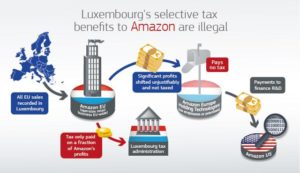
India vs Google, October 2017, Income Tax Appellate Tribunal, IT(TP)A.1511 to 1516/Bang/2013

Google Ireland licenses Google AdWords technology to its subsidiary in India and several other countries across the world. The Tax Tribunal in India found that despite the duty of Google India to withhold tax at the time of payment to Google Ireland, no tax was withheld. This was considered tax evasion, and Google was ordered to pay USD 224 million. The case has now been appealed by Google to the Supreme Court of India.
European Commission vs Amazon and Luxembourg, October 2017, State Aid - Comissions decision, SA.38944

European Commission vs Amazon and Luxembourg, October 2017, State Aid – Comissions decision, SA.38944

Luxembourg gave illegal tax benefits to Amazon worth around €250 million The European Commission has concluded that Luxembourg granted undue tax benefits to Amazon of around €250 million.  Following an in-depth investigation launched in October 2014, the Commission has concluded that a tax ruling issued by Luxembourg in 2003, and prolonged in 2011, lowered the tax paid by Amazon in Luxembourg without any valid justification. The tax ruling enabled Amazon to shift the vast majority of its profits from an Amazon group company that is subject to tax in Luxembourg (Amazon EU) to a company which is not subject to tax (Amazon Europe Holding Technologies). In particular, the tax ruling endorsed the payment of a royalty from Amazon EU to Amazon Europe Holding Technologies, which significantly reduced Amazon EU’s taxable profits. The Commission’s investigation showed that the level of the royalty payments, endorsed by the tax ruling, was inflated and did not reflect economic reality. On this basis, the Commission concluded that the tax ruling granted a selective economic advantage to Amazon by allowing the group to pay less tax than other companies subject to the same national tax rules. In fact, the ruling enabled Amazon to avoid taxation on three quarters of the profits it made from all Amazon sales in the EU. Amazon’s structure in Europe The Commission decision concerns Luxembourg’s tax treatment of two companies in the Amazon group – Amazon EU and Amazon Europe Holding Technologies. Both are Luxembourg-incorporated companies that are fully-owned by the Amazon group and ultimately controlled by the US parent, Amazon.com, Inc. Amazon EU (the “operating company”) operates Amazon’s retail business throughout Europe. In 2014, it had over 500 employees, who selected the goods for sale on Amazon’s websites in Europe, bought them from manufacturers, and managed the online sale and the delivery of products to the customer.Amazon set up their sales operations in Europe in such a way that customers buying products on any of Amazon’s websites in Europe were contractually buying products from the operating company in Luxembourg. This way, Amazon recorded all European sales, and the profits stemming from these sales, in Luxembourg. Amazon Europe Holding Technologies (the “holding company”) is a limited partnership with no employees, no offices and no business activities. The holding company acts as an intermediary between the operating company and Amazon in the US. It holds certain intellectual property rights for Europe under a so-called “cost-sharing agreement” with Amazon in the US. The holding company itself makes no active use of this intellectual property. It merely grants an exclusive license to this intellectual property to the operating company, which uses it to run Amazon’s European retail business. Under the cost-sharing agreement the holding company makes annual payments to Amazon in the US to contribute to the costs of developing the intellectual property. The appropriate level of these payments has recently been determined by a US tax court. Under Luxembourg’s general tax laws, the operating company is subject to corporate taxation in Luxembourg, whilst the holding company is not because of its legal form, a limited partnership.Profits recorded by the holding company are only taxed at the level of the partners and not at the level of the holding company itself. The holding company’s partners were located in the US and have so far deferred their tax liability. Amazon implemented this structure, endorsed by the tax ruling under investigation, between May 2006 and June 2014. In June 2014, Amazon changed the way it operates in Europe. This new structure is outside the scope of the Commission State aid investigation. The scope of the Commission investigation The role of EU State aid control is to ensure Member States do not give selected companies a better tax treatment than others, via tax rulings or otherwise. More specifically, transactions between companies in a corporate group must be priced in a way that reflects economic reality. This means that the payments between two companies in the same group should be in line with arrangements that take place under commercial conditions between independent businesses (so-called “arm’s length principle”). The Commission’s State aid investigation concerned a tax ruling issued by Luxembourgto Amazon in 2003 and prolonged in 2011. This ruling endorsed a method to calculate the taxable base of the operating company. Indirectly, it also endorsed a method to calculate annual payments from the operating company to the holding company for the rights to the Amazon intellectual property, which were used only by the operating company. These payments exceeded, on average, 90% of the operating company’s operating profits. They were significantly (1.5 times) higher than what the holding company needed to pay to Amazon in the US under the cost-sharing agreement. To be clear, the Commission investigation did not question that the holding company owned the intellectual property rights that it licensed to the operating company, nor the regular payments the holding company made to Amazon in the US to develop this intellectual property. It also did not question Luxembourg’s general tax system as such. Commission assessment The Commission’s State aid investigation concluded that the Luxembourg tax ruling endorsed an unjustified method to calculate Amazon’s taxable profits in Luxembourg. In particular, the level of the royalty payment from the operating company to the holding company was inflated and did not reflect economic reality. The operating company was the only entity actively taking decisions and carrying out activities related to Amazon’s European retail business. As mentioned, its staff selected the goods for sale, bought them from manufacturers, and managed the online sale and the delivery of products to the customer. The operating company also adapted the technology and software behind the Amazon e-commerce platform in Europe, and invested in marketing and gathered customer data. This means that it managed and added value to the intellectual property rights licensed to it. The holding company was an empty shell that simply passed on the intellectual property rights to the operating company for its exclusive use. The holding company was not itself in any way

Argentina vs. Nike, August 2017, Tribunal Fiscal de la Nación, Case No 24.495-I
The tax authorities had partly disallowed amounts deducted by Nike Argentina for three expenses; royalties for use of trademarks and technical assistance, promotional expenses for sponsorship of the Brazilian Football Confederation, and commissions of Nike Inc. for purchasing agents. Issue one and two was dropped during the process and the remaining issue before the tribunal was expenses related to commissions for purchases according to a contract signed between Nike Argentina and Nike Inc. The tax authorities (AFIP) had found that the 7% commission rate paid by Nike Argentina had not been determined in accordance with the arm’s length principle. The tax authorities stated that the purchase management services were provided by NIAC, and that Nike Inc.’s participation was merely an intermediary, and therefore it charged a much higher percentage than the one invoiced by the company performing the actual management. The Tribunal Fiscal ruled in favor of Nike Argentina. The analysis in the Transfer Price Study based on external comparables supported the 7% commission. Click here for Translation
Luxembourg vs Lux SA, August 2017, Administrative Court, Case No 39019C
Luxembourg vs Lux SA, August 2017, Administrative Court, Case No 39019C

By a trademark license agreement dated August 22, 2008, a group company in Luxembourg granted another group company a non-exclusive right to use and exploit the brands registered in the territory of the Grand Duchy of Luxembourg, Benelux and the European Community for an initial period of ten years, renewable tacitly each time for a period of one year and this against a license fee paid and calculated annually corresponding to 3% of this turnover. By letters of 30 January 2015, the Tax Office informed the company that they intended to refuse to deduct the royalties paid to the company for the years 2010, 2011 and 2010. An appeal was filed by Lux SA with the Administrative Tribunal, which later dismissed the appeal and upheld the assessment issued by the tax authorities. An appeal was then filed by Lux SA with the Administrative Court. Judgment The Administrative Court set aside the decision of the tribunal and ruled in favour of Lux SA. Click here for English translation Click here for other translation
Bulgaria vs "B-Production", August 2017, Supreme Administrative Court, Case No 10185
Bulgaria vs “B-Production”, August 2017, Supreme Administrative Court, Case No 10185

“B-Production” is a subsidiary in a US multinational group and engaged in production and sales. “B-Production” pays services fees and royalties to its US parent. Following an audit, the tax authorities issued an assessment where deductions for these costs had been reduced which in turn resulted in additional taxabel income. An appeal was filed by “B-Production” with the Administrative court which in a judgment of June 2015 was rejected. An appeal was then filed by “B-Production” with the Supreme Administrative Court. In the appeal “B-Production” contested the findings of the Administrative Court that there was a hidden distribution of profits by means of the payment of management fees and duplication (overlapping) of the services at issue under the management contract and the other two agreements between the B-Production and the parent company. B-Production further argued that the evidence in the case refutes the conclusions in the tax assessment and the contested decision that the services rendered did not confer an economic benefit and in addition argues that the costs of royalties and the costs of engineering and control services under the other two contracts are not a formative element of the invoices for management services, a fact which was not considered by the court. Judgment of the Supreme Administrative Court The Supreme Administrative Court decided in favour of the tax authorities and dismissed the appeal of B-Production as unfounded. Excerpts “The dispute in the case concerned the recognition of expenses for intra-group services. The NRA Transfer Pricing Manual (Fact Sheet 12) states that intra-group services in practice refers to the centralisation of a number of administrative and management services in a single company (often the parent company), which serves the activities of all or a number of enterprises of a group of related parties selected on a regional or functional basis. The provision of such services is common in multinational companies. The concept of intra-group services covers services provided between members of the same group, in particular technical, administrative, financial, logistical, human resource management (HRM) and any other services. In the present case, the costs in question relate to a contract for the provision of management services dated 26.11.2002, paid by the subsidiary [company], registered in the Republic of Bulgaria, to the parent company, [company], registered in the USA. The OECD Transfer Pricing Guidelines for Multinational Enterprises and Tax Administrations (‘the OECD Guidelines’) should therefore be taken into account in the analysis of those costs and, accordingly, in the interpretation and application of the substantive law. According to paragraph 7.5 of the OECD Guidelines, the analysis of intra-group services involves the examination of two key questions: 1/ whether the intra-group services are actually performed and 2/ what the remuneration within the group for those services should be for tax purposes. In the present case, the dispute in the case relates to the answer to the first question, since it is apparent from the reasoning of the audit report, the revenue authorities and the ultimate conclusion of the court of first instance that the services did not confer an economic benefit on the domestic company and constituted a disguised distribution of profits within the meaning of section 1(5)(b) of the Act. “a” of the Tax Code. Therefore, the arguments in the cassation appeal for material breaches of the rules of court procedure – lack of instructions concerning the collection of evidence related to the amount of the price of the intra-group service and the allocation of the burden of proof to establish this fact – are irrelevant to the subject matter of the dispute. Paragraph 7.6 of the OECD Guidelines states that, according to the arm’s length principle, whether an intra-group service is actually performed when an activity is carried out for one or more group members by another group member will depend on whether the activity provides the group member concerned with an economic or commercial advantage to improve its commercial position. This can be determined by analysing whether an independent undertaking would, on comparable terms, be willing to pay for the activity if it were carried out for it by an independent undertaking or whether it would only have carried it out with its own funds. It is correct in principle, as stated in the appeal in cassation, that the analysis of intra-group services and their recognition for tax purposes is based on the facts and circumstances of each particular case. For example, the OECD Guidelines lists activities which, according to the criterion in point 7.6, constitute shareholding activities. According to paragraph 7.10, b. “b” of the OECD Guidance, expenses related to the accounting requirements of the parent company, including consolidation for financial statements, are defined as such. The evidence in this case established beyond a reasonable doubt that the management services covered by the contract at issue in this case included the compensation of a responsible financial and accounting manager, including cash flow planning and reporting, preparation of monthly, quarterly and annual reports (American Accounting Standards accounting. These activities, which there is no dispute that they were performed, fall within the definition of Section 7.10 for “shareholder activities.” The remaining activities included in management services, including the costs associated with the use of the software programs referred to in the expert report, are imposed by the parent company’s requirements for control and accountability of the subsidiary under the three sets of activities – managing director, production and finance. There is no merit in the objection in the cassation appeal that the management contract services do not duplicate the costs of the other two contracts. It is established from the conclusion of the FTSE that the costs of engineering and control services and royalties (know-how and patent) are not a formative element of the invoices for management services. The conclusion of the experts was based only on the fact that separate contracts had been concluded for the individual costs and not on an analysis of the elements that formed the fees. According to Annex 6 to the expert report,
Indonesia vs Cussons Indonesia, June 2017, Supreme Court, Nomor 907/B/PK/PJK/2017

Indonesia vs Cussons Indonesia, June 2017, Supreme Court, Nomor 907/B/PK/PJK/2017

The tax authorities had disallowed royalty payments of 3% of net sales from Cussons Indonesia to its parent company in the UK, PZ Cussons International Ltd. According to the tax authorities Cussons had been unable to prove that the transaction was at arm’s-length, as well as unable to provide transfer pricing documentation. Cussons claimed that the royalty payments was supported with documents such as royalty agreement, VAT payment, and withholding tax on royalty. Cussons further argued that sales in Indonesia were positively influenced by Cusson’s trademark. Following a tax court decision (Put.53966/2014) in favour of Cussons, the tax authorities brought an appeal to the Supreme Court. Judgment of the Supreme Court The Supreme Court dismissed the appeal of the tax authorities and upheld the decision in favour of Cussons. Click here for translation

France vs IKEA, May 2017, CAA of Versailles, No 15VE00571
The French tax authorities had issued an assessment for the fiscal years 2002, 2003 and 2004 related to royalty fees paid by IKEA France to foreign group companies. It was claimed that the royalty fees paid were excessive. The Court reject the position of the authorities. It had not been proven that the fees paid by IKEA France to foreign IKEA companies were excessive based on the arm’s length principle and on Article 57 of the CGI. The Court stresses the irrelevance of the comparables presented by the administration: “Considering that the nine trademarks used as comparables by the administration relate to the French market, the furniture sector and distribution methods similar to that of Ikea; that, however, as the company Ikea Holding France argues, the Minister does not give any precise indication on the content of the services rendered to the franchisees of these trademarks in return for their royalty; these trademarks are notoriously inferior to Ikea’s and they are not comparable in terms of concept, business strategy and range of products; that, furthermore, it is not disputed that the profitability of the DSIF and MIF companies is much higher than that of their competitors and that of the trademarks used as comparables by the administration; Lastly, the documents produced by Ikea Holding France show that, in the few cases where Ikea stores are not managed by Ikea group companies but by third-party franchisees, they pay the 3% franchise fee and get their supplies from wholesalers of the Ikea group; that, when purchasing directly from Ikea suppliers without going through a wholesaler of the group, they pay the 2% commission for the development and design of Ikea products and the commission of 5.5% for supplier management; that if it is not established that, in this case, they also pay the 1% commission for the coordination of supplies, this commission remunerates a service which benefits in the first place wholesalers, and not distributors;” Click here for translation
India vs Herbalife International India , April 2017, Income Tax Appellate Tribunal - Bangalore, IT(TP)A No.924/Bang/2012

India vs Herbalife International India , April 2017, Income Tax Appellate Tribunal – Bangalore, IT(TP)A No.924/Bang/2012

Herbalife International India is a subsidiary of HLI Inc., USA. It is engaged in the business of dealing in weight management, food and dietary supplements and personal care products. The return of income for the assessment year 2006-07 was filed declaring Nil income. The Indian company had paid royalties and management fees to its US parent and sought to justify the consideration paid to be at arm’s length. In the transfer pricing documentation the Transactional Net Margin Method (TNMM) had been selected as the most appropriate method for the purpose of bench marking the transactions. The case was selected for scrutiny by the tax authorities and following an audit, deductions for administrative services were denied and royalty payments were reduced. Disagreeing with the assessment Herbalife filed an appeal. Decision of the Income Tax Appellate Tribunal The Tax Appellate Tribunal dismissed the appeal of Herbalife and upheld the tax assessment. Excerpts “The appellant had not filed any additional evidences to prove the administrative services/technical knowhow are actually received by the appellant and thus the assessee company had failed to discharge this onus of proving this aspect. Therefore, even as per the provisions of Indian Evidence Act, the presumption can be drawn that the assessee has no evidence to prove this aspect. Therefore, the AO/TPO was justified in adopting the ALP in respect of payment of administrative services and royalty at Nil. Thus, the grounds of appeal in ground Nos. 2 to 7 are dismissed. In respect of the other grounds of appeal, since we held that there was no proof of receipt of administrative services as well as technical knowhow which is used in the process of manufacturing activity, the question of bundling of transaction or aggregating all other transactions does not arise.” “Thus all the grounds of appeal relating to the royalty and administrative services have been dismissed. Then the only ground of appeal that survives is ground IT(TP)A No.1406/Bang/2010 IT(TP)A No.924/Bang/2012 relating to uphold of disallowance on account of doubtful advance written off of Rs.1,20,16,395/-. The brief facts surrounding this addition are as under:”

Luxembourg vs Lux SA, December 2016, Administrative Tribunal Case No 36954
By a trademark license agreement dated August 22, 2008, a group company in Luxembourg granted another group company a non-exclusive right to use and exploit the brands registered in the territory of the Grand Duchy of Luxembourg, Benelux and the European Community for an initial period of ten years, renewable tacitly each time for a period of one year and this against a license fee paid and calculated annually corresponding to 3% of this turnover. By letters of 30 January 2015, the Tax Office informed the company that they intended to refuse to deduct the royalties paid to the company for the years 2010, 2011 and 2010. Click here for translation
Royalty and License Payments
US vs. Medtronic Inc. June 2016, US Tax Court

US vs. Medtronic Inc. June 2016, US Tax Court

The IRS argued that Medtronic Inc failed to accurately account for the value of trade secrets and other intangibles owned by Medtronic Inc and used by Medtronic’s Puerto Rico manufacturing subsidiary in 2005 and 2006 when determening the royalty payments from the subsidiary. In 2016 the United States Tax Court found in favor of Medtronic, sustaining the use of the CUT method to analyze royalty payments. The Court also found that adjustments to the CUT were required. These included additional adjustments not initially applied by Medtronic Inc for know-how, profit potential and scope of product. The decision from the United States Tax Court has been appealed by the IRS in 2017.
Indonesia vs "Indonesia Ltd", April 2016 Supreme Court, Case No. Put-70118/PP/M.IA/15/2016
Indonesia vs “Indonesia Ltd”, April 2016 Supreme Court, Case No. Put-70118/PP/M.IA/15/2016

In this case “Indonesia Ltd” paid royalties for use of IP owned by the Japanese parent. Following an audit, the tax authorities issued an assessment where the royalty payments were disallowed. Judgment of the Court The Court ruled in favour of the taxpayer. According to the court “Indonesia Ltd” had been able to prove that services had actually been rendered. Click here for translation
Sweden vs AB bioMérieux, March 2016, Administrative Court of Appeal, Case No 7416-14
Sweden vs AB bioMérieux, March 2016, Administrative Court of Appeal, Case No 7416-14

AB bioMérieux had entered into a trademark and know-how licensing agreement, followed by a reduction of its activities and a transfer of strategic personnel to its French parent company. The tax authorities concluded that the entire arrangement constituted a transfer of value (intangible assets) and issued a notice of additional taxable income resulting from the transfer. AB bioMérieux filed an appeal which ended up in the Administrative Court of Appeal. Judgment The court upheld the assessment of the tax authorities. It found that AB bioMérieux became the formal legal owner of the intangible assets, while the value (intangible assets related to the ongoing business) was transferred to the French parent company. Excerpt in English “Initially, based on the wording of the licence agreement and the legal opinions issued by the professors………………………………………………, the Administrative Court of Appeal cannot find sufficient reasons to consider that the agreement in itself is something other than a licence agreement under civil law. Thus, the licence agreement as such alone does not constitute grounds for departing from the parties’ characterisation of the agreement itself as a licence agreement. However, when assessing which transaction has been undertaken between the parties, all of the parties’ dealings must be taken into account (cf. paragraph 1.52 et seq. of the OECD Guidelines). Similarly, there may be reasons to disregard the parties‘ designation of the transaction in the case where a transaction is indeed the same in form and content, but where the parties’ other dealings in relation to the transaction, viewed as a whole, differ from those that would have applied between independent traders acting in a commercial and rational manner (paragraph 1.65 of the Guidelines). In addition to the written licence agreement, the actual circumstances and the parties‘ intention as well as the economic significance of the parties’ combined conduct must therefore also be taken into account. The Administrative Court of Appeal considers, as does the Administrative Court, that it cannot be considered consistent with the arm’s length principle to isolate the licence from the parties’ other dealings during the period from the share acquisition in June 2008 to the licence in July 2010. The Administrative Court of Appeal further agrees with the Administrative Court’s assessment that the actual circumstances are best described as a restructuring. Prior to the share acquisition in 2008, the company was a fully fledged company, which meant that the company itself developed, manufactured, marketed and sold its products. In addition to the exclusive licence that the company granted to …………. under the licence agreement, the company gradually ceased its activities relating to research and development, manufacturing, marketing, sales and distribution of ……………….. during 2008-2010, while …………. was given the opportunity to conduct the same activities. Following the expiry of the licence agreement, the company retains only the ownership of the know-how and trade marks relating to………….. The licence agreement clearly regulates the assignment of the intellectual property rights between the parties for a fixed period. Furthermore, it is clear that, even taking into account that no unit or branch of activity has been transferred from the company to the parent company, the restructuring in its entirety means that the company has relinquished the functions linked to the …………… and …………….. products in favour of the parent company. It is also apparent from the documents in the cases that two persons who have been the bearers of the know-how that the licence agreement is intended to regulate have terminated their employment in the company in order to work for a certain period of time in the parent company for the purpose of incorporating know-how relating to …………….. The Administrative Court of Appeal further finds that the financial risk associated with functions and activities linked to has essentially been transferred to the parent company. According to what has emerged, it is …………… that ties up capital, carries out investments for research and development and bears all operational risks, e.g. linked to production, damages, etc. This assessment is also well in line with points 9.188-9.189 of the guidelines. The gradual winding down of the company’s operations and the start-up of the same operations together with the licence agreement has thus entailed a transfer of value in that assets, functions and risks linked to ——— have been transferred to ……………….. (cf. ongoing concern, paragraph 9.93 of the OECD Guidelines). The entire reorganisation and the resulting transfer of value should therefore be regarded as one transaction. In the opinion of the Court of Appeal, the transaction that should form the basis for the continued assessment is thus the transfer of research and development, manufacturing, marketing, sales and distribution of Etest, as well as the licensing of know-how and trademarks linked to …………… for a period of ten years.” Click here for English translation Click here for other translation
US vs Guidant Corporation, February 2016, US Tax Court, Case No 146 T.C. No. 5

US vs Guidant Corporation, February 2016, US Tax Court, Case No 146 T.C. No. 5

The U.S. Tax Court held in favor of the Commissioner of Internal Revenue, stating that neither Internal Revenue Code §482 nor the regulations thereunder require the Respondent to always determine the separate taxable income of each controlled taxpayer in a consolidated group contemporaneously with the making of the resulting adjustments. The Tax Court further held that §482 and the regulations thereunder allow the Respondent to aggregate one or more related transactions instead of making specific adjustments with respect to each type of transaction.

Indonesia vs P.T. Sanken Electric Indonesia Ltd, February 2016, Tax Court, Case No. Put.68357/PP/M.IA/15/2016
P.T. Sanken Electric Indonesia Ltd. – an Indonesian subsidiary of Sanken Electric Co., Ltd. Japan – paid royalties to its Japanese parent for use of IP. The royalty payment was calculated based on external sales and therefore did not include sales of products to group companies. The royalty payments were deducted for tax purposes. The tax authorities denied the deduction as the license agreement had not been registrered in Indonesia. Furthermore, the royalty payment was not found to have been determined in accordance with the arm’s length principle. P.T. Sanken Electric Indonesia Ltd appealed the decision of the Tax Court. Judgment of the Tax Court The tax court set aside the assessment and decided in favor of taxpayer. Click here for translation
Royalty and License Payments
Germany vs. License GmbH, January 2016, Supreme Tax Court, Case No I R 22/14

Germany vs. License GmbH, January 2016, Supreme Tax Court, Case No I R 22/14

The Supreme Tax Court has held that a parent company cannot be deemed to have earned income from allowing its Polish subsidiary to register locally in the group name. A German business was active in a field of patented technology associated with its own firm name, “B”. It allowed its Polish subsidiaries to register in that name, “B Sp.z.o.o.”, but made an appropriate charge for the use of the technology. It also did not authorise the Polish companies to use its logo, but left it up to them to design their own. The tax office maintained that the group name was a valuable intangible and demanded an income adjustment to reflect its use by foreign subsidiaries. However, the Supreme Tax Court has now confirmed its previous case law in holding that the mere use of the group name in the company registration of a subsidiary – including the right to trade under that name – does not give rise to a royalty entitlement of the parent. Such entitlement only arises in connection with other associated rights, such as the use of a logo or technology, in which case, the benefit from the use of intangibles should be seen as a package. However, this did not arise in the case at issue, as the rights to the logo had not been assigned and the rights to the technology had been charged for separately. Se also the publication [Verwaltungsanweisung] from the German Bundesministerium der Finanzen (BMF) 2017-04-07-namensnutzung-im-konzern and the prior German ruling on the issue I R 12/99. The prior ruling of the Local Tax Court is found in case No 4 k 1053 11 e. Click here for translation

Hungary vs Trademark Ltd, May 2015, Appeals Court Curia No. Kfv. I. 35.774/2014
The Hungarian company “Trademark Ltd” was involved in distribution of trademark rights. Trademark Ltd obtained the trademark rights from affiliated companies in Luxembourg and Barbados and then also passed trademark rights on to other affiliated company. For the purpose of determining the remuneration, only one company in the group had a transfer price record. According to this, the basis for calculating the remuneration was the turnover achieved. The tax authorities examined the nature of the prices charged between the parties and found that they were not the normal market price. The consideration for the trademark rights was therefore assessed by applying a weighted average cost of capital to the net profit margin. For FY 2006 this rate was set at 12% applied at the group level. On that basis, the amount of the trademark payments was reduced, thereby increasing the tax base of Trademark Ltd by HUF 209,357,000. Trademark Ltd disagreed with the assessment. The judgment of the Court On the basis of the evidence obtained by the court the WACC indicator approach was not appropriate for determining the arm’s length profit margin of Trademark Ltd. The count noted that a WACC indicator is not suitable for measuring the company’s market profit, measuring short-term one-year returns. The Court further stated that the transfer price is a price range, not a specific abstract price, thus there is no specific price from which to deviate. The court decided that the remuneration of Trademark Ltd should be determined by application of TNM method. According to the decision of the Curia, it is the responsibility of Trademark Ltd to apply the calculation based on the net profit margin of the transaction referred to in Article 18 (2) (d). Click here for translation
Canada vs. Skechers USA Canada Inc. March 2015, Federal Court of Appeal
Canada vs. Skechers USA Canada Inc. March 2015, Federal Court of Appeal

In this case the Federal Court of Appeal upheld the decision of the Canadian International Trade Tribunal in which the tribunal upheld seven decisions – one for each of the years 2005 through 2011 – of the Canada Border Services Agency under subsection 60(4) of Canada’s Customs Act. Skechers Canada, a subsidiary of Skechers USA, purchases footwear to sell in Canada from its parent at a price equal to the price paid by Skechers US to its manufacturers, the cost of shipping the foodware to the US and warehousing, and an arm’s length profit. Skechers Canada also makes payments to Skechers US pursuant to a cost sharing agreement to compensate the parent for activities associated with the development and maintenance of the Skechers brand and to the creation and sale of footwear. The Court ruled that CSA payments relating to research, design, and development (R&D) were “in respect of” the goods sold for export into Canada and thus part of the “price paid or payable” for the goods for customs purposes. As a result, Skechers Canada must add the amounts of these payments made to Skechers USA to the customs value of imported footwear supplied by its parent. In its conclusion, the Court found that the conclusion reached by CITT “falls within the range of possible, acceptable outcomes, defensible in respect of the facts and the law.”
Sweden vs S AB, February 2015, Administrative Court of Appeal, Case No 7476-13 and 7477-13
Sweden vs S AB, February 2015, Administrative Court of Appeal, Case No 7476-13 and 7477-13

S AB appealed a decision by the Swedish Tax Agency regarding its income assessments for 2007 and 2008, which involved disputes over transfer pricing. The primary issue was the valuation of trademarks sold by S AB, specifically whether the sale price of SEK 103 million adhered to the arm’s length principle. The Swedish Tax Agency argued that a hypothetical independent buyer would be willing to pay more, estimating an arm’s length price of SEK 134 million by factoring in the tax effects of the transaction. Judgment The Administrative Court of Appeal agreed with the valuation of the Tax Agency, thereby adjusting S AB’s taxable income for the years in question. S AB had contended that tax benefits should not influence the valuation, citing ambiguities in the 2006 OECD guidelines and challenging the suitability of using the Gordon growth model. However, the court determined that tax implications for both buyer and seller are relevant to the valuation of intangible assets and should be included. Click here for English translation Click here for other translation
India vs LG Electronics India Pvt Ltd, December 2014, Income Tax Appellate Tribunal, ITA No. 5140/Del/2011

India vs LG Electronics India Pvt Ltd, December 2014, Income Tax Appellate Tribunal, ITA No. 5140/Del/2011

LG India is a wholly owned subsidiary of LG Korea, a multinational manufacturer of electronic products and electrical appliances. LG Korea and LG India entered into a technical assistance and royalty agreement in 2001 where LG India, as a licensed manufacturer, would pay a 1% royalty to LG Korea for the use of various rights for the manufacture and sale of products in India. The agreement also gave LG India a royalty-free use of the LG brand name and trademarks. The tax tribunal in 2013 held that the advertising, marketing and promotion (AMP) expenditure in excess of the arm’s length range helps to promote the brand of the foreign associated enterprise and that the Indian associated enterprise should necessarily be compensated by the foreign one. Then an appeal was filed with the Income Tax Appellate Tribunal.
Indonesia vs Cussons Indonesia, July 2014, Tax Court, Put.53966/2014
Indonesia vs Cussons Indonesia, July 2014, Tax Court, Put.53966/2014

The tax authorities had disallowed royalty payments of 3% of net sales from Cussons Indonesia to its parent company in the UK, PZ Cussons International Ltd. According to the tax authorities Cussons had been unable to prove that the payment was at arm’s-length, as well as unable to provide transfer pricing documentation supporting the pricing. Cussons claimed that the royalty payments was supported with documents such as a royalty agreement, documentation for VAT payments, and withholding tax on royalty. Judgment of the Tax Court The court decided in favour of Cussons and set aside the assessment of the tax authorities Click here for translation
Indonesia vs Roche Indonesia, February 2014, Tax Court, Put.53966/2014

Indonesia vs Roche Indonesia, February 2014, Tax Court, Put.53966/2014
In the case of Roche Indonesia the tax authorities had disallowed deductions for royalties paid by the local company to F. Hoffmann-La Roche & Co. Deductions for marketing and and promotions costs paid by the local company had also been disallowed. Judgment of the Tax Court The court decided predominantly in favour of the tax authorities. Roche Indonesia had been unable to prove the value, existence and ultimate owner of intangible assets for which the royalty was paid. In regards to the disallowed deductions of cost related to marketing and and promotions, half of the costs were allowed and the other half disallowed. Click here for translation
Germany vs License GmbH, February 2014, Local Tax Court, Case No 4 K 1053/11 E
Germany vs License GmbH, February 2014, Local Tax Court, Case No 4 K 1053/11 E

The Local Tax Court found that the arm’s-length principle requires a licence to be paid for the use of group name where the name/trademark has value in itself. The decision of the Local Court was later overturned by the Supreme Tax Court ruling in Case no. I R 22 14  Click here for English translation Click here for other translation
Royalty and License Payments
Indonesia vs Sharp Semiconductor Indonesia, December 2013, Tax Court, Put.49339/2013

Indonesia vs Sharp Semiconductor Indonesia, December 2013, Tax Court, Put.49339/2013

In the case of Sharp Semiconductor Indonesia the tax authorities had disallowed deductions for royalties paid by the local company to the Japanese Sharp Corporation. Judgment of the Tax Court The court decided predominantly in favour of the tax authorities. According to the court Sharp Semiconductor Indonesia had not been able to prove the existence of know-how, the existence of training provided, the value of intangible property owned by Sharp Corporation. Moreover, Sharp Semiconductor Indonesia only sells its product to related parties and royalty fees are first relevant once the product is sold to independent parties. Finally Sharp Semiconductor Indonesia was not able to prove the economic benefit it had received from the trademark “Sharp”. Click here for translation

Slovenia vs “Buy/Sell Distributor”, October 2013, Administrative Court, Case No UPRS sodba I U 727/2012
At issue was the existence of a basis for taking into account the deductibility of the costs of services, the costs related to the repurchase and destruction of products and the tax deductibility of royalty expenses charged between related parties. Judgment of the Court The Administrative Court concluded that “Buy/Sell Distributor” had failed to prove that the disputed services charged to it were actually supplied and necessary for it. As regards the costs relating to the redemption and destruction of the products, it held that “Buy/Sell Distributor” was not obliged to bear those costs in view of the functions it performed within the multinational company’s system and the risks it bore. The Court also held that there was no basis for treating the royalty payment as a tax deductible expense. Click here for English translation Click here for other translation
Spain vs "X Beverages S.A.", October 2013, TEAC, Case No 00/02296/2012/00/00
Spain vs “X Beverages S.A.”, October 2013, TEAC, Case No 00/02296/2012/00/00

“X Beverages S.A.” had entered into an agreement with the ABCDE Group for the use of concentrate and trademarks for the production and sale of beverages in Spain, but according to the agreement, “X Beverages S.A.” only paid for the concentrate. Following an audit for the financial years 2005-2007, the tax authorities issued an assessment which considered part of the payment to be royalties on which withholding tax should have been paid. Court’s Judgment The Court agreed that part of the payment could be qualified as royalties, but the assessment made by the tax authorities had been based on secret comparables – leaving the taxpayer defenceless – and on this basis the Court annulled the assessment. Excerpts “The taxpayer itself seems to recognize that the so-called “Contract of …” contains both a distribution contract and a trademark assignment contract when it says on page 127 of its statement of allegations “Indeed, this authorization of use is necessary to be able to carry out the activity of packaging and distribution that is the object of the contract, and it would not be possible for X to carry out its obligations under the contract if it did not have this authorization to use the trademark. If X did not have the right to use the trademark, it would not be able to package and label the product as required by its principal (Z), nor would it be able to distribute it under said trademark, in accordance with the terms of the contract.” And although the “authorization of use” of the trademark recognized by the taxpayer is qualified by the latter as an obligation and not as a right of the same, seeming to want to reach the conclusion that only if it were a right it would generate a royalty, in the opinion of this Court both aspects (obligation and right) are not mutually exclusive but complementary: X acquires the right to use the trademark and the obligation to use the same with respect to the products (the beverages) made by it with the “concentrates” acquired from the ABCD Group. And without the existence of limits and/or conditions. Limits and/or conditions which, on the other hand, are inherent to any assignment of rights contract, which is never absolute. In the present case, such limits would be that X may not use the trademark to identify other products not made with the “concentrates” purchased from the ABCD Group and that it may not identify the products made with such “concentrates” under another trademark. Both things are logical since the trademark owner remains the owner of the trademark (he only assigns its use in a certain temporal and territorial scope) and must protect its prestige by means of the indicated precautions (previously called limits and/or conditions). Por otro lado, y en contra de lo alegado (pág. 129 of the pleadings), the right to use the trademark is not something merely “instrumental” but something “substantial” to the contracts entered into between the parties in the sense that it is in the interest of the supplier to sell its concentrates and of X to market the products it manufactures with such concentrates under certain trademarks (ABCD or M8), of special diffusion and prestige in the market and whose use implies a volume of sales notably higher than that which it would obtain if it marketed the products under X ‘s own denomination without such diffusion and prestige in the market. The importance of the trademark is such (and more so the ones we are now dealing with) that it would be difficult to understand in the opinion of the Inspectorate a purely “instrumental” transfer of use of the same, and much less free of charge, as the claimant defends. This circumstance is supported by the Inspection in the Valuation Report, which grants to the assignment of the trademark, as an example, percentages of 61.17% of the price of the concentrate in the case of ABCD-1 and 46.18% in the case of ABCD-2.” “Thus, it is clear that the promotion of the ABCD trademark in Spain (not of the products themselves, which is what is made with the “concentrates” acquired by X) generates expenses for the holder of the trademark[2] ( ABCD Group and, specifically,ABCD C…), the inspection revealed that “it does not seem reasonable to think that the ABCD trademarks in Spain only generate expenses and no income” (….) “From a strictly economic perspective, the actions of the ABCD group, assuming such an amount of expenses to make the brand known to the consumer without this action generating any income for the brand in Spain, lacks all rationality”. This is an additional fact taken into account by the Inspectorate for the purpose of confirming the rationality of the fact that the assignment of use of the trademark is not free of charge but that the ABCD Group obtains income from it.” “In the case at hand, we cannot properly speak of “lack of evidence” but more properly of “lack of externalized evidence” since, even if such evidence exists (which this Court, in principle, has no doubt about), it cannot be incorporated into the file that is made available to the interested party, Therefore, the latter is defenseless when it comes to being able to oppose the suitability of the comparables used, so that, as stated in the previously transcribed SAN, we are faced with an “inadequate assessment method” in terms of generating defenselessness in the taxpayer. This Central Court has recently pronounced in the same sense as above in its RG of 05-09-2013 (RG 3780/11). Having said the above with respect to the “subjective motivation”, it should be noted that the objections raised by the taxpayer with respect to the “technical motivation” refer basically to the fact that the data used by the Inspection to assess are not in any case comparable with those of ABCD because ABCD is unique and neither by its product characteristics, nor by the characteristics of the product …. . In
Indonesia vs Panasonic Indonesia, May 2013, Tax Court, Put.45162/2013

Indonesia vs Panasonic Indonesia, May 2013, Tax Court, Put.45162/2013

In the case of Panasonic Indonesia the tax authorities had disallowed deductions for services and royalties paid for by the local company to the Panasonic Corporation Japan. The tax authorities held that Panasonic Indonesia did not received the purported services and that the company should not pay royalty due to its status as a contracting manufacturer. Judgment of the Tax Court The Court decided predominantly in favour of the tax authorities. The court found that Panasonic Indonesia had been unable to prove that actual ‘services’ had been received for an amount equal to 3% of net sales of all product manufactured and 1% of net sales for technical assistance and brand fees. Furthermore it was notet that Panasonic Indonesia reported consistent losses. Click here for translation
Norway vs Accenture, May 2013, Borgarting lagmannsrett, Case No 11-190854ASD-BORG/01
Norway vs Accenture, May 2013, Borgarting lagmannsrett, Case No 11-190854ASD-BORG/01

In this case, the royalty payments of Accenture Norway was at issue. The Norwegian tax authorities held that the royalty payments to Accenture Global Services in Switzerland had been excessive. The Court disagreed and found in favor of Accenture. Click here for translation
Italy vs Computer Associates SPA, February 2013, Supreme Court no 4927
Italy vs Computer Associates SPA, February 2013, Supreme Court no 4927

The Italian tax authorities had challenged the inter-company royalty paid by Computer Associates SPA, 30% as per contract, to it’s American parent company, registered in Delaware. According to the authorities a royalty of 7% percentage was determined to be at arm’s length and an assessment for FY 1999 was issued, where deduction of the difference in royalty payments was disallowed. The tax authorities noted the advantage for group to reduce the income of Computer Associates SPA, increasing, as a result, that of the parent company, due to the much lower taxation to which the income is subject in the US state of Delaware, where the latter operates (taxation at 36% in Italy, and 8.7% in the State of Delaware). The Supreme Court dismissed the appeal of Computer Associates SPA and concluded that the assessment was in compliance with the law. Click here for English translation Click here for other translation
India vs SC Enviro Agro India Pvt. Ltd, 2012, November 2012, Income Tax Appellate Tribunal, ITA Nos.2057 & 2058
India vs SC Enviro Agro India Pvt. Ltd, 2012, November 2012, Income Tax Appellate Tribunal, ITA Nos.2057 & 2058

SC Enviro Agro India is a manufacturer of household insecticides and pesticides and had entered into a technology license agreement with a related party – SCCL Japan – and it also purchases the requirement of intermediates from the said company only.  In the years in question, it has purchased intermediates and sold the products to the entities that approved by the SCCL. One of the company to whom most of the products were sold was SCI, a 100% subsidiary of SCCL. In the transfer pricing report SC Enviro Agro India stated that the arrangement with SCCL and SCI was in the nature of contract manufacturing. Following an audit, the tax authorities accepted the price paid/received as arm’s length price for purchase of insecticides and pesticides, intermediates from SCCL and sale of insecticides and pesticides to SCI. But in regards of the royalty payment of 5% to SCCL as per the technology license agreement, the authorities were of the opinion that since the purchase and sales are only from/to associate concerns and not to anybody else, there is no commercial exploitation of technical knowhow. SC Enviro Agro India was nothing but contract manufacturing and as such there was no basis for payment of royalty. Accordingly, deductions for royalty payments were disallowed in assessment year 2003-04 and assessment year 2004-05.  SC Enviro Agro India submitted that it has not paid royalty on entire sales price, but only on the value addition made to the intermediates purchased from the principal company, therefore, no royalty was paid on purchase cost of the raw material and only on the value addition. Furthermore, details of sales made to outside parties i.e. third parties was submitted so as to counter the observations that it has sold only to the related parties. On that basis the tax authorities allowed royalty payment on the sales made to third parties and reduced the assessment. An appeal was filed by SC Enviro Agro India in which it stated that since it had obtained technical knowhow from SCCL, 5% royalty on the entire value addition made should have been allowed rather than restricting to sales made to third parties. SC Enviro Agro India also stated that it was not a contract manufacturer. It was also further stated that since royalty was paid at 5%, it could not be disallow since it was within the safe harbor range of (+)/(-) 5% Judgment of the Court The Court decided in favour of SC Enviro Agro India and dismissed the assessment issued by the tax authorities. Excerpts “…Till assessment year 2003-04 there was no dispute with reference to the payment of royalty and even in the original assessment completed the royalty was allowed as eligible expenditure in the order under section 143(3). In assessment year 2004-05 this issue for the first time was examined by the TPO on the basis of the TP report of assessee wherein assessee submitted that the arrangement is in the nature of contract manufacturers in the FAR analysis. Since this was admitted by assessee, the TPO without examining the nature of agreement or the manufacturing activity of assessee or any other incidental factor came to a conclusion that since assessee admitted to be a contract manufacturer, there is no need to pay any royalty. In his order the TPO also mentions that assessee was not making any sales to outside parties, the fact of which is not correct. On the basis of his observations, he arrived at the royalty arm’s length price at Nil.” “The TPO has to examine whether the price paid or amount paid was at arm’s length or not under the provisions of Transfer Pricing and its rules. The rule does not authorize the TPO to disallow any expenditure on the ground that it was not necessary or prudent for assessee to have incurred the same. On that principle alone, we cannot approve the order of the TPO as it not only considered the facts wrongly but also exceeded the jurisdiction available to the TPO in examining the arm’s length price on a transaction.” “Even though admittedly assessee mentioned in the TP report that the arrangement is in the nature of contract manufacturing, the facts indicates otherwise. The royalty was paid as per the agreement on the value-added price to the SCCL for providing the license and technical knowhow. This payment is independent of whether assessee is full fledged manufacturer or a contract manufacturer or a toll manufacturer and the nature of manufacturing activity cannot have any bearing on the payment of royalty. “ “Since we do not find any reason to restrict the royalty to Nil, we are not in a position to approve the order of the CIT (A) on this issue. Without going into the nitty-gritty of determining whether assessee is a contract manufacturer or a full-fledged manufacturer, since royalty is paid for allowing assessee in utilizing the technical knowhow and the license for manufacturing activity, we are of the opinion that the payment of royalty is wholly and exclusively for the purpose of business. In view of this, we allow assessee’s ground and direct AO to allow the royalty as claimed.”
Poland vs "H-trademark S.A.", February 2012, Administrative Court, Case No I SA/Po 827/11

Poland vs “H-trademark S.A.”, February 2012, Administrative Court, Case No I SA/Po 827/11

“H-trademark S.A.” applied for a ruling on the tax rules governing a business restructuring where trademarks were transferred to another group company and licensed back – whether Polish arm’s length provisions would apply to the transaction. The company was of the opinion that Polish arm’s length provision (article 11) would not apply, since the arrangement was covered by special Polish provisions related to financial leasing (article 17b-g). Judgment of the Court The Court found that the Polish arm’s length provisions applied to the transaction. Excerpts “In the present case, the legal problem boils down to the correct identification of the nature of the norms arising from Article 11 of the A.p.d.o.p. and its relationship with the provisions on leasing raised by the applicant (Articles 17b – 17g of the A.p.d.o.p.). Indeed, the applicant takes the view that the leasing provisions themselves introduce derogations from market conditions and that, consequently, it is not possible to examine certain activities governed by the leasing provisions on the basis of the criteria provided for in Article 11 of the A.p.d.o.p.” “Therefore, it should be stated that the norm of Article 11 of the A.l.t.d.o.p. constitutes lex specialis in relation to the norms concerning taxation of leasing agreements (Article 17a et seq. of the A.l.d.o.p.). It may therefore also be applied in the case concerning taxation of such agreements. Thus, the Court does not share the view of the Appellant Company that it is the provisions concerning the leasing agreement that constitute lex specialis in relation to Article 11 of the discussed Act. It is also of no significance for the position of the Court that the agreement presented in the description of the future event is not a commonly occurring agreement, and therefore, as the appellant claims, it will not be possible to make determinations on the basis of Article 11 of the A.l.t.d.o.p. This is because the very demonstration that the price would have been different if certain connections on the basis of the aforementioned provision had not occurred is already an element of establishing the facts and conducting tax proceedings in a specific case. Meanwhile, the subject of the present proceedings, was the answer to the question whether the aforementioned provision is excluded in the case of taxation of leasing agreements. In addition, it should be noted that, contrary to the assertions in the application, it was not in the description of the future event, but in the position presented by the party that it stated that: “(…) the initial value of the rights to be used will be determined on the basis of a valuation prepared by an independent entity and will therefore correspond to their market value”.” Click here for English translation Click here for other translation
India vs Sona Okegawa Precision Forgings Ltd., November 2011, Income Tax Appellate Tribunal, Case No. ITA No. 5386/Del/2010
India vs Sona Okegawa Precision Forgings Ltd., November 2011, Income Tax Appellate Tribunal, Case No. ITA No. 5386/Del/2010

In this case royalty payments from Sona Okegawa Precision Forgings Ltd. – a contract manufacturer in India – had been disallowed by the tax authorities. The tax authorities “had analyzed this transaction and observed that assessee manufactured the goods and sold those goods to the AE. These goods are specific goods which have been produced for the associate enterprises. The technology has been received from the AE for producing these goods, therefore, the assessee has to be construed as a contract manufacturer for these products. The payment of royalty in the case of a contract manufacturer to the AE is not justified as per OECD guidelines.” Judgment The appeal of the tax authorities was dismissed “…The first aspect is whether the royalty paid by the assessee @ 3% is excessive and not computed at arm’s length price. We find that the assessee has placed on record copy of the letter dated 30.4.1993 written by the RBI, Exchange Control Department to M/s. Sona Steering System Ltd. wherein royalty @ 3% on domestic sales subject to taxes for a period of five years was allowed to be paid. There are similar other correspondence which have been placed on the paper book. Similarly, on page 51 of the paper book, a press note issued in 2003 issued by the Government of India, Ministry of Commerce & Industries, Department of Industrial Policy and Promotion has been placed. In this press release, royalty payment at 8% on export and 5% on domestic sales has been referred as a reasonable payment for processing the cases for approval. Thus, learned TPO failed to bring any material on the record which can suggests that payment of royalty @ 3% was excessive, one and not at arm’s length price. The other aspect is whether assessee has made the sales to the A.E at arm’s length price or not? This issue has not been considered by the learned TPO in detail. He was unable to collect any material indicating that sales price charges by the assessee was not at arm’s length. In a way, he accepted that sales made by the assessee to Assessing Officer are on arm’s length. Learned First Appellate Authority has considered this aspect also in the finding extracted above. Learned TPO further not brought any material indicating the fact that assessee is a contract manufacturer. He only draws inference in this regard. In assessment year 2004-05, ITAT has considered this aspect and has upheld the order of the Learned CIT(Appeals) deleting such addition. Thus, after taking into consideration the facts and circumstances and the findings of the Learned CIT(Appeals) extracted supra, we do not find any merit in this appeal. It is dismissed.”
US vs The Talbots Inc., March 2011, Massachusetts Appellate Tax Board, Case No 79 Mass. App. Ct. 159

US vs The Talbots Inc., March 2011, Massachusetts Appellate Tax Board, Case No 79 Mass. App. Ct. 159

In the case of The Talbots, Inc. vs. Commissioner of Revenue, Talbots appealed a decision by the Appellate Tax Board that upheld the Commissioner of Revenue’s refusal to abate certain corporate excise taxes. ​ The taxes were related to disallowed deductions for royalty payments made by Talbots to its wholly owned subsidiary, The Chicago Classics, Inc. (TCC), for the use of intellectual property. ​ The board found that the transfer and licensing of the intellectual property between Talbots and TCC was a sham transaction designed solely for tax avoidance, lacking any substantial business purpose. ​ The court affirmed this decision, supporting the board’s findings that TCC’s operations were controlled by Talbots and that the arrangement had no economic substance beyond creating tax benefits. ​ Consequently, the court also upheld the reattribution of TCC’s income to Talbots for tax purposes. ​
India vs Maruti Suzuki India Ltd., July 2010, High Court, Case No 6876/2008
India vs Maruti Suzuki India Ltd., July 2010, High Court, Case No 6876/2008

Maruti Suzuki India manufactures and sells cars and spare parts. A license agreement had been entered with the group parent for use of licensed information and trademark for the manufacture and sale of the products. Hence, Maruti Suzuki paid royalties to the parent for trademark and technology. The tax administration made an adjustment where the royalty paid for use of the trademark was disallowed and where a reimbursement with mark-up for non-routine advertising, marketing and promotion of the brand name was imputed. The High Court, referred the case back to the tax administration with observations. If there is an agreement between the group parent and the taxpayer which carries an obligation on the taxpayer to use the trademark owned by the group parent. Such agreement should be accompanied either by an appropriate payment by the group parent or by a discount provided to the taxpayer. Appropriate payment should be made on account of benefit derived by the group parent in the form of marketing intangibles obtained from such mandatory use of the trademark. However, if the agreement between the group parent and Maruti Suzuki for the use of the trademark is discretionary, no payment is required to the foreign entity.
India vs Gemplus India Pvt. Ltd. March 2009, Income Tax Appellate Tribunal, ITA No. 352/Bang/2009

India vs Gemplus India Pvt. Ltd. March 2009, Income Tax Appellate Tribunal, ITA No. 352/Bang/2009
Gemplus India Pvt. Ltd. is a part of the Gemplus group, engaged in providing smart card solutions for the telecommunications industry, financial services industry and other e-businesses. The company entered into a intra group management services agreement for receipt of services in marketing and sales support, customer service support, finance, accounting and administration support and legal support. The tax administration found there was no clear proof that such services had actually been rendered. There was no specific benefit derived by the Indian company. Gemplus India Pvt. Ltd. had not established the benefit of these services and had already incurred expenses towards professional and consultancy services and employed qualified personnel in India for rendering similar services. The Appellate Tribunal decided the case in favour of Revenue. To satisfy the arm’s-length standard, a charge for intra group services or intangibles must at least meet the following conditions: • The need for intra group services or intangibles is established. • The intra group services or intangibles have actually been received. • The benefit from intra group services or intangibles is commensurate with the charge.
Germany vs "Trademark GmbH", November 2007, Bundesfinanzhof, Case No I B 7/07
Germany vs “Trademark GmbH”, November 2007, Bundesfinanzhof, Case No I B 7/07

A German company on behalf of its Austrian Parent X-GmbH distributed products manufactured by the Austrian X-KG. By a contract of 28 May 1992, X-GmbH granted the German company the right to use the trademark ‘X’ registered in Austria. According to the agreement the German company paid a license fee for the right to use the trade mark. In 1991, X-GmbH had also granted X-KG a corresponding right. By a contract dated 1 July 1992, X-KG was granted exclusive distribution rights for the German market. In the meantime, the mark ‘X’ had been registered as a trademark in the Internal Market. The tax authorities considered the payment of royalties to X-GmbH for the years in question a hidden profit distribution. An appeal was filed with the administrative court which upheld the decision of the tax authorities. An appeal was then filed with the Supreme Administrative Court. Judgment The Supreme Administrative Court upheld the assessment of the tax authorities and dismissed the appeal. Click here for English translation Click here for other translation
Netherlands vs Shoe Corp, June 2007, District Court, Case nr. 05/1352, (ECLI:NL:RBBRE:2007:BA5078)
Netherlands vs Shoe Corp, June 2007, District Court, Case nr. 05/1352, (ECLI:NL:RBBRE:2007:BA5078)

This case is about a IP sale-and-license-back arrangement. The taxpayer acquired the shares in BV Z (holding). BV Z owns the shares in BV A and BV B (the three BVs form a fiscal unity under the CITA). BV A produces and sells shoes. In 1993, under a self-proclaimed protection clause, BV A sells the trademark of the shoes to BV C, which is also part of the fiscal unity. The protection clause was supposedly intended to protect the trademark in case of default of BV A. Taxpayer had created BV C prior to the sale of the trademark. In 1994, the taxpayer entered into a licensing agreement with BV C: the taxpayer pays NLG 2 to BV C per pair of shoes sold. Next, BV C is then moved to the Netherlands Antilles, which results in the end of the fiscal unity as of January 1, 1994. The roundtrip arrangement, the sale of an intangible and the subsequent payment of licensing fees, is now complete. In 1999 the royalty for use of the trademark was increased from fl. 2 per pair of shoes to fl. 2.50 per pair, resulting in annual royalty payments of fl. 300.000 from A BV to B BV. The Court disallowed tax deductions for the royalty payments. The payments were not proven to be at arm’s length. B BV had no employees to manage the trademarks. There were no business reasons for the transactions, only a tax motive. Hence the sale-and-license back arrangement was disregarded for tax purposes. Also, the licensing agreement were not found to produce effective protection of the brand and was therefore also considered part of a tax planning plan. Taxpayers often seek to maximise differences in tax rates through selling intangibles to a low- tax country and subsequently paying royalties to this country for the use of these intangibles, thereby decreasing the tax-base in the high-tax country. The arm’s length principle requires taxpayers to have valid business purposes for such transactions and requires them to make sure that the royalties are justified – why would an independent company pay royalties to a foreign company for an intangible it previously owned?’ To adress such situations a decree was issued in the Netherlands on August 11, 2004. The decree provided additional rules for transfers of intangibles when the value is uncertain at the time of the transaction (HTVI). It refers to situations in which an intangible is being transferred to a foreign group company and where this company furthermore licenses the intangible back to the transferor and/or related Dutch companies of this company. In these situations a price adjustment clause is deemed to have been entered. The deemed price adjustment clause prevents a sale at a very low price with a consequent high royalty fee to drain the Dutch tax base. Through the price adjustment clause the Dutch tax authorities are guaranteed a fair price for the sale of the intangible. Click here for translation
South Africa vs. BP Southern Africa (Pty) Ltd, March 2007, Supreme Court of Appeal, Case No 60 / 06, 2007-07
South Africa vs. BP Southern Africa (Pty) Ltd, March 2007, Supreme Court of Appeal, Case No 60 / 06, 2007-07

the Supreme Court of Appeal held that royalty payments are tax deductible in terms of s 11(a) of the Income Tax Act. It accordingly upheld an appeal by BP Southern Africa (Pty) Ltd against a judgment of the Income Tax Special Court. During 1997 BP Southern Africa (Pty) Ltd concluded a written trade mark licence agreement with its parent company BP plc in terms whereof it was granted authorisation to use and display the licensed marks and licensed marketing indicia of the latter against payment of royalties. For the tax years 1997, 1998 and 1999 the royalty fee payments were respectively R 40.190.000, R 45.150.000 and R 42.519.000. BP Southern Africa (Pty) Ltd subsequently claimed those payments as deductions in terms of section 11(a) of the Income Tax Act 58 of 1962 in the determination of its taxable income. The South African Revenue Services disallowed those deductions. BP Southern Africa (Pty) Ltd’s objection to the disallowance was overruled by the Revenue Services and its subsequent appeal to the Income Tax Special Court was dismissed. The Supreme Court of Appeal reasoned that the annual royalty payment procured for BP Southern Africa (Pty) Ltd the use – not ownership – of the intellectual property of its parent company. The recurrent nature of the payment which neither created nor preserved any asset in the hands of BP Southern Africa (Pty) Ltd was to all intents and purposes indistinguishable from recurrent rent paid for the use of another’s property. The Supreme Court of Appeal concluded that the expenditure in issue was so closely linked to the appellant’s income-earning operations during the tax years in question as to constitute revenue expenditure in respect of each of those tax years. The Supreme Court of Appeal accordingly declared those amounts to be deductible under section 11(a) of the Act and directed that South African Revenue Services alter the assessments for each of those tax years accordingly.
Germany vs "Trademark GmbH", November 2006, FG München, Case No 6 K 578/06
Germany vs “Trademark GmbH”, November 2006, FG München, Case No 6 K 578/06

A German company on behalf of its Austrian Parent X-GmbH distributed products manufactured by the Austrian X-KG. By a contract of 28 May 1992, X-GmbH granted the German company the right to use the trade mark ‘X’ registered in Austria. According to the agreement the German company paid a license fee for the right to use the trade mark. In 1991, X-GmbH had also granted X-KG a corresponding right. By a contract dated 1 July 1992, X-KG was granted exclusive distribution rights for the German market. In the meantime, the mark ‘X’ had been registered as a Community trade mark in the Internal Market. The tax authorities dealt with the payment of royalties to X-GmbH for the years in question as vGA (hidden profit distribution). Click here for English translation Click here for other translation
Royalty and License Payments
France vs. SA Cap Gemini, Nov. 2005, CE, No 266436
France vs. SA Cap Gemini, Nov. 2005, CE, No 266436

In Cap Gemini, the Court concluded that the tax administration did not demonstrate the “indirect transfer of benefit” in the absence of a comparability study. The transaction in question consisted of a licence of the Cap Gemini trademark and logo. The French subsidiaries were charged with a 4% royalty, whereas European and American subsidiaries were charged no or lower royalty. The court found that the value of a trademark and logo may differ depending on each situation and market. In the ruling, the court reaffirmed that a transfer pricing assessment must be based on solid evidence. Click here for translation
South Africa vs. B SA Limited, Aug 2005, Tax Court, Case No. 11454
South Africa vs. B SA Limited, Aug 2005, Tax Court, Case No. 11454

B SA Limited was incorporated in South Africa 9 May 1924. C plc is the controlling shareholder of the company. On 24 October 1979 B SA Limited amended paragraph 1 of its memorandum of association by adding the following to it: The corporate name “B SA Limited” is adopted and used by permission of (C) Limited. On withdrawal of that permission B SA Limited will cease to use such name and will immediately change its corporate name and trading name so that neither includes the mark (B) or any trade mark, trade name, name or other mark of ownership belonging to (C) Company Limited, or any other trade mark, trade name, name or other mark of ownership likely to be confused therewith. During 1996 C plc decided that users of its licensed marks and the licensed marketing indicia should be required to pay a royalty. To this end it commissioned an independent company to determine the value of its licensed marks and licensed marketing indicia. This study identified the role played by the brand in the various business segments in which B SA Limited was involved. Based on this information calculation was made in respect of the profit actually generated by each segment which could be attributable to the licensed marks. Consequent upon the above B SA Limited made the following royalty payments during the relevant years of assessment: 1997 1998 1999 : : : R 40.190.000; R 45.150 000; and R 42.519.000. B SA Limited then claimed a deduction of the above amounts in calculating its taxable income in its Income Tax Returns for the years 1997, 1998 and 1999. The Revenue Service issued an assessment disallowing the deduction of the royalties in calculating the taxable income. B SA Limited objected and appealed against the disallowance of the deduction. The Court ruled as follows: The consideration paid in terms of the Trademark Licence Agreement enabled the Respondent to trade in its economic sphere with a valuable brand. The payments made were made with the purpose of maintaining and growing market share. The agreement was crucial as it is the foundation and pre-requisite of any entitlement to conduct the Appellant’s business in the manner and form that it conducts its business. The payments in issue are thus in substance a purchase price for a business which gave a substantial market share in the defined area, similar to a franchise agreement. The payments made to obtain these rights must therefore by its very nature be a capital expense. In the statement of agreed facts it is recorded that the price of (the products in which Appellant trades) are fixed. As a result, the only way that the Appellant can distinguish its products from its competitors is by its brand. Brand is thus the nucleus to secure and guarantee the Appellant a market share. Having regard to what I have said above I am satisfied that the expenditure incurred by the Appellant in paying for the licensed marks and the licensed marketing indicia are expenses which are capital in nature and the Respondent was thus entitled to disallow such expense as it properly did. B SA Limited’s appeal against the assessment was dismissed.
US vs. Sherwin-Williams Company, October 2002, Massachusetts Supreme Judicial Court, Case No 438 Mass. 71
US vs. Sherwin-Williams Company, October 2002, Massachusetts Supreme Judicial Court, Case No 438 Mass. 71

Sherwin-Williams is an Ohio corporation, headquartered in Cleveland, and is engaged in the manufacture, distribution and sale of paints and paint-related products. In 1991, it formed two subsidiaries under Delaware law to hold certain tradenames, trademarks and service marks that it had developed. Sherwin-Williams and the subsidiaries teen entered into nonexclusive licensing agreements for the right to use these various intangibles. In filing its 1991 state income tax return, Sherwin-Williams deducted all royalty and interest expenses accrued under the agreement, in computing taxable income. Following an audit, the Department of Revenue disallowed the deductions and assessed additional tax, because the transfer and license back of the marks was a “sham” disallowed under the “sham-transaction doctrine”. According to the Department of Revenue the royalty payments were not deductible, because the transactions had no valid business purpose and transactions were not at “arm’s-length.” On appeal, the Appellate Tax Board upheld the assessment of the tax authorities. Judgment for the Court The Supreme Judicial Court of Massachusetts concluded that the Appellate Tax Board incorrectly found that certain transfer and licensing back transactions between the corporate taxpayer and its subsidiaries were without economic substance and therefore a sham, where the record established that the transactions between the corporate taxpayer and its subsidiaries were genuine, creating viable businesses engaged in substantive economic activities apart from the creation of tax benefits for the taxpayer. Certain royalty payments made by a corporate taxpayer to two wholly owned subsidiaries for the use of certain trade names, trademarks, and service marks (marks) that the taxpayer had transferred to the subsidiaries and licensed back as part of a corporate reorganization of its intangible assets were deductible by the taxpayer as ordinary and necessary business expenses, where obtaining licenses to use the marks was necessary to the conduct of its business; and where, even assuming G. L. c. 63, s. 39A, empowered the Commissioner of Revenue to eliminate payments made between a foreign parent corporation and its subsidiaries, it did so only to the extent that such payments were in excess of fair value, and in light of the substantial evidence that the royalties paid by the taxpayer reflected fair value, that was no basis to support the elimination of the payments. This court concluded that certain interest expense paid by a corporate taxpayer to a wholly owned subsidiary in connection with a loan made to it by the subsidiary, which was later repaid, was deductible, where certain transfer and license back transactions between the taxpayer and its subsidiary were not a sham, where royalty payments by the taxpayer to the subsidiary were necessary and ordinary business expenses of the taxpayer, and where there was no dispute that the loan was actually made.
Italy vs “Philip Morris”, May 2002, Supreme Court, Cases No 7682/2002
Italy vs “Philip Morris”, May 2002, Supreme Court, Cases No 7682/2002

At issue in the Philip Morris case was the scope of the definition of permanent establishments – whether or not activities in Italy performed by Intertaba s.p.a. constituted a permanent establishment of the Philip Morris group. According to the tax authorities the taxpayer had tried to conceal the P.E. in Italy by disguising the fact that the Italian company was also acting in the exclusive interest of the Philip Morris group. The Court of Appeal set aside the assessment issued by the tax authorities, and the tax authorities in turn filed an appeal with the Supreme Court. Judgment of the Supreme Court The supreme court set aside the decision of the court of first instance and remanded the case with the following instructions: “…According to Art. 5(5) of the OECD Model, structures having the authority to conclude contracts in the name of the enterprise cannot be regarded as independent persons. This power, according to the Commentary (sub-article 5(5)(33)), must not be understood in the sense of direct representation, but also includes all those activities that contributed to the conclusion of contracts, even if they were concluded in the name of the enterprise. Authoritative international doctrine has not failed to emphasise that the expedient of separating the material activity of concluding contracts from that of formally concluding them (split – up of business responsibilities on the one hand and legal authority on the other) may be considered as tax avoidance (tax circumvention), substance prevailing over form for the application of para. 5. In other words, the ascertainment of the power to conclude contracts must relate to the actual economic situation, and not to civil law, and may also relate to individual steps, such as negotiations, and not necessarily include the power to negotiate the terms of the contract. 3.9. In conclusion, it must be held that the Regional Tax Commission, in addition to failing to provide adequate reasoning on the evidence offered by the office, in particular by failing to provide a complete statement of the elements collected in the Guardia di Finanza’s audit and to carry out an analytical assessment in the light of the reasons of the parties, infringed or misapplied the rules and principles contained in the OECD. Model and incorporated in the Italy-Germany bilateral convention. The upholding of the appeal entails setting aside the contested judgment, and remanding the case to another section of the Lombardy Regional Tax Commission. The referring judges must therefore, after analytically examining the content of the documentation offered and the findings made in the assessment, an examination of which they must give adequate reasons, comply with the following principles of law: (I) a capital company with its registered office in Italy may take on the role of a multiple permanent establishment of foreign companies belonging to the same group and pursuing a single strategy. In such a case, the reconstruction of the activity carried out by the domestic company, in order to ascertain whether or not it is an ancillary or preparatory activity, must be unitary and refer to the programme of the group as a whole; (II) the activity of controlling the exact performance of a contract between a resident company and a non-resident company cannot – in principle – be regarded as auxiliary, within the meaning of Article 5(4) of the OECD Model and Article 5(3)(e) of the Convention between Italy and the Federal Republic of Germany against double taxation of 18 October 1989, ratified and made enforceable in Italy by Law No 459 of 24 November 1992 (III) the participation of representatives or appointees of a domestic structure in a phase of the conclusion of contracts between a foreign company and another resident person may be attributed to the power to conclude contracts in the name of the company, even outside a power of representation? (IV) the entrusting to a domestic structure of the function of business operations (management) by a company not established in Italy, even if concerning a certain area of operations, entails the acquisition by that structure of the status of permanent establishment for income tax purposes; (V) the assessment of the requirements of the permanent establishment, including that of dependence and that of participation in the conclusion of contracts, must be conducted not only at the formal level, but also – and above all – on the substantive level. If it comes to the conclusion that Intertaba s.p.a. acted as a permanent establishment of Philip Morris GMBH, the Regional Commission must decide on the issues raised concerning the finding of omitted invoicing without payment of tax and on the other issues raised in the application, absorbed by the acceptance of the complaints concerning the (in)existence of a permanent establishment.” Click here for English translation Click here for other translation
Italy vs “Philip Morris”, March 2002, Supreme Court, Cases No 3368/2002
Italy vs “Philip Morris”, March 2002, Supreme Court, Cases No 3368/2002

At issue in the Philip Morris case was the scope of the definition of permanent establishments – whether or not activities in Italy performed by Intertaba s.p.a. constituted a permanent establishment of the Philip Morris group. According to the tax authorities the taxpayer had tried to conceal the P.E. in Italy by disguising the fact that the Italian company was also acting in the exclusive interest of the Philip Morris group. On the basis of a tax audit report the Revenue Department – VAT office of Milan, by means of separate adjustment notices for the years 1992 to 1995, charged AAA, and on its behalf BBB s.p.a, for having failed to invoice the amounts paid by the State Monopolies Administration for the supply-distribution in the national territory of cigarettes under the CCC brand. In addition, according to the Administration, the company had failed to self-invoice the amounts for transport and distribution of the tobacco in the national territory. The Court of Appeal set aside the assessment issued by the tax authorities, and the tax authorities in turn filed an appeal with the Supreme Court. Judgment of the Supreme Court The Supreme Court set aside the decision of the court of first instance and remanded the case with the following instructions: “…Ultimately, the activity in question – especially if it relates to the distribution of goods in a large market – does not seem to be comparable to that of a broker or a general or independent agent, which do not give rise to a permanent establishment, as expressly provided for in Article 5(6) of the OECD Model. 3.8. In conclusion, it must be held that the Regional Tax Commission not only failed to provide an adequate statement of reasons for the evidence offered by the office, in particular by failing to provide a full account of the evidence gathered in the inspection by the Guardia di Finanza and to carry out an analytical assessment in the light of the reasons of the parties, but also infringed and/or misapplied the rules and principles contained in the OECD Model and incorporated in the bilateral Italy-Germany Convention. The upholding of the appeal entails the cassation of the contested judgment, with referral to another section of the Regional Tax Commission of Lombardy. The referring judges must therefore, after analytically examining the content of the documentation offered and the findings made in the assessment, an examination of which they must give adequate reasons, comply with the following principles of law: (I) a corporation with its registered office in Italy may take on the role of a multiple permanent establishment of foreign companies belonging to the same group and pursuing a single strategy. In such a case, the reconstruction of the activity carried out by the domestic company, in order to ascertain whether or not it is an ancillary or preparatory activity, must be unitary and related to the group’s program considered as a whole; (II) an independent supply of services rendered in the national territory for consideration, when there is a direct and immediate link between the supply and the consideration, constitutes a transaction subject to VAT and to the related obligations of invoicing or self-billing, declaration and payment of the tax, regardless of whether it is part of a contract providing for other services to be rendered by the recipient and regardless of whether the latter, being a non-resident, has a fixed establishment in Italy; (III) the activity of controlling the exact performance of a contract between a resident and a non-resident person cannot in principle be regarded as an auxiliary activity within the meaning of Article 5(4) of the OECD Model Law and Article 5(3)(e) of the Convention between Italy and the Federal Republic of Germany against double taxation of 18 October 1989, which was ratified and made enforceable in Italy by Law No 459 of 24 November 1992? (IV) the entrusting to a domestic structure of the function of business operations (management) by a company not having its seat in Italy, even if it concerns a certain area of operations, entails the acquisition by that structure of the status of a permanent establishment for the purposes of VAT; (V) the assessment of the requirements of the permanent establishment or fixed establishment, including that of dependence and that of participation in the conclusion of contracts, must be conducted not only at the formal level, but also – and above all – at the substantive level. If it reaches the conclusion that BBB s.p.a. acted as a permanent establishment of AAA, the Regional Commission will have to decide on the issues raised in relation to the finding of omitted invoicing without payment of tax and on the other issues raised in the preliminary appeals, which have been absorbed by the upholding of the complaints on the non-existence of a permanent establishment.” Click here for English translation Click here for other translation
Germany vs "Group Name GmbH", August 2000, I R 12/99

Germany vs “Group Name GmbH”, August 2000, I R 12/99
A German group company’s payment for use of the group name was not found to be deductible under German transfer pricing regulations. Guidance on payments for use of the group name has been provided in the Transfer Pricing Guidelines 6.81 – 6.85 and 7.12. As a general rule, no payment should be recognised for transfer pricing purposes for simple recognition of group membership or the use of the group name merely to reflect the fact of group membership. However, where one member of the group is the owner of a trademark or other intangible for the group name, and where use of the name provides a financial benefit to members of the group other than the member legally owning such intangible, it is reasonable to conclude that a payment for use would have been made in arm’s length transactions. In determining the amount of payment with respect to a group name, it is important to consider the amount of the financial benefit to the user of the name attributable to use of that name, the costs and benefits associated with other alternatives, and the relative contributions to the value of the name made by the legal owner, and the entity using the name in the form of functions performed, assets used and risks assumed. Where an existing successful business is acquired by another successful business and the acquired business begins to use a name, trademark or other branding indicative of the acquiring business, there should be no automatic assumption that a payment should be made in respect of such use. If there is a reasonable expectation of financial benefit to the acquired company from using the acquiring company’s branding, then the amount of any payment should be informed by the level of that anticipated benefit. Click here for English translation Click here for other translation
US vs Hyatt Group Holding, Inc. and Subsidiaries, October 1999, United States Tax Court, No T.C. Memo. 1999-334
US vs Hyatt Group Holding, Inc. and Subsidiaries, October 1999, United States Tax Court, No T.C. Memo. 1999-334

At issue in this case were (the lack of) royalties payments to Hyatt and Hyatt International from foreign subsidiaries. Hyatt US had not recieved royalties from its foreign Subsidiaries. The IRS had determined a 1.5 % rate of hotel gross revenues for foreign subsidiaries use of Hyatt trade names and trademarks. The Tax Court found the 1,5 % rate unreasonable, but did not accept taxpayer’s argument that no royalties were due either. The Tax Court instead found that 0,4 % of hotel gross revenues was an arm’s length charge.
France vs. SA Bossard Consultants, March 1998, Adm. Court, no 96pa00673N° 96PA00673

France vs. SA Bossard Consultants, March 1998, Adm. Court, no 96pa00673N° 96PA00673

A subsidiary company, which paid royalties for a licence of a trademark to its parent company, could not deduct part of the sums paid as a temporary increase of the royalties by one point because it could not justify the benefit from the use of the trademark. Click here for translation
France vs. PHARMATIQUE INDUSTRIE, July 1994, CAA, No 92PA01392

France vs. PHARMATIQUE INDUSTRIE, July 1994, CAA, No 92PA01392

The Pharmatique Industrie case shows the high comparability standard required by the courts of France. The tax authorities used five similar license agreements in the same pharmaceutical sector, as comparables in a transfer pricing dispute regarding payments of royalties for the use of knowhow and trademarks. Judgment of the Court The court ruled in favour of the tax authorities. Excerpt “.., is not confirmed by a reading of the contracts attached to the file not only the granting of trademarks for the specialities in question, but also, as in the grants put forward by way of comparison by the administration, of manufacturing processes or know-how, the service must be regarded as providing proof of the exaggerated nature and therefore non-deductible nature of the said royalties in the above-mentioned proportion; that in any case, and without it being necessary to examine whether the royalties are deductible in principle, it follows that the company PHARMATIQUE INDUSTRIE is not entitled to maintain that it is wrongly that, by the judgment in question, which is sufficiently reasoned, the Administrative Court of Paris rejected the request of the company Laboratoires Schoum for discharge of the supplements to corporation tax…” Click here for English translation Click here for other translation

US vs Seagate Tech, 1994, US Tax Court 102 T.C. 149
In the Seagate Tech case the US Tax Court was asked to decide on several distinct transfer pricing issues arising out of a transfer pricing adjustments issued by the IRS. Whether respondent’s reallocations of gross income under section 482 for the years in issue are arbitrary, capricious, or unreasonable; whether respondent should bear the burden of proof for any of the issues involved in the instant case; whether petitioner Seagate Technology, Inc. (hereinafter referred to as Seagate Scotts Valley), paid Seagate Technology Singapore, Pte. Ltd. (Seagate Singapore), a wholly owned subsidiary of Seagate Scotts Valley, arm’s-length prices for component parts; whether Seagate Scotts Valley paid Seagate Singapore arm’s-length prices for completed disk drives; whether Seagate Singapore paid Seagate Scotts Valley arm’s-length royalties for the use of certain intangibles; whether the royalty fee Seagate Singapore paid Seagate Scotts Valley for disk drives covered under a section 367 private letter ruling applies to all such disk drives shipped to the United States, regardless of where title passed; whether the procurement services fees Seagate Singapore paid Seagate Scotts Valley were arm’s length; whether the consideration Seagate Singapore paid Seagate Scotts Valley pursuant to a cost-sharing agreement was arm’s length; and whether Seagate Scotts Valley is entitled to offsets for warranty payments Seagate Singapore paid to Seagate Scotts Valley.
US vs Perkin-Elmer Corp. & Subs., September 1993, United States Tax Court, Case No. T.C. Memo. 1993-414

US vs Perkin-Elmer Corp. & Subs., September 1993, United States Tax Court, Case No. T.C. Memo. 1993-414

During the years in issue, 1975 through 1981, the worldwide operations of Perkin-Elmer (P-E) and its subsidiaries were organized into five operating groups, each of which was responsible for the research, manufacturing, sales, and servicing of its products. The five product areas were analytical instruments, optical systems, computer systems, flame spray equipment and materials, and military avionics. P-E and PECC entered into a General Licensing Agreement dated as of October 1, 1970, by the terms of which P-E granted PECC an exclusive right to manufacture in Puerto Rico and a nonexclusive right to use and sell worldwide the instruments and accessories to be identified in specific licenses. P-E also agreed to furnish PECC with all design and manufacturing information, including any then still to be developed, associated with any licensed products. PECC agreed to pay royalties on the products based upon the “Net Sales Price”, defined as “the net amount billed and payable for *** [licensed products] excluding import duties, insurance, transportation costs, taxes which are separately billed and normal trade discounts.” In practice, P-E and PECC interpreted this definition to mean the amount PECC billed P-E rather than the amount P-E billed upon resale. The specified term of this agreement was until the expiration of the last license entered into pursuant to the agreement. Following an audit the tax authorities issued an assessment of additional income taxes related to controlled transactions between the above parties. The issues presently before the Tax Court for decision were: [1) Whether the tax authorities’s allocations of gross income to P-E under section 482 were arbitrary, capricious, or unreasonable; (2) whether the prices FE paid for finished products to a wholly owned subsidiary operating in Puerto Rico were arm’s-length amounts; (3) whether the prices the subsidiary paid to P-E for parts that went into the finished products were arm’s-length amounts; (4) whether the royalties the subsidiary paid to P-E on sales of the finished products to P-E were arm’s-length amounts; and (5) for prices or royalties that were not arm’s length, what the arm’s-length amounts are.

US vs Proctor & Gamble Co, April1992, Court of Appeal (6th Cir.), Case No 961 F.2d 1255

Proctor & Gamble is engaged in the business of manufacturing and marketing of consumer and industrial products. Proctor & Gamble operates through domestic (US) and foreign subsidiaries and affiliates. Proctor & Gamble owned all the stock of Procter & Gamble A.G. (AG), a Swiss corporation. AG was engaged in marketing Proctor & Gamble’s products, generally in countries in which Proctor & Gamble did not have a marketing subsidiary or affiliate. Proctor & Gamble and AG were parties to a License and Service Agreement, known as a package fee agreement, under which AG paid royalties to Proctor & Gamble for the nonexclusive use by AG and its subsidiaries of Proctor & Gamble’s patents, trademarks, tradenames, knowledge, research and assistance in manufacturing, general administration, finance, buying, marketing and distribution. The royalties payable to Proctor & Gamble were based primarily on the net sales of Proctor & Gamble’s products by AG and its subsidiaries. AG entered into agreements similar to package fee agreements with its subsidiaries. In 1967, Proctor & Gamble made preparations to organize a wholly-owned subsidiary in Spain to manufacture and sell its products in that country. Spanish laws in effect at that time closely regulated foreign investment in Spanish companies. The Spanish Law of Monetary Crimes of November 24, 1938, in effect through 1979, regulated payments from Spanish entities to residents of foreign countries. This law required governmental authorization prior to payment of pesetas to residents of foreign countries. Making such payments without governmental authorization constituted a crime. Decree 16/1959 provided that if investment of foreign capital in a Spanish company was deemed economically preferential to Spain, a Spanish company could transfer in pesetas “the benefits obtained by the foreign capital.” Proctor & Gamble requested authorization to organize Proctor & Gamble Espana S.A. (Espana) and to own, either directly or through a wholly-owned subsidiary, 100 percent of the capital stock of Espana. Proctor & Gamble stated that its 100 percent ownership of Espana would allow Espana immediate access to additional foreign investment, and that Proctor & Gamble was in the best position to bear the risk associated with the mass production of consumer products. Proctor & Gamble also indicated that 100 percent ownership would allow Proctor & Gamble to preserve the confidentiality of its technology. As part of its application, Proctor & Gamble estimated annual requirements for pesetas for the first five years of Espana’s existence. Among the items listed was an annual amount of 7,425,000 pesetas for royalty and technical assistance payments. Under Spanish regulations, prior authorization of the Spanish Council of Ministers was required in order for foreign ownership of the capital of a Spanish corporation to exceed fifty percent. The Spanish government approved Proctor & Gamble’s application for 100 percent ownership in Espana by a letter dated January 27, 1968. The letter expressly stated that Espana could not, however, pay any amounts for royalties or technical assistance. For reasons that are unclear in the record, it was determined that AG, rather than Proctor & Gamble, would hold 100 percent interest in Espana. From 1969 through 1979, Espana filed several applications with the Spanish government seeking to increase its capital from the amount originally approved. The first such application was approved in 1970. The letter granting the increase in capital again stated that Espana “will not pay any amount whatsoever in the concept of fees, patents, royalties and/or technical assistance to the investing firm or to any of its affiliates, unless with the approval of the Administration.” All future applications for capital increases that were approved contained the same prohibition. In 1973, the Spanish government issued Decree 2343/1973, which governed technology agreements between Spanish entities and foreign entities. In order to obtain permission to transfer currency abroad under a technology agreement, the agreement had to be recorded with the Spanish Ministry of Industry. Under the rules for recording technology agreements, when a foreign entity assigning the technology held more than 50 percent of the Spanish entity’s capital, a request for registration of a technology agreement was to be looked upon unfavorably. In cases where foreign investment in the Spanish entity was less than 50 percent, authorization for payment of royalties could be obtained. In 1976, the Spanish government issued Decree 3099/1976, which was designed to promote foreign investment. Foreign investment greater than 50 percent of capital in Spanish entities was generally permitted, but was conditioned upon the Spanish company making no payments to the foreign investor, its subsidiaries or its affiliates for the transfer of technology. Espana did not pay a package fee for royalties or technology to AG during the years at issue. Espana received permission on three occasions to pay Proctor & Gamble for specific engineering services contracts. The Spanish Foreign Investments Office clarified that payment for these contracts was not within the general prohibition against royalties and technical assistance payments. Espana never sought formal relief from the Spanish government from the prohibition against package fees. In 1985, consistent with its membership in the European Economic Community, in Decree 1042/1985 Spain liberalized its system of authorization of foreign investment. In light of these changes, Espana filed an application for removal of the prohibition against royalty payments. This application was approved, as was Espana’s application to pay package fees retroactive to July 1, 1987. Espana first paid a dividend to AG during the fiscal year ended June 30, 1987. The Commissioner determined that a royalty of two percent of Espana’s net sales should be allocated to AG as royalty payments under section 482 for 1978 and 1979 in order to reflect AG’s income. The Commissioner increased AG’s income by $1,232,653 in 1978 and by $1,795,005 in 1979 and issued Proctor & Gamble a notice of deficiency.1 Proctor & Gamble filed a petition in the Tax Court seeking review of the deficiencies. The Tax Court held that the Commissioner’s allocation of income was unwarranted and that there was no deficiency. The court concluded that allocation of income under section 482 was not proper in this case because Spanish
Australia vs Estee Lauder, July 1991, Federal Court of Australia, Case No [1991] FCA 359
Australia vs Estee Lauder, July 1991, Federal Court of Australia, Case No [1991] FCA 359

An Australian subsidiary of Estee Lauder paid a licence fees to licensor on sales of cosmetics in Australia whether imported or made locally. At issue is whether this fees should be taken into account in determining price and thus “transaction value” of goods for purposes of assessing customs duty. Judgment of the Federal Court The Court found that the fee should not be included. “The royalties will also be part of the price of the goods if it were open to a Collector to conclude that the licence agreement was so closely connected with the contracts of sale pursuant to which the goods were imported and to the goods that together they formed a single transaction. I do not think there is any basis for the taking of such a view. The licence agreement was made in 1969 and appointed the applicant exclusive licensee of the relevant trade marks in Australia. The agreement entitled the applicant to use the trade marks on goods manufactured in Australia as well as upon finished goods imported here. The applicant’s manufacturing operations in Australia were and are extensive so that its sales comprise substantial quantities of cosmetics manufactured here in addition to those which are imported. Then there is the fact that the licence fees are calculated on sales. For this purpose locally manufactured cosmetics and imported cosmetics are treated indistinguishably. There is also the circumstance that not all goods imported or manufactured by the applicant are sold. Some are given away either in the course of promotions or for reasons not so directly connected with the applicant’s advertising and marketing activities. All these factors lead, in my opinion, to the conclusion that it could not be correct to say that either of the contracts pursuant to which the goods were imported and the licence agreement together formed a single transaction. The question, in relation to “price related costs”, is, firstly, whether the royalties paid under the agreement are paid directly or indirectly by or on behalf of the purchaser to the vendor or to another person “under the import sales transaction”. If they are, the further question arises whether the only relationship which the royalties have to the imported goods is insubstantial or incidental. In order for the Comptroller to succeed, the royalties must be paid “under” each of the import sales transactions. “Under” in this context is synonymous with “pursuant to”. In my opinion the royalties were not paid pursuant to either of the import sales transactions. The transactions stood separately and apart from the licence agreement which entitled the Canadian company to a royalty in respect of all sales – not imports or purchases – of Estee Lauder products. If I be wrong in this conclusion, then I do not think that the relationship of the royalties to the imported goods is otherwise than insubstantial or incidental. I do not think it possible to take any other view of the matter when one considers what is involved in the licence agreement and considers it in relation to the import transactions and the surrounding facts and circumstances. The explanatory memoranda earlier referred to show that a principal purpose of the amendments which were made to the legislation in 1989 was to overcome what was referred to as “transaction split”. To the extent that the new sections were designed to overcome the mischief of transaction splitting, it has to be said that no such considerations affected the transactions which are in question here. The evidence shows a long standing licence agreement and a continuing business relationship in which goods bearing the Estee Lauder trade marks were imported by the applicant and, independently of those importations, royalties being paid to the Canadian company. I mention this matter only because of the emphasis placed upon it in argument. I do not think it has any ultimate bearing on the outcome of the case because it would not be right to limit the operation of the provisions of the new Division 2 to transactions which, although not properly characterised as transaction splitting, nevertheless fell within the words of the relevant sections. In the result neither the Comptroller nor the Collector was, in my opinion, entitled to take into account the royalties paid by the applicant to the Canadian company when the transaction values of the goods were assessed. The applicant is thus entitled to succeed. In its application it claimed injunctive as well as declaratory relief. I do not think this is a case where it is appropriate to grant injunctive relief. The applicant will be sufficiently protected by the making of appropriate declarations. The respondents are to pay the applicant its costs of the application.” FCA 359″]
US vs BAUSCH & LOMB INC, May 1991, United States Court of Appeals, No. 1428, Docket 89-4156.
US vs BAUSCH & LOMB INC, May 1991, United States Court of Appeals, No. 1428, Docket 89-4156.

BAUSCH & LOMB Inc (B&L Inc) and its subsidiaries were engaged in the manufacture, marketing and sale of soft contact lenses and related products in the United States and abroad. B&L Ireland was organized on February 1, 1980, under the laws of the Republic of Ireland as a third tier, wholly owned subsidiary of petitioner. B&L Ireland was organized for valid business reasons and to take advantage of certain tax and other incentives offered by the Republic of Ireland. Pursuant to an agreement dated January 1, 1981, petitioner granted to B&L Ireland a nonexclusive license to use its patented and unpatented manufacturing technology to manufacture soft contact lenses in Ireland and a nonexclusive license to use certain of its trademarks in the sale of soft contact lenses produced through use of the licensed technology worldwide. In return, B&L Ireland agreed to pay B&L Inc. a royalty equal to five percent of sales. In 1981 and 1982, B&L Ireland engaged in the manufacture and sale of soft contact lenses in the Republic of Ireland. All of B&L Ireland’s sales were made either to B&L Inc or certain of B&L Inc’s wholly owned foreign sales affiliates at a price of $7.50 per lens. The tax authorities determined that the $7.50 sales price did not constitute an arm’s-length consideration for the soft contact lenses sold by B&L Ireland to B&L Inc. Furthermore the authorities determined that, the royalty contained in the January 1, 1981 license agreement did not constitute an arm’s-length consideration for the use by B&L Ireland of B&L Inc’s intangibles. Opinion of the Tax Court A. Determination of Arm’s-Length Prices Between B&L Inc and B&L Ireland for Soft Contact Lenses “… The market price for any product will be equal to the price at which the least efficient producer whose production is necessary to satisfy demand is willing to sell. During 1981 and 1982, the lathing methods were still the predominant production technologies employed in the soft contact lens industry. American Hydron, an affiliate of NPDC and a strong competitor in the contact lens market, was able to produce 466,348 and 762, 379 soft contact lenses using the lathing method in 1981 and 1982, for $6.18 and $6.46 per unit, respectively. It is questionable whether any of B&L Ireland’s competitors, save B&L, could profitably have sold soft contact lenses during the period in issue for less than the $7.50 charged by B&L Ireland. The fact that B&L Ireland could, through its possession of superior production technology, undercut the market and sell at a lower price is irrelevant. Petitioners have shown that the $7.50 they paid for lenses was a ‘market price‘ and have thus ‘earned the right to be free from a section 482 reallocation.‘ United States Steel Corp. v. Commissioner, supra at 947. Finally, respondent argues that B&L COULD HAVE produced the contact lenses purchased from B&L Ireland itself at lesser cost. However, B&L DID NOT produce the lenses itself. The mere power to determine who in a controlled group will earn income cannot justify a section 482 allocation of the income from the entity who actually earned the income. Bush Hog Mfg. Co. v. Commissioner, 42 T.C. 713, 725 (1964); Polak’s Frutal Works, Inc. v. Commissioner, 21 T.C. 953, 976 (1954). B&L Ireland was the entity which actually produced the contact lenses. Respondent is limited to determining how the sales to B&L by B&L Ireland would have been priced had the parties been unrelated and negotiating at arm’s length. We have determined that the $7.50 charged was a market price. We thus conclude that respondent abused his discretion and acted arbitrarily and unreasonably in reallocating income between B&L and B&L Ireland based on use of a transfer price for contact lenses other than the $7.50 per lens actually used. When conditions for use of the comparable uncontrolled price method are present, use of that method to determine an arm’s-length price is mandated. Sec. 1.482-2(e)(1)(ii), Income Tax Regs. Therefore, we need not consider petitioner’s alternative position — that application of the resale price method supports the arm’s-length nature of the $7.50 transfer price. We note, however, that application of such method lends further support to the arm’s-length nature of B&L Ireland’s $7.50 sales price. Uncontrolled purchases and resales by American Optical, Southern, Bailey-Smith, and Mid-South indicate gross profit percentages of between 22 and 40 percent were common among soft contact lens distributors. This is confirmed by the testimony of Thomas Sloan, president of Southern, who testified that he tried to purchase lenses from manufacturers at prices which allowed Southern to maintain a reasonable profit margin of between 25 and 40 percent. Applying a 40- percent gross margin to B&L’s average realized price of $16.74 and $15.25 for domestic sales in 1981 and 1982, respectively, indicates a lens cost of $10.04 and $9.15, respectively — well above the $7.50 received by B&L Ireland for its lenses and also above the $8.12 cost to B&L when freight and duty are added.” B. Determination of Arm’s-Length Royalty Payable by B&L Ireland for use of B&L’s Intangibles “… Obviously, no independent party would enter into an agreement for the license of intangibles under circumstances in which the royalty charged would preclude any reasonable expectation of earning a profit through use of the intangibles. We therefore find respondent’s section 482 allocation with respect to the royalty to be arbitrary, capricious and unreasonable. Our rejection of the royalty rate advocated by respondent does not, however, require that we accept that proposed by petitioners. G.D. Searle v. Commissioner, 88 T.C. at 367. Both Dr. Arons and Dr. Plotkin testified that in their opinion a royalty of five percent of the transfer price charged for the contact lenses sold by B&L Ireland was inadequate as arm’s-length consideration. On brief, petitioners recalculated the royalty due from B&L Ireland based on five percent of the average realized price (ARP) of Irish-produced lenses, arriving at royalties of $1,072,522 and $3,050,028 for 1981 and 1982, respectively. This translates to a royalty of
US vs. Sundstrand Corp, Feb. 1991, United States Tax Court

US vs. Sundstrand Corp, Feb. 1991, United States Tax Court

Sunstrand licenced technology to its Singapore-based subsidiary, SunPac. The United States Tax Court ruled that the amounts paid by Sunstrand to SunPac did not constitute and arm’s-length consideration under Section 482, but also that the IRS overstepped its authority in calculating taxable net income. The Court also eliminated interest penalties imposed by the IRS.

US vs Proctor & Gamble, September 1990, US Tax Court, Opinion No. 16521-84.
Proctor & Gamble is an US corporation engaged in the business of manufacturing and marketing of consumer and industrial products. Proctor & Gamble operates through domestic and foreign subsidiaries and affiliates. Proctor & Gamble owned all the stock of Procter & Gamble A.G. (AG), a Swiss corporation. AG was engaged in marketing Proctor & Gamble’s products, generally in countries in which Proctor & Gamble did not have a marketing subsidiary or affiliate. Proctor & Gamble and AG were parties to a License and Service Agreement, known as a package fee agreement, under which AG paid royalties to Proctor & Gamble for the nonexclusive use by AG and its subsidiaries of Proctor & Gamble’s patents, trademarks, tradenames, knowledge, research and assistance in manufacturing, general administration, finance, buying, marketing and distribution. The royalties payable to Proctor & Gamble were based primarily on the net sales of Proctor & Gamble’s products by AG and its subsidiaries. AG entered into agreements similar to package fee agreements with its subsidiaries. In 1967, Proctor & Gamble made preparations to organize a wholly-owned subsidiary in Spain to manufacture and sell its products in that country. Spanish laws in effect at that time closely regulated foreign investment in Spanish companies. The Spanish Law of Monetary Crimes of November 24, 1938, in effect through 1979, regulated payments from Spanish entities to residents of foreign countries. This law required governmental authorization prior to payment of pesetas to residents of foreign countries. Making such payments without governmental authorization constituted a crime. Decree 16/1959 provided that if investment of foreign capital in a Spanish company was deemed economically preferential to Spain, a Spanish company could transfer in pesetas “the benefits obtained by the foreign capital.” Proctor & Gamble requested authorization to organize Proctor & Gamble Espana S.A. (Espana) and to own, either directly or through a wholly-owned subsidiary, 100 percent of the capital stock of Espana. Proctor & Gamble stated that its 100 percent ownership of Espana would allow Espana immediate access to additional foreign investment, and that Proctor & Gamble was in the best position to bear the risk associated with the mass production of consumer products. Proctor & Gamble also indicated that 100 percent ownership would allow Proctor & Gamble to preserve the confidentiality of its technology. As part of its application, Proctor & Gamble estimated annual requirements for pesetas for the first five years of Espana’s existence. Among the items listed was an annual amount of 7,425,000 pesetas for royalty and technical assistance payments. Under Spanish regulations, prior authorization of the Spanish Council of Ministers was required in order for foreign ownership of the capital of a Spanish corporation to exceed fifty percent. The Spanish government approved Proctor & Gamble’s application for 100 percent ownership in Espana by a letter dated January 27, 1968. The letter expressly stated that Espana could not, however, pay any amounts for royalties or technical assistance. For reasons that are unclear in the record, it was determined that AG, rather than Proctor & Gamble, would hold 100 percent interest in Espana. From 1969 through 1979, Espana filed several applications with the Spanish government seeking to increase its capital from the amount originally approved. The first such application was approved in 1970. The letter granting the increase in capital again stated that Espana “will not pay any amount whatsoever in the concept of fees, patents, royalties and/or technical assistance to the investing firm or to any of its affiliates, unless with the approval of the Administration.” All future applications for capital increases that were approved contained the same prohibition. In 1973, the Spanish government issued Decree 2343/1973, which governed technology agreements between Spanish entities and foreign entities. In order to obtain permission to transfer currency abroad under a technology agreement, the agreement had to be recorded with the Spanish Ministry of Industry. Under the rules for recording technology agreements, when a foreign entity assigning the technology held more than 50 percent of the Spanish entity’s capital, a request for registration of a technology agreement was to be looked upon unfavorably. In cases where foreign investment in the Spanish entity was less than 50 percent, authorization for payment of royalties could be obtained. In 1976, the Spanish government issued Decree 3099/1976, which was designed to promote foreign investment. Foreign investment greater than 50 percent of capital in Spanish entities was generally permitted, but was conditioned upon the Spanish company making no payments to the foreign investor, its subsidiaries or its affiliates for the transfer of technology. Espana did not pay a package fee for royalties or technology to AG during the years at issue. Espana received permission on three occasions to pay Proctor & Gamble for specific engineering services contracts. The Spanish Foreign Investments Office clarified that payment for these contracts was not within the general prohibition against royalties and technical assistance payments. Espana never sought formal relief from the Spanish government from the prohibition against package fees. In 1985, consistent with its membership in the European Economic Community, in Decree 1042/1985 Spain liberalized its system of authorization of foreign investment. In light of these changes, Espana filed an application for removal of the prohibition against royalty payments. This application was approved, as was Espana’s application to pay package fees retroactive to July 1, 1987. Espana first paid a dividend to AG during the fiscal year ended June 30, 1987. The Commissioner determined that a royalty of two percent of Espana’s net sales should be allocated to AG as royalty payments under section 482 for 1978 and 1979 in order to reflect AG’s income. The Commissioner increased AG’s income by $1,232,653 in 1978 and by $1,795,005 in 1979 and issued Proctor & Gamble a notice of deficiency.1 Proctor & Gamble filed a petition in the Tax Court seeking review of the deficiencies. Decision of the Tax Court The Tax Court held that the Commissioner’s allocation of income was unwarranted and that there was no deficiency. The court concluded that allocation of income under section 482 was
France vs. Caterpillar, October 1989, CE No 65009

France vs. Caterpillar, October 1989, CE No 65009

In Caterpillar, a 5% royalty was found to be an arm’s-length rate for the manufacturing and assembling operations. The court did not accept that there should be different rates for the two different activities. Excerpt from the Judgment “…According to the administration, the rate of the royalty paid by the company “Caterpillar France” is admissible only when it applies to the selling price of equipment entirely manufactured by the company, but not when it affects the gross margin made on equipment that the company has only assembled, since the assembly operations make less use of the technology and know-how acquired by the American company than the machining operations themselves; that, however, the details provided and the documents produced in this respect by the company do not make it possible to make such a distinction between the operations that successively contribute to the production of the finished products; that the uniform rate of the fee cannot, in the circumstances of the case, be regarded as excessive; that, consequently, the Minister is not justified in maintaining that the Administrative Court was wrong to hold that, as regards the tax years 1969 to 1972, the company ‘Caterpillar France’ provided proof that, contrary to what the departmental commission considered, the amount of the royalty paid by it to the company ‘Caterpillar Tractor’ was justified in the light of the rights granted and the services rendered, that, as regards the tax years 1973 to 1976, the administration did not establish that the royalty could have constituted a means of transferring profits, and that, for all these years, the disputed increases could not find a legal basis in the provisions of Article 57 of the General Tax Code;” Click here for English translation Click here for other translation