

Category: Transfer Pricing Case Laws
Canada vs Daimler AG, March 2011, $ 2.2bn
According to a U.S. regulatory filing, Daimler AG has paid the federal, Ontario and Alberta governments more than $700 million after accepting a settlement in June, 2010. Daimler further expects to pay the remainder of a $1.5-billion extra tax bill this year to settle a long-standing dispute over how its former partner, Chrysler, accounted for auto and parts shipments across the Canada-U.S. border. The tax case is about transfer pricing, or how Chrysler accounted for intercompany shipments of vehicles and parts across the Canada-U.S. border. The auto maker was reassessed taxes by the Canada Revenue Agency for those 11 years, starting in 1996. The agency asserted that Chrysler Canada Inc. should have reported higher profits in Canada and lower profits in the United States.

Developments in Canada – Tax Controversy and Settlements
Developments in Canada In January 2016, the Federal Court of Appeal affirmed the decision of the Tax Court of Canada in Marzen Artistic Aluminum Ltd. v. The Queen, 2016 FCA 34, upholding most of the CRA’s transfer pricing adjustments and the imposition of transfer pricing penalties. The case, however, provided little insight into the meaning of “reasonable efforts” in the context of transfer pricing documentation, given that the taxpayer did not prepare contemporaneous documentation. The Tax Court is scheduled to hear its first recharacterization case later in 2016 (Cameco v. The Queen). This case will also consider whether a nil transfer price can give rise to the application of paragraphs 247(2)(a) and (c) of the Act and of the specific circumstances, if any, in which both paragraphs 247(2)(a) and (c) and paragraphs 247(2)(b) and (d) of the Act may apply. Other cases before the Tax Court include Canadian Imperial Bank of Commerce (payment to settle litigation), Burlington Resources Finance Co. (deduction of guarantee payments and transfer pricing penalties), Conoco Funding Co. (deduction of guarantee fees and sale of financial instruments), and Silver Wheaton Corp. (service fees, penalties, and recharacterization). Canadian case law continues to reflect the principle that a settlement must be principled and that “hazards of litigation” are not grounds for reaching a deal arbitrarily without some legal foundation. In Sood v. Canada (National Revenue), 2015 FC 857, the Federal Court confirmed that settlements can be reached through comprise in situations where the “factual situation lends itself to some interpretation and room for negotiation,” unlike a case involving “an all or nothing proposition.” Settlements are enforceable provided they are based on the law and the facts and represent an outcome that could have been reached by a court at trial (1390758 Ontario Corp. v. R., 2010 TCC 572). Within the last two years, the Tax Court has rendered a number of important decisions about financial transactions, including Kruger Inc. v. The Queen, 2015 TCC 119, (writing and selling foreign currency option contracts); George Weston Ltd., 2015 TCC 42, (gains from the collapse of long-term U.S. currency swap contracts); and Agnico–Eagle Mines Ltd., 2014 TCC 324, (conversion and redemption of convertible debt). These decisions involve the taxation of derivative transactions, foreign exchange transactions, and hedging transactions. The decisions in Kruger Inc. and Agnico-Eagle Mines Ltd. are currently under appeal.

Uncovering Low Tax Jurisdictions and Conduit Jurisdictions
By Javier Garcia-Bernardo, Jan Fichtner, Frank W. Takes, & Eelke M. Heemskerk Multinational corporations use highly complex structures of parents and subsidiaries to organize their operations and ownership. Offshore Financial Centers (OFCs) facilitate these structures through low taxation and lenient regulation, but are increasingly under scrutiny, for instance for enabling tax avoidance. Therefore, the identifcation of OFC jurisdictions has become a politicized and contested issue. We introduce a novel data-driven approach for identifying OFCs based on the global corporate ownership network, in which over 98 million firms (nodes) are connected through 71 million ownership relations. This granular firm-level network data uniquely allows identifying both sink-OFCs and conduit-OFCs. Sink-OFCs attract and retain foreign capital while conduit-OFCs are attractive intermediate destinations in the routing of international investments and enable the transfer of capital without taxation. We identify 24 sink-OFCs. In addition, a small set of countries – the Netherlands, the United Kingdom, Ireland, Singapore and Switzerland – canalize the majority of corporate offshore investment as conduit-OFCs. Each conduit jurisdiction is specialized in a geographical area and there is signifcant specialization based on industrial sectors. Against the idea of OFCs as exotic small islands that cannot be regulated, we show that many sink and conduit-OFCs are highly developed countries. Conduits-and-Sinks-in-the-Global-Corporate-Ownership-Network.pdf
Israel – Guidance on Limited Risk Distribution – Circular 11/2018
Circular on transfer pricing – profitability rates and ranges for certain transactions – Limited Risk Distributors (LRDs)

Canada vs. AGF Management Ltd, Nov. 2017, Dispute settlement $71.9-million in back taxes
Mutual-fund seller AGF Management Ltd. has settled a federal tax case over income shifted from Canada to an overseas subsidiary. The company has recently disclosed that the Canada Revenue Agency sought a total of $71.9-million in back taxes, interest and penalties related to the period spanning 2005-10. An agreement has since been reached, but the terms were not disclosed. In its latest quarterly report, AGF said the disagreement over taxes owed relates to transfer pricing with a foreign jurisdiction. The AGF disclosures do not mention whether the issues relate to operations in Ireland or Singapore. AGF is one of the largest independent investment managers in Canada with approximately $37-billion in total assets under management.
Israel – Guidance on Limited Risk Distribution – Circular 12/2018
Circular on transfer pricing – profitability rates and ranges for certain transactions – Limited Risk Distributors (LRDs)

US vs Boston Scientific, June 2018, IRS and Boston Scientific finalize a $608m settlement
Boston Scientific and the U.S. Internal Revenue Service have finalized a settlement of $610 million in taxes and interest dating back to the $26 billion acquisition of Guidant in 2006. Boston will pay $303 million in taxes and $305 million in interest to the IRS within the next three months. In 2016, Boston Scientific agreed to pay the IRS $275 million plus interest in a dispute over transfer pricing, plus charges related to a 2006 deal in which Abbott bought Guidant’s stent business from Boston Scientific.

March 2019: ATO – Risk assessment of inbound distribution arrangements
The Guideline outlines ATO’s compliance approach to the transfer pricing outcomes associated with the following activities of inbound distributors: distributing goods purchased from related foreign entities for resale, and distributing digital products or services where the intellectual property in those products or services is owned by related foreign entities Such activities, together with any related activities involving the provision of ancillary services, are referred to in this Guideline as ‘inbound distribution arrangements’. This Guideline applies to inbound distribution arrangements of any scale. The framework in the Guideline is used to assess the transfer pricing risk of inbound distribution arrangements and tailor our engagement with you. Where this Guideline applies, we rate the transfer pricing risk of your inbound distribution arrangements having regard to a combination of quantitative and qualitative factors. If an inbound distribution arrangements fall outside the low transfer pricing risk category, the transfer pricing outcomes of the arrangements can be expected to be monitor, tested and/or verified. The framework set out in the Guideline can be used to: assess the transfer pricing risk of inbound distribution arrangements understand the compliance approach given the transfer pricing risk profile of the inbound distribution arrangements mitigate the transfer pricing risk of the inbound distribution arrangements Structure of the Guideline The Guideline is structured as follows: the main body sets out general principles relevant to our framework for assessing transfer pricing risk and applying compliance resources to inbound distribution arrangements to which the Guideline applies, and the schedules set out quantitative and qualitative indicators relevant to distributors generally or based on their industry sector, including those that operate in the life science, information and communication technology (ICT) and motor vehicle industries. This Guideline does not provide advice or guidance on the technical interpretation or application of Australia’s transfer pricing rules or other tax provisions.

The Australian Taxation Office and Mining Giant BHP have settled an ongoing Transfer Pricing Dispute
The Australian Taxation Office has agreed on a settlement with BHP Mining Group to resolve a transfer pricing dispute relating to transfer pricing treatment of commodities sold to a Singapore marketing hub. BHP had originally been assessed with over AUD 1 billion in additional taxes. According to the settlement BHP will pay additional tax of AUD 529 million to resolve the dispute, covering the years 2003–18. According to the settlement BHP Group will also increase its ownership of BHP Billiton Marketing AG, the company conducting BHP’s Singapore marketing business, from 58 percent to 100 percent. The change in ownership will result in all profits made in Singapore in relation to the Australian assets owned by BHP Group being fully subject to Australian tax. BHP’s Singapore marketing arrangements will continue to be located in Singapore and will also be within the ‘low risk’ segment for offshore marketing hubs.
2018: ATO Taxpayer Alert on Mischaracterisation of activities or payments in connection with intangible assets (TA 2018/2)
The ATO is currently reviewing international arrangements that mischaracterise intangible assets[1] and/or activities or conditions connected with intangible assets. The concerns include whether intangible assets have been appropriately recognised for Australian tax purposes and whether Australian royalty withholding tax obligations have been met. Arrangements that allocate all consideration to tangible goods and/or services, arrangements that allocate no consideration to intangible assets, and arrangements that view intangible assets collectively, or conceal intangible assets, may be more likely to result in a mischaracterisation. Where arrangements are between related parties, we are concerned about whether the: amount deducted by the Australian entity under the arrangement meets the arm’s length requirements of the transfer pricing provisions in the taxation law[2] functions performed, assets used and risked assumed by the Australian entity, in connection with the arrangement, are appropriately compensated in accordance with the arm’s length requirements of the transfer pricing provisions in the taxation law. These arrangements typically display most, if not all, of the following features: intangible assets are developed, maintained, protected or owned by an entity located in a foreign jurisdiction (an ‘IP entity’) the Australian entity enters into an arrangement to undertake an activity or a combination of activities the Australian entity requires the use of the relevant intangible assets in order to undertake these activities the Australian entity purchases goods and/or services from an IP entity or a foreign associate of an IP entity in order to undertake these activities the Australian entity agrees to pay an amount, or a series of amounts, to a foreign entity which the Australian entity does not recognise or treat as wholly or partly being for the use of an IP entity’s intangible assets. This Taxpayer Alert (Alert) does not apply to international arrangements which involve an incidental use of an intangible asset. For example, this Alert does not apply to resellers of finished tangible goods where the activity of reselling the goods involves an incidental use of a brand name that appears on the goods and related packaging. Whether a use is incidental in this sense will depend on an analysis of the true relationship and activities of the parties. The fact that an arrangement fails to expressly provide for the use of an intangible asset does not, in itself, determine that a use is incidental.
Analog Devices hit by $52m tax demand in Ireland
Analog Devices has been issued a $52m tax demand from the Revenue Commissioners in Ireland. The assessment is related to inter-company transfers back in 2013, where – according to the tax authorities – the Irish entity has failed to conform to OECD transfer pricing guidelines. Analog Devices specialises in data converters and chips that translate a button press or sound – into electronic signals. The company was established in Ireland in 1977, where today about 1,200 people is employed at its original and main hub in Limerick, in addition to its design facility in Cork. Analog Devises 10K filing “The Company has numerous audits ongoing at any time throughout the world, including an Internal Revenue Service income tax audit for Linear’s pre-acquisition fiscal 2015 and fiscal 2016, various U.S. state and local tax audits, and transfer pricing audits in Spain, the Philippines and Ireland. With the exception of the Linear pre-acquisition audit, the Company’s U.S. federal tax returns prior to fiscal year 2015 are no longer subject to examination. All of the Company’s Ireland tax returns prior to fiscal year 2013 are no longer subject to examination. During the fourth quarter of fiscal 2018, the Company’s Irish tax resident subsidiary received an assessment for fiscal 2013 of approximately €43.0 million, or $52.0 million (as of November 3, 2018), from the Irish Revenue Commissioners. This assessment excludes any penalties and interest. The assessment claims that the Company’s Irish entity failed to conform to 2010 OECD Transfer Pricing Guidelines. The Company strongly disagrees with the assessment and maintains that its transfer pricing is appropriate. Therefore, the Company has not recorded any additional tax liability related to the 2013 tax year or any other periods. The Company intends to vigorously defend its originally filed tax return position and has filed an appeal with the Irish Tax Appeals Commission, which is the normal process for the resolution of differences between Irish Revenue and taxpayers. If Irish Revenue were ultimately to prevail with respect to its assessment for the tax year 2013, such assessment and any potential impact related to years subsequent to 2013 could have a material unfavorable impact on the Company’s income tax expense and net earnings in future periods. The tax returns for Linear Technology Pte. Ltd. (Singapore) prior to the fiscal 2018 are no longer subject to examination by the Economic Development Board pursuant to terms of the tax holiday re-negotiation. Although the Company believes its estimates of income taxes payable are reasonable, no assurance can be given that the Company will prevail in the matters raised or that the outcome of one or all of these matters will not be different than that which is reflected in the historical income tax provisions and accruals. The Company believes such differences would not have a material impact on the Company’s financial condition.“ According to the 10K filing Analog Devises is present in numerous well known low-tax jurisdictions. “Non-U.S. jurisdictions accounted for approximately 75.9% of our total revenues for fiscal 2018, compared to approximately 77.3% of our total revenues fiscal 2017. This revenue generated outside of the U.S. results in a material portion of our pretax income being taxed outside the U.S., primarily in Bermuda, Ireland and Singapore, at tax rates ranging from 0% to 33.3%. We have a partial tax holiday in Malaysia through July 2025. A partial tax holiday in Singapore had been in place through August 2019, but was terminated effective September 2018 due to negotiations with the Economic Development Board. The aggregate dollar benefits derived from these tax holidays approximated $27.7 million and $27.4 million in fiscal 2018 and 2017, respectively. The impact of the tax holidays during fiscal 2018 increased the basic and diluted net income per common share by $0.07 each. The impact of the tax holidays during fiscal 2017 increased the basic and diluted net income per common share by $0.08 each. The impact on our provision for income taxes on income earned in foreign jurisdictions being taxed at rates different than the U.S. federal statutory rate was a benefit of approximately $434.8 million and a foreign effective tax rate of approximately 7.4% for fiscal 2018, compared to a benefit of approximately $385.1 million and a foreign effective tax rate of approximately 7.8% for fiscal 2017. A reduction in the ratio of domestic taxable income to worldwide taxable income effectively lowers our overall tax rate, due to the fact that the tax rates in the majority of foreign jurisdictions.“
The Australian Taxation Office and Bupa Health Insurance reaches $157m settlement after decade-long dispute
Bupa reaches $157m settlement with the Australian tax office after decade-long dispute The settlement was the result of a decade-long dispute with the ATO over a “number of different matters”, included transfer pricing issues with acquisitions in Australia in 2007 and 2008. Bupa’s tax affairs came under scrutiny last year in a report by the Tax Justice Network. The report alleged that Bupa frequently used related party loans and debts from a corporate restructure, among other things, to reduce its profits in Australia. According to the report, Bupa posted a total income of $7.5bn in Australia in 2015-16, but paid just $105m in tax on a taxable income of $352m. Its aged care business in Australia made more than $663m, about 70% of which was from government funding. At the time of the report’s release, Bupa denied it had breached any tax laws.
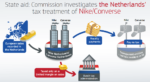
The European Commission opens in-depth investigation into tax treatment of Nike and Converse in the Netherlands
The European Commission has opened an in-depth investigation to examine whether tax rulings granted by the Netherlands to Nike may have given the company an unfair advantage over its competitors, in breach of EU State aid rules. Margrethe Vestager, Commissioner in charge of competition policy, said: “Member States should not allow companies to set up complex structures that unduly reduce their taxable profits and give them an unfair advantage over competitors. The Commission will investigate carefully the tax treatment of Nike in the Netherlands, to assess whether it is in line with EU State aid rules. At the same time, I welcome the actions taken by the Netherlands to reform their corporate taxation rules and to help ensure that companies will operate on a level playing field in the EU.” Nike is a US based company involved worldwide in the design, marketing and manufacturing of footwear, clothing, equipment and accessories, in particular in the sports area. The formal investigation concerns the tax treatment in the Netherlands of two Nike group companies based in the Netherlands, Nike European Operations Netherlands BV and Converse Netherlands BV. These two operating companies develop, market and record the sales of Nike and Converse products in Europe, the Middle East and Africa (the EMEA region). Nike European Operations Netherlands BV and Converse Netherlands BV obtained licenses to use intellectual property rights relating to, respectively, Nike and Converse products in the EMEA region. The two companies obtained the licenses, in return for a tax-deductible royalty payment, from two Nike group entities, which are currently Dutch entities that are “transparent” for tax purposes (i.e., not taxable in the Netherlands).The Nike group’s corporate structure itself is outside the remit of EU State aid rules. From 2006 to 2015, the Dutch tax authorities issued five tax rulings, two of which are still in force, endorsing a method to calculate the royalty to be paid by Nike European Operations Netherlands and Converse Netherlands for the use of the intellectual property. As a result of the rulings, Nike European Operations Netherlands BV and Converse Netherlands BV are only taxed in the Netherlands on a limited operating margin based on sales. At this stage, the Commission is concerned that the royalty payments endorsed by the rulings may not reflect economic reality. They appear to be higher than what independent companies negotiating on market terms would have agreed between themselves in accordance with the arm’s length principle. In particular, a preliminary analysis of the companies’ activities found that: Nike European Operations Netherlands BV and Converse Netherlands BV have more than 1,000 employees and are involved in the development, management and exploitation of the intellectual property. For example, Nike European Operations Netherlands BV actively advertises and promotes Nike products in the EMEA region, and bears its own costs for the associated marketing and sales activities. In contrast, the recipients of the royalty are Nike group entities that have no employees and do not carry out any economic activity. The Commission investigation will focus on whether the Netherlands’ tax rulings endorsing these royalty payments may have unduly reduced the taxable base in the Netherlands of Nike European Operations Netherlands BV and Converse Netherlands BV since 2006. As a result, the Netherlands may have granted a selective advantage to the Nike group by allowing it to pay less tax than other stand-alone or group companies whose transactions are priced in accordance with market terms. If confirmed, this would amount to illegal State aid.
The Australian Taxation Office and Mining Giant BHP have settled yet another Transfer Pricing Dispute
BHP Group has agreed to pay the state of Western Australia A$250 million to end a dispute over royalties paid on iron ore shipments sold through its Singapore marketing hub. The State government found in January that the world’s biggest miner had underpaid royalties on iron ore shipments sold via Singapore stretching back over more than a decade. BHP reached a deal to pay A$529 million in additional taxes to the Australian government late last year to settle a long-running tax dispute over the miner’s Singapore hub on its income from 2003-2018.
Telenor will have to pay additional taxes of 2.5 billion Norwegian crowns
Telenor Norway has received a tax assessment according to which the company will have to pay additional taxes in Norway of 2.5 billion Norwegian crowns for tax year 2013. A deduction expenced in 2013 for a loss suffered in 2012 due to settlement of bank guarantees given in respect of external funding in its Indian subsidiary Unitech Wireless has been disallowed for tax purposes by the Norwegian Tax Authorities Telenor decided to enter the market in India in 2008. In 2012, the Supreme Court of India revoked the licenses of the Telenor mobile company and seven other mobile companies. In the fall of 2012, Telenor paid around NOK 4.2 billion to buy back licenses in six of 22 telecommunications regions. Following a dispute with Telenor’s Indian partnership – Unitech – the parties agreed to transfer all the valuables of their joint unit company Mobile Unitech Wireless to a Telenor-controlled company – Telenor India. In the annual report for 2018, Telenor Norway writes that in 2012 the company recognized claims against Unitech Wireless after the company released its guarantee of NOK 10.6 billion for all interest-bearing debt in Unitech Wireless . – deferred tax asset of 2.5 billion Norwegian kroner has been recognized. In 2013, the business transfer from Unitech Wireless to Telenor India was completed and Telenor ASA deducted NOK 9.3 billion as a tax loss in its tax returns. Telenor later withdraw from the Indian market after losses in total of 25 billion.
The L’Oréal group announced additional payment of 320 million euros in corporate tax to the French tax authorities to “settle a dispute”
The French cosmetic group L’Oréal announced in September 2019 that it would pay 320 million euros to the French tax authorities to “settle a dispute” related to the payment of corporate tax for three of its subsidiaries for fiscal years 2014 and 2018. In detail, the charge was 47 million euros for Lancôme Parfums et Beauté, 115 million euros for Active International Cosmetics and 158 million euros for Prestige and Collections International.
Malaysian Energy Group – TENAGA Nasional Bhd – has been issued a RM 4.000.000.000 tax bill by the Revenue Board of Malaysia
Malaysian Energy Group – TENAGA Nasional Bhd – has begun legal proceedings against the Inland Revenue Board of Malaysia. In November 2019, the Inland Revenue Board issued a tax assessment according to which taxes of RM3.98 bil (or USD 1 billion) is owed for years 2015-2017. After reciving the assessment, TENAGA responded “Based on the legal advice obtained from our tax solicitors, TNB has a good basis to contend that there is no legal and factual basis for IRB to issue the said notices” “Accordingly, TNB will be appealing against the said notices.” The High Court has now granted an interim stay of all further proceedings including the enforcement of the notices until the hearing of the leave application on April 2, 2020. In a prior case back from 2015 TENAGA received notices for the years of assessment 2013 and 2014 amounting to RM2.07 bil. Back then, TANAGA responded in the same way and said it would be “appealing against the said notices and the appeal process has commenced.” This prior dispute was later settled when Tenaga opted for an appeal to the Special Commissioners of Income Tax (SCIT) to qualify for a “reinvestment allowance”.
Facebook France has agreed to pay 106 million euros in back taxes and penalties
The agreement, according to which Facebook France will pay 106 million euros in back taxes and penalties, was reached after French tax authorities had carried out an extensive audit covering FY 2009-2018. Furthermore, Facebook’s French revenues were increased last year after the company decided to include advertising income from French companies in its local accounts, instead of declaring them in Ireland, where Facebook’s international operations are based. As a result, Facebook will pay 8.4 million euros in taxes in France this year – 50% more than last year. These changes are likely the result of efforts from the French government to have global online businesses pay more taxes locally.
Mining Group Rio Tinto in new $86 million Dispute with ATO over pricing of Aluminium
In March 2020 the Australian Taxation Office issued an tax assessment regarding transfer pricing to Rio Tinto’s aluminium division according to which additional taxes in an amount of $86.1 million must be paid for fiscal years 2010 – 2016. According to the assessment Rio’s Australian subsidiaries did not charge an arm’s length price for the aluminium they sold to Rio’s Singapore marketing hub. This new aluminum case is separate to Rio’s long-running $447 million dispute with the ATO over the transfer pricing of Australian iron ore. Rio intents to object to the ATO’s aluminium claim and states that the pricing of iron ore and aluminium has been determined in accordance with the OECD guidelines and Australian and Singapore domestic tax laws.
Fiat Chrysler reaches a EUR 2.5 billion settelment with the Italien tax authorities
Fiat Chrysler has reached a settlement with the Italian tax agency over taxable gains related to a transfer of the U.S. Chrysler business from Fiat SpA Italy to Fiat Chrysler Automobiles NV (Netherlands). The Italian tax agency claimed that the value of the U.S. Chrysler business had been underestimated and issued a preliminary assessment with an additional taxable gain of 5.1 billion euros. The agency had valued Chrysler at 12.5 billion euros, while Fiat SpA had declared it to be worth less than 7.5 billion. Under the terms of the latter settlement the additional taxable gain has agreed at 2.5 billion euros.

Korean tax authorities investigates Starbucks’ pricing of coffee beans
Starbucks Korea is now being investigated for overpricing goods and services imported from abroad. Officials from the National Tax Service have seized accounting records and data held at Starbucks’ Korean head office in Seoul. Subject of the investigation is transfer pricing of coffee beans and others products for sale at its more than 1,370 local shops. In 2019 Starbucks Korea reported sales of over 1.87 trillion won ($1.53 billion) and net profits of 132.8 billion won.
Mining Company Oyu Tolgoi LLC receives a second Tax Assessment from the Mongolian Tax Authority
The Oyu Tolgoi copper-gold mine is a joint venture between Turquoise Hill Resources (which is 50.8 per cent owned by Rio Tinto), and the Mongolian Government. The Mongolian government has not been satisfied by the result of the joint venture and has concerns that increasing development costs of the Oyu Tolgoi project has eroded the economic benefits it anticipated receiving. “It is calculated that Mongolia will not receive dividend payments until 2051 and will incur debts of US$22 billion,” said Mongolia’s deputy chief cabinet secretary, Solongoo Bayarsaikhan. “In addition, Oyu Tolgoi is estimated to pay profit taxes or corporate income taxes only in four years until 2051.” The Mongolian authorities has put forward proposals to coordinate and lower management services received from Rio Tinto and increase Mongolia’s benefits by reducing shareholder loan interest rates. On December 23, 2020 the Mongolian Tax Authority issued a press release concerning the results of a completed transfer pricing audit of Oyu Tologi LLC. “The Mongolian Tax Authority has recently completed an audit of Oyu Tolgoi LLC’s 2016-2018 tax returns and identified a number of violations and breaches of relevant laws and the International Rules. As a result, Oyu Tolgoi LLC was notified of MNT 649.4 billion (approximately US$228 million) of additional taxes, inclusive of penalty and default interests, that are due to be paid in cash to the Government of Mongolia. In addition, the MTA has reduced Oyu Tolgoi LLC’s operating loss carry forward balance by MNT 3.4 trillion (approximately US$ 1.2 billion). The Mongolian Tax Authority concluded that certain transactions between Oyu Tolgoi LLC and Rio Tinto and its affiliates were not done at an arm’s length basis and were in violation of the International Rules. Accordingly, the value of such transactions was adjusted, for tax purposes, to reflect the actual value that would have been paid had the transactions occurred between unrelated parties dealing at an arm’s length basis. Major adjustments were made to a series of transactions between Oyu Tolgoi LLC and affiliated entities of Rio Tinto whereby economic value was transferred.” The 2016-2018 audit of Oyu Tologi LLC follows up on a previous assessment for FY 2013-2015. According to an announcement from Turquoise Hill Resources, the previous assessment has now been referred to international arbitration.
Spain releases note on arm’s length range and benchmarking.
On 25 February 2021, a note was released by the Spanish Tax Agency on number of practical issues relating to application of the arm’s-length range. The note – which is based on the OECD transfer Pricing Guidelines, guidance on benchmark studies issued by the Joint Transfer Pricing Forum, and relevant Spanish case laws – answers the following questions – How is the range of values determined? – Is it possible to determine a range of values in which the figures are relatively equally reliable? – How to proceed if a range is determined in which all figures are not relatively equally reliable? – When should statistical tools be used to narrow the range? – What should be done if there is a wide dispersion in the range? – Where in the range should the value of the linked transactions be selected? – When can the administration adjust the values used by the taxpayer in its controlled transactions covered by a range of values? The note concludes that – Any transfer pricing adjustment requires justification that the value declared by the taxpayer does not comply with the arm’s length principle. – While in some cases it will be possible to determine a single figure as a more reliable benchmark to establish whether a transaction is at arm’s length, in many cases the application of the most appropriate valuation method will lead to a range of figures. – In determining a range of arm’s length values, those transactions with a lower degree of comparability should be eliminated. Also, to the extent that comparability can be improved and where possible, comparability adjustments should be made for those values that require them. However, it is common for a lack of information to prevent such adjustments from being made. – A range of values with a wide dispersion is often indicative of comparability defects in the values that determine the range and should lead to a more detailed analysis. – After such refinements, a range of values could be obtained in which all results are very reliable and relatively equal. In this case, any point in the range complies with the arm’s length principle and therefore no adjustment is appropriate if the value reported by the taxpayer is within the range. If it is outside the range, the adjustment will take the value of the controlled transaction to the value that is closest within the range. – In practice, the range will usually not comprise very reliable and relatively equal results. In this case, once the least comparable results have been eliminated, if there are still defects in comparability that cannot be identified or quantified (and therefore cannot be adjusted for), statistical tools are commonly used which, while not eliminating these defects in comparability, improve the reliability of the analysis. This is achieved by narrowing the range by using only those values between the 1st and 3rd quartiles. – In this case, if the value declared by the taxpayer is within the arm’s length range (whether declared by the taxpayer and accepted by the government or determined by the government), no adjustments should be made. – If, on the other hand, the value declared by the taxpayer is outside the range, the adjustment should generally be made to the median. This is unless, as expressly stated in EU doctrine, after a thorough analysis of the facts and circumstances of the case, there is justification for choosing another particular point in the range, with the burden of proof falling on the person seeking to assert that other point. Click here for English translation
Diageo – British multinational beverage and alcohol group – is facing various tax challenges
Diageo (British multinational beverage and alcohol group – owner of numerus brands including Jonny Walker, Captain Morgan, Gordons Gin, Smirnoff and Guinness) is facing difficult tax challenges according to the group’s August 2020 SEC-filings During 2017 Diageo was in discussions with UK tax authorities to seek clarity on Diageo’s transfer pricing and related issues, and in the first half of the year ending 30 June 2018 a preliminary assessment for diverted profits tax notice was issued. Final charging notices were issued in August 2017 and Diageo paid £107 million in respect of the two years ended 30 June 2016. In June 2018 an agreement was reached with UK tax authorities that diverted profits tax does not apply the Diageo and at the same time a resolution was reached on the transfer pricing issues being discussed. The agreement in respect of transfer pricing covers the period from 1 July 2014 to 30 June 2017 and has resulted in an additional UK tax charge of £143 million. In the year ended 30 June 2018 an additional tax charge of £47 million was recognised in current tax which is based on the approach agreed with UK tax authorities. In April 2019, the European Commission issued its decision in a state aid investigation into the Group Financing Exemption in the UK controlled foreign company rules. The European Commission found that part of the Group Financing Exemption constitutes state aid. The Group Financing Exemption was introduced in legislation by the UK government in 2013. In common with other UK-based international companies whose arrangements are in line with current UK CFC legislation Diageo may be affected by the ultimate outcome of this investigation. The UK government and other UK-based international companies, including Diageo, have appealed to the General Court of the European Union against the decision. The UK government is required to commence collection proceedings and therefore it is expected that Diageo will have to make a payment in the year ending 30 June 2021 in respect of this case. At present it is not possible to determine the amount that the UK government will seek to collect. If the decision of the European Commission is upheld, Diageo calculates its maximum potential liability to be approximately £275 million. Based on its current assessment, Diageo believes that no provision is required in respect of this issue. In July 2019 Diageo reached a resolution with the French tax authorities on the treatment of interest costs for all open periods which resulted in a total exceptional charge of €100 million (£88 million), comprising a tax charge of €69 million (£61 million), penalties of €21 million (£18 million) and interest of €10 million (£9 million). This brought to a close all open issues with the French tax authorities for periods up to and including 30 June 2017. Diageo also has a large number of ongoing tax cases in Brazil and India. The current assessment of the aggregate possible exposures is up to approximately £285 million for Brazil and up to approximately £150 million for India. The group believes that the likelihood that the tax authorities will ultimately prevail is lower than probable but higher than remote. Due to the fiscal environment in Brazil and in India the possibility of further tax assessments related to the same matters cannot be ruled out. Based on its current assessment, Diageo believes that no provision is required in respect of these issues. Diageo states that payments were made under protest in India in respect of the periods 1 April 2006 to 31 March 2017 in relation to tax assessments where the risk is considered to be remote or possible. These payments have to be made in order to challenge the assessments and as such have been recognised as a receivable on the consolidated balance sheet. The total amount of protest payments recognised as a receivable as at 30 June 2020 is £117 million (corporate tax payments of £107 million and indirect tax payments of £10 million).
Airbnb under examination by the Internal Revenue Service for 2013 and 2016
Airbnb is under examination by the Internal Revenue Service for its income taxes in 2013 and 2016, according to the company’s December 2020 SEC filing. According to the filing a draft notice of adjustment from the IRS proposes that the company owes an additional $1.35 billion in taxes plus interest and penalties for the years in question. The assessment is related to valuation of its intellectual property that was transferred to a subsidiary in FY 2013. Airbnb then had had two subsidiaries outside the United States – Airbnb International Holdings Ltd and Airbnb International Unlimited Co – both resident for tax purposes in tax haven Jersey. The company plans to fight a potential adjustment. “We disagree with the proposed adjustment and intend to vigorously contest it,” “If the IRS prevails in the assessment of additional tax due based on its position and such tax and related interest and penalties, if any, exceeds our current reserves, such outcome could have a material adverse impact on our financial position and results of operations, and any assessment of additional tax could require a significant cash payment and have a material adverse impact on our cash flow,” Finally, it appears that the company is now in the process of moving its intellectual property back to the United States. Excerpts From Airbnb’s SEC filings “We are currently under examination for income taxes by the Internal Revenue Service (“IRS”) for the years 2013 and 2016. We are continuing to respond to inquiries related to these examinations. While we have not yet received a Revenue Agent’s Report generally issued at the conclusion of an IRS examination, in September 2020, we received a Draft Notice of Proposed Adjustment from the IRS for the 2013 tax year relating to the valuation of our international intellectual property which was sold to a subsidiary in 2013. The notice proposes an increase to our U.S. taxable income that could result in additional income tax expense and cash tax liability of $1.35 billion, plus penalties and interest, which exceeds our current reserve recorded in our consolidated financial statements by more than $1.0 billion. A formal Notice of Proposed Adjustment is expected from the IRS by the end of 2020. Following formal receipt of the Revenue Agent’s adjustment which is anticipated late in the fourth quarter of 2020, we intend to vigorously contest the IRS’s proposed adjustment, including through all administrative and, if necessary, judicial remedies which may include: entering into administrative settlement discussions with the IRS Independent Office of Appeals (“IRS Appeals”) in 2021, and if necessary petitioning the U.S. Tax Court (“Tax Court”) for redetermination if an acceptable outcome cannot be reached with IRS Appeals, and finally, and if necessary, appealing the Tax Court’s decision to the appropriate appellate court. If the IRS prevails in the assessment of additional tax due based on its position and such tax and related interest and penalties, if any, exceeds our current reserves, such outcome could have a material adverse impact on our financial position and results of operations, and any assessment of additional tax could require a significant cash payment and have a material adverse impact on our cash flow.“ “We may have exposure to greater than anticipated income tax liabilities. In September 2020, we received a Draft Notice of Proposed Adjustment from the IRS for the 2013 tax year proposing an increase to our U.S. taxable income that could result in additional income tax expense and cash tax liability of $1.35 billion, plus penalties and interest, which exceeds our current reserve recorded in our consolidated financial statements by more than $1.0 billion.“ “The Company is in various stages of examination in connection with its ongoing tax audits globally, and it is difficult to determine when these examinations will be settled. The Company believes that an adequate provision has been recorded for any adjustments that may result from tax audits. However, the outcome of tax audits cannot be predicted with certainty. If any issues addressed in the Company’s tax audits are resolved in a manner not consistent with management’s expectations, the Company may be required to record an adjustment to the provision for income taxes in the period such resolution occurs. It is reasonably possible that over the next 12-month period the Company may experience an increase or decrease in its unrecognized tax benefits as a result of tax examinations or lapses of the statute of limitations. However, an estimate of the range of the reasonably possible change in the next twelve months cannot be made.“ “On July 27, 2015, the United States Tax Court (the “Tax Court”) issued an opinion in Altera Corp. v. Commissioner (the “Tax Court Opinion”), which concluded that related parties in a cost sharing arrangement are not required to share expenses related to stock-based compensation. The Tax Court Opinion was appealed by the Commissioner to the Ninth Circuit Court of Appeals (the “Ninth Circuit”). On June 7, 2019, the Ninth Circuit issued an opinion (the “Ninth Circuit Opinion”) that reversed the Tax Court Opinion. On July 22, 2019, Altera Corp. filed a petition for a rehearing before the full Ninth Circuit. On November 12, 2019, the Ninth Circuit denied Altera Corp.’s petition for rehearing its case. The Company accordingly recognized tax expense of $26.6 million related to changes in uncertain tax positions during the year ended December 31, 2019. The Company will continue to monitor future developments in this case to determine if there will be further impacts to its consolidated financial statements.” “The Ninth Circuit Court of Appeals issued a decision in Altera Corp. v. Commissioner in June of 2019 regarding the treatment of stock-based compensation expense in a cost sharing arrangement, which had a material effect on our tax obligations and effective tax rate for the quarter in which the decision was issued.” “The Company is in the process of providing documentation to the Internal Revenue Service in connection with an examination of the Company’s 2013 income taxes with the primary issue under examination being the valuation of the

German TP-Legislation updated as of June 2021
German legislation on transfer pricing has been updated to align the rules with the OECD Transfer Pricing Guidelines 2017. The new amendments are effective as of fiscal year 2022. The rules includes revised content on Substance over form Risk analysis Best method rule Use of interquartile range Aggregation of transactions Determination of actual ownership vs legal ownership DEMPE functions Valuation of Hard to value intangibles Unofficial translation of the new amendments to the German TP legislation Article 5 Amendment of the Foreign Tax Act The Foreign Tax Act of 8 September 1972 (BGBl. I p. 1713), as last amended by Article 4 of the Act of 25 March 2019 (BGBl. I p. 357), shall be amended as follows: section 1 shall be amended as follows: (a) Paragraph 1 shall be amended as follows: aa) In sentence 1, the words “related” shall be replaced by the word “related”. bb) In sentence 2, the words “and within the meaning of § 1a” shall be inserted after the word “provision”. (b) Paragraph 3 shall be replaced by the following paragraphs 3 to 3c: “(3) For the determination of the transfer prices (arm’s length prices) corresponding to the arm’s length principle for a business relationship within the meaning of paragraph 1 sentence 1, the actual circumstances underlying the respective business transaction shall be decisive. In particular, it shall be taken into account which functions are performed by which person involved in the business transaction in relation to the respective business transaction, which risks are assumed in this respect and which assets are used for this purpose (function and risk analysis). The relationships within the meaning of sentences 1 and 2 shall form the standard for determining the comparability of the business transaction to be examined with business transactions between unrelated third parties (comparability analysis); the relationships on which these business transactions are based shall be decisive in the corresponding application of sentences 1 and 2, insofar as this is possible. The circumstances at the time of the agreement of the business transaction shall be taken into account. The arm’s length price shall in principle be determined according to the most appropriate transfer pricing method with regard to the comparability analysis and the availability of values for comparable transactions of independent third parties. Differences between the ratios of the arm’s length transactions used for comparison and the ratios underlying the transaction under review that may affect the application of the transfer pricing method shall be eliminated by appropriate adjustments, if possible; this shall only apply if comparability is thereby enhanced. If no comparative values can be determined, a hypothetical arm’s length comparison shall be carried out for the determination of the arm’s length price in compliance with paragraph 1 sentence 3 from the perspective of the supplier and the respective service recipient using economically recognised valuation methods. (3a) The application of the arm’s length principle regularly leads to a range of values. This range shall be narrowed if differences in comparability remain after application of paragraph 3 sentence 6. If these values themselves do not offer any indications for a certain narrowing, the quarter of the smallest and the quarter of the largest values shall be disregarded from this range. If the value used by the taxpayer to determine his income lies outside the range pursuant to sentence 1 or the narrowed range, the median shall be decisive if the taxpayer does not credibly demonstrate that another value complies with the arm’s length principle. When applying the hypothetical arm’s length principle according to paragraph 3, sentence 7, a range of agreement regularly results from the minimum price of the supplier and the maximum price of the service recipient. In the cases of sentence 5, the mean value of the agreement range shall be used as a basis if the taxable person does not credibly demonstrate that another value within the agreement range complies with the arm’s length principle. (3b) If a function, including the associated opportunities and risks as well as the assets or other benefits transferred along with the function, is transferred and paragraph 3 sentence 7 is to be applied to the transferred function because no comparative data can be determined for the transfer of the function as a whole (transfer package), the agreement range shall be determined on the basis of the transfer package. This may be waived if the taxpayer can credibly demonstrate that neither significant intangible assets nor other benefits were the subject of the transfer of function. This applies if the receiving company performs the transferred function exclusively vis-à-vis the transferring company and the consideration to be recognised for the performance of the function and the provision of the corresponding services is to be determined according to the cost-plus method. (3c. A transfer or assignment for use of an intangible asset shall be remunerated if it is made on the basis of a business relationship as defined in paragraph 4 and it has a financial effect on the transferee, the user, the transferor or the assignor. Intangible assets are assets that are neither tangible assets nor equity interests nor financial assets which may be the subject of a transaction without being individually transferable; and which can give a person an actual or legal position over that asset. The identification of the ownership or holder of an intangible asset, including rights derived from such an asset, is the starting point for determining which party to the transaction is entitled to the revenue arising from any disposition of that intangible asset. To the extent that a related party of the owner or holder of the intangible asset performs functions, uses assets or assumes risks in connection with the development or creation, enhancement, maintenance, protection or any form of exploitation of the intangible asset, those functions shall be appropriately compensated by the owner or holder of the related party. The financing of the development or creation, maintenance or protection of an intangible asset shall be appropriately remunerated and shall not give rise

ATO and Singtel in Court over Intra-company Financing Arrangement
In 2001, Singtel, through its wholly owned Australian subsidiary, Singapore Telecom Australia Investments Pty Limited (Singtel Au), acquired the majority of the shares in Cable & Wireless Optus for $17.2 billion. The tax consequences of this acqusition was decided by the Federal Court in Cable & Wireless Australia & Pacific Holding BV (in liquiatie) v Commissioner of Taxation [2017] FCAFC 71. Cable & Wireless argued that part of the price paid under a share buy-back was not dividends and that withholding tax should therefor be refunded. The ATO and the Court disagreed. ATO and Singtel is now in a new dispute – this time over tax consequences associated with the intra-group financing of the takeover. This case was heard in the Federal Court in August 2021. At issue is a tax assessments for FY 2011, 2012 and 2013 resulting in additional taxes in an amount $268 million. In the assessment interest deductions claimed in Australia on notes issued under a Loan Note Issuance Agreement (LNIA) has been disallowed by the ATO.
Austrian Ministry of Finance issues Updated Local Transfer Pricing Guidelines (VPR 2021)
In October 2021 the Austrian Ministry of Finance issues updated local transfer pricing guidelines – VPR 2021 The Transfer Pricing Guidelines 2021 (VPR 2021) are an interpretative aid to the arm’s length principle and serve to ensure its uniform application. They are to be regarded as a summary of the applicable transfer pricing provisions and thus as a reference work for administrative and operational practice. Rights and obligations that go beyond the statutory provisions cannot be derived from the guidelines. In 1995, the OECD published general principles for the determination of arm’s length transfer prices between associated enterprises (OECD Transfer Pricing Principles; OECD TPG), which were published with their updates in 1996, 1997 and 1998 in a German translation agreed between Switzerland and Austria in the Official Gazette of the Austrian Tax Administration (AÖF No. 114/1996, 122/1997, 155/1998, 171/2000). In 2010, a major update of the OECD TPG followed, in which Chapters I to III were revised in depth and a new Chapter IX relating to corporate reorganisations was added (OECD TPG 2010). Based on this, Austria’s own guidelines were published for the first time in 2010: the VPR 2010 (AÖF No. 221/2010 idF 22/2011). Since then, the OECD TPG have been continuously developed. Particularly comprehensive changes to the OECD TPG have recently resulted from the OECD/G20 work in the context of the Base Erosion and Profit Shifting (BEPS) project which VPR 2021 GZ 2021-0.586.616 of 07 October 2021 resulted in an update in 2017 (OECD-TPG 2017). Therefore, there is a need for a fundamental revision of the VPR 2010, a repeal of the existing enactments and a new promulgation of the VPR (VPR 2021). Within the scope of this fundamental revision, the previous structure of the VPR was largely retained, but some very comprehensive additions were necessary. In addition, the latest version of the BMF Info on the Transfer Pricing Documentation Act (BMF Info of 17 December 2019, BMF-010221/0395-IV/8/2019) was incorporated into the VPR as section 3.2. For reasons of clarity and transparency, the VPR are therefore newly promulgated. The VPR 2021 replace the Transfer Pricing Guidelines 2010 (VPR 2010). Link to Austrian Local Transfer Pricing Guidelines 2021 Unofficial English Translation

Amgen in $3.6 billion transfer pricing dispute with the IRS
Amgen, in a note to its financial statement for the quarterly period ended June 30, 2021, disclosed that it has been issued tax assessments of approximately $3.6b plus interest for tax years 2010, 2011 and 2012 by the IRS. Proposed adjustments for FY 2013, 2014 and 2015 has also been issued. The dispute relates to the allocation of profits between Amgen group entities in the United States and the U.S. territory of Puerto Rico. According to the note, Amgen has filed a petition in the U.S. Tax Court to contest the assessments. 4. Income taxes The effective tax rates for the three and six months ended June 30, 2021, were 16.8% and 12.6%, respectively, compared with 11.2% and 10.4%, respectively, for the corresponding periods of the prior year. The increase in our effective tax rate for the three and six months ended June 30, 2021, was primarily due to the non-deductible IPR&D expense arising from the acquisition of Five Prime. The effective tax rates differ from the federal statutory rate primarily as a result of foreign earnings from the Company’s operations conducted in Puerto Rico, a territory of the United States that is treated as a foreign jurisdiction for U.S. tax purposes, that are subject to a tax incentive grant through 2035. In addition, the Company’s operations conducted in Singapore are subject to a tax incentive grant through 2034. These earnings are also subject to U.S. tax at a reduced rate of 10.5%. The U.S. territory of Puerto Rico imposes an excise tax on the gross intercompany purchase price of goods and services from our manufacturer in Puerto Rico. The rate of 4% is effective through December 31, 2027. We account for the excise tax as a manufacturing cost that is capitalized in inventory and expensed in cost of sales when the related products are sold. For U.S. income tax purposes, the excise tax results in foreign tax credits that are generally recognized in our provision for income taxes when the excise tax is incurred. One or more of our legal entities file income tax returns in the U.S. federal jurisdiction, various U.S. state jurisdictions and certain foreign jurisdictions. Our income tax returns are routinely examined by tax authorities in those jurisdictions. Significant disputes may arise with tax authorities involving issues regarding the timing and amount of deductions, the use of tax credits and allocations of income and expenses among various tax jurisdictions because of differing interpretations of tax laws, regulations and relevant facts. In 2017, we received a Revenue Agent Report (RAR) and a modified RAR from the Internal Revenue Service (IRS) for the years 2010, 2011 and 2012 proposing significant adjustments that primarily relate to the allocation of profits between certain of our entities in the United States and the U.S. territory of Puerto Rico. We disagreed with the proposed adjustments and calculations and pursued a resolution with the IRS administrative appeals office. As previously reported, we were unable to reach resolution with the IRS appeals office. In July 2021, we filed a petition in the U.S. Tax Court to contest two duplicate Statutory Notices of Deficiency (Notices) for 2010, 2011 and 2012 that we received in May and July 2021. The duplicate Notices seek to increase our U.S. taxable income by an amount that would result in additional federal tax of approximately $3.6 billion, plus interest. Any additional tax that could be imposed would be reduced by up to approximately $900 million of repatriation tax previously accrued on our foreign earnings. In any event, we firmly believe that the IRS’s positions in the Notices are without merit and we will vigorously contest the Notices through the judicial process. In addition, in 2020, we received an RAR and a modified RAR from the IRS for the years 2013, 2014 and 2015 also proposing significant adjustments that primarily relate to the allocation of profits between certain of our entities in the United States and the U.S. territory of Puerto Rico, similar to those proposed for the years 2010, 2011 and 2012. We disagree with the proposed adjustments and calculations and are pursuing resolution with the IRS administrative appeals office. We are currently under examination by the IRS for the years 2016, 2017 and 2018. We are also currently under examination by a number of other state and foreign tax jurisdictions. Final resolution of these complex matters is not likely within the next 12 months. We believe our accrual for income tax liabilities is appropriate based on past experience, interpretations of tax law, application of the tax law to our facts and judgments about potential actions by tax authorities; however, due to the complexity of the provision for income taxes and uncertain resolution of these matters, the ultimate outcome of any tax matters may result in payments substantially greater than amounts accrued and could have a material adverse impact on our condensed consolidated financial statements. We are no longer subject to U.S. federal income tax examinations for the years ended on or before December 31, 2009. During the three and six months ended June 30, 2021, the gross amounts of our unrecognized tax benefits (UTBs) increased $50 million and $110 million, respectively, as a result of tax positions taken during the current year. Substantially all of the UTBs as of June 30, 2021, if recognized, would affect our effective tax rate.

ResMed Inc has entered a $381.7 million tax settlement agreement with the Australian Tax Office
ResMed – a world-leading digital health company – in an October 2021 publication of results for the first quarter of FY 2022, informs that a $381.7 million tax settlement agreement has been entered with the Australian Tax Office. The dispute concerns the years 2009 through 2018, in which the ATO alleged that ResMed should have paid additional Australian taxes on income derived from the company’s Singapore operations. Excerpts from the announcement “Operating cash flow for the quarter was negative $65.7 million and was impacted by a payment to the Australian Tax Office of $284.8 million, which was the settlement amount of $381.7 million net of prior remittances.” “During the quarter, concluded the settlement agreement with the Australian Taxation Office (“ATO”), which fully resolves the transfer pricing dispute for all prior years since 2009. ResMed previously recognized a tax reserve in êscal year 2021 in anticipation of the settlement. The net impact of the settlement was $238.7 million ($381.7 million gross less credits and deductions of $143.0 million). The settlement provides closure for historic Australian tax matters and greater clarity into the future. As a result of the ATO settlement and due to movements in foreign currencies, recognized a $4.1 million reduction in tax credits during the quarter, which was recorded as an increase in income tax expense.“ Back in 2015 ResMed rigorously defended its tax position in a submission to the Australien Senate Economics Reference Committee following an inquiry into Corporate Tax Avoidance practices.

South African Revenue Service releases comprehensive Interpretation Note on intra-group loans
The South African Revenue Service (SARS) has published a comprehensive Interpretation Note on intra-group loans. The note provides taxpayers with guidance on the application of the arm’s length principle in the context of the pricing of intra-group loans. The pricing of intra-group loans includes a consideration of both the amount of debt and the cost of the debt. An intra-group loan would be incorrectly priced if the amount of debt funding, the cost of the debt or both are excessive compared to what is arm’s length. The Note also provides guidance on the consequences for a taxpayer if the amount of debt, the cost of debt or both are not arm’s length. The guidance and examples provided are not an exhaustive consideration of every issue that might arise. Each case will be decided on its own merits taking into account its specific facts and circumstances. The application of the arm’s length principle is inherently of a detailed factual nature and takes into account a wide range of factors particular to the specific taxpayer concerned.

Italy releases operational instructions on arm’s length range and benchmarking.
On 24 May 2022, the Italian Tax Agency (Agenzia delle Entrate) released CIRCULAR NO. 16/E containing operational instructions on issues relating to application of the arm’s length range. The circular – which is based on the OECD transfer Pricing Guidelines, guidance on benchmark studies issued by the Joint Transfer Pricing Forum, and relevant Italian case laws – provides operational instructions regarding the correct interpretation of the notion of “arm’s length range”, as also specified in Article 6 of the Decree of 14 May 2018, when applying the provisions set forth in Article 110, paragraph 7, of the Consolidated Income Tax Act or of the provisions contained in the Double Taxation Treaties entered into by Italy in accordance with Article 9 of the OECD Model Convention. The operational instructions concludes as follows the correct application of the most appropriate transfer pricing method may, instead of a single value, lead to a range of values all complying with the arm’s length principle; in such cases, the full range of values within the arm’s length range may be used if all the transactions identified in the range are equally comparable; if, on the other hand, some of the transactions within the range show defects of comparability that cannot be reliably identified or quantified and, therefore adjusted, the use of ‘statistical tools’ (in order to strengthen their reliability) and a value within the narrow range is preferable. Recourse, on the other hand, to a value as central as possible within the range (also in order to minimise the risk of error due to the presence of such defects) must be limited to cases in which the range does not include values characterised by a sufficient degree of comparability even to consider reliable any point within the narrow range by means of statistical tools and must, in any case, be specifically justified; Therefore, it will be the responsibility of the Offices to resort to the “full range” for the purpose of identifying the arm’s length range only in those cases in which a perfect comparability of all the observations of the set with the “tested party” can be discerned. In conclusion, in recalling once again that according to the OECD Guidelines the identification of a set of values could be symptomatic of the fact that the application of the arm’s length principle allows in certain circumstances to reach only an approximation of the conditions that would have been established between independent enterprises, it is recommended that the adjustments involving the identification of the point that best satisfies the arm’s length principle within the range be argued in detail. Click here for English translation Click here for other translation

McDonald’s has agreed to pay €1.25bn to settle a dispute with French authorities over excessive royalty payments to Luxembourg
On 16 June 2022 McDonald’s France entered into an settlement agreement according to which it will pay €1.245 billion in back taxes and fines to the French tax authorities. The settlement agreement resulted from investigations carried out by the French tax authorities in regards to abnormally high royalties transferred from McDonald’s France to McDonald’s Luxembourg following an intra group restructuring in 2009. McDonald’s France doubled its royalty payments from 5% to 10% of restaurant turnover, and instead of paying these royalties to McDonald’s HQ in the United States, going forward they paid them to a Swiss PE of a group company in Luxembourg, which was not taxable of the amounts. During the investigations it was discovered that McDonald’s royalty fees could vary substantially from one McDonald’s branch to the next without any justification other than tax savings for the group. This conclusion was further supported by statements of the managers of the various subsidiaries as well as documentation seized which showed that the 100% increase in the royalty rate was mainly explained by a higher profitability of McDonald’s in France and a corresponding increase in taxes due. The investigations led the French tax authorities to question the overall economic substance of the IP company in Luxembourg and the contractual arrangements setup by the McDonald’s group. After being presented with the findings of the investigations and charged with tax fraud etc. McDonald’s was offered a public interest settlement agreement (CJIP) under Article 41-1-2 of the French Code of Criminal Procedure. The final settlement agreement between McDonald’s and the French authorities was announced in a press release from the Financial Public Prosecutor (English translation below). On 16 June 2022, the President of the Paris Judicial Court validated the judicial public interest agreement (CJIP) concluded on 31 May 2022 by the Financial Public Prosecutor (PRF) and the companies MC DONALD’S FRANCE, MC DONALD’S SYSTEM OF FRANCE LLC and MCD LUXEMBOURG REAL ESTATE S.A.R.L pursuant to Article 41-1-2 of the Criminal Procedure Code. under Article 41-1-2 of the Code of Criminal Procedure. Under the terms of the CJIP, MC DONALD’S FRANCE, MC DONALD’S SYSTEM OF FRANCE LLC and MCD LUXEMBOURG REAL ESTATE S.A.R.L, undertake to pay the French Treasury a public interest fine totalling 508,482,964 euros. Several French companies of the MC DONALD’S group have also signed a global settlement with the tax authorities, putting an end to the administrative litigation. The sum of the duties and penalties due under the overall settlement and the public interest fine provided for under the CJIP amounts to a total of EUR 1,245,624,269. Subject to the payment of the public interest fine, the validation of the CJIP extinguishes the public prosecution against the signatory companies. This agreement follows a preliminary investigation initiated by the PNF on 4 January 2016 after the filing of a complaint by the works council of MC DONALD’S OUEST PARISIEN. Opened in particular on the charge of tax fraud, the investigation had been entrusted to the Central Office for Combating Corruption and Financial and Fiscal Offences (OCLCIFF). This is the 10ᵉ CJIP signed by the national financial prosecutor’s office. The Financial Public Prosecutor Jean-François Bohnert Validated Settlement Agreement of 16 June 2022 English translation of the Validated Settelment Agreement Preliminary Settlement Agreement of 31 May 2022 with statement of facts and resulting taxes and fines English translation of the Preliminary Settlement Agreement of 31 May 2022

Rio Tinto has agreed to pay AUS$ 1 billion to settle a dispute with Australian Taxation Office over its Singapore Marketing Hub
On 20 July 2022 Australian mining group Rio Tinto issued a press release announcing that a A$ 1 billion settlement had been reached with the Australian Taxation Office. “The agreement resolves the disagreement relating to interest on an isolated borrowing used to pay an intragroup dividend in 2015. It also separately resolves the pricing of certain transactions between Rio Tinto entities based in Australia and the Group’s commercial centre in Singapore from 2010-2021 and provides certainty for a further five-year period. Rio Tinto has also reached agreement with the Inland Revenue Authority of Singapore (IRAS) in relation to transfer pricing for the same periods. Reaching agreement with both tax authorities ensures Rio Tinto is not subject to double taxation. As part of this agreement, Rio Tinto will pay to the ATO additional tax of A$613m for the twelve historical years (2010 to 2021). This is in addition to the A$378m of tax paid in respect of the original amended assessments issued by the ATO. Over this period, Rio Tinto paid nearly A$80bn in tax and royalties in Australia. Peter Cunningham, Rio Tinto Chief Financial Officer, said “We are glad to have resolved these longstanding disputes and to have gained certainty over future tax outcomes relating to our Singapore marketing arrangements. Rio Tinto remains committed to our commercial activities in Singapore and the valuable role played by our centralised commercial team.” Additional Information Rio Tinto was issued amended assessments in respect of iron ore marketing in 2017 (A$447m for the 2010 to 2013 years), for aluminium marketing in 2020 (A$86m for the 2010 to 2016 years) and for the intragroup dividend financing matter in 2021 (A$738m for the 2015 to 2018 years). The agreements separately reached with the ATO and IRAS cover the transfer pricing related to the marketing of all products between Australia and Singapore, including iron ore and aluminium, for all historical years from 2010 to 2021 and the future period to 2026. The ATO settlement payment includes A$55m of interest and A$22m of penalties. On 20 March 2020, Rio Tinto lodged requests for dispute resolution between the ATO and IRAS under the double tax treaty between Australia and Singapore (as disclosed in Rio Tinto’s 2020 half-year results). As a result of the agreements reached with both tax authorities, those requests have been withdrawn.” The settlement agreement has also been announced by the Australian Tax Office. See also Australia vs Rio Tinto and BHP Billiton, April 2017 – Going to Court and Mining Group Rio Tinto in new A$ 86 million dispute with the ATO over pricing of aluminum
Hungary – Legislation on use of Interquartile Range and Median
As part of tax legislation recently enacted in Hungary, rules governing the application of statistical tools – arm’s length range and adjustments within the range – will now be governed by law. When determining arm’s length prices based on benchmarks of comparables it will now be mandatory to use the interquartile range. If the price falls outside the arm’s length range, adjustment must be made to the median value – unless the taxpayer can prove that another value within the range is more appropriate. Where the price is within the arm’s length range, taxpayers will no longer be allowed to make year-end adjustments. The above amendments will have effect for FY 2022 and forward. Furthermore, certain information related to controlled transactions will now have to be provided in the corporate tax return. Details in this regard will be contained in a later Ministerial Decree. Click here for unofficial English translation Click here for other translation

Uber-files – Tax Avoidance promoted by the Netherlands
Uber files – confidential documents, leaked to The Guardian newspaper shows that Uber in 2015 sought to deflect attention from its Dutch conduits and Caribbean tax shelters by helping tax authorities collect taxes from its drivers. At that time, Uber’s Dutch subsidiary received payments from customers hiring cars in cities around the world (except US and China), and after paying the drivers, profits were routed on as royalty fees to Bermuda, thus avoiding corporate income tax. In 2019, Uber took the first steps to close its Caribbean tax shelters. To that end, a Dutch subsidiary purchased the IP that was previously held by the Bermudan subsidiary, using a $16 billion loan it had received from Uber’s Singapore holding company. The new setup was also tax driven. Tax depreciations on the IP acquired from Bermuda and interest on the loan from Singapore will significantly reduce Uber’s effective tax rate in years to come. Centre for International Corporate Tax Accountability and Research (CICTAR) has revealed that in 2019 Uber’s Dutch headquarter pulled in more than $US5.8 billion in operating revenue from countries around the world. “The direct transfer of revenue from around the world to the Netherlands leaves little, if any, taxable profits behind,“. “Uber created an $8 billion Dutch tax shelter that, if unchecked, may eliminate tax liability on profits shifted to the Netherlands for decades to come.” According to the groups 10-Q filing for the quarterly period ended June 30, 2022, Uber it is currently facing numerous tax audits. “We may have exposure to materially greater than anticipated tax liabilities. The tax laws applicable to our global business activities are subject to uncertainty and can be interpreted differently by different companies. For example, we may become subject to sales tax rates in certain jurisdictions that are significantly greater than the rates we currently pay in those jurisdictions. Like many other multinational corporations, we are subject to tax in multiple U.S. and foreign jurisdictions and have structured our operations to reduce our effective tax rate. Currently, certain jurisdictions are investigating our compliance with tax rules. If it is determined that we are not compliant with such rules, we could owe additional taxes. Certain jurisdictions, including Australia, Kingdom of Saudi Arabia, the UK and other countries, require that we pay any assessed taxes prior to being allowed to contest or litigate the applicability of tax assessments in those jurisdictions. These amounts could materially adversely impact our liquidity while those matters are being litigated. This prepayment of contested taxes is referred to as “pay-to-play.” Payment of these amounts is not an admission that we believe we are subject to such taxes; even when such payments are made, we continue to defend our positions vigorously. If we prevail in the proceedings for which a pay-to-play payment was made, the jurisdiction collecting the payment will be required to repay such amounts and also may be required to pay interest. Additionally, the taxing authorities of the jurisdictions in which we operate have in the past, and may in the future, examine or challenge our methodologies for valuing developed technology, which could increase our worldwide effective tax rate and harm our financial position and operating results. Furthermore, our future income taxes could be adversely affected by earnings being lower than anticipated in jurisdictions that have lower statutory tax rates and higher than anticipated in jurisdictions that have higher statutory tax rates, changes in the valuation allowance on our U.S. and Netherlands’ deferred tax assets, or changes in tax laws, regulations, or accounting principles. We are subject to regular review and audit by both U.S. federal and state tax authorities, as well as foreign tax authorities, and currently face numerous audits in the United States and abroad. Any adverse outcome of such reviews and audits could have an adverse effect on our financial position and operating results. In addition, the determination of our worldwide provision for income taxes and other tax liabilities requires significant judgment by our management, and we have engaged in many transactions for which the ultimate tax determination remains uncertain. The ultimate tax outcome may differ from the amounts recorded in our financial statements and may materially affect our financial results in the period or periods for which such determination is made. Our tax positions or tax returns are subject to change, and therefore we cannot accurately predict whether we may incur material additional tax liabilities in the future, which could impact our financial position. In addition, in connection with any planned or future acquisitions, we may acquire businesses that have differing licenses and other arrangements that may be challenged by tax authorities for not being at arm’s-length or that are otherwise potentially less tax efficient than our licenses and arrangements. Any subsequent integration or continued operation of such acquired businesses may result in an increased effective tax rate in certain jurisdictions or potential indirect tax costs, which could result in us incurring additional tax liabilities or having to establish a reserve in our consolidated financial statements, and could adversely affect our financial results. Changes in global and U.S. tax legislation may adversely affect our financial condition, operating results, and cash flows. We are a U.S.-based multinational company subject to tax in multiple U.S. and foreign tax jurisdictions. U.S. tax legislation enacted on December 22, 2017, and modified in 2020, the Tax Cuts and Jobs Act (“the Act”), has significantly changed the U.S. federal income taxation of U.S. corporations. The legislation and regulations promulgated in connection therewith remain unclear in many respects and could be subject to potential amendments and technical corrections, as well as interpretations and incremental implementing regulations by the U.S. Treasury and U.S. Internal Revenue Service (the “IRS”), any of which could lessen or increase certain adverse impacts of the legislation. In addition, it remains unclear in some instances how these U.S. federal income tax changes will affect state and local taxation, which often uses federal taxable income as a starting point for computing state and local tax liabilities. Furthermore, beginning on

TELE2 announces SEK 1,8 billion victory in Swedish Courts
In a press release dated November 7, 2022, TELE2 announced a SEK 1,8 billion win related to tax deductions for foreign exchange losses on intra-group loans, that had previously been disallowed by the Swedish tax authorities in an assessment issued back in 2019. According to the tax authorities the company would not – at arms length – have agreed to a currency conversion of certain intra-group loans which resulted in the loss. Tele2 appealed the decision to the Administrative Court where, during the proceedings, the authorities acknowledged deductions in part of the currency loss – SEK 745 millions. Hence, at issue before the Court was disallowed deductions of the remaining amount of SEK 1 billion. In January 2021 the administrative court dismissed TELE2’s appeal in regards of the remaining amount of SEK 1 billion. Tele2 then filed an appeal with the Court of Appeal. The Court of Appeal decided in favour of Tele2 and granted the full tax deduction. According to the court, a reasonable and probable explanation for the currency loss had been provided by the company. Excerpts: ” Although it may be considered somewhat remarkable that the revocation clause in the Form of Selection Note does not more clearly reflect the party intent and purpose that the company claims the clause has, the Court of Appeal considers that the company has provided a reasonable and probable explanation in this respect. … The Court of Appeal also considers that the alleged intention of the parties and the purpose of the withdrawal clause are supported by the chronology of events leading up to the buy-out of Asianet from MTS. When it became clear that the transaction would go ahead, the withdrawal clause was removed, moreover without changing the market interest rate on the loans to MTS. In addition, the Court of Appeal considers that there is some ambiguity in how the revocation clause should be read with regard to the possibility of revoking the conversion retroactively, i.e. with effect from 1 September 2015. In conclusion, the Court of Appeal considers that it is not clear that it has been a realistic option for the company to withdraw the conversion on the basis of the withdrawal clause. The fact that the company did not revoke the conversion cannot therefore be used as a basis for denying the company a deduction for the remaining exchange rate loss of SEK 1 095 764 000 after tax on the basis of the adjustment rule. … The Administrative Court of Appeal considers that the company incurred a risk of foreign exchange losses through the conversion on 1 September 2015 due to the decoupling of the KZT from the USD. However, the decoupling took place on 20 August 2015, at which time the KZT exchange rate fell by approximately 30%. Subsequently, the exchange rate recovered and at the time of the conversion, according to the company’s report, which was not challenged by the Swedish Tax Agency, it was slightly higher than at the time of the decoupling from the USD. Although there must have been a significant risk of a further fall in the exchange rate, the Court of Appeal considers that KZT could not be considered to be in free fall at the time of conversion. Nor can it be considered that it was clear that it was highly unlikely that the conversion would not result in an exchange rate loss for the company. It also appears that a functioning banking and foreign exchange market existed in Kazakhstan after the KZT was decoupled from the USD. The interest rate received by the company from MTS both before and after the conversion has been in line with market conditions. The Administrative Court of Appeal has also, as stated above, found no reason to question the company’s description of how the conditions for MTS to repay the loans to the company improved after the conversion. In conclusion, the Administrative Court of Appeal considers that the conversion cannot be used as a basis for denying the company a deduction for the remaining exchange loss of SEK 1 095 764 000 by means of after-taxation, on the basis of the correction rule. The appeal must therefore be allowed.” TELE2 Press Release dated November 7, 2022

OECD Publishes Consultation Document on Amount B
On 9 December 2022 OECD published a consultation document on Amount B as part of the ongoing work on OECD’s two-pillar solution to address the tax challenges arising from the digitalisation of the economy. Amount B is one of the components of Pillar One and aims to simplify and streamline application of the arm’s length principle in regards to in-country baseline marketing and distribution activities. A particular concern of low capacity jurisdictions has been the relative unavailability of appropriate local market comparables through which arm’s length prices can be established. Amount B will address this issue by providing a basis to establish an arm’s length price in all cases using suitable comparables, wherever they are geographically drawn from. The consultation document outlines the main design elements of Amount B – scope, pricing methodology and the current status of discussions concerning an appropriate implementation framework. Deadline for submission of comments is 25 January 2023.
Accessing Comparables Data – A Toolkit on Comparability and Mineral pricing
The Platform for Collaboration on Tax (IMF, OECD, UN and the WBG) has published a toolkit for addressing difficulties in accessing comparables Data for Transfer Pricing Analyses. The Toolkit Includes a supplementary report on addressing the information gaps on prices of Minerals Sold in an intermediate form.

Report on the Use of Comparables in the EU (2017)
In March 2017 the JTPF agreed the Report on the Use of Comparables in the EU. The report establishes best practices and pragmatic solutions by issuing various recommendations for both taxpayers and tax administrations in the EU and aims at increasing in practice the objectivity and transparency of comparable searches for transfer pricing. JTPF-comparables-October-2016

EU REPORT ON THE USE OF COMPARABLES IN THE EU (2016)
EU REPORT ON THE USE OF COMPARABLES IN THE EU Background The EU Joint Transfer Pricing Forum (JTPF), as part of its work programme for 2015- 2019 (“Tools for the rules”), addresses the use of comparables in the EU (section 2.2 doc. JTPF/005/2015). Non-Governmental Members and Member States were asked to provide contributions as part of the preparation of the two meetings of 18 February 2016 and 23 June 2016. Those led to issuing two working documents (respectively, (doc. JTPF/009/2016/EN and JTPF/013/2016/EN) and were considered in the preparation of an overview on the current state of play, issues and possible solutions. A draft discussion paper on “Comparables in the EU” was prepared and discussed at the JTPF meeting in February 2016 (doc. JTPF/001/2016/EN). The present report also reflects the outcome of this discussion. Contents Background………………………………………………………………………………………………………………. 3 Introduction: context and scope……………………………………………………………………………….. 3 Comparable search…………………………………………………………………………………………………… 4 General aspects……………………………………………………………………………………………………. 4 Search strategy proposal………………………………………………………………………………………. 5 Specific aspects dealing with internal comparables……………………………………………………. 6 Selecting internal comparables……………………………………………………………………………… 6 Using internal comparables…………………………………………………………………………………… 7 Specific aspects dealing with external comparables……………………………………………………. 8 Sources of information in the EU……………………………………………………………………………. 8 Selecting external comparables……………………………………………………………………………… 9 Processing and interpreting external comparables……………………………………………….. 11 Specific aspects of comparability adjustments…………………………………………………………… 13 Observation in practice:………………………………………………………………………………………… 13 General aspects to be considered for comparability adjustments…………………………. 13 State of play and way forward on pan-European comparables………………………………….. 14 Assessing the reliability of the comparability analysis………………………………………………… 16 2. Introduction: context and scope 2. The application of the arm’s length principle is generally based on a comparison of the conditions in a controlled transaction with the conditions in transactions between independent parties (‘comparability analysis’). The OECD Transfer Pricing Guidelines (‘TPG’)1 describe two key aspects of the comparability analysis (i) to identify the commercial and financial relations between the associated enterprises, the conditions and economically relevant circumstances attaching to these relations in order that the controlled transaction is accurately delineated; (ii) the search for comparables, described as “compar(ing) the conditions and the economically relevant circumstances of the controlled transaction as accurately delineated with the conditions and the economically relevant circumstances of comparable transactions between independent enterprises“2. These two components are part of the typical process of a comparability analysis3, whereas the delineation is part of step 3 and the comparable search is addressed in steps 4 to 9. 3. Delineating the transaction (see component (i) above) and drawing conclusions from the risk analytical framework4 is the first step and separate from the search for comparables. The delineation has significant consequences on the result of the comparability analysis. The search for comparables therefore needs to be systematically positioned vis-à-vis the delineation of the transaction. It is the delineated transaction, which governs the comparables search and not vice versa. 4. This report focusses on the second component described above, i.e. the search for comparables. It contains various recommendations for both taxpayers and tax administrations and aims at increasing in practice the objectivity and transparency of comparable searches in the EU. The purpose here is to make progress towards best practices and to find pragmatic solutions for companies doing business in the while sections 3 and 4 apply to search for comparable data in general, Sections 5 and 6 are mainly related to the search for data on potential comparable companies (‘comparable company search’). 3. Comparable search 3.1 General aspects 5. A comparable search should be put in context of the following general aspects. The search for comparable data is part of the comparability analysis. As such, it is inter-linked with the delineation of the transaction and directly based on the facts and circumstances of each individual case. Most Member States have set out legislation and practical guidance on how a comparability analysis should be performed5, which broadly reflect the guidance given in Chapter III of the OECD Transfer Pricing Guidelines. This Chapter has not been revised further to the recent Report on BEPS Actions 8-10 Aligning Transfer Pricing Outcomes with Value Creation and is confirmed as setting out the process of “making comparisons between the controlled transactions and the uncontrolled transactions in order to determine an Arm’s length price for the controlled transaction”. There is also more and more case law available on the use of comparables in EU Member States and in third countries6, which is of growing interest. Finding acceptable comparable data is regarded as a challenge in the practical application of transfer pricing. It is recognised that complete elimination of judgments from the selection of comparable data would not be feasible, but also that much can be done to increase objectivity and ensure transparency in the application of subjective judgments7 . A balance has to be found between (i) care, thought, analysis and judgment, on the one hand, and, (ii) ensuring consistency and maximizing objectivity, on the other hand. The first (i) attributes need to be exercised when searching for comparables but the second term (ii) is crucial in the context of the EU to ensure a proper implementation of the TPG and best practice and therefore to prevent tax disputes “Recommendation 1: a) Both taxpayers and tax administrations should apply a principle of transparency when they respectively conduct or control a comparable search. This means that taxpayers should justify and document the steps of the searches vis-à-vis the tax administration, and, symmetrically, that the tax administration should provide the relevant information for these steps to the taxpayer, when preparing or challenging such searches. b) The burden on both taxpayers and administrations as regards comparable searches execution and review should be proportionate. Additionally, the emphasis should be placed on quality, transparency and consistency of the analysis when conducting a comparable search. Consistency here refers to the application of a coherent approach at each step from the start of the search until its last step (e.g. the adjustment phase), but also considering each step in relation with the others and, overall, the comparable search in correlation with the delineation of the transaction. Consistency over time is a good practice: once an approach is taken, it should be consistently applied, unless valid reasons are put

ATO seeks special leave to appeal the Full Federal Court’s PepsiCo-decision to the High Court
The Australian Tax Office (ATO) has applied for special leave to appeal to the High Court of Australia against the Full Federal Court’s decision in PepsiCo, Inc. v Commissioner of Taxation [2024] FCAFC 86. At issue was the ‘royalty-free’ use of intangible assets under an agreement whereby PepsiCo Singapore sold concentrate to Schweppes Australia. According to the ATO, part of the payments made by Schweppes Australia to PepsiCo Singapore were in fact royalties for the use of trademarks and trade names, which were subject to Australian withholding taxes. See also ATO’s draft ruling TR 2024/D1. In June 2024, the Full Federal Court found that PepsiCo was not liable for royalty withholding tax and that the diverted profits tax (DPT) did not apply, overturning the previous decision of the Federal Court which, in a judgment dated 30 November 2023, had ruled in favour of the ATO and found PepsiCo liable for additional withholding taxes and penalties.

Peru – SUNAT guidance on pricing of intra-group services and application of the benefit test
9 September 2024, the Peruvian tax authority – SUNAT – issued guidance on the qualification of services, transfer pricing methods for services and the application of the “benefit test”. Click here for English translation
US vs Facebook, May 2025, US Tax Court, T.C. Opinion No 164 T.C. No. 9, Docket No. 21959-16
In 2009 Facebook entered a cost-sharing arrangement, under which the US parent company granted its Irish affiliate the right to use its platform, user base, advertising relationships, and other marketing intangibles in all territories outside the US and Canada. Facebook valued those assets at $6.3 billion, arguing that Ireland’s ongoing share of research costs should be calculated from this figure. The Internal Revenue Service disagreed, asserting that the correct method for valuing the transfer was the ‘income method’. Using its own forecasts, discount rate and licensing benchmark, the IRS concluded that the US assets were actually worth $19.9 billion. Facebook challenged both the figures and the regulations. The company argued that, since both parties had contributed ‘non-routine’ intangibles, the income method was inappropriate. Even if that method had been applicable, Facebook claimed that the IRS had used inflated revenue projections and an unjustified risk premium in its discount rate, as well as an unrealistically low cost-plus alternative to cost sharing. Facebook also claimed that the 2009 cost-sharing regulations were invalid, and that Ireland’s actual returns already fell within the permissible range, shielding it from further adjustments. Opinion The Tax Court ruled in favour of the IRS on the legal basis for adjusting the transaction and on the method chosen for pricing it. However, the amount calculated by the IRS was significantly reduced by the court in favour of Facebook. While the Tax Court agreed that the income method was the best fit, as only Facebook U.S. had supplied a non-routine platform contribution, it found the IRS’s inputs to be unreliable. After substituting Facebook’s internal ‘Long Range Plan’ forecasts for the ‘Other Revenue’ line, adopting the original 17.7% discount rate used by Ernst & Young, and selecting a 13.9% cost-plus licensing alternative, the court recalculated the present value of the transferred intangibles at approximately $7.8 billion. This was higher than Facebook’s figure of $6.3 billion, but below the IRS’s figure of $19.9 billion. The Court upheld the 2009 regulations, rejected the idea that cost-sharing payers must achieve a positive net present value and ruled that the IRS’s method of projecting benefits indefinitely to determine Ireland’s annual research cost share was reasonable. However, this method must also be revised using the corrected inputs.
Czech Republic vs Inventec s.r.o., May 2025, Supreme Administrative Court, Case No 1 Afs 2/2025 – 59
Inventec carried out manufacturing activities in the electronics industry on behalf of its parent company. It took formal title to the raw materials, but considered that its role was limited to assembly, without assuming risk or adding value to the materials. Inventec therefore used ROVAC (return on value added costs – not including cost of materials) as a profit level indicator (PLI) in its transfer pricing analysis. The tax authorities disagreed with the choice of PLI and considered ROTC (return on total costs – including materials) to be more appropriate. An appeal was filed by Inventec, which ended up before the Regional Court, which in its decision no. 29 Af 91/2019-147 found that the tax authorities had not taken into account Inventec’s FAR profile and that the alternative choice of profit level indicator – ROTC instead of ROVAC – had therefore not been sufficiently justified. On this basis, the court quashed the assessment and remitted the case to the tax authorities for reconsideration. The tax authorities reconsidered their approach and carried out an additional FAR analysis and amended their assessment accordingly. The new assessment was then the subject of the new appeal to the Regional Court which in a ruling issued in December 2024 upheld the tax assessment issued by the tax authorities. An appeal was then filed with the Supreme Administrative Court. Judgment The Supreme Administrative Court dismissed the appeal of Inventec s.r.o. and upheld the decision of the Regional Court. Click here for English Translation Click here for other translation
Denmark vs EET Group A/S, May 2025, Supreme Court, Case No BS-35371/2024-HJR
The case concerned the assessment of EET Group’s taxable income for the income years 2010-2012 in relation to the company’s income from the sale of goods to seven of the group’s sales companies. EET Group A/S purchases IT components and spare parts from independent suppliers and resells them to the group’s distribution companies, which are established in a number of European countries. The tax authorities increased EET Group’s taxable income for the income years 2010-2012. According to the tax authorities, the distribution companies in the group had earned significantly more than comparable low risk distributors. The Tax Tribunal subsequently annulled the adjustment for FY 2010, and reduced the adjustment for FY 2011 and 2012 by adjusting only to the outer quartile of the arm’s length range. An appeal was then filed with the Court of Appeal, which in June 2024 delivered a ruling in favour of EET Group. The tax authorities then filed an appeal with the Supreme Court. Judgment The Supreme Court reached a similar conclusion to that of the Court of Appeal, ruling in favour of EET Group A/S. The Court found that there was no basis for concluding that the transfer pricing documentation was significantly deficient. Furthermore, the Court found that the fact that the margins of a number of EET sales companies were outside the interquartile range (i.e. the middle 50%) of comparable companies’ margins was not sufficient proof that the EET Group and distribution companies had not priced their transactions at arm’s length. The Court stated that, in the present case, calculations of interquartile ranges were only of limited use in determining whether there had been no arm’s length pricing, as information was available on only a limited number of comparable companies. Click here for English translation Click here for other translation
Norway vs DHL Global Forwarding (Norway) AS, April 2025, Court of Appeal, Case No LB-2024-100530
The tax authorities had assessed the income of DHL Forwarding (Norway) AS for the years 2014-2019, and increased the income by a total of NOK 242 million, pursuant to Section 13-1 of the Taxation Act containing the Norwegian arm’s length provisions. An appeal was filed by DHL Global Forwarding (Norway) AS with the District Court, which later ruled in favour of DHL finding that the conditions for an assessment were not met. The tax authorities then appealed to the Court of Appeal. Judgment The Court of Appeal upheld the decision from the District Court and likewise found that the conditions for discretionary assessment were not met. It had not been substantiated that the company’s income had been reduced due to a common of interest with the DHL Group. It had not been demonstrated that the pricing of transactions between the company and the Group was not arm’s length, in accordance with the OECD Transfer Pricing Guidelines. There was no basis for setting a service charge solely because of persistent losses. Excerpts from the judgment in English “The question is then whether the service charge can be calculated on a basis other than actual transactions, as assumed in the decision, more specifically whether OECD Guidelines section 1.130 provides an independent basis for determining the service charge for persistent deficits. TPG paragraph 1.130 reads: 1.130 The fact that there is an enterprise making losses that is doing business with profitable members of its MNE group may suggest to the taxpayers or tax administrations that the transfer pricing should be examined. The loss enterprise may not be receiving adequate compensation from the MNE group of which it is a part in relation to the benefits derived from its activities. For example, an MNE group may need to produce a full range of products and/or services in order to remain competitive and realize an overall profit, but some of the individual product lines may regularly lose revenue. One member of the MNE group might realize consistent losses because it produces all the loss-making products while other members produce the profit-making products. An independent enterprise would perform such a service only if it were compensated by an adequate service charge. Therefore, one way to approach this type of transfer pricing problem would be to deem the loss enterprise to receive the same type of service charge that an independent enterprise would receive under the arm’s length principle. Together with section 1.129 of the TPG, section 1.130 indicates that a company’s transfer pricing in the event of persistent losses should be subject to a closer examination. In the Court of Appeal’s view, it is most obvious to understand the provision in such a way that an investigation should be carried out in accordance with the guidelines that apply to the control of the arm’s length principle. There does not appear to be any basis for interpreting the provision in such a way that it basically provides an independent “legal basis” for imposing a service charge, regardless of whether pricing in breach of the arm’s length principle has been uncovered. In the Court of Appeal’s view, this would in this case involve a form of structural adjustment, cf. below.” […] “A reduction in revenue may also be due to the fact that the related parties have agreed on a transaction structure that deviates from the structure that commercially rational, independent parties would have agreed on under comparable circumstances. Transaction structure refers to contractual terms in addition to price, such as the definition of the object of the agreement, termination clauses or provisions regulating the functions to be performed by the parties and the risks they bear. An adjustment of such contractual terms is often referred to as a “structural adjustment” (as opposed to a “price adjustment” or “value adjustment”), see e.g. Prop. 98 L (2018-2019) section 9.1 p. 63; Bullen (2007), p. 112-113. The question of making a structural adjustment arises after the content of the controlled transaction has been clarified, cf. section 1B step 1 above. The clear starting point is that section 13-1 of the Tax Act should only be used to assess the transfer price in the actual transaction, and that no structural adjustments should therefore be made. This principle, which is referred to as the “as-structured principle”, is set out in the OECD Guidelines, point 141, which reads as follows: “Every effort should be made to determine pricing for the actual transaction as accurately delineated under the arm’s length principle (…). A tax administration should not disregard the actual transaction or substitute other transactions for it unless the exceptional circumstances described in the following paragraphs 1.142-1.145 apply”. The principle is based, among other things, on the need to prevent arbitrary adjustments and economic double taxation, see Bullen (2011), pp. 231-273. A structural adjustment as described above implies disregarding the transaction structure agreed by the parties, for example, agreements within the group on the division of functions and distribution of risk between different companies. As stated in section 1.121 of the TPG, “exceptional circumstances” are required in order to make such an adjustment. The more detailed conditions are set out in sections 1.122 – 1.125. In the Court of Appeal’s view, calculating the service charge solely on the basis of losses over time, as the decision is based on, would involve a far more far-reaching “adjustment” than changing, for example, agreements as mentioned. In reality, such an adjustment implies that DGF Norway’s entire business is “set aside”, not just certain elements of it. Since neither specific transactions nor specific contractual relationships in the Group that are not market-based have been demonstrated, it is obvious to consider the decision to be based on the fact that, in the tax office’s view, the entire business is not run “at arm’s length”. The coherence of the regulations thus clearly indicates that the conditions for making such an adjustment cannot be less strict than for other structural changes. On this basis, the Court of Appeal finds that the
![Australia vs Alcoa, April 2025, Administrative Review Tribunal, Case No [2025] ARTA 482](https://tpguidelines.com/wp-content/uploads/Alcoa-1-142x200.png)
Australia vs Alcoa, April 2025, Administrative Review Tribunal, Case No [2025] ARTA 482
Alcoa of Australia Ltd. is engaged in mining and sold smelter-grade alumina to an unrelated party, Aluminium Bahrain B.S.C., under long-term contracts. [Australia’s transfer pricing legislation is applicable if an Australian entity gets a tax benefit in Australia from non-arm’s length cross-border conditions, regardless of whether the parties are related to one another. There are no control or ownership thresholds for the legislation to apply. This ensures that independent parties engaging in, for example, collusive behavior or other practices where they are not dealing exclusively in their own economic interests will not circumvent the rules by reason of their non-association.] Following an audit in which the arm’s-length pricing of the transactions was tested using the CUP method, the tax authorities concluded that Alcoa had not received an arm’s-length consideration for its sale of alumina. According to the tax authorities, it had undercharged Aluminium Bahrain B.S.C. by more than USD 420 million over FY 1993–2009, resulting in an assessment of additional taxes of AUD 213 million. After receiving the assessment, Alcoa filed objections with the Administrative Review Tribunal. Decision of the Tribunal The Tribunal allowed Alcoa’s objections and set aside the tax assessment. It found that the commercial terms and context were essential for a CUP analysis and concluded, based on the evidence provided, that Alcoa’s pricing was consistent with, or above, those found in comparable market transactions. Excerpts “ 502. As with the prior years, Mr Meurer provided a range of prices (low to high) which in his expert opinion represented arm’s length consideration for the years 2002 to 2009. If these prices are accepted as arm’s length consideration, then it is somewhat remarkable to observe that Alcoa received a price equal to or above what in Mr Meurer’s opinion was arm’s length consideration for the years 2002 and 2007, 2008 and 2009.407 It follows that on the Commissioner’s own evidence, Alcoa did not receive less than arm’s length consideration for those years. It is difficult to understand how the Commissioner pursued a claim with respect to those four years when the opinion of his own expert did not support his case. Mr Meurer’s insistence that the consideration received by Alcoa was nevertheless less than arm’s length consideration because the distribution agreements did not contain price review provisions is, in our view, untenable. Despite some flaws in Mr Meurer’s approach which we identify below, we are prepared to accept his opinion that Alcoa received a price equal to or above arm’s length consideration for the years 2002 and 2007, 2008 and 2009 because it is supported by Alcoa’s experts.” “509. The relevant test is not whether the Commissioner can establish an arm’s length consideration; it is whether the taxpayer received arm’s length consideration. As the Full Court said in Glencore, “what controls the range of acceptable arm’s length outcomes is the concept of what might reasonably be expected”.420…” “521. While we have found that Alcoa has not proved it was dealing at arm’s length with the Dahdaleh Entities, it is our view that Alcoa nevertheless received not less than arm’s length consideration in respect of its supply of alumina to the Dahdaleh Entities in 2002 to 2009. “ “DECISION 523. We have concluded that Alcoa has proved the consideration it received for the relevant supplies in each of the Relevant Years is not less than arm’s length consideration. It follows that Alcoa has proved the assessments are excessive and the amounts that should be assessed are the returned amounts based on the actual consideration received by Alcoa. 524. Accordingly, the Tribunal decides to set aside the Commissioner’s objection decision dated 1 April 2022 and substitute it with a decision that each of Alcoa’s objections is allowed in full.” Click here for translation
Luxembourg vs “EQ LUX”, April 2025, Administrative Court, Case No 50602C (ECLI:LU:CADM:2025:50602)
“EQ LUX” had classified its interest-free intra-group contributions as loans for tax purposes and treated a Malaysian branch with very limited substance as a permanent establishment. The tax authorities reclassified the loans as equity and denied permanent-establishment status to the branch. “EQ LUX” appealed to the Administrative Tribunal, which in May 2024 dismissed the appeal and upheld the additional-tax assessment issued by the authorities. A further appeal was lodged with the Administrative Court. Judgment The Administrative Court upheld the Tribunal’s decision and ruled in favour of the tax authorities. Applying the substance-over-form doctrine, the Court confirmed that the “loans” were, in substance, equity: they financed long-term assets, produced an excessive debt-to-equity ratio, lacked genuine repayment guarantees and, in their economic context, behaved like capital. The Court dismissed the taxpayer’s reliance on Luxembourg’s informal 85/15 leverage guideline and rejected the submitted transfer-pricing study for failing to analyse realistic alternatives. It emphasised that debt-capacity considerations belong in the initial classification exercise, not as a later adjustment. The Court also found that the Malaysian branch failed the treaty tests of having a fixed place of business, permanence and effective business activity. EQ LUX could not prove the branch’s office location, the presence of staff or any Malaysian business functions beyond a paper allocation of shares; permanent-establishment status was therefore denied. Excerpts in English “Considering that even a moderately diligent and conscientious manager, seeking to ensure the profitability of a commercial operation, would not waive the collection of interest when it has granted a loan to its subsidiary, would not advance funds while ultimately assuming all the consequences if it did not seek a certain return in the medium or long term, and would not have encouraged undercapitalisation as in the present case; that it follows that an independent creditor acting in accordance with market practice would not have granted credit to the claimant in the given situation; Considering that, in tax law, ‘hidden distribution and hidden contribution are similar transactions with the following characteristics. They involve the granting of an advantage between related parties motivated by social relations’ (Tax Studies No. 113/114/115, Guy Heintz, Income Tax on Local Authorities); Considering that it follows from the foregoing that the tax office made a correct assessment of the facts and that it was right not to recognise the existence of a permanent establishment in Malaysia, while reclassifying the alleged debt instruments as hidden contributions; ” “In view of the above, the appellant’s argument concerning the existence of a fixed place of business in the form of a branch in Malaysia must be rejected and the court’s assessment on this point must be upheld. Consequently, this second part of the appeal is unfounded and the judgment under appeal must be upheld in this respect. Since the Court has just held, like the first judges, that the Direct Taxation Authority validly reclassified the disputed loans on the basis of the principle of economic assessment and validly found that there was no alleged branch and, therefore, no permanent establishment of the appellant in Malaysia, the question of whether there was an abuse of rights is no longer relevant. The tax treatment criticised by the appellant is already justified by these conclusions, since, in the absence of a permanent establishment in Malaysia, Luxembourg retains the right to tax the appellant’s income and net assets and it is not possible for the appellant to have transferred its shareholdings to a non-existent branch. In other words, since the appellant has failed to meet the burden of proof incumbent upon it to demonstrate the facts on which it relies in order to obtain tax treatment different from that adopted by the Direct Taxation Administration, it is not necessary to consider the issue of abuse of rights in order to justify the tax treatment criticised.” Click here for English translation Click here for other translation

South Africa vs SC (Pty) Ltd, April 2025, Tax Court, Case No 45840
SC (Pty) Ltd (SCL) received remuneration for activities performed for SIL, a related party resident in Mauritius. According to the company, SIL was responsible for trademarks, know-how, and related intangibles, as outlined in the franchise agreements with the non-RSA subsidiaries. Following a transfer pricing audit, the South African Revenue Service (SARS) concluded that it was evident from the conduct of both SIL and SCL, their respective employees and boards, and the general correspondence provided to SARS, that SCL had in fact determined the strategies with respect to the group’s expansion into the African market. SCL set the standard with regard to the development of marketing intangibles in non-RSA jurisdictions. SIL was only responsible for entering into the franchise agreements after they had been drafted and vetted by SCL employees. SARS therefore concluded that the remuneration received by SCL fell below the arm’s length range determined using the CUP method, and adjusted SCL’s taxable income accordingly. SCL objected to the assessment and subsequently appealed against it. They contended that the arrangements did not give rise to non-arm’s length revenue streams, and that the CUP method adopted by SARS was defective and inapplicable. The first issue that the Tax Court had to decide was whether SARS could submit an expert report in support of their assessment order. This was contested by SCL in their appeal. Decision The Tax Court dismissed the appeal of SCL and ruled in favour of SARS. Click here for other translation
Romania vs SC Arcomet Towercranes SRL, April 2025, European Court of Justice – AG Opinion, Case No C‑726/23
Arcomet Towercranes SRL (Arcomet Romania), a subsidiary of Arcomet Belgium, had entered into a transfer pricing agreement ensuring that the company would remain within an agreed profit margin of -0.71% to 2.74%, with invoices issued when the profit was above or below this range. In 2011, 2012 and 2013, Arcomet Romania recorded a profit above the said margin, for which it received three invoices from Arcomet Belgium. These invoices were recorded by Arcomet Romania as payments for intra-group services. Arcomet Romania was subject to a tax audit, covering the period during which these invoices were issued, and which resulted in the company being ordered to pay additional CIT and VAT, as the deductions were denied on the grounds that the company had not justified the necessity of the services invoiced in the context of its taxable activities. Furthermore, no supporting documents had been provided. The case ended up in the Romanian Court of Appeal, which decided to stay the proceedings and to refer the following questions to the Court of Justice of the European Union for a preliminary ruling: “1) Is Article 2(1)(c) of Council Directive 2006/112/EC on the common system of value added tax (1) to be interpreted as meaning that the amount invoiced by a company (the principal company) to an associated company (the operating company), equal to the amount necessary to align the operating company’s profit with the activities carried out and the risks assumed in accordance with the margin method of the OECD Transfer Pricing Guidelines, constitutes a payment for a service which therefore falls within the scope of VAT?? 2) If the answer to the first question is in the affirmative, with regard to the interpretation of Articles 168 and 178 of Council Directive 2006/112/EC on the common system of value added tax, are the tax authorities entitled to require, in addition to the invoice, documents (for example, activity reports, [works] progress reports, and so forth) justifying the use of the services purchased for the purposes of the taxable person’s taxable transactions, or must that analysis of the right to deduct VAT be based solely on the direct link between purchase and supply or [between purchase and] the taxable person’s economic activity as a whole?” Opinion of the Advocate General The Advocate General proposes that the Court should answer the questions as follows: 1) Article 2(1)(c) of Council Directive 2006/112/EC of 28 November 2006 on the common system of value added tax, as amended by Council Directive 2010/45/EU of 13 July 2010, should be interpreted as meaning that: the remuneration for intragroup services, provided by a parent company to a subsidiary and detailed contractually, which is calculated according to the transactional net margin method recommended by the principles of the Organisation for Economic Co-operation and Development (OECD) on transfer pricing for multinational enterprises and tax administrations, must be considered as being the consideration for a provision of services carried out for consideration, within the meaning of this provision, and must be subject to value added tax (VAT). 2) Articles 168 and 178 of Directive 2006/112, as amended by Directive 2010/45, must be interpreted as meaning that: they do not object to the tax administration requiring a taxable person requesting VAT deduction to provide documents other than the invoice to justify the use of the services purchased for the purposes of its taxable transactions, provided, on the one hand, that these documents are requested in compliance with the principle of proportionality and, on the other hand, that they are of a nature to prove the existence of the services in question and their use for the purposes of the taxable person’s taxable transactions. Click here for unofficial English translation Click here for other translation
Slovakia vs SK MTS, s.r.o., March 2025, Administrative Court, Case No. 2Sf/8/2023 (ECLI:SK:SpSBB:2025:0823100247.2)
To support its transfer pricing, SK MTS, s.r.o. submitted documentation that included a benchmark study, asserting that its pricing fell within the full range. Upon review, the tax authorities found that 9 out of the 10 companies included in the benchmark were not truly independent. Consequently, the authorities conducted their own benchmarking study and determined that the pricing of SK MTS, s.r.o.’s controlled transactions fell outside the interquartile range. They therefore adjusted the pricing to the median and issued an assessment. SK MTS, s.r.o. appealed the assessment to the Administrative Court. Judgment of the Court The Administrative Court dismissed the appeal and upheld the assessment issued by the tax authorities. Excerpts “22. Given that the companies compared by the plaintiffs did not meet the condition of independence and the plaintiff did not submit transfer documentation for 2019 to the tax administrator or prepare a comparability analysis, the tax administrator prepared such an analysis himself, and this procedure cannot be criticised. When preparing the analysis, the tax administrator (i) selected from publicly available sources comparable entities that carried out the same activity (road freight transport), were not economically, personally or otherwise linked, were established before 2014 and had a comparable turnover and a similar number of employees in the year under review; (ii) selected from the financial statements of the selected companies the data necessary to calculate the profitability of income from economic activities, which the taxpayer chose as an indicator, and (iii) calculated the profitability in % for selected entities that can be considered comparable. The average profitability was calculated at 2.83% from the data on the profitability of these companies. For the sake of completeness, it should be noted that the tax administrator did not have detailed data on the selected entities, as it relied only on data from publicly available and published financial statements for 2019, and therefore referred to point 3.62 of the OECD Guidelines, which states that: “In determining this point within a range that contains relatively similar and highly reliable results, it could be argued that any point within that range is consistent with the arm’s length principle. If some comparability deficiencies still remain, as indicated in paragraph 3.57, it may be appropriate to use a mid-range indicator (e.g. median, arithmetic or weighted average, etc., depending on the specific characteristics of the data set) to determine this point in order to minimise the risk of error due to unknown or unquantifiable residual comparability deficiencies.” With regard to the use of the median, the administrative court states that the OECD guidelines recommend using the median in order to minimise errors due to persistent unknown or unquantifiable comparability flaws. The administrative court must agree with the tax administrator’s argument that independent companies were selected in an effort to find the most comparable companies possible, but that the median is used precisely in order to eliminate unknown comparability impairments, i.e. those that could occur despite all efforts made in the selection process. In general, it should be noted that the selection of independent comparable companies involves a huge number of risks that cannot be captured by the comparability adjustments used. The Administrative Court is of the opinion that the fact that the tax administrator accepted certain companies as comparable does not mean that the selected companies perform exactly the same functions and bear exactly the same risks as the applicant. The Administrative Court finds that the tax administrator took into account, from the available sources, the specific characteristics and conditions relevant to the calculation of an independent business relationship and correctly applied to the calculation of the adjustment of the economic result the profit margin of comparable independent entities, which is 2.07%, the most common median value. On this basis, the difference between the prices in mutual business relations between foreign entities and the prices used between independent entities in comparable business relations constitutes an item to be added to the economic result. In view of the above, the administrative court states that the use of the median was correct, appropriate and lawful, and therefore all the objections raised in this regard are unfounded.” […] “24. The Administrative Court points out that, on the basis of the evidence taken, the tax authority established the facts correctly and in accordance with the Tax Code. After examining the defendant’s administrative file, the Administrative Court came to the same conclusion that the tax authorities, in their decisions, thoroughly and extensively described the facts established, the evidence obtained by the tax administrator in the course of the tax audit and the assessment procedure, and also properly assessed and dealt with all the objections raised by the applicant. These conclusions, together with the correct citation of the relevant legal provisions, provide sufficient legal grounds for the contested decision of the defendant. The administrative court agreed with them in their entirety, considering the legal assessment of the case by the defendant to be correct.” Click here for English translation Click here for translation

Canada vs MEGlobal Canada ULC, March 2025, Tax Court, Case No. 2025 TCC 50
MEGlobal Canada ULC had sought a downward transfer pricing adjustment, which the tax authorities had refused to grant. An appeal was then filed with the Tax Court. Judgment The Court quashed MEGlobal Canada ULC’s appeal for lack of jurisdiction. The Court held that the refusal to grant such an adjustment was a discretionary decision, distinct from a non-discretionary assessment. Because the Tax Court can only hear appeals related to assessments and cannot interfere with the Minister’s discretionary authority, it lacked jurisdiction to consider the merits of the company’s request. The Court also declined to allow the company to amend its Notice of Appeal. Click here for translation

Poland vs “Fertilizer TM S.A.”, March 2025, Supreme Administrative Court, Case No II FSK 916/22
A Polish fertilizer manufacturer, “Fertilizer TM S.A.”, had transferred legal ownership of its trademarks to its subsidiary “B” and then paid substantial royalties for the use of the same trademarks. The tax authority considered B’s role to be merely “administrative” and recharacterised the licence agreement as a contract for trademark management services. On this basis, the tax deductions taken by “Fertilizer TM S.A.” were significantly reduced and an assessment of the resulting additional taxable income was issued. On appeal, the assessment was upheld by the Court of First Instance and the case was then brought before the Regional Administrative Court. In April 2022 the Regional Administrative Court concluded that, under the provisions of the Income Tax Act in force during the period under review (2013-2014), the tax authority could not lawfully disregard a valid licence agreement or replace it with another type of service agreement. Article 11 of the CIT Act, in its previous version, allowed the authorities to estimate income only if they could prove that the prices set between related entities deviated from arm’s length standards. However, it did not allow the authorities to reclassify legal transactions; such a power was introduced in 2019. The Court stressed that, if the ownership of the trademarks was effectively transferred to B and “Fertilizer TM S.A.” then needed a valid licence to continue using them, the central question was whether the licence fees themselves reflected market conditions. The Court held that, in order to assess whether the amount of the licence fee was at arm’s length, the authorities had to apply recognised transfer pricing methods – comparable uncontrolled price, cost-plus or resale price – and only if these methods could not be used should they resort to transactional profit methods. By relying on the 2017 OECD Guidelines (which significantly changed aspects of transfer pricing analysis and included concepts that had not been translated into Polish at the time of the transaction), the authorities improperly applied principles that were not legally binding in 2013-2014. The court ordered the tax authority to reconsider the matter and correctly assess “Fertilizer S.A”‘s income and allowable licensing costs by valuing the royalty payments under the appropriate transfer pricing methods, rather than rejecting them on the grounds that B was merely a “manager” of the trademarks. An appeal was then filed with the Supreme Administrative Court. Judgment The Supreme Administrative Court upheld the decision of the Regional Administrative Court. Click here for English Translation Click here for other translation
Peru vs “Airline S.A.”, March 2025, Tax Court, Case No 02374-4-2025
“Airline S.A.” claimed various expenses as deductible payments for intra-group services, arguing that these costs were essential and necessary within the corporate group. However, the tax authorities determined that “Airline S.A.” had not provided sufficient documentation to demonstrate that the services were actually rendered. “Airline S.A.” appealed to the Tax Court, contending that under transfer pricing principles—specifically the OECD Guidelines for Intra-Group Services—the key questions should be whether the services were indeed provided and whether the charges were at arm’s length. Judgment The Tax Court dismissed the appeal and ruled in favor of the tax authorities. The Court held that the central issue was not compliance with transfer pricing rules, but rather the absence of concrete evidence that the claimed expenses were actually incurred. To qualify as deductible, taxpayers must substantiate that the transactions took place and provide reliable documentation proving both the provision of the services and the corresponding payments. Click here for English Translation Click here for other translation
![Kenya vs Stefanutti Stocks Kenya Limited, March 2025, Tax Appeal Tribunal, Case No [2025] KETAT 185 (KLR)](https://tpguidelines.com/wp-content/uploads/Ken2025-1-145x200.png)
Kenya vs Stefanutti Stocks Kenya Limited, March 2025, Tax Appeal Tribunal, Case No [2025] KETAT 185 (KLR)
In FY 2013, Stefanutti Stocks Kenya Limited, a Kenyan subsidiary of a South African company, had deducted salary costs amounting to Kshs 46,391,512.00 in respect of expatriates provided by its South African affiliated company due to lack of local resources. According to the tax authorities, the salary costs were not sufficiently substantiated to qualify as expenses wholly and exclusively incurred in the production of income and, on this basis, disallowed deductions for the reported costs. On appeal, the Tax Appeal Tribunal initially upheld the position of the tax authorities in a 2021 decision. However, Stefanutti Stocks Kenya Limited appealed to the High Court, which ruled in 2023 that the Tribunal had failed to determine whether the salary expenses were allowable under section 15. The High Court remitted the matter back to the Tribunal to deal specifically with this issue. Judgment of the Tribunal On re-examination of the matter, the Tribunal found that although Stefanutti Stocks Kenya Limited claimed that the salary costs were for expatriates provided by its South African subsidiary due to a lack of local resources, it failed to provide any substantiating evidence. The only documents provided were intercompany invoices and a credit note, which were insufficient to demonstrate that the claimed expenses were wholly and exclusively incurred in the production of income. Key supporting documents – such as employment contracts, expatriate assignments or work permits – were not provided either at the objection stage or at the hearing. Furthermore, the transfer pricing documentation submitted was dated 2016, which was after the relevant tax period and therefore irrelevant. The Tribunal emphasised that tax law places the burden of proof on the taxpayer and reiterated that the evidence must be both competent and relevant. As Stefanutti Stocks Kenya Limited had failed to meet this standard, the Tribunal concluded that the tax authorities had been justified in disallowing the salary expenses. The Tribunal dismissed the appeal and upheld the tax assessment. Click here for translation

India vs Beam Global Spirits & Wine (India) Pvt.Ltd., March 2025, High Court of Delhi, ITA 155/2022
The core issue was whether Beam Global Spirits & Wine’s Advertisement, Marketing, and Promotion expenses for brand promotion constituted an “international transaction” under Section 92B of the Income Tax Act, thereby warranting a transfer pricing adjustment. The tax authorities had applied the Bright Line Test to determine that the AMP expenditure was excessive compared to comparable companies, inferring from this a presumed international transaction with the foreign associated enterprise and making an arm’s length price adjustment. On appeal, the Income Tax Appealante Tribunal overturned the tax authorities adjustment, holding that the existence of an international transaction must be established by tangible evidence—such as an agreement or arrangement—and not by inference from advertisement, marketing, and promotion spending alone. An appeal was then filed by the tax authorities with the High Court. Judgment The High Court dismissed the appeals and upheld the ITAT’s view, reiterating principles from previous rulings, especially Maruti Suzuki and Sony Ericsson. The Court emphasized that: A transfer pricing analysis under Chapter X of the Act can only be initiated if there is a demonstrable international transaction. The mere use of a foreign brand or incurrence of high advertisement, marketing, and promotion expenses does not, by itself, imply a transaction exists. The Bright Line Test is not a valid legal tool for inferring the existence of an international transaction or for computing arm’s length pricing. The retrospective clarification to Section 92B (via the 2012 Explanation) does not override the need for proving an actual agreement, understanding, or concerted action between associated enterprises. There is no statutory machinery in the Indian transfer pricing regime to permit quantitative adjustments based solely on advertisement, marketing, and promotion expenditure. Accordingly, the Court found no basis for the tax authorities benchmarking and transfer pricing adjustment in the absence of a proven international transaction, and dismissed the Revenue’s appeals. Click here for other translation

Bulgaria vs Sofia Med AD, January 2025, Supreme Administrative Court, Case no 2048 (7967/2024)
The tax authorities had challenged the transfer prices applied for FY 2014 in several of Sofia Med AD’s related-party transactions, including the purchase of intermediary services, the purchase of copper cathodes (with deferred payment interest), and the sale of finished products and an assessment of additional taxable income was issued. An appeal was made to the Administrative Court, which largely upheld the tax authorities’ decision, and Sofia Med AD then appealed to the Supreme Administrative Court. The main complaints in Sofia Med AD’s appeal were the lack of reasoning in the decision when rejecting the comparability analysis carried out by the company in the transfer pricing documentation submitted, the lack of evidence in the case regarding the additional analysis carried out by the tax authorities of the transactions for the purchase of intermediary services and the sale of production, as well as the failure to consider the evidence submitted in the administrative proceedings and the conclusion of the forensic economic expert. Judgment The Supreme Administrative Court referred the case back to the lower court for reconsideration. It found that the lower court had failed to assess key elements of the case and had not provided adequate reasoning, in particular as to whether the additional comparability criteria used by the tax authorities – grouping transactions by product type, geographical region and volume – were actually relevant to the pricing of intermediary services and the sale of products. The Court also noted that the lower court did not address the company’s argument that adjustments to the financial result should be made to reduce, and not only to increase, its tax base when applying transfer pricing rules. The Court found similar procedural omissions concerning the deferred payment interest on copper cathodes, where the tax authorities used short-term bank loan interest rates as comparables without establishing a suitable range of market values or explaining in detail how those loans were truly comparable to the extended payment terms. Because of these omissions and the lack of clarity on critical factual issues, the Supreme Administrative Court annulled the lower court’s ruling in the contested part and sent the case back for re-examination. It instructed the first-instance court to appoint an expert who would more precisely address the company’s objections to the additional comparability criteria and to give Sofia Med AD the opportunity to present further evidence, including translated documents, to demonstrate whether the services under certain invoices from a related party had indeed been rendered. The Court emphasized that only after clarifying these factual disputes in accordance with transfer pricing legislation could a proper legal assessment be made. Click here for English translation Click here for other translation
Czech Republic vs RR Donnelley Czech s.r.o., February 2025, Supreme Administrative Court, Case 7 Afs 31/2024 – 27
The assessment centered on whether RR Donnelley’s pricing with a related party reflected arm’s length terms under Section 23(7) of the Czech Income Tax Act. In particular, the tax authorities claimed that RR Donnelley was essentially lending funds to a related party by purchasing materials (disk drives, HDDs) on the latter’s behalf. They argued that this was a virtually risk-free transaction akin to a deposit of funds, so they chose the USD LIBOR rate as a reference for what an arm’s length return would look like. RR Donnelley appealed, and the Regional Court agreed in part that the transaction might have been low-risk. However, it ruled that the tax authorities had not thoroughly or transparently established a proper arm’s length price, nor had they shown why no comparable transactions could be found. Simply relying on the USD LIBOR rate did not suffice, since that rate applies to short-term interbank lending—an entirely different context from internal inventory purchases by non-banking companies. According to the Regional Court, this lack of a reasoned analysis made the tax authorities’ decision unreviewable, and so the decision was annulled and sent back for further proceedings. An appeal was then filed by the tax authorities with the Supreme Administrative Court. Judgment The Supreme Administrative Court agreed with the Regional Court. Although Czech law allows tax authorities to use various methods to approximate an arm’s length price in related-party transactions, it also requires that the chosen approach be adequately explained and grounded in economically comparable data. The Court found that the tax authorities had failed to document why the USD LIBOR rate should govern a transaction between a manufacturer and its affiliate, or why comparable arm’s length data could not be located. Because the tax authority’s rationale for its chosen reference price was conclusory and unsupported, the Supreme Administrative Court dismissed the appeal and maintained the Regional Court’s annulment of the assessment. Click here for English Translation Click here for other translation

Spain vs Nutreco España S.A., February 2025, Supreme Court, Case No. STS 904/2025 – ECLI:ES:TS:2025:904
Nutreco España, S.A. had taken on significant debt to finance an acquisition of shares by other foreign group companies. Its role in the acquisition was limited to the channelling of funds. The debt consisted of an intercompany loan of 240 million euros granted by Nutreco Nederland B.V. and an amount of 100 million euros from a centralised treasury system (cash pool) within the Group. Interest payments on these loans totalled more than 30 million euros for the years 2011-2013, which Nutreco España, S.A. deducted from its taxable income. The tax authorities found that the financial arrangement was artificial and put in place only for the purpose of obtaining tax benefits. Deductions of expenses related to the debt was therefore denied and an assessment of additional taxable income issued. An appeal was filed Nutreco España, S.A. that ultimately ended up in the Supreme Court after being dismissed by the National High Court. Judgment The Supreme Court dismissed the appeal filed by Nutreco España, S.A., and upheld the prior judgment by the National High Court that denied the company’s deduction of financial expenses related to a complex cross-border financing structure used to acquire assets in Canada and the United States. The Court concluded that the presence of a cross-border element was not sufficient, in itself, to declare a transaction artificial. The artificiality of the transaction will be determined by analyzing whether the disputed transaction allows the taxable event to be totally or partially avoided or the tax base or debt to be reduced through acts or transactions from which no extra-tax benefits are derived. The financial structure in question—where Nutreco España assumed a debt to fund the acquisition made by other group entities abroad—had no relevant economic or legal effects beyond achieving tax savings. Since it did not generate additional benefits beyond the tax benefits, the operation was artificial, and the taxpayer must regularize the payment of the corresponding taxes. The court affirmed that national anti-abuse rules must be applied in line with EU principles, and that artificial arrangements designed to erode tax bases may be denied tax benefits. Excerpts in English “In short, the artificiality of the operation is constituted by the pursuit exclusively of a tax advantage, and not by the presence of a cross-border element, as the appellant repeatedly argues. 7. The tax administration has correctly identified the tax advantage sought, which consists of Nutreco España S.A. deducting the financial expenses of the loan used to make the aforementioned acquisition, thus eroding the tax base. Likewise, these financial expenses were also deducted in the tax jurisdictions where the group companies that made the acquisition are based. In this way, the Nutreco Group, with the operation designed in terms of how the funds were channelled, achieved a double deduction of the same financial expenses: in Spain and in the countries that finally made the acquisition from the Maple Group, Canada and the USA. It is true that the CJEU judgment of 20 January 2020, C-484/19, Lexel, states that ‘transactions carried out at arm’s length do not constitute purely artificial or fictitious arrangements carried out for the purpose of avoiding the tax normally due on profits generated by activities carried out in the national territory’, although this doctrine does not prevent the application of a national anti-abuse clause, article 15 LGT, provided that, as the court of first instance has done, said clause is interpreted in accordance with EU law to prevent the creation of purely artificial arrangements. Consequently, and in accordance with the case law of the CJEU, the Court of First Instance has found the existence of an abusive practice, consisting of creating a purely artificial arrangement, devoid of economic reality, with the sole purpose of obtaining a tax advantage. (…) In addition to the above, the national anti-abuse clause, article 15 of the General Taxation Law, is applied without distinction as to whether or not the group of companies is cross-border, it only requires that the requirements of the law be met which, in the case under examination, as has been pointed out, are concurrent. In accordance with the case law of the CJEU, the Court of First Instance has found the existence of an abusive practice, consisting of creating a purely artificial arrangement, devoid of economic reality, with the sole objective of obtaining a tax advantage.” Click here for English translation Click here for other translation Link to original Supreme Court Judgment No. 904/2025
Iceland vs Íslenska kalkþörungafélagið ehf., Febuary 2025, District Curt, Case No E-3861/2023
The dispute concerns whether Íslenska kalkþörungafélagið ehf., a local Icelandic producer of calcareous algae, properly determined its transfer prices when selling its production to its Irish parent company in the years 2016 – 2020. According to the Icelandic tax authorities, the company’s cost-plus method did not comply with the OECD transfer pricing guidelines. In particular, the authorities concluded that the company had incorrectly determined its cost base by excluding both payroll expenses and depreciation of fixed assets, thereby understating actual costs and reducing taxable income in Iceland. The authorities also found that the transfer pricing documentation submitted by Íslenska kalkþörungafélagið ehf. was insufficient. Íslenska kalkþörungafélagið ehf. argued that it correctly applied the cost-plus method by focusing only on “variable” costs and claimed that adding such fixed costs would make its exports uncompetitive and that much of the group’s value was created by the parent company’s investments and expertise in Ireland. After receiving the assessments, Íslenska kalkþörungafélagið ehf. appealed to the State Revenue Board, which later upheld the assessment in a decision issued in December 2022. The company then appealed to the District Court, again arguing that its pricing was in fact at arm’s length and should not be adjusted. Judgment The District Court ruled in favor of the tax authorities and rejected the company’s claims. It upheld the assessments of the tax authorities and the 25% surcharge imposed by the Director of Internal Revenue, concluding that Íslenska kalkþörungafélagið ehf. had not met its burden of proving that its transfer pricing was arm’s length. The court found no procedural or substantive defects in the decisions of the Director of Internal Revenue or the State Internal Revenue Board. As a result, the Icelandic State was acquitted of all claims and the company was ordered to pay the State’s legal costs. Excerpts “104 In paragraphs 2.39–2.55 of the OECD guidelines, the cost-plus method is described for determining transfer pricing between related entities, including how it should be applied. Under that method, the market price is found by determining the cost base to the seller and adding an appropriate markup. In other words, the focus is on the seller’s cost in transactions with a related party, and a suitable margin is placed on that cost base, having regard to market conditions and the burden of effort. From the OECD guidelines, it is clear that the cost-plus method is best suited for the sale of semi-finished products between related parties, for the sharing of joint facilities, or for long-term product transactions, as well as for certain service transactions between related parties, cf. final part of paragraph 2.39 in the OECD guidelines. 105 Paragraph 2.47 of the OECD guidelines states that although accounting standards vary by country, a seller’s cost is generally considered threefold: direct production cost, e.g. cost of raw materials; indirect production cost, e.g. cost of asset maintenance that might be shared by other production items besides the one being priced; and general operating cost, e.g. management, supervision, or overhead. 106 Paragraph 2.48 of the OECD guidelines makes clear that under the cost-plus method, the cost base of the goods or services sold includes both direct and indirect production cost, plus a markup. From the wording, one also sees that the cost-plus method is distinguished from profit-based methods in that it is less crucial under cost-plus to separate precisely between the three categories enumerated in paragraph 2.47; cost-plus may even account for overhead if it is part of the cost structure of production (operating expenses). 107 The State Internal Revenue Board’s ruling states that the OECD guidelines assume that for the cost-plus method, direct production costs are always included in the cost base. Otherwise, the entire rationale of the method would fail. The court agrees, referencing paragraphs 2.47 and 2.48. It is undisputed that wage cost and depreciation are typical production cost items. … 122 Otherwise, the Court does not accept that it has been shown that maintaining an unchanged markup benchmark, i.e. continuing to use a 50% gross margin on the cost price of goods sold after wage costs and depreciation of fixed assets have been added to the cost base, violates the proportionality principle. Regarding this, reference is made to the above discussion in subsection I of the judgment’s conclusion, and especially the reasoning in the State Internal Revenue Board’s ruling about the markup, i.e. that the plaintiff’s contribution to the production and market conditions were considered, which the Court accepts is consistent with paragraph 2.39 of the OECD Guidelines. The plaintiff has not demonstrated that the mentioned cost-plus method or the tax authorities’ determination of the cost base, which includes wage costs and depreciation, breaches that paragraph in the OECD Guidelines or any of their other provisions, or that it is excessive. Still less has the plaintiff shown any comparable basis of calculation for other companies mentioned in its comparison analysis regarding cost base and markup or the interaction of those factors. In this context, the Court reiterates its conclusion that the plaintiff carries the burden of proof on these matters. … 124 Concerning the plaintiff’s reference to paragraph 4.13 of the OECD Guidelines on the burden of proof, the Court finds it appropriate to note that the provision addresses the point that when the burden of proof rests on the taxpayer, the tax authorities are generally not permitted to increase the taxpayer’s levy in ways not clearly provided in law. In this case, the Court considers that the basis for the tax authorities’ rulings is clearly provided in the Income Tax Act, Regulation No. 1180/2014, and the OECD Guidelines, and the OECD Guidelines specifically set out in detail with examples how the cost-plus method is to be applied, as has been recounted above. The provision also states specifically that if the taxpayer demonstrates in court that its pricing fulfilled the arm’s length rule, the burden of proof shifts so that the tax authorities then must show the contrary. As previously recounted, however, the plaintiff in this case is not considered
Italy vs Iprona SpA, February 2025, Supreme Court, Case No 4853/2025
Iprona SpA is an Italian company that sells fruit extract powder. It had sold products to an Austrian subsidiary at a price that was nearly tripled when the goods were quickly resold through related companies before reaching a final buyer in Liechtenstein. The tax authorities argued that the final price received by the Liechtenstein company should have been treated as the “normal value” of the initial sale from Iprona SpA, indicating an artificial profit shift. A tax assessment was issued on this basis. The case ended up in the Supreme Court. Judgment The Supreme Court decided that Iprona SpA had not applied the arm’s length principle correctly. The Court emphasized that, to establish normal value for transfer pricing purposes, one can rely on various complementary methods under both domestic law and OECD guidelines, such as the resale price method. The tax authority had shown that no further processing of the goods had occurred and that the rapid resale at a substantially higher price signaled an abnormally low initial sale price. The Court therefore overturned the regional judgment and remitted the case to a different composition of the Bolzano Court of Tax Justice. It instructed the lower court to verify whether the entire chain of sales took place among entities in the same group and whether the purchase price at issue was abnormally low relative to prices charged in comparable transactions with independent parties. The Court also rejected Iprona’s incidental challenges about alleged procedural flaws, noting that an adequate intra-procedural exchange had occurred and that a tax assessment need not address every point raised by the taxpayer so long as it contains sufficient reasoning. Click here for English translation Click here for other translation
Austria vs “Health & Beauty AG”, February 2025, Bundesfinanzgericht, Case No GZ RV/7100946/2016
“Health & Beauty AG” acted as a holding company within a larger international group. It had acquired 51% of the shares in I-GmbH in 2003 and the remaining 49% in 2009 from two Irish investment companies. The acquisition of the remaining shares was financed by a €12.4 million loan from A-BV at an interest rate of 7.855%. The loan was repaid early in 2013-2014 and interest expenses were claimed for the years 2009 to 2011. It had also deducted interest expences related to financing of subsidiaries in Spain and Italy. The tax authorities disallowed the deduction of these interest payments and an appeal was lodged, which ended up at the Austrian Federal Finance Court. Decision The court found that the loan agreement regarding the Acquisition of I-Gmbh was properly documented and at arm’s length and therefore the interest was deductible. It also concluded that “Health & Beauty AG” was the beneficial owner of the shares in I-GmbH, as it bore the risks and had the powers typical of an owner. Coordination with the group’s central departments did not negate its ownership status, nor did internal financial control or the fact that the purchase price was paid by another group company. The court rejected the tax authority’s claim that the structure was abusive because no tax benefits were realised from the transactions in question. Regarding interest expenses connected to group-financed grants to subsidiaries in Italy and Spain, the Court found that a large portion of the intra-group loans effectively was hidden equity contributions, thus disallowing the corresponding interest costs. The court also considered a dispute over the valuation of liabilities for unredeemed vouchers older than three years. It ruled that such liabilities should not be fully recognised at face value due to the extremely low probability of redemption, resulting in an upward adjustment of taxable income for 2011. Click here for English translation Click here for other translation

Denmark vs Viking Life-Saving Equipment A/S, February 2025, Court of Appeal, Case No BS-24597/2023-VLR (SKM2025.242.VLR)
Viking A/S sold life-saving equipment products to its foreign subsidiaries (internal service stations) at lower prices than to unrelated parties (external service stations). Its transfer pricing documentation did not clearly state or justify the pricing method used. The way in which Viking compared internal sales with external prices also included non-comparable transactions, such as mixing sales to end customers with sales to external service stations, without sufficient explanation of the comparability defects. Following an audit, the tax authorities issued a transfer pricing assessment after finding that Viking’s documentation did not adequately demonstrate compliance with the arm’s length principle. The tax authorities selected the transactional net margin method (TNMM) and conducted a benchmark study of the profitability of comparable external service stations to determine the arm’s length profitability of the foreign subsidiaries (internal service stations). They applied the interquartile range to account for imperfect comparability and used the median to determine the profits that should have been earned by the subsidiaries at arm’s length, and on that basis determined the additional profits that should have been reported by Viking A/S in Denmark if the transactions had been at arm’s length. Viking appealed to the district court, which in a decision of April 2023 overturned the tax assessment. The tax authorities then appealed to the Court of Appeal. Judgment The Court agreed that Viking’s documentation was deficient and that the group’s allocation of profits to its foreign subsidiaries was improperly skewed. It upheld the tax authorities’ use of the TNM method and found their choice of comparables and reliance on the interquartile range to be reasonable and in line with OECD standards. Although the final adjustment to Viking’s Danish income was slightly reduced after a calculation error was identified, the court ultimately upheld the discretionary assessment and ordered Viking and LL Cold ApS to repay legal costs plus interest. Excerpts in English ““In the Court of Appeal’s opinion, it must be considered a significant deficiency that Viking’s transfer pricing documentation does not unambiguously or otherwise clearly show which method has been used, and that no justification has been provided that can be verified by SKAT.” “Viking would not have sold at the lower price if all service stations had been external. It has therefore been established that Viking did not receive a market-based remuneration from the subsidiaries for providing the most important value-adding functions in the design and taking the greatest risks.” “Overall, the Court of Appeal assesses on this basis that SKAT, in the work on the benchmark analysis of Viking, has made a customary selection of comparable companies based on objectively founded decisions, which have been further qualified in connection with the processing of the case in the National Tax Tribunal before a final administrative decision was made in the case.” Click here for English translation Click here for other translation
Greece vs “Dairy Distributor S.A.”, February 2025, Administrative Tribunal, Case No 330/2025
“Dairy Distributor S.A.” produces a variety of dairy products and sells to consumers in the Greek market products produced in its own factory or by other Group companies. For the rights to use the trademarks and know-how for its production and sales activities, “Dairy Distributor S.A.” had entered into a trademark licence agreement and a know-how licence agreement with a related party in the Netherlands and until 2017 paid a royalty for the use of trademarks of 2% on net sales and a royalty for the use of know-how of 2% on net sales of locally produced products. In 2018, “Dairy Distributor S.A.” was changed from a limited risk distributor to a full risk distributor and was now also required to pay royalties for know-how on net sales of products that it did not produce itself. Following an audit for FY2018 – FY2022, the tax authorities disallowed deductions for these additional royalty payments, concluding that these did not comply with the arm’s length principle or qualify as payments for genuine know-how rights. The authorities also disallowed the deductions for these payments as intra-group services, as they found no evidence that these services conferred a distinct, additional benefit to the local entity – particularly as it already possessed the expertise needed to sell the products. “Dairy Distributor S.A.” appealed to the Directorate of Dispute Settlement. Decision The Directorate rejected the appeal and confirmed the tax assessment issued by the tax authorities. Click here for English translation Click here for other translation
![UK vs Royal Bank of Canada, February 2025, Supreme Court, Case No [2025] UKSC 2](https://tpguidelines.com/wp-content/uploads/uksc_2023_0101_judgment_92d3643255-pdf-image-141x200.jpg)
UK vs Royal Bank of Canada, February 2025, Supreme Court, Case No [2025] UKSC 2
A UK PE of the Royal Bank of Canada had (through its Canadian head office) advanced loans of CAD $540 million in the early 1980s to Sulpetro Limited (“Sulpetro”), a Canadian company, to help fund the exploitation by its group of companies of rights to drill for oil, largely in the Buchan field of the North Sea. The Sulpetro group sold its interest in the Buchan oil field to the BP group in 1986, in exchange for various sums including an entitlement to contingent royalty payments on production from the oil field (linked to the excess of the market price of the oil in question above a benchmark level) (“the Payments”). Sulpetro was already in financial difficulties at the time of the sale to BP and ultimately went into receivership in 1993, by which time some Payments had started to be made due to the rise in oil prices. After the remainder of its assets were realised, Sulpetro still owed the Bank some CAD $185 million and its rights to all future Payments were formally assigned to the Bank with the approval of the Canadian courts for nominal consideration. BP later sold its interest in the Buchan field to another UK company, Talisman Energy (UK) Limited, as a result of which Talisman Energy assumed the obligation to make the Payments. The Payments made by it have been accounted for as a deduction from its ringfence profits of its UK oil exploitation trade. The Bank treated the Payments received by it as income of its banking business in Canada (which it has accounted for as a partial recovery of the bad debt it had previously recognised in respect of its loan to Sulpetro), and not reported it in any UK tax return. Although it has at all times had a permanent establishment in the UK, this transaction did not involve it. The tax authorities (HMRC) were checking Talisman Energy’s corporation tax return for 2013 when they became aware of the Payments being made by Talisman to the Bank. An assessment of additional taxes for FY 2008 – 2015 was issued. According to the HMRC, the Bank ought to account for UK corporation tax on the Payments it received during the relevant years, as part of a ring-fence activity carried on through a deemed UK permanent establishment. Not agreeing with the assessment of additional taxes, an appeal was filed by Royal Bank of Canada with the UK Tax Tribunal. The tribunal dismissed the appeal and Upper Tribunal later upheld the decision. The Court of Appeal allowed the Royal Bank of Canada’s appeal and held that the rights that BP acquired and for which it was paying Sulpetro did not amount to a “right to work” the Buchan Field. Furthermore, the Payments were not made “as consideration for” any right to work. Having decided that the UK did not have the right to tax the Payments under the UK/Canada Convention, the Court of Appeal did not have to consider the correct construction of section 1313. An appeal was then filed by the tax authorities with the Supreme Court. Judgment The Supreme Court upheld the decision of the Court of Appeal and dismissed the appeal of the tax authorities. The Court held that the Royal Bank of Canada was not subject to UK tax on the payments because Sulpetro had never held the “right to work” the oil field in its own name. Legally, it was Sulpetro (UK) that held the government licence and undertook the extraction obligations, even though Sulpetro provided the funds and effectively controlled operations. Because only a true holder of the relevant resource rights can confer a “right to work,” and because Sulpetro merely funded and directed its subsidiary rather than possessing the licence itself, the Court concluded that the payments did not fall under Article 6(2). A dissenting judge, would have allowed HMRC’s appeal by emphasizing Sulpetro’s economic reality as de facto operator of the field. Nonetheless, the majority found that the Royal Bank of Canada’s receipts could not be seen as “consideration for” a “right to work” and therefore lay outside the UK’s taxing jurisdiction under the treaty. In light of my conclusion on Issue 1, I would dismiss the appeal. The Illustrative Agreement did not confer on Sulpetro the right to work the natural resources in the Buchan Field, and hence the Payments made for the transfer by Sulpetro to BP of those rights when the Illustrative Agreement was novated, were not “consideration for” the right to work.

India vs AON Consulting Pvt. Ltd., February 2025, High Court of Delhi, Case ITA 244/2024
AON Consulting provided services such as human resources consulting, payroll processing, business process outsourcing and software development services. It had controlled transactions with both US and non-US related parties. The pricing of the US transactions had been agreed in a Mutual Agreement Procedure (MAP) between the US and India. The issue for the High Court was whether the non-US transactions should be priced using the same framework as that used to price the US transactions, as ordered by the Income Tax Appellate Tribunal (ITAT) in its decision. In the appeal to the High Court, AON argued that the MAP is based on a consensus between the competent authorities of the contracting states and that the basis for TP adjustments under the MAP cannot be applied to international transactions which are not subject to negotiation under the MAP. Judgment The High Court ruled in favour of AON and set aside the decision of the ITAT. Excerpt “36. An agreement arrived at by the competent authorities of two contracting states under MAP cannot substitute the determination of ALP under the Act and the Rules in cases which are not covered under the MAP. The ALP in such cases must necessarily be determined in accordance with Section 92C of the Act and Rule 10B of the Rules. As noted above, MAP is a specific procedure for addressing issues arising out of DTAA and must necessarily be confined to those issues and the subject transactions. The Agreement under MAP cannot be extrapolated as a determination of ALP of international transactions, which are not subject to MAP, under Section 92C of the Act or Rule 10B of the Rules. 37. The decision of the learned ITAT to direct the determination of the ALP for Non-US Transactions on the basis of framework as agreed to by the competent authorities under MAP for US Transactions, is not in accordance with law and thus, the said decision cannot be sustained. 38. The question of law as framed is, thus, answered in favour of the Assessee and against the Revenue. The Assessee’s appeal is restored to the learned ITAT for decision in accordance with the Act.”

Poland vs “I VAT Sp. z o.o.”, February 2025, Supreme Administrative Court, Case No I FSK 2452/21
“I VAT Sp. z o.o.” is a distributor of ERP software and is part of a multinational group. Under a group licence agreement, it paid monthly fees for software licences in such a way as to maintain a certain arm’s length target operating margin. To achieve this, corrective invoices were issued to adjust previous licence payments. If the operating margin fell below the target, it received compensatory payments, and if the margin was higher, it was charged additional fees. The tax authority partially accepted the monthly licence fees and certain corrective invoices. However, the tax authority concluded that the compensation payments received constituted payment for services subject to VAT. “I VAT Sp. z o.o.” appealed to the Administrative Court, challenging, inter alia, the VAT aspect of the assessment, arguing that the compensation payments were not related to a specific service provided by it. In September 2021 the Administrative Court found that the authority’s conclusion about treating the compensation payments as VAT-remuneration was incorrect but upheld other aspects of the assessment. An appeal was then filed by the tax authority with the Supreme Administrative Court. Judgment The Supreme Administrative Court dismissed the appeal and upheld the decision of the Administrative Court. Click here for English Translation Click here for other translation

Switzerland vs “B-WHT SA”, February 2025 , Federal Supreme Court, Case No 6B_90/2024
In 2011, a Swiss real estate company “B-WHT SA” within a multinational group received a loan from a related party in Ireland at 3.15% interest. During a tax audit, this rate was deemed excessive and a revised rate of 2.5% was agreed upon, rendering the 0.65% excess payments a hidden dividend distribution and triggering a withholding tax liability. The company failed to report this liability to the Swiss tax authorities within the required 30 days, only declaring and paying it in July 2016. In 2018, the tax authorities launched criminal proceedings, eventually targeting the company’s controller with a CHF 8,000 fine for failing to declare the hidden dividend, despite knowing about it by early 2015. Judgment The Federal Supreme Court upheld the fine issued to the controller, confirming that he had acted with at least conditional intent. Excerpt in English “5. According to the principle of self-assessment applicable to withholding tax, taxpayers are expected to have specific knowledge of their tax obligations and, therefore, to fulfil them correctly: it is therefore their responsibility, when the tax is due, to submit the prescribed statement accompanied by supporting documents to the FTA without waiting to be requested to do so, and to pay the tax at the same time (see Art. 16 and 38 para. 2 LIA). The formal aspect of the reporting principle means that failure to report and declare tax is in itself considered tax evasion under Art. 61 let. a LIA, regardless of whether the payment of the tax was actually compromised (see judgment 2A.215/1998 of 4 August 1999, consid. 2c; YVES ROBERT, La procédure non-contentieuse en matière de droits de timbre et d’impôt anticipé [Non-contentious proceedings in stamp duty and withholding tax matters], in Les procédures en droit fiscal [Tax law proceedings], 4th ed. 2021, p. 426; HENRI TORRIONE, Les infractions fiscales [Tax offences], in Les procédures en droit fiscal [Tax law proceedings], op. cit., p. 1045). The latter provision punishes anyone who, intentionally or negligently, for their own benefit or that of a third party, evades withholding tax payable to the Confederation. In the present case, it is not disputed that the taxable income of B.________ SA for the 2014 financial year was not declared within 30 days of the deadline for doing so, i.e. 4 June 2015. The objective elements of tax evasion under Art. 61 para. 1 lit. a LIA are therefore met. As regards the subjective element of the offence, it is clear from the cantonal findings, which are not arbitrary (see supra para. 4), that the appellant was aware of the existence of taxable income that had to be declared voluntarily to the FTA without waiting for an audit. Although his duties included signing the accounts and preparing the company’s tax returns, no declaration of the withholding tax due was made. On the basis of the external circumstances, the previous judges held that the appellant had acted at least with reckless intent within the meaning of Art. 12 para. 2 of the Swiss Criminal Code, speculating on the absence of an audit by the FTA. The appellant does not challenge this assessment, except to argue that he always acted in good faith, as evidenced by his conduct during the cantonal administration’s tax assessment procedure. However, he overlooks the fact that this procedure – known as mixed taxation – is fundamentally different from that relating to withholding tax – known as voluntary taxation – since in the former, the taxpayer and the administration jointly determine the tax due, with the taxpayer having a duty to cooperate, whereas this is not the case in the withholding tax assessment procedure, where the taxpayer must act spontaneously as soon as he fulfils the conditions for liability, which was the case here. In other words, the appellant cannot rely on his cooperation in the mixed taxation procedure to obtain elements in his favour regarding his failure to make a spontaneous declaration. In any event, the cantonal court’s assessment does not appear to violate federal law.” […] “6.2. In the present case, it is clear from the non-arbitrary findings of the contested judgment (see supra, para. 4) that in 2014 the appellant replaced the person responsible for tax matters for Switzerland at B. ________ SA and, as controlling manager, was responsible in particular for signing the accounts and completing the company’s tax returns, as well as co-signing them once they had been approved by the country manager. He was also the company’s contact person in connection with the FTA audit procedure, and it was to him that the FTA notified its assessment. The fact that B.________ SA called upon its auditor, C.________ SA, in connection with the tax issue of excessive interest, and that the appellant always consulted his superiors in this context regarding the proposals made by the auditor, does not alter the role of the person concerned once the existence of a significant monetary benefit became known and the obligation, in accordance with his duties, to declare it spontaneously to the FTA, which he failed to do (see supra consideration 5). In view of these factors, the Cantonal Court was right to find that the appellant was not merely an instrument in the hands of the perpetrators. 6.3. Ultimately, by concluding that the appellant was criminally liable for withholding tax evasion for the 2014 financial year of B.________ SA, the Cantonal Court did not violate Art. 6 para. 1 DPA.” Click here for English translation Click here for other translation

Bulgaria vs Sofia Med AD, January 2025, Supreme Administrative Court, Case no 641 (7114/2024)
Sofia Med AD is a manufacturer of a wide range of rolled and pressed copper and copper alloy products. It was subject to a tax audit in which the tax authorities challenged several aspects of its tax reporting, including transfer pricing adjustments on intercompany transactions. The dispute concerned the deductibility of intermediary fees, the application of the arm’s length principle, and the classification of certain payments as taxable under withholding tax rules. Intercompany Transactions and Transfer Pricing Adjustments The tax authorities audited Sofia Med’s pricing methods for transactions involving related entities. The company had used different pricing approaches over the years — first linking intermediary service fees to tonnes of production sold, then shifting to a percentage of net sales revenue. The authorities found that this methodology failed to ensure a reliable comparability analysis, as required under both Bulgarian regulations and OECD transfer pricing guidelines. Applying the CUP method, the tax authorities adjusted the company’s financial results, arguing that the transfer pricing policies did not adequately reflect market conditions. Intermediary Fees and Economic Substance Sofia Med had paid commission and agency fees to STEELMET (Cyprus) for market research and customer identification services. The tax authorities disallowed part of these expenses, asserting that no intermediary role had been contractually established for certain sales transactions. The court upheld the tax authorities’ position, concluding that a portion of the claimed service fees did not meet the criteria for tax deductibility. Regarding other fees classified as intra-group service payments, the court applied OECD guidelines, emphasizing that a service must provide an economic or commercial benefit. The Administrative Court annulled the assessment and the tax authorities appealed to the Supreme Administrative Court. Judgment The Supreme Administrative Court overturned the decision of the Administrative Court and largely upheld the transfer pricing adjustments, confirming that the tax authorities correctly applied the arm’s length principle. The court found that Sofia Med failed to provide a sufficient comparability analysis to justify its pricing methodologies for related-party transactions. The disallowed deductions for intermediary services and intra-group payments remained in place. The court found that the supporting documentation was insufficient to demonstrate that STEELMET’s activities improved Sofia Med’s business position. Given that the company reported financial losses during the audited years, the authorities determined that these payments facilitated intra-group profit shifting rather than legitimate business operations. However, the court ruled that some of the tax liabilities were time-barred under Bulgarian law, leading to a partial annulment of the additional taxes assessed. Click here for English translation Click here for other translation
Italy vs Kulch S.P.A., January 2025, Supreme Court, Case No 1311/2025
The case arises from tax assessments issued by the Italian Revenue Agency to Eco Leather S.p.A. and Kulch S.p.A., involving alleged transfer pricing irregularities under Article 110(7) of Presidential Decree No. 917/1986, as well as the non-deductibility of certain costs. After separate proceedings before the Provincial Tax Commission, the companies appealed an unfavorable judgment, and the Regional Tax Commission then annulled or partially annulled several of the contested assessment notices. The Revenue Agency appealed that decision to the Court of Cassation, arguing that the Regional Commission had wrongly applied the OECD Guidelines and incorrectly rejected the transactional net margin method (TNMM). Judgment The Court of Cassation ultimately upheld the Commission’s rulings. It found that the Commission had reasonably preferred the comparable uncontrolled price (CUP) method in evaluating transactions between related parties, deemed there was insufficient proof that the American subsidiary owed interest for delayed payments, and upheld the conclusion that commissions paid to a Hong Kong company were genuine deductible expenses. As a result, the Court rejected the Revenue Agency’s appeal, confirming the partial annulment of the assessment notices and ordering the Agency to pay the legal costs. Click here for English translation Click here for other translation

Denmark vs Accenture A/S, January 2025, Supreme Court, Case No BS-49398/2023-HJR and BS-47473/2023-HJR (SKM2025.76.HR)
Accenture A/S had been issued a tax assessment on two types of intra-group transactions – loan of employees (IAA) and royalty payments for access to and use of intangible assets. The loan of employees (IAA) were temporary intra-group loans of “idle” employees who were not in the process of or were about to perform specific tasks for the operating company in which they were employed. To a large extent, these were cross-border loans of employees. In the loan of employees, the borrowing operating company provided a consultancy service to a customer, and it was also the borrowing operating company that bore the business risk. The royalty payments related to Accenture A/S’ use of the Group’s intangible assets, which were reportedly owned by a Swiss company. In the case, it was stated that the Accenture Group’s operating companies’ intangible assets and future development and improvements of the same had been transferred to the Swiss company, and the other operating companies’ access to the use of the Group’s intangible assets was regulated in licence agreements entered into between the Swiss company and the operating companies. In a judgment issued in August 2023, the Court of Appeal ruled in favour of the tax authorities. An appeal was then filed by Accenture A/S with the Supreme Court. Judgment of the Supreme Court The Supreme Court overturned the decision of the Court of Appeal and decided in favour of Accenture A/S. According to the court the Ministry of Taxation had not demonstrated that Accenture’s global transfer pricing documentation for the income years 2005-2011 was deficient to such a significant extent that it could be equated with missing documentation. The Supreme Court noted that the transfer pricing documentation was based on the OECD’s transfer pricing guidelines and that it contained, among other things, a reasoned choice of method (the Cost Plus method), a functional and risk analysis and a comparability analysis made on an informed data basis. The fact that the Ministry of Taxation disagreed with the pricing method or the comparability analysis did not in itself render the documentation deficient. The Supreme Court found that Accenture A/S’ income regarding the costs of hiring employees under the IAA agreement for the income years 2005-2011 could not be assessed on a discretionary basis and that the Ministry of Taxation had not demonstrated that the profit margin was not at arm’s length. Regarding the royalty rate, the Supreme Court found that the Ministry of Taxation had not demonstrated that Accenture’s global transfer pricing documentation for the income year 2007 was deficient to such a significant extent that it could be equated with missing documentation. The Supreme Court noted that the transfer pricing documentation was based on the OECD’s transfer pricing guidelines and that it contained, among other things, a justified choice of method (the Residual Profit Split method), a functional and risk analysis and a comparability analysis made on an informed data basis. The fact that the Ministry of Taxation believed that insufficient consideration had been given to the fact that Accenture A/S’ contributed to the value of the intangible assets did not in itself render the transfer pricing documentation deficient. Accenture’s deductions regarding royalty payments could therefore not be assessed on a discretionary basis. Furthermore, the Ministry of Taxation had not demonstrated that the fixed royalty rate was not at arm’s length. Click here for English translation Click here for other translation

Bulgaria vs Kamenitza AD, January 2025, Supreme Administrative Court, Case № 21 (6818 / 2023)
Kamenitza AD had acquired the Kamenitza trademark from a related party, StarBev Netherlands B.V., in 2014 for €40.1 million. The tax authorities challenged the pricing of the transaction, arguing that the trademark’s market value was significantly lower. Relying on a 2009 sale price of €12.75 million, the the tax authorities priced the transaction using the CUP method and concluded that Kamenitza AD had overvalued the trademark. This reassessment resulted in additional corporate tax liabilities for the years 2014-2016, along with interest charges. Kamenitza AD filed an appeal with the administrative court, asserting that the 2014 purchase price was based on an Ernst & Young valuation using the relief-from-royalty method, a widely accepted approach in transfer pricing. The company further argued that the 2009 sale price was not a valid comparable due to changes in economic conditions. It also objected to the tax authorities application of the 2017 OECD Guidelines, specifically the guidance on DEMPE functions for intangibles, which were introduced after the transaction took place. The company maintained that these guidelines should not be retroactively applied to assess a 2014 transaction. The administrative court upheld the tax authorities’ decision, largely reproducing the reasoning provided by the tax authorities. Kamenitza AD appealed to the Supreme Administrative Court, arguing that the lower court had failed to conduct its own independent assessment. Judgment The Supreme Administrative Court overturned the decision of the administrative court and ruled parcially in favour of Kamenitza AD and remanded the case. According to the Supreme Administrative Court, the administrative court had not justified its reliance on the 2009 valuation over a 2012 valuation of the same trademark. It also ruled that the administrative court had failed to address the applicability of the 2017 OECD Guidelines and had disregarded expert reports that contradicted the tax authorities conclusions. Due to these procedural violations, the Supreme Administrative Court annulled the corporate tax reassessment and remanded the case for reconsideration by a different panel of the Administrative Court. However, it upheld the tax authorities’ decision regarding withholding tax liabilities on payments made to foreign service providers, confirming that the company had failed to apply the correct withholding tax rules. The ruling is final and not subject to further appeal. Excerpts in English “First of all, it is rightly pointed out by the appellant that the court did not set out its own reasoning, but reproduced in full the reasoning and legal conclusions set out by the Director of the Directorate of the ETRS Sofia in the decision confirming the RA. In the contested judgment there is no ruling on issues of substance, as the administrative court referred to the ruling of the decision-making body on the appellant’s objections, which, however, cannot properly replace the need for the court to set out its own reasons and legal conclusions. The failure to state reasons constitutes an infringement of the procedural rules of the substantive kind, since, in addition to constituting a failure by the judge to fulfil the imperative duty imposed on him to state reasons for his decision, it infringes the rights and the opportunity of the parties to defend themselves, precludes the possibility of cassation review and infringes the principle of the two-instance nature of judicial review. In addition, the judgment does not rule at all on the objection of Kamenitza AD in relation to the valuation of the trademark used by the revenue administration as a market analogue in 2009 instead of the valuation of the same asset in 2012. Since it has been categorically established in the case that the conclusion of the auditing authorities on the non-market nature of the price of the 2014 transaction was formed after comparison with the valuation of the 2012 transaction, the question why the latter was not used as a comparable uncontrolled transaction in this case, but the 2009 one, is essential for the proper resolution of the dispute. In this regard, the court did not provide any reasoning, i.e. it did not decide whether the 2012 valuation of the intangible asset, prepared by the same valuer as that of the 2014 transaction at issue, should be taken into account in determining the market value under the comparable uncontrolled price method applied by the revenue authorities. As the sole ground for not applying the 2012 valuation, the court referred to the absence of a forensic accounting expert engaged by the appellant, for which, however, no instructions were given to the party in accordance with the requirement of Article 171(5) of the Code of Civil Procedure, read in conjunction with Article 171(5) of the Code of Criminal Procedure. § 2 of the RPC and in violation of the principle of enhanced ex officio principle in the administrative process (Article 9(3) of the APC in conjunction with § 2 of the RPC). In its ruling on the merits, the court was first of all obliged to answer the disputed question referred to above – whether there are grounds for applying the 2012 valuation of the asset in the transaction between independent traders when determining the market value of the asset in the 2014 transaction. Instead, the administrative court only discussed the legality and reasonableness of the market value determined on the basis of the 2009 valuation of the mark, without providing its own reasoning on another of the company’s main complaints – the application of the OECD Guide, as revised in 2017, in assessing the terms of the 2014 transaction at issue. In this respect, the general reasoning of the tax director is reproduced in full, but no definitive conclusion is formed by the court as to whether the depreciation method – the DEMPE functions, which were introduced by the OECD Guide in its 2017 edition – was correctly applied by the auditing authorities in determining the market price of the asset.” Click here for English Translation Click here for other translation

Spain vs IHLT ESPAÑA S.L. (NEX TYRES S.L.), December 2024, Audiencia Nacional, Case No SAN 6910/2024 – ECLI:ES:AN:2024:6910
IHLE ESPAÑA (later NEX TYRES) purchased tyres from its German parent company (IHLE BB) using what it claimed was the CUP method. It claimed that IHLE BB sold the tyres at the same price as it paid to third party suppliers, simply passing on additional transport costs and a small administration fee. The tax authorities rejected the CUP method used by IHLE and instead applied a TNMM, selecting a group of EU car parts wholesalers as comparables, using statistical tools to determine an interquartile range and then adjusting IHLE ESPAÑA’s profit to the median. IHLE ESPAÑA appealed. Judgment The Court ruled largely in favour of the tax authorities, but partially upheld IHLT’s appeal. The Court ruled that the “CUP method” used by IHLT was inconsistent because, once all indirect costs were added to the price, IHLE appeared to buy the tyres at a higher total price than it sold them, resulting in negative or minimal gross margins that no independent distributor would accept. In addition, the Court noted that IHLE had relied on internal comparables – tyres purchased independently in Spain – but that the tax authorities had identified various shortcomings in the comparability: differences in volumes, return policies and other conditions of sale which made a reliable price adjustment impossible. The Court upheld the tax authorities’ choice of transfer pricing method (TNMM) and approved the comparables in the benchmark, agreeing that it was reasonable to look beyond the Spanish market to find companies of comparable size and activity, given the taxpayer’s own pan-European sourcing strategy. However, the Court concluded that the tax authorities had adjusted to the median without explaining how remaining “comparability deficiencies” justified disregarding lower points in the range. Under the OECD Guidelines, the use of the median requires a clear demonstration that there are imperfections in the comparables such that only a measure of central tendency can correct them. As the tax authorities did not provide such justification, the Court partially upheld the taxpayer’s appeal on this point. Finally, the Court examined the tax authorities’ refusal to recognise the taxpayer’s tax losses from previous years (2006-2010). The tax authorities had assumed that the same transfer pricing errors discovered in 2011-2014 would also invalidate the earlier losses. The Court found that assumption unfounded and allowed those tax losses to stand unless and until the tax authorities had properly demonstrated that they resulted from incorrect transfer pricing in those unaudited years. Click here for English translation Click here for other translation

Netherlands vs “II Real Estate Loan B.V.”, December 2024, Amsterdam Court of Appeal, Case No 22/366 to 22/369, ECLI:NL:GHAMS:2024:3632
“II Real Estate Loan B.V.” had deducted 10% interest on loans from its shareholder in its taxable income. The tax authorities found that the 10% interest rate was not at arm’s length. Furthermore, according to the tax authorities the loans were “non-businesslike” and the deductibility of the interest was therefore limited. The district court upheld the assessment. Not satisfied, “II Real Estate Loan B.V.” appealed to the Court of Appeal. Judgment The Court of Appeal ruled largely in favour of the tax authorities, concluding that a significant portion of the interest was not deductible and was therefore deemed to be a dividend to the shareholders. The court reduced the interest rate on the loans from 10% to 2.43%. Excerpts in English 5.3.6.13. Since no (non profit-sharing) arm’s length interest rate can be found in the market, and the AHL thus qualifies as a so-called non-business loan for all years, in accordance with the non-business loan jurisprudence, an interest rate must then be determined as if the AHL had been provided by a third party under surety (cf. HR 25 November 2011, ECLI:NL:HR:2011:BN3442, BNB 2012/37, r.o. 3.3.4: “() The default risk assumed by a company in granting an imprudent loan is comparable to the risk assumed by a company that stands surety for a loan taken directly from a third party under similar conditions by an associated company. In view of this, in the case of an imprudent loan, the company’s taxable profit will have to be determined, as far as possible, in the same way as if it had guaranteed a loan taken by an associated company directly from a third party under comparable conditions. In view of the foregoing and partly for reasons of simplicity, the rule of thumb is that the interest on the imprudent loan is set at the interest that the associated company would have to pay if it borrowed from a third party with the guarantee of the group company under otherwise identical conditions. This will also prevent a difference in the earnings of the affiliated company with respect to the interest expense depending on whether it borrows under a guarantee from a third party or directly from the group company.”) On the basis of the so-called guarantee analogy included in the aforementioned judgment, the inspector determined the interest rate for the present case at a maximum of 2.38%. In doing so, he assumed the AHL but without taking into account the default risk. Furthermore, in connection with the escrow analogy, the inspector pointed to the credit rating of [name 4] Ltd. as the holding company of its three subsidiaries that are shareholders/creditors in the interested party with a total interest of 99.26% (see section 2 of the court ruling). [Name 4] Ltd. could therefore be a guarantor in this regard, according to the inspector, if the AHL were sourced from an independent third party. 5.3.6.14. The Court considers that the inspector correctly used the escrow analogy as a starting point to determine the interest payment. The Court considered that in that regard, it had been made plausible by the inspector that [name 4] Ltd. would qualify as a guarantor. However, in the opinion of the Court, neither party has made the interest rate to be taken into account sufficiently plausible. For instance, the inspector indicated under his primary argument that given the term of the loan there is reason to take into account a somewhat higher interest rate, while in the opinion of the Court he wrongfully completely ignores this when applying the surety analogy. The interested party also did not make the interest rate it defended plausible since in the reports and analyses on which that rate was based, the AHL was not taken as a starting point without default risk. Therefore, taking all things into consideration, the Court, applying the surety analogy in good justice, will set the interest rate on the AHL at 2.43%. 5.3.6.15. What has been considered above with respect to the renegotiated interest rate under application of the guarantee analogy, has the effect for the interested party as debtor that, in principle (see below at 5.3.6.16 and 5.3.6.17), it cannot deduct an amount in excess of the renegotiated interest payment; whatever more has been deducted from profits is considered a deduction. 5.3.6.16. Interested party further disputed that the AHL qualifies as an impaired loan within the meaning of the Supreme Court’s impaired loan jurisprudence because the affiliation requirement formulated in that jurisprudence was not met. To this end, the interested party first argues that, at least as the Court understands the interested party’s contention, more than 90% of the AHL was essentially provided to it by private pensioners and policyholders; in other words, the pension insurers are transparent. To this end, it points to the opinions it submitted (see 5.2.7). According to the interested party, there are therefore no creditors affiliated with the interested party to this extent. Secondly, the interested party pointed to Mr. [Person 4]’s shareholding of 0.74%. Therefore, since there is no affiliation within the meaning of the impaired loan jurisprudence, there cannot be an impaired loan granted by [Person 4] . 5.3.6.17. The Court considered as follows. The application of the non-business loan jurisprudence requires that the acceptance of the default risk is based on the shareholder relationship between the debtor and the creditor. There may also be an impracticable loan in the event of a disposal as referred to in Section 3.92 of the IB Act 2001 and situations in which a debtor risk that an independent third party would not have taken is accepted on the basis of personal relationships between natural persons (cf. HR 18 December 2015, ECLI:NL:HR:2015:3599, BNB 2016/38) or in cases where a company has accepted this debtor risk with the intention of serving the interest of its shareholder (cf. HR 20 March 2015, ECLI:NL:HR:2015:645). The inspector argued, without dispute, that the (pension) insurers who are parties to the AHL as creditors are, in any case, legal owners of
Costa Rica vs Molinos de Guanacaste S.A., December 2024, Supreme Court, Case No 01869 – 2024
The tax authorities had audited Molinos and determined that transactions with a related party, Coopeliberia, had not been at arm’s length. According to the tax authorities, the prices set by Molinos resulted in losses for the company while benefiting Coopeliberia, which was exempt from income tax. This arrangement, artificially reduced Molinos’ taxable income, violating the principles outlined in the OECD’s transfer pricing guidelines. Judgment of the Supreme Court The Court upheld the tax adjustments made by the tax authorities, determining that the practice of shifting profits to a tax-exempt entity while incurring losses in a taxable entity constituted an abuse of tax regulations. Despite arguments presented by Molinos regarding economic conditions and compliance with international accounting standards, the Court reaffirmed the tax administration’s authority to intervene when pricing arrangements distort tax liabilities. Ultimately, the Court ruled against Molinos, upholding the adjustments imposed by the tax authorities and rejecting the company’s request to annul the tax resolution. However, due to procedural deficiencies in the lower court’s reasoning, the Supreme Court annulled the prior judgment and remanded the case for reconsideration. Click here for English translation Click here for other translation
Czech Republic vs Inventec s.r.o., December 2024, Regional Court, Case No 29 Af 56/2022
Inventec carried out manufacturing activities in the electronics industry on behalf of its parent company. It took formal title to the raw materials, but considered that its role was limited to assembly, without assuming risk or adding value to the materials. Inventec therefore used ROVAC (return on value added costs – not including cost of materials) as a profit level indicator (PLI) in its transfer pricing analysis. The tax authorities disagreed with the choice of PLI and considered ROTC (return on total costs – including materials) to be more appropriate. An appeal was filed by Inventec, which ended up before the Regional Court, which in its decision no. 29 Af 91/2019-147 found that the tax authorities had not taken into account Inventec’s FAR profile and that the alternative choice of profit level indicator – ROTC instead of ROVAC – had therefore not been sufficiently justified. On this basis, the court quashed the assessment and remitted the case to the tax authorities for reconsideration. The tax authorities reconsidered their approach and carried out an additional FAR analysis and amended their assessment accordingly. The new assessment was then the subject of the new appeal to the Regional Court. Decision The Regional Court upheld the tax assessment issued by the tax authorities. Click here for English Translation Click here for other translation
Germany vs “GER-PE”, December 2024, Bundesfinanzhof, Case No I R 45/22 (ECLI:DE:BFH:2024:U.181224.IR45.22.0)
A Hungarian company had a permanent establishment (PE) in Germany. The PE provided installation and assembly services to third parties in Germany. Following an audit of the German PE for FY 2017 the German tax authorities issued an assessment of additional taxabel income calculated based on the cost-plus method, cf. section 32 of the BsGaV (German ordinance on allocation of profits to permanent establishments). Not satisfied with the assessment a complaint was filed by the taxpayer with the Tax Court, which later decided in favour of the PE and set aside the tax assessment. An appeal was then filed by the tax authorities with the Federal Tax Court. Judgment The Federal Tax Court upheld the decision of the Tax Court and ruled in favour of the PE. Excerpt in English “1. It already follows from the wording of Section 1(5) sentence 1 of the Foreign Tax Act (AStG), according to which paragraphs 1, 3 and 4 on the ‘correction of income’ are to be applied mutatis mutandis, that Section 1( 5 AStG is a provision for the correction of income and not an independent provision for determining the profits of a permanent establishment. Therefore, § 1 (5) sentence 1 AStG in conjunction with Section 32(1) sentence 2 of the Permanent Establishment Profit Allocation Ordinance (BsGaV) does not justify rejecting a causally related determination of profits of a dependent permanent establishment within the scope of the limited tax liability of a foreign corporation without further investigation and replacing it with a determination of profits based on a cost-oriented transfer pricing method (known as the cost surcharge method). 2. The reduction in income required by section 1(5) sentence 1 of the AStG must – as a causal condition – arise ‘through’ the agreement of conditions (transfer prices) that are not in line with the arm’s length principle and is not deemed to exist either by section 1(4) sentence 1 no. 2 of the AStG or by section 32 of the BsGaV.” Click here for English translation Click here for other translation

Germany vs “MEAT PE”, December 2024, Federal Tax Court, Case No I R 49/23 (ECLI:DE:BFH:2024:U.181224.IR49.23.0)
A Hungarian company had a permanent establishment (PE) in Germany. The PE carried out meat cutting work on the basis of work contracts dated 23 February 2017 with the Hungarian company Z Kft. The PE concluded a service agreement with A Kft. in which A Kft. undertook to provide administrative services in the area of support for employees in Germany and was to receive a fee calculated as a percentage of net sales in return. Following an audit of the PE the German tax authorities issued an assessment of additional taxabel income based on the German ordinance on allocation of profits to permanent establishments. In the assessment the service fee was instead determined using the cost plus method. Not satisfied with the assessment a complaint was filed by the PE with the Tax Court. In its complaint the PE argued that the tax authorities corrected all of the PE’s sales in Germany without a corresponding legal basis. Contrary to the opinion of the tax authorities, the BsGaV does not constitute a legal basis for a profit correction. In particular, the profit determinations contained in § 30 et seq. BsGaV are not covered by Section 1 of the AStG. The Court decided in favour of the PE and set aside the tax assessment. An appeal was then filed by the tax authorities with the Federal Tax Court. Judgment The Federal Tax Court mostly upheld the decision of the Tax Court. The court ruled that the German tax authorities could not reject the profits declared by German permanent establishments based on section 1(5) AStG, without thorough examination and further reasoning. Excerpt in English “Although the plaintiff based its tax returns for the years in dispute on an independent, cause-related determination of profits for its domestic permanent establishment (on this fundamental legal standard for the allocation of income under national law [Section 2 No. 1 of the Corporation Tax Act in conjunction with Section 49(1)(2)(a) of the Income Tax Act in the version applicable to the years in dispute [….] the tax office rejected this calculation without further examination, merely referring to section 1(5) sentence 1 in conjunction with para. 4 sentence 1 no. 2 AStG and § 16 BsGaV and determined the profit to be assessed on the basis of the cost-oriented transfer pricing method (‘cost plus’ with 5% of personnel expenses in the broader sense) regulated in § 16 para. 2 BsGaV. The Senate can leave open whether the details on profit allocation set out in the Permanent Establishment Profit Allocation Regulation are fully covered by the enabling provision in Section 1(6) AStG. In any case, § 1 (5) sentence 1 AStG in conjunction with § 16 (2) BsGaV does not provide a sufficient legal basis in the case in dispute for completely rejecting a causation-based determination of profits and replacing it exclusively with a ‘determination of profits’ based on the so-called cost plus method as a cost-oriented transfer pricing method (permanent establishment as a ‘routine enterprise’, even though the plaintiff’s core operating business is performed for the customer of the entire enterprise [correctly Kudert, PIStB 2024, 191, 198]) for limited tax liability.” Click here for English translation Click here for other translation

France vs SAS Roger Vivier Paris, December 2024, CAA de PARIS, Case No 23PA01130
SAS Roger Vivier Paris operates a store in Paris that sells shoes and luxury goods under the Roger Vivier brand. Since its inception in 2003, it had systematically generated negative net margins. Following an audit for the financial years 2012 to 2014, the tax authorities considered that SAS Roger Vivier Paris had indirectly transferred profits to foreign related parties due to non-arm’s length pricing of controlled transactions – low prices for returned unsold products and excessive costs related to the promotion and marketing of the Roger Vivier brand, which it did not own. In order to determine the arm’s length results of SAS Roger Vivier Paris, the tax authorities carried out a benchmark study and applied an operating margin of 6.76%, corresponding to the average operating margin of the study. This average operating margin was determined on the basis of the margins corresponding to the operating results reported by the companies included in the study for the financial years 2005 to 2014 inclusive. (The first quartile was 2.03%, the median quartile was 4.12% and the third quartile was 12.46%). SAS Roger Vivier Paris appealed to the Paris Administrative Court in January 2023, which ruled that there was no need to rule on the claim for a refund of the withholding tax levied on Roger Vivier Paris for the years 2012 to 2014 and dismissed the remainder of Roger Vivier Paris’s claim. An appeal was then lodged with the Administrative Court of Appeal. Judgment The Administrative Court of Appeal dismissed the appeal of SAS Roger Vivier Paris and upheld the assessment. Excerpts in English “18. First, contrary to what RVP maintains, the transactional net margin method applied by the department did not consist of adjusting downwards the prices of the products sold by Tod’s, but of comparing the ratio of its net margin to its turnover from its operations with that of forty-three companies operating at arm’s length and performing a distribution function in the same area of activity, the high-end clothing sector. As a result, the applicant company cannot usefully argue that the absence of any abnormality in its resale prices identified by the department would prevent a finding that its parent company, the owner of the brand, was not adequately remunerated for its brand development functions, as the Court rightly pointed out in paragraph 11 of its judgment. In addition, it has not provided any evidence to show that this method was not appropriate or that another method would have been better suited to its situation. 19. On the other hand, for the same reasons as set out in paragraph 16, RVP has no grounds for arguing that the forty-three companies in the selection of comparables could not be used as a basis for comparison and for criticising the period used to make that comparison. 20. In addition, RVP has not provided any evidence to show that the service should have applied the median net margin rate resulting from the selection of comparables of comparables, and not the average net margin rate. Moreover, neither the OECD Transfer Pricing Guidelines for Multinational Enterprises and Public Administrations, in their 2022 version, in particular those set out in point 3.62 in the event of application of the transactional net margin method, nor the comments of the tax authorities imply that such a median should be applied. … 22. It follows from all of the foregoing that the tax authorities have established that, by re-invoicing only part of the costs of promoting and developing the Roger Vivier brand, by not applying any margin to the costs of promotion and development that it re-invoiced and by applying an average discount of 65% of the purchase price to the invoicing of unsold products returned to Tod’s, which only gave it a 4% discount on the purchase price of these products, RVP indirectly transferred profits to Dorint Holding, Gousson and Tod’s, within the meaning of the aforementioned provisions of Article 57 of the General Tax Code. RVP, which does not prove or even allege that the advantages it granted to these companies were justified by the receipt of consideration, has not provided any evidence to rebut the presumption established by these provisions.” Click here for English translation Click here for other translation

Romania vs Weatherford Atlas Gip – Request for preliminary ruling, December 2024, European Court of Justice, Case No C‑527/23
In 2016, Weatherford Atlas Gip acquired Foserco SA, a Romanian company. Foserco’s business was to provide ancillary services for oil and gas production. In the years following the acquisition, Foserco SA paid for administrative services (IT, HR, marketing, etc.) to other companies within the Weatherford group. The Romanian tax authorities disallowed VAT deductions on the payments for these services because, in their view, there was no evidence that the services were used for taxable transactions. The case was brought before the Romanian Regional Court, which decided to stay proceedings and refer the following questions to the EU Court of Justice for a preliminary ruling ‘(1) Must Article 168 of [the VAT Directive], read in the light of the principle of fiscal neutrality, be interpreted as precluding, in circumstances such as those in the main proceedings, the tax authority from refusing a taxable person the right to deduct the [VAT] paid in respect of administrative services acquired, where it is established that all the costs recorded for the services purchased have been included in the taxable person’s general costs and that the taxable person carries out only taxable transactions, that the supply of services is expressly confirmed by the tax authority and that the tax treatment applied is that of the reverse charge procedure (which precludes a loss to the Treasury)? (2) For the purposes of interpreting the provisions of Articles 2 and 168 of [the VAT Directive], in circumstances such as those in the main proceedings, may the services of management and administration (namely assistance and consultancy in various fields, financial and legal advice) provided between intra-group companies for the benefit of different members of the group be regarded by each member in part as being used for the purposes of taxable transactions, that is to say, acquired for its own purposes? (3) For the purposes of interpreting Article 2 of [the VAT Directive], where it is established that intra-group services are not supplied to a member of the group, may a company which is part of the group but is deemed not to have benefited from such services be regarded as a taxable person acting as such?’ Ruling of the Court The EU Court of Justice answered the questions as follows It is for the referring court to ascertain, in the first place, that the purchases of administrative services at issue in the main proceedings are transactions subject to VAT and to that end, the referring court will have to ascertain whether there is a direct link between those services and the consideration paid by Foserco. “34 The fact that the administrative services at issue in the main proceedings are provided simultaneously to several recipients appears to be irrelevant in that regard. By contrast, it is for the referring court to satisfy itself that the proportion of the costs relating to those services, borne by the taxable person, actually corresponds to the services which it received for the purposes of its own taxed output transactions. 35 The question whether the purchase of the administrative services at issue in the main proceedings was necessary or appropriate also seems irrelevant, since the VAT Directive does not make the exercise of the right of deduction subject to a criterion of the economic profitability of the input transaction. The common system of VAT is intended to ensure neutrality of taxation of all economic activities, whatever their purpose or results, provided that they are themselves subject in principle to VAT. Therefore, the right to deduct, once it has arisen, is retained even if the intended economic activity was not carried out and, therefore, did not give rise to taxed transactions or if the taxable person was unable to use the goods or services which gave rise to a deduction in the context of taxable transactions by reason of circumstances beyond its control….. 36 As regards, lastly, the burden of proof, it is settled case-law that it is for the taxable person seeking deduction of VAT to establish that it meets the conditions for eligibility…. … 38 Consequently, Article 168 of the VAT Directive must be interpreted as precluding national legislation or a national practice under which the tax authority refuses the right to deduct input VAT paid by a taxable person when acquiring services from other taxable persons belonging to the same group of companies on the grounds that those services were supplied at the same time to other companies in that group and that their purchase was not necessary or appropriate, where it is established that those services are used by that taxable person for the purposes of its own taxed output transactions.”

Japan vs “E Corp”, December 2024, Tokyo High Court, Case No 東京高裁令和6年12月11日判決
Plaintif, “E Corp” is a Japanese corporation whose business activities are focused on four business fields: resources and energy, public infrastructure, industrial machinery, and aeronautics and space. Through company B, E Corp owned the shares in Company A located in Thailand. Company A purchased vehicle turbocharger parts or components from “E Corp” or local suppliers, manufactured vehicle turbochargers under a licence agreement with E Corp and also recieved services from E Corp. It sold the turbochargers mainly to Japanese automobile manufacturers, and also both finished products and parts to E Corp’s other affiliated companies. Following an audit a dispute arose between E Corp and the tax authorities as to what transfer pricing method to apply. An assessment was issued where the tax authorities applied a “method equivalent to the Transactional Net Margin Method” “E Corp” filed a complaint which the district court alleging that the method used by the tax authoritis was not equivalent to a TNMM, and therefore the amount calculated by the tax authorities could not be considered at arm’s length. In 2023 the Tokyo District Court overturned the tax assessment and upheld the E Corp’s claim. An appeal was filed by the tax authorities with the Tokyo High Court. Judgment The Tokyo High Court upheld the district court’s decision and ruled in favour of ‘E Corp’, concluding that the transfer pricing method used by the tax authorities was inappropriate for this case. Excerpt in English “The OECD Guidelines (2010 Edition) list the characteristics of the transferred assets or services, the functions performed by the parties, and the economic circumstances of the parties as important attributes to be considered in a comparability analysis. It states that even if transactions involve the same assets or services, Furthermore, in determining the similarity of markets, the guidelines cite economic conditions relevant to the determination of market similarity, including ‘the degree of competition in the market and the relative competitive positions of buyers and sellers in the market,’ as well as ‘the level of supply and demand in the market as a whole and in specific regions.’ Additionally, operating profit indicators are cited as reflecting competitive position, including the competitive position within the industry. In addition, operating profit indicators are noted as potentially directly influenced by the forces acting within the industry, including competitive position, and as a factor that may result in differing profitability even if two companies belong to the same industry. ‘market share (market share ratio)’ and ‘competitive position’ as factors that may result in different profitability even if two companies belong to the same industry. (See the same paragraph 2.1.5.5, 2.72.)‘market share (market share ratio)’ and ‘competitive position’ as factors that may result in differing profitability even if two companies belong to the same industry. (Same paragraph 1.5, 2.72). Furthermore, in accordance with the same guidelines, Article 66-4(3) of the Measures Act states that when selecting comparable transactions, the following factors should be considered: When determining the degree of similarity between related-party transactions and non-related-party transactions, consideration should be given to the similarity of the following elements, such as the nature of the business of the corporation, related parties, and non-related parties, as well as the ‘functions performed by the seller or buyer’ and ‘market conditions’ (see Eth 4-4-975-11-5). From this, it is clear that when considering comparability (similarity of transactions), it goes without saying that the ‘functions performed by the seller or buyer’ in the transactions to be compared should be taken into account. However, in addition to this, ‘market conditions’ should also be considered, and when considering ‘market conditions,’ factors such as ‘market share’ and ‘demand’ are factors that may be considered. The foreign related party in this case and the comparable company both manufacture automobile parts, but there are significant differences in the market conditions for each product, such as market share and demand, and it cannot be immediately recognised that these differences do not have a significant impact on the operating profit margin. Therefore, the transactions in question lack similarity in ‘market conditions,’ and while adjustments to account for these differences may be necessary, it is not clear that such adjustments are possible. Based on the above, it must be concluded that there is no comparability between the transactions of the foreign related party and the comparable entity. Conclusion Based on the above, the defendant’s claims are all well-founded and should be granted, and the original judgment to the same effect is appropriate. The appeal is without merit.” Click here for English Translation Click here for other translation
Germany vs “Pharma Distributor A GmbH”, December 2024, Bundesfinanzhof, Case No I R 41/21
A German group distributor (“A” GmbH) marketed its foreign parent’s original pharmaceuticals during 2006–2010. Under German health-care rules, domestic pharmacies must source part of their inventory from lower-priced parallel importers, so A’s promotional efforts on the German marked inevitably boosted the sales of those independent importers -and, indirectly, benefited the group -without A being compensated for this contribution. On audit the tax authorities treated this uncompensated contribution as a hidden profit distribution, increasing A’s taxable income by the estimated value of the economic advantage provided by A to the group. An appeal was filed with the Nuremberg Finance Court which in 2021 annulled the tax assessment, finding no proof that an independent distributor would have earned a higher margin under comparable circumstances. The tax authorities then filed an appeal with the Federal Fiscal Court (BFH). Judgment The BFH set aside the decision of the Finance Court. It held that a hidden profit distribution can arise not only from direct transfers but also from expense savings for the shareholder; here the parent gained by avoiding marketing costs that A bore. The lower court had therefore erred when it dismissed the possibility of a prevented asset increase merely because parallel imports reduced the group’s overall margin. The BFH stressed that A’s bonus payments to sales staff, which were calculated partly on turnover generated by parallel-imported products, indicate that an arm’s-length distributor would have sought reimbursement. It also faulted the lower court for rejecting market studies and for accepting a six-to-six-and-a-half-percent net margin as implicitly covering parallel-import remuneration without analysing A’s full functional and risk profile. Although Section 1 of the Foreign Tax Act overlaps with the hidden-profit rules in Section 8 KStG, the BFH confirmed that the hidden-distribution framework could still be applied because no stricter adjustment potential arose under the transfer-pricing statute. Because key factual findings were missing—particularly the size of the parent’s economic advantage and the portion of A’s sales-force bonuses attributable to parallel imports—the case was remanded to the Finance Court. On remand the court must establish an arm’s-length charge, at minimum equal to the proportion of sales-force remuneration linked to parallel-import turnover, and add an appropriate markup that reflects the weight of parallel imports in the group’s German sales. Excerpts in English 9. “The FG justifies its assumption by stating that the profit margin for the original products imported into Germany through parallel trade is lower than for medicinal products sold directly through A in Germany (see on this aspect, see also Nientimp/Schwarz/Stein, Ubg 2015, 699; Heidecke/Sauer/Naumann, Internationale Wirtschaftsbriefe IWB 2022, 481). However, the FG fails to take into account that A’s marketing activities are unavoidably in the economic interest of the group as a whole in terms of their (unintended but not impossible) effect on parallel imports (see Grotherr, Ubg 2022, 576, 580 et seq.; Krüger, DStR 2022, 2109, 2112 et seq.; Fammels, IWB 2022, 722; Wendel, Jahrbuch der Fachanwälte für Steuerrecht 2014/2015, 823, 827; see also Reiß, Die Problematik von Verrechnungspreisen im Hinblick auf Parallelimporte [The problem of transfer pricing with regard to parallel imports], IIFS [ed.], Hamburger Hefte zur internationalen Besteuerung [Hamburg Journal on International Taxation], issue 225 [2023], p. 12 et seq.), since, according to the findings of the FG, the parent company also benefited from the parallel imports by supplying the original products to the parallel importers (see also Reiß, loc. cit., p. 47 [‘second distribution channel of the group’]). This is not altered by the fact that the group’s overall profit would have been higher if the medicinal products had been sold domestically solely through the plaintiff and thus without parallel importers (see again Wendel, ibid., 823, 827 et seq.). The assumption of the lower court is therefore legally incorrect. 10. bb) Furthermore, the assumption of the lower court that A, through its marketing activities, provided services to the parent company which (admittedly) ‘were also indirectly reflected in domestic sales in the form of parallel imports sold’ but that this advantage should not be remunerated is not free from legal errors. Insofar as the FG justifies this by stating that A had no ‘leverage’ over the parent company to demand remuneration for this and that a third party would also not have had a promising negotiating position in this respect, this is not supported by corresponding findings. 11. In the opinion of the Senate, it is precisely the ‘arm’s length remuneration’ of A’s sales representatives, including the turnover from parallel imports, which, according to the FG’s assessment, suggests that passing on these costs would be in line with arm’s length principles (see also Grotherr, Ubg 2022, 576). The lower court did not adequately address this aspect. Nor does the FG’s reference to ‘various aspects … of the respective remuneration’ negate the connection demonstrated with the total domestic turnover of the group’s original products (see also Reiß, loc. cit., p. 20), even if the net margin of A was intended, as the FG states, ‘primarily’ for distribution ‘via the sales channel established within the group’. 12. In this context, the FG also failed to sufficiently examine the proportion of bonuses for parallel imports in the total remuneration of the sales representatives. However, the amount of this proportion could possibly allow conclusions to be drawn about the behaviour of a diligent and conscientious manager (see also Grotherr, Ubg 2022, 576, 582 et seq. and 585). The higher this proportion, the greater the economic necessity for A to receive appropriate remuneration for the expenses incurred. 13. cc) The lower court also failed to examine how high the economic advantage of the parent company from the parallel imports could have been. The amount of this advantage may in turn allow conclusions to be drawn about the conduct of a prudent and conscientious manager, even of a company belonging to a group. This is because the greater the economic advantage for the receiving parent company, the more likely it would have been willing to remunerate this advantage accordingly (general principle of a so-called benefit test – see
Slovenia vs “Pharma Seller Ltd”, December 2024, Administrative Court, UPRS Sodba I U 1489/2021-22 (ECLI:SI:UPRS:2024:I.U.1489.2021.22)
“Pharma Seller Ltd” — a Slovenian member of a multinational pharmaceutical group — had argued that, after a 2012 restructuring in which warehousing and logistics for South-Eastern Europe were moved to a newly formed Hungarian affiliate, it became merely a routine service provider entitled to a modest cost-plus return. During an audit the tax authorities concluded that “Pharma Seller Ltd” still performed the critical, value-creating functions for drug sales in the region: marketing to doctors, tender management, price setting, credit-risk monitoring and other commercial activities. Those activities were carried out by more than thirty highly qualified employees who remained on the Slovenian payroll, demonstrating that know-how, customer relationships and commercial risk control—constituting a marketable marketing intangible—had not migrated to Hungary. The tax authorities therefore treated the Hungarian company as performing only low-value distribution services, rewarded it with a 5 percent cost-plus mark-up, and allocated the residual (“non-routine”) profit to “Pharma Seller Ltd” through a notional royalty. An appeal was filed with the Administrative Court. Judgment The Administrative Court accepted the approach taken by the tax authorities, relying on Article 16 of the Corporate Income Tax Act, the Slovene Transfer Pricing Rules and the OECD Transfer Pricing Guidelines, which allow a profit-split method when traditional cost-based methods do not reflect the arm’s-length outcome. The Court held that “Pharma Seller Ltd”, bore the burden of supplying reliable comparables; because “Pharma Seller Ltd”’s own analyses used advertising-agency data unrelated to the regulated pharmaceutical context and failed to match its true functions, the tax authority was entitled to substitute the cost plus method with its own method. The partial relief previously granted on 2011 assessments was unaffected; for 2014 the additional corporate income tax of € 943,821.48 and related interest remain payable. Click here for English translation Click here for other translation

Greece vs “Lifts Ltd.”, December 2024, Administrative Court, Case No 5045/2024
“Lifts Ltd.” had used the transactional net margin method to set the pricing of its sales to related parties. The tax authority rejected that method for certain sales and applied a cost plus method instead, drawing comparisons to the company’s sales to third parties. This approach resulted in upward adjustments to taxable income. An appeal was filed by “Lifts Ltd.” with the Administrative Court. Judgment The Court largely upheld the authority’s use of a traditional (cost plus) method for most sales, finding that internal comparables of sales to independent parties existed and could be made sufficiently reliable through adjustments. However, it ruled that sales to a Turkish affiliate were not properly comparable to sales in Swedish or Czech markets. Given the market differences and the company’s strategy to penetrate Turkey, the authority had not shown that the transfer prices for those sales were outside an acceptable arm’s length range. Consequently, the related upward adjustment for the Turkish sales was annulled. Click here for English translation Click here for other translation

Colombia vs Abb Ltda (formerly Asea Brown Boveri Ltda), December 2024, Supreme Administrative Court, Case No. 25000-23-37-000-2015-01813-01 (25803)
The case concerned whether the tax authorities had been justified in rejecting five out of the sixteen comparable companies that had been selected by ABB Ltda. in a benchmark study to justify the pricing of its intercompany transactions, which was the basis for a tax assessment that had been issued by the tax authorities. The court of first instance accepted four of the comparables originally disallowed by the tax authorities, finding that the grounds for their exclusion were not adequately proven. It only upheld the exclusion of Dulhunty Power Ltd., because the company’s intangibles were well over ten percent of its sales, and there was no technical explanation for omitting that portion of its assets from the study. After recalculating the interquartile range with the accepted comparables, the court adjusted upward the sales of produced inventories but recognized the costs linked to purchases for production, as these fell within the arm’s-length range. Regarding technical assistance and royalty expenses, which were also rejected administratively on the same grounds and over allegations of failing to register contracts, the first-instance ruling observed that only the failure to comply with transfer pricing principles was ultimately sustained by the tax authorities. Once the court established that four of the disputed comparables should indeed be included, those transactions showed a profit margin within the arm’s-length range, and the court reinstated the disallowed expenses. Judgment In the appeal, the Council of State affirmed the court of first instance’s decision, reiterating that the existence of additional lines of business or a one-time loss does not, on its own, justify discarding a comparable. It upheld the exclusion of Dulhunty Power Ltd. because the presence of significant intangible assets beyond the threshold established in the company’s selection criteria remained unjustified. It also clarified that each type of transaction subject to transfer pricing must be analyzed separately, so excluding comparables for sales to related parties does not automatically apply to royalty and technical assistance transactions. Finally, the Council of State upheld the inaccuracy penalty, although it remained reduced by applying the principle of favorability. Click here for English translation Click here for other translation
Switzerland vs “A Pharma Distributor SA”, December 2024, Administrative Court, Case No A 2023 1
“A Pharma Distributor SA” (A SA), is a Swiss pharmaceutical company that had been acquired by a Canadian group and subsequently turned into a limited risk distributor. Following the restructuring A. SA had reported a negative operating margin of -21.8% for 2018 to achieve an overall average operating margin of 1.2% over a three-year period (2016-2018). The tax authorities adjusted the 2018 operating margin to 1.1%, which resulted in additional taxable profit of CHF 8,922,473. A. SA appealed, arguing that its three-year average operating margin of 1.2% should be recognized instead of an annual assessment. Judgment The Administrative Court dismissed the appeal and upheld the tax authority’s adjustment. The court examined whether A. SA’s reported losses for 2018 were justified under Swiss tax law. The company argued that OECD Transfer Pricing Guidelines permit the use of multi-year data to determine appropriate margins and that adjustments could be necessary due to delayed pricing changes in international markets. However, the court upheld the tax authorities’ position, emphasizing that Swiss tax law follows the principle of periodicity, requiring profit assessments on an annual basis. The court found no legal basis for retrospectively smoothing margins over multiple years to artificially align with an arm’s length range. Additionally, the court determined that A. SA had not provided sufficient evidence to justify its substantial losses in 2018. It ruled that the company’s intra-group transactions, including inflated purchase prices and transfer pricing adjustments, lacked economic substance and likely constituted a hidden profit distribution. Click here for English translation Click here for other translation

Pakistan vs Interquest Informatics, November 2024, Supreme Court, C.R.P. 988 to 1001/2023
Interquest Informatics, a company incorporated in the Netherlands and thus a non-resident for income tax purposes in Pakistan, entered into two agreements with Schlumberger Seaco, Inc., a company operating in Pakistan. These agreements were titled the “Agreement for Lease of FLIC Tapes” and the “Software Rental Agreement”. Interquest Informatics, in its tax returns, declared the receipts under the Agreements as “business profits” and sought exemption from income tax in Pakistan under Article 7 of the tax treaty between the Netherlands and Pakistan. The tax authorities concluded that the payments fell within the definition of “royalties” under paragraph 3(a) and (b) of Article 12 in the tax treaty and subjected them to income tax. An appeal was filed by the company that ended up in the Supreme Court. Judgment The Supreme Court decided in favor of Interquest Informatics. Excerpts “As for ground (iv), it has been contended on behalf of the petitioner that, in the majority judgment, it escaped the notice of this Court that there is no significant difference in the definition of “royalties” provided in Article 12 of the UN MC and Article 12 of the OECD MC; therefore, the reference to Article 12 of the OECD MC, instead of Article 12 of the UN MC, by the High Court was inconsequential. This contention, we find, is supported by a plain reading of the two definitions. The only material difference between the definitions of “royalties” in the UN MC and the OECD MC is that the former includes payments received as consideration “for the use of, or the right to use, industrial, commercial or scientific equipment” in its definition. However, since neither the Income Tax Officer, the Commissioner (Appeals), the Tribunal, nor the respondent before this Court relied upon this clause of the definition of “royalties” as FLIC tapes containing computer software programs are admittedly not “equipment”, this difference was immaterial to the decision of the case.” “The minority judgment, after a detailed examination of all clauses of the definition of “royalties” that could possibly bring the receipts received by the petitioner within the scope of “royalties” and thereby taxable in Pakistan, concluded that the receipts received by the petitioner for the lease of FLIC tapes containing computer software programs fall neither within the clause “information concerning industrial, commercial or scientific experience” nor within any other clause of the definition of “royalties”. It is reiterated that if a payment is in respect of rights to use the copyrights in a program, (e.g. by reproducing it and distributing it) then such a payment would be considered as a royalty. Other payments, however, only give a user the right to operate the program, where a consumer pays for a copy of computer program to use, this is not royalty payment. “For the same reasons as recorded in the minority judgment, we hold that the Tribunal was not correct, and the High Court was correct, in determining that the receipts received by the petitioner for the lease of FLIC tapes containing computer software programs were not income from “royalties” but were “business profits”, as claimed by the petitioner in its tax returns.” “For the above reasons, we find that the majority judgment under review suffers from errors apparent on the face of the record.”

Sweden vs “CA AB”, November 2024, Supreme Administrative Court, Case No 1348-24, 1349-24
Following an audit, the Norwegian tax authorities had issued a tax assessment in which the interest paid by a Norwegian subsidiary on an intra-group loan provided by the Swedish company had been adjusted downwards in accordance with the arm’s length principle, resulting in additional taxable income in Norway. As the full interest payments had been taxed in the Swedish company, the Swedish company applied for a corresponding downward adjustment of the interest income under Article 9.2 of the Nordic Tax Treaty. The Swedish tax authorities disagreed with the Norwegian tax authorities’ assessment and rejected the Swedish company’s request for a corresponding adjustment. The Swedish company then appealed. The Administrative Court of Appeal concluded that the provisions regarding corresponding adjustments in Article 9.2 of the Nordic Tax Treaty were intended for the tax authorities and not for the courts. The Swedish tax authorities’ decision not to grant the adjustment could therefore not be reviewed by the courts. An appeal was lodged with the Supreme Administrative Court. Judgment The Supreme Administrative Court overturned the decision of the Administrative Court of Appeal and held that a claim for an corresponding adjustment under Article 9.2 of the Tax Treaty could indeed be reviewed by the courts. On this basis, the case was remitted for further review, with the Administrative Court of Appeal being instructed to examine whether the foreign adjustment for which the corresponding adjustment had been requested was justified or not. Click here for English Translation Click here for other translation

Kenya vs Avic International Beijing (EA) Limited, November 2024, Tax Appeals Tribunal, Case no. TAT E786 OF 2023
A Kenyan company, Avic International Beijing (EA) Limited, purchased completely knocked-down motor vehicle parts from Avic International Beijing Company Limited (China) and then assembled them into finished products and sold these products to independent buyers. To determine the pricing of the controlled transaction between Avic International Beijing (EA) Limited (Kenya) and Avic International Beijing Company Limited (China), the resale price method had been applied. The tax authorities disagreed with use of the resale price method and instead applied a TNMM which resulted in additional taxable income, and moreover a deemed dividend distribution to which withholding taxes was applied. An appeal was filed by Avic International Beijing (EA) Limited with the Tax Appeal Tribunal. Judgment The tribunal upheld the assessment regarding use of the TNMM, but the calculation of withholding taxes on the deemed dividend distribution was changed due to lack of legal basis for collecting and recovering the WHT in part of the period under review. Excerpts on choice of method “222.The Tribunal refers to Paragraph 2.34 of the OECD TP Guidelines which provides that the Resale Price Method may become less reliable as a result of differences between the controlled and uncontrolled transactions and parties to the transactions which materially affect the gross margin. Paragraph 2.34 provides as follows: -2.34. The resale price method also depends on comparability of functions performed (taking into account assets used and risks assumed). It may become less reliable when there are differences between the controlled and uncontrolled transactions and the parties to the transactions, and those differences have a material effect on the attribute being used to measure arm’s length conditions, in this case the resale price margin realised. Where there are material differences that affect the gross margins earned in the controlled and uncontrolled transactions (e.g. in the nature of the functions performed by the parties to the transactions), adjustments should be made to account for such differences. The extent and reliability of those adjustments will affect the relative reliability of the analysis under the resale price method in any particular case. 223.The Tribunal notes that the criteria for selection of comparables that the Appellant applied in its benchmarking analysis did not include assembly, design and fabrication of motor vehicles which is a significant function undertaken by the Appellant. The Tribunal observes that the Appellant, having selected itself as the tested party, significantly impacted the selected comparables by omitting this criterion in the search for comparables. 224.The Tribunal further refers to Paragraph 2.35 of the OECD TP Guidelines which highlights the complexity of applying the Resale Price Method where before resale, the reseller substantially adds value to the product, as follows: -“ “235.An appropriate resale price margin is easiest to determine where the reseller does not add substantially to the value of the product. In contrast, it may be more difficult to use the resale price method to arrive at an arm’s length price where, before resale, the goods are further processed or incorporated into a more complicated product so that their identity is lost or transformed (e.g. where components are joined together in finished or semi-finished goods)…” 227.Based on the pleadings and evidence of the Appellant, it is clear that the Appellant further processes the completely knocked down kits that it purchases from AIBCL, which alters the imported CKD kits to assembled vehicles. The Appellant further state, as cited above, that it owns marketing intangibles in terms of design, fabrication and customer retention. Considering that the Appellant selected itself as the tested party in the application of the Resale Price Method for the controlled transaction of purchase of product from AIBCL, the Tribunal finds that the application of the Resale Price Method to arrive at an arm’s length remuneration would lead to unreliable results. 228.Based on the foregoing, the Tribunal finds that the Appellant erred in selection of the Resale Price Method as the most appropriate transfer pricing method. 229.The Tribunal thus, concurs with the Respondent’s selection of the Transactional Net Margin Method as the most appropriate transfer pricing method in the controlled transaction of purchase of products, the Respondent’s selection of the Appellant as the tested party due to availability of the Appellant’s financial information and the benchmarking analysis it conducted to arrive at the arm’s length remuneration which the Appellant failed to rebut with evidence. 230.As per the foregoing, the Tribunal finds that the Appellant did not discharge its burden of proof as it failed to demonstrate that the Respondent’s transfer pricing adjustment was excessive or incorrect as it is mandated by Section 56(1) of the Tax Procedures Act and Section 30 of the Tax Appeals Tribunal Act. 231.Consequently, the Tribunal finds that the Respondent was justified in making the transfer pricing adjustment amounting to Kshs. 424,914,851.00 for the years of income 2017 to 2021 and was justified in assessing Corporation tax on the same.” Excerpts on withholding taxes on deemed dividend “264.Based on the foregoing, the Tribunal finds that WHT was applicable to the deemed dividend distribution from the transfer pricing adjustment that the Respondent made. 265.Notwithstanding that WHT is applicable to the deemed dividend distribution, as established by the Tribunal above, the Respondent’s assessment of WHT for the tax periods before July 2018 was illegal and the same was not justified… … 270.In view of the aforesaid analysis, the Tribunal finds that the Respondent has no legal basis for collecting and recovering the WHT which the Appellant failed to deduct from the deemed dividend distribution for the periods before 7th November 2019, and the resultant penalties and interest, as tax due and payable by the Appellant. 271.The Tribunal further finds that the Respondent was justified in assessing and demanding WHT on the deemed dividend distribution for periods commencing on 7th November 2019…”

Poland vs “Bedding Textiles Sp. z o.o.”, November 2024, Administrative Court, Case No I SA/Łd 592/24
“Bedding Textile Sp. z o.o.” (A) is a producer of bedding textiles which is sold to a related party C. Following an audit, the tax authorities concluded, inter alia, that the pricing of the controlled transactions between A and C was not at arm’s length. This conclusion was based on a benchmark study which showed that the profit earned by A (1.61% ROTC) was lower than the net profit earned by unrelated comparables. The interquartile range for the transaction in question was determined to be between 4.20% and 9.22%, with a median of 5.23% (after rejecting extreme results), and since the profit reported by A was outside the interquartile range, the tax authorities adjusted to the median of 5.23%, i.e. the value that most closely approximates the market value. An appeal was filed by A with the Administrative Court. Judgment The Administrative Court upheld the decision of the tax authorities in regards of the transfer pricing adjustment. Excerpts in English “In order to verify whether the terms and conditions of the transactions concluded by a party with a related party for the sale of products to C. are acceptable as transactions concluded on a free market basis, the authorities carried out a comparative analysis of the pricing methods in transactions between related parties with those carried out by independent parties. Based on external databases, i.e., inter alia, the CEIDG application, the REGON search engine, the D. company website, the National Court Register (online version), the authority identified 8 entities carrying out activities comparable to the party, finally, for the analysis it adopted four entities indicating their characteristics comparable to the party, taking into account the business profile, for the study it adopted the period from 2015-2019. For the verification of transactions it selected the net transaction margin method, considering it the most appropriate, taking into account: the type of transaction documented, functional analysis, as well as the availability of financial data. For the purposes of the financial analysis, he used the ratio of the mark-up to operating expenses – the operating mark-up, calculated according to the formula: operating profit (loss) x 100% / operating expenses (according to the authority’s calculation, Company A. achieved an operating profit ratio of 1.61% in 2020). As a result of the analysis and the results obtained, the authority found that the interquartile range for the transaction under review is between 4.20% and 9.22% with a median of 5.23% (after rejecting extreme results). The authority – taking into account the assets involved by the company, the risks incurred, the access to capital, the way the company is managed – assumed that the amount of the operating mark-up in transactions to a related party that most closely approximates market value is the value corresponding to the median of 5.23%. Taking into account the arm’s-length principle, as well as the scope of A.’s functions, the assets involved and the amount of risk taken, while comparing the prices resulting from the analysis), he concluded that an operating profit mark-up of 1.61% on a sale by a controlled company to a related party was not market value. Consequently, it found a breach by the party of Article 11c(1) of the A.P.C. and, pursuant to the provision of Article 11c(2) of the A.P.C., determined the party’s income from the transaction with the related party without taking into account the conditions arising from the relationship and calculated its amount by increasing the Company’s tax revenue for 2020 by PLN 1,133,197.73. In the Court’s opinion, the calculations presented by the tax authorities and the methods applied do not raise any doubts, and the reasoning in this respect, as well as the justification of the groundlessness of the appeal allegations in this respect, deserve approval. Having regard to the party’s allegations, it should be briefly pointed out that, when selecting the most appropriate method in the given circumstances, particular consideration shall be given to the conditions which have been established or imposed between related parties, the availability of information necessary for the correct application of the method and the specific criteria for its application – as indicated by paragraph 3 of the aforementioned Article 11d of the Act. In turn, in accordance with § 14(4) of the Ordinance of the Minister of Finance on corporate income tax transfer prices: the selection of an appropriate financial indicator is made taking into account the specifics of the industry (i.e. the subject of the business) and the relevant circumstances of the transaction. In the present case, the authorities reasonably took into account that the functional analysis showed that the applicant Company in the examined transaction performs functions typical of a producer and not of a distributor or agent. Which justifies the omission of the indicator indicated by the party, i.e. the net sales mark-up indicator. In doing so, it should be highlighted that the legislator only indicates that: transactions (accepted for examination) entered into by independent parties are to be comparable to those entered into by related parties, not identical. Similarly, the base: it is to be consistent and comparable, not identical. As regards the indicator cited by the party as correct for the transactions in question: the net sales mark-up, the authority correctly pointed out that this is an indicator to assess the mark-up applied in transactions between related parties for distributors and sales agents in relation to the purchase price (and not producers). The functional analysis showed that the complainant Company in the transaction under examination performs functions typical of a producer and not of a distributor or agent. Different economic indicators will apply to a trader that is a producer, others to a trader that is a distributor, still others to a seller or service provider. Consequently, the determination under Article 58a § 1(4) of the CIT of an additional corporate income tax liability in connection with the issuance of a transfer pricing decision is justified, as the terms and conditions of the transaction between related parties in the present case were not determined
![UK vs Refinitive and others (Thomson Reuters), November 2024, Court of Appeal, Case No [2024] EWCA Civ 1412 (CA-2023-002584)](https://tpguidelines.com/wp-content/uploads/UK-vs-TR-1-141x200.png)
UK vs Refinitive and others (Thomson Reuters), November 2024, Court of Appeal, Case No [2024] EWCA Civ 1412 (CA-2023-002584)
The case concerns the legality of a diverted profits tax (DPT) assessment issued by the tax authorities against three UK-based companies in the Thomson Reuters group. The total amount assessed was in excess of £167 million, with Refinitiv Limited receiving the largest assessment. The issue is whether the tax assessments for FY 2015-2018 under UK diverted profit tax-provisions were inconsistent with an Advance Pricing Agreement (APA) previously agreed between the companies and the tax authorities in January 2013. The APA, which covered the period from October 1, 2008 to December 31, 2014, established a transfer pricing method (TNMM/Cost Plus Method) for the pricing of certain intercompany services between UK companies and a Swiss company of the Thomson Reuters group. The UK companies (TRUK) provided intellectual property (“IP”) services to a Swiss group company (TRGR) which held the group’s main IP assets. According to the tax authorities, these services increased the value of the IP held by the Swiss company and resulted in high profits being allocated to the Swiss company, which was taxed at much lower rates than the UK companies. According to the tax authorities, the UK companies did not receive the compensation for providing those services that they would have done if the services had been provided at arm’s length. In broad terms, this remained the position until the IP was sold by the Swiss company in 2018 for a very substantial gain, as part of a disposal by the Thomson Reuters group of its “Financial & Risk” (“F&R”) business unit to a new joint venture company, Refinitiv Holdings Limited. It was also part of the tax authorities’ case that the services supplied by the UK companies to the Swiss company throughout the period from 2008 to 2018 contributed (a) to the generation of annual profits by the Swiss company in future years (as well as in the year of supply) and (b) to the value of the IP sold in 2018, and thus to the capital profits made on the sale by the Swiss company in 2018. Following the expiry of the APA the tax authorities formed the view that in later accounting periods (FY 2015 and onwards) it was no longer appropriate to use a cost-plus methodology in relation to the IP-related DEMPE-services supplied by UK companies to the Swiss company, but a profit-split methodology should be used instead. “TRUK, through its value-adding services, makes a significant contribution to the value of TRGR’s intangibles and, therefore, it is appropriate that it is compensated by reference to a share of the returns earned by TRGR from the exploitation of the intangibles in two ways: first, by using the intangibles to sell products and services as part of its commercial operations; and second, by selling the intangibles as part of the disposal of the F&R business. Therefore, it is in line with the arm’s length principle for TRUK to be rewarded by reference to a share of the profits generated by TRGR from both the use of intangibles to sell products and services to customers and the IP value crystallised on the sale of the F&R business in 2018.” The companies appealed, arguing that the tax authorities were bound by the transfer pricing method agreed and applied under the APA. The Upper Tribunal dismissed the companies’ judicial review claim and the companies then appealed to the Court of Appeal. Judgment The Court of Appeal considered the statutory framework for corporation tax and DPT, the terms of the APA and the arguments put forward by both parties. The court concluded that the 2018 accounting period falls outside the temporal limits and effective scope of the APA. Therefore, the APA does not apply to the 2018 period and there is no public law objection to the DPT assessments made by the tax authorities for that period. The appeal was dismissed. Excerpts “Neither party, in my judgment, could reasonably have contemplated that, if (as happened) the APA was not renewed, the methodology used and applied for the years covered by the APA should have a continuing and constraining effect on HMRC’s approach to transfer pricing in future accounting periods from 1 January 2015 onwards. Those future periods lay outside the temporal scope of the APA, so in the absence of further agreement each succeeding accounting period must be examined separately for corporation tax purposes unaffected by the APA. Still less, in my judgment, could the parties reasonably have contemplated that the time-limited methodology of the APA should somehow constrain the extent or nature of any charges to DPT that HMRC might later seek to impose on TR UK under legislation that did not yet exist, and had only very recently been announced, when the five-year term of the APA came to an end on 31 December 2014.” “I am willing to accept that one of the functions of clause 3.1 is to stipulate the temporal limits of the Covered Transactions to the extent that the limits are not made clear in the relevant definitions, but that alone does not begin to explain how the agreed treatment of the transactions could continue to have effect and bind HMRC after the end of the term of the APA. There is, of course, no dispute that HMRC were bound by the APA throughout its term. They have never sought to argue otherwise, or to re-open the transfer pricing treatment agreed for those chargeable periods. But for the reasons I have already given, I can find nothing in the language of the APA to support the notion that the agreed treatment should enjoy a potentially indefinite afterlife in future accounting periods once the term of the APA had come to an end. In truth, the words which I have italicised in Mr Peacock’s submissions on this point are no more than bare assertions, and they do nothing to advance the debate.” “To conclude, therefore, I am satisfied that the 2018 accounting period of TR UK falls outside the temporal limits and the effective scope of

France vs Foncière Vélizy Rose, November 2024, Conseil d’État, Case No 471147
In 2014, Sté Foncière Vélizy Rose paid an advance dividend to its sole shareholder, the Luxembourg company Vélizy Rose Investment SARL. Foncière Vélizy Rose claimed exemption from withholding tax under Article 119 of the General Tax Code. However, following an audit, the tax authorities concluded that Vélizy Rose Investment SARL was not the beneficial owner of the dividends and therefore the exemption from withholding tax did not apply. A tax assessment was issued for the resulting withholding taxes. Sté Foncière Vélizy Rose lodged an appeal, which was rejected by the Administrative Court and subsequently by the Administrative Court of Appeal in December 2022. A final appeal was then lodged with the Conseil d’État. Judgment The Court upheld the judgment of the Administrative Court of Appeal and the assessment of the tax authorities. In its decision, the Court referred to the fact that Vélizy Rose Investment SARL held the entire capital of Foncière Vélizy Rose and that the advance dividend received was paid the following day to the sole shareholder of Vélizy Rose Investment SARL (the Luxembourg company Dewnos Investment). In addition, Vélizy Rose Investment SARL had no other funds or activities other than holding the shares of Foncière Vélizy Rose. Excerpt in English “14. Neither the provisions of Articles 8 of the Franco-Luxembourg Convention and 9 of the Franco-German Convention, which predate the introduction of a so-called beneficial owner clause in Article 10, entitled “‘dividends'”, of the model tax convention on income and on capital established by the Organisation for Economic Co-operation and Development, in the version adopted by its Council on 11 April 1977, nor any of the elements relating to the context or purpose for which these conventions were established, prevent the benefit of the application of the reduced rate of withholding tax provided for therein for dividend income paid to a resident of the other State party to the convention from being subject to the condition that the resident in question is the beneficial owner of such income. Consequently, these conventions are not applicable when the recipient of dividends from French sources, who is a resident of Luxembourg or Germany, is only the apparent beneficiary thereof. On the other hand, they are likely to apply when the beneficial owner of such income resides in one or other of these States, even if they have been paid to an intermediary established in a third State. 15. While the status of beneficial owner of the interim dividend in dispute of the Luxembourg company Dewnos Investment and MA.., in the respective amounts of EUR 360,000 and EUR 24,192, is clearly apparent from the documents in the file submitted to the trial judges, in particular the rectification proposal of 21 December 2017, the same is not true of their status as tax residents of Luxembourg and Germany respectively, nor, as regards the company Dewnos Investment, of compliance with the condition provided for in Article 10 bis of the Franco-Luxembourg tax convention cited in point 13. Consequently, and in any event, the applicant company is not justified in arguing that the withholding tax rate of 15% provided for in the provisions of 2. a) of 2 of Article 8 of the Franco-Luxembourg tax convention and Article 9 of the Franco-German tax convention. 16. It follows from all of the above that Foncière Vélizy Rose is not entitled to request the annulment of the judgment it is contesting.” Click here for English translation Click here for other translation
![Australia vs Oracle Corporation Australia Pty Ltd, October 2024, Federal Court, Case No [2024] FCA 1262](https://tpguidelines.com/wp-content/uploads/2024FCA1262-pdf-image-141x200.jpg)
Australia vs Oracle Corporation Australia Pty Ltd, October 2024, Federal Court, Case No [2024] FCA 1262
Oracle Australia purchases enterprise software and hardware from Oracle Ireland and distributes these products in Australia. The supply by Oracle Ireland to Oracle Australia is governed by complex contractual arrangements under which Oracle Australia made sublicence fee payments to Oracle Ireland. One bundle of rights which Oracle Australia obtained from Oracle Ireland related to Oracle Australia’s use of computer programs in which Oracle Ireland owned the copyright. The sublicence fee payments were made in the income years ending 31 May 2013 to 31 May 2018. If these sublicence fee payments are found to be ‘royalties’ within the meaning of Art 13(3) of the Agreement between the Government of Australia and the Government of Ireland for the Avoidance of Double Taxation, then Oracle Ireland will be liable to pay withholding tax on them. An assessment was issued by the tax authorities where they concluded that the payments were royalties and that withholding taxes should therefore be paid by Oracle Ireland. A MAP was then initiated by Oracle, and a Stay Application was filed with the Federal Court. Judgment The court assessed Oracle’s application by considering several legal factors, including the likelihood of success in the appeal, the balance of convenience, potential prejudice to either party, and broader implications for justice and public interest. Excerpts “The Court’s decision of whether to stay the proceedings is discretionary. The terms of the treaties show that, generally speaking, in a case where a taxpayer has been forced to commence domestic proceedings to meet a time limit, proceedings should be stayed to permit the mutual agreement procedure (including any arbitration) to proceed if that is what the taxpayer wishes. It is the taxpayer which, generally speaking, gets to choose whether to pursue domestic proceedings or to enliven the mutual agreement procedure between the competent authorities. Denying a stay in such cases would effectively result in the competent authority being able to force the taxpayer to abandon one process. Because this is not what the treaties contemplate, this is a powerful consideration favouring the grant of the stay sought. However, the question of what a royalty is under the various double taxation agreements and how it is to be applied to 15 different taxpayers is a question which subtends the position of the taxpayers in this case, as does the dispute with the United States. This larger consideration speaks powerfully to the need for there to be a final appellate judicial determination of the issue. Such a determination will provide guidance to the various competent authorities, to the other taxpayers, to arbitrators and to any other trading partners with whom the Commonwealth is presently in dispute about the nature of a royalty. This consideration strongly suggests that one case should proceed to final appellate determination for the guidance of all.” (…) “Were it not for the position of the 15 other taxpayers and the dispute with the United States, I would grant the stay sought. The balance of the other discretionary matters are outweighed by my impression of how these treaties are generally to operate in circumstances such as the present. 86 However, the need for a judicial determination of the royalties question for the benefit of others persuades me that a stay should not be granted for public interest reasons.” Click here for translation
Chile vs CAPITARIA S.A., October 2024, Court of Appeal, Case N° Rol: 191-2024
Capitaria S.A.’s main lines of business are financial services. The case concerned a dispute over transfer pricing calculations made by Capitaria S.A. in relation to a joint venture agreement with a related foreign company, KT Financial Group BVI. Capitaria had segmented its financial statements to separate income derived from various business lines, including currency derivatives brokerage and advisory services, and had reported an operating margin of 69.24% for the joint venture activity in its 2014 tax return. The tax authorities contested the segmentation methodology, arguing that the line items for costs and expenses were not clearly attributable to the joint venture and that accepting Capitaria S.A.’s approach could pave the way for erosion of the tax base. An appeal was filed by Capitaria S.A. with the District Court, which upheld it’s claim after evaluating the transfer pricing study and the supporting documentary evidence. The court found that the segmented results sufficiently demonstrated the profitability margin from the joint venture contract and that there was an adequate basis to treat the relevant revenues, costs, and expenses as distinct from other business lines. An appeal was then filed by the tax authorities with the Court of Appeal. Judgment The Court of Appeal dismissed the appeal and confirmed the ruling of the court of first instance, noting that the lower court had properly weighed the evidence under rules of sound criticism. There was no error in the judge’s reasoning, which rested on the thorough examination of the taxpayer’s transfer pricing study and the plausibility of the allocated costs and revenues. As a result, the annulment of the tax authorities’ assessment was maintained, confirming the legitimacy of the taxpayer’s reported margin for the 2014 tax year. Excerpt in English “Secondly: As stated in the case file, in the 2014 tax year, the claimant reported in DJ No. 1907 that during that period it carried out a transaction with the related company KT Financial Group BVI, domiciled in the British Virgin Islands, reporting a return of 69.24%. Likewise, it can be seen that it is an undisputed fact that on 30 December 2009, the taxpayer signed a joint venture contract with the foreign company KT Financial Group BVI and that it presented a transfer pricing study which indicates that for the calculation of the profitability margin of 69.24%, when applying the valuation method it proposes, segmented its results, as demonstrated by the profuse documentary evidence provided as part of the evidence. Third: That, from the analysis of the appealed ruling, it can be seen that the trial judge reached his verdict after scrutinising the evidence presented at trial in accordance with the rules of sound criticism, based on the multiplicity, gravity and precision of the evidence and in accordance with the legal, logical and technical reasons developed in the thirteenth ground, which certainly support and give reasonableness to the decision adopted, validating the profitability declared by the taxpayer in the 2014 tax year. logical and technical reasons that he develops in the thirteenth reason, which certainly give support and reasonableness to the decision adopted, validating the returns declared by the taxpayer in the 2014 tax year and the calculation methodology applied based on the transfer pricing study she provided. Fourth: That, for the reasons noted, this Court shares the decision of the judge of first instance and finds that the judge weighed and assessed the evidence presented on its merits, as can be seen from the twelfth ground of the judgment under review, the appeal cannot be upheld, since, in the opinion of this court, the flaws and errors denounced by the appellant in the appeal she is attempting are not observed.”. Click here for English translation Click here for other translation

Australia vs Singapore Telecom Australia Investments Pty Ltd, October 2024, High Court of Australia
Singapore Telecom Australia Investments Pty Ltd entered into a loan note issuance agreement (the LNIA) with a company (the subscriber) that was resident in Singapore. Singapore Telecom Australia and the subscriber were ultimately 100% owned by the same company. The total amount of loan notes issued to the Participant was approximately USD 5.2 billion. The terms of the LNIA have been amended on three occasions, the first and second amendments being effective from the date the LNIA was originally entered into. The interest rate under the LNIA as amended by the third amendment was 13.2575%. Following an audit, the tax authorities issued an assessment under the transfer pricing provisions and disallowed interest deductions totalling approximately USD 894 million in respect of four years of income. In the view of the tax authorities, the terms agreed between the parties deviated from the arm’s length principle. Singapore Telecom Australia appealed to the Federal Court, which in a judgment published on 17 December 2021 upheld the assessment and dismissed the appeal. An appeal was then made to the Full Federal Court which, in a judgment published on 8 March 2024, dismissed the appeal and upheld the previous decision. An application for special leave to appeal was then filed with the High Court. The High Court refused Singapore Telecom Australia’s application. “Having regard to the state of the evidence before the primary judge, we are not persuaded that the appeal would present as a suitable vehicle for this Court to examine the issue of principle sought to be raised by proposed ground 1. Otherwise, we consider that the proposed appeal would have insufficient prospects to warrant a grant of special leave to appeal. Special leave to appeal is refused with costs.”
India vs JCB India Ltd, October 2024, Income Tax Appellate Tribunal, ITA No.512/Del/2022
RIn this case, JCB India Ltd. challenged the assessment order for the assessment year 2017–18, where the tax authorities made a transfer pricing adjustment of approximately ₹166 crores to the royalty payments made by the company to its associated enterprises (AEs). JCB argued that the arm’s length price for royalties should be 4%, in line with a Mutual Agreement Procedure (MAP) settled between Indian and UK tax authorities for previous years. The company further contended that similar royalty arrangements were consistent with those already accepted in earlier years, and that a recently signed Advance Pricing Agreement (APA) for assessment years 2018–19 to 2022–23, which set the royalty rate at 5%, should guide the treatment of the royalty payments in the current year as well. Decision The Tribunal noted that while the royalty arrangements with UK AEs were covered under the MAP and APA in other years, the current assessment year (2017–18) was not included. As a result, the Tribunal held that the MAP or APA terms could not automatically apply to royalty payments made to non-UK entities like those in the US and Germany. Referring to a similar decision for an earlier year, the Tribunal found merit in reassessing the royalty payments independently. Therefore, it remanded the issue back to the tax authorities for fresh determination of the arm’s length price, specifically for the transactions with non-UK AEs, while granting the company the opportunity to present its case again. All other grounds raised in the appeal became redundant or were dismissed as withdrawn or not pressed. Click here for other translation

India vs Sabic India Pvt Ltd., October 2024, High Court of Delhi, Case ITA 514/2024 & CM APPL. 59663/2024
Sabic India is a subsidiary of the Sabic group and provided marketing services to other companies in the group. For purposes of pricing the controlled transactions, the TNMM had been chosen with a cost based PLI as well as a Berry ratio. Following an audit for FY 2015 and 2016, the tax authorities (the TPO) rejected the method and issued an assessment based on an “other method”. A complaint was filed Sabic India and the assessment was later overturned by the Income Tax Appellate Tribunal. An appeal was then filed by the tax authorities with the High Court. Judgment The High Court upheld the judgment of the Tribunal and found in favour of Sabic India. Excerpts “Undeniably, Rule 10AB of the Rules does permit determination of the ALP by simulating the price that would have been charged in similar uncontrolled transactions under similar circumstances having regard to all relevant facts. However, the recourse to this method would be available only if none of the other methods are considered as the most appropriate method. However, as noted above, the TPO had provided no reasons for rejecting TNMM, which had been used in earlier years. The TPO had also not discussed the applicability of any other methods.” “The assessee had selected a set of four comparable transactions and used the TNMM with OP/VAE (Operating Profit / Value Added Expenses) as well as Berry ratio (gross profit / value added expenses) as PLI’s. The computation of the assessee’s PLI is significantly higher than the mean PLI of the comparable entities. In addition, the assessee had also furnished benchmarking studies of other entities engaged in trading by deleting the value of stocks and working capital to corroborate that the international transactions were at ALP. In view of the above, no substantial question of law arises in the present appeal. The appeal is, accordingly, dismissed. The pending application is also disposed of.”

Hungary vs “Metal KtF”, October 2024, Supreme Administrative Court, Case No Kfv.35289/2023/7
“Metal KtF”‘s main activity was the production of metal parts for the automotive industry. It had been making losses since 2012, while the group to which it belonged was profitable as a whole. The tax authorities conducted an audit and classified “Metal KtF” as a low-risk manufacturing company (contract manufacturer) because the functions and business risks assumed were not the same as those of an independent manufacturing company and the losses were partly the result of decisions taken by the parent company. The tax authorities concluded that “Metal KtF” provided a hidden service to the parent company by tolerating loss-making production. An assessmet was issued where the difference between the operating result (loss) reported by “Metal KtF” and the calculated arm’s length operating result had been added to the taxable income. “Metal KtF” filed an appeal, which was mostly dismissed by the Administrative Court, and an appeal was then filed with the Supreme Administrative Court. Judgment The Supreme Administrative Court ruled predominantly in favour of “Metal KtF” and remanded the case for reconsideration. Excerpts in English “[43] On the basis of the above, the Curia emphasises, also in the light of the cited provisions of Article 18 of the Tao. tv., that the defendant, although correctly stating that transactions between unrelated parties are not subject to transfer pricing and that the profit margin achieved in transactions with related parties must therefore be calculated separately, nevertheless, in the merits of its decision, and in a logically contrary manner, accepted the legality of the first instance tax authority’s assessment of 100% of the product sales for transfer pricing purposes. On the record before it, there is no derivation of the arm’s length price for the related party sales referred to by the defendant, which is negatively determined from the sales to unrelated parties. Furthermore, the defendant has also pointed out the correctness of the decision at first instance in relation to the aggregation of sales of goods between related parties with the provision of services between related parties, but there is no factual element in the decision at first instance in this respect, nor is there any data explicitly relating to the aggregation of these two categories of transactions. It is not clear from the decision of the defendant what services the defendant means by these services, the decisions of the tax authorities at first instance only contain data on the licence fee paid by the applicant to related parties, the interest on cash-pool loans and the management services used by the applicant, but not on the definition of the services provided by the applicant. The service provided by the plaintiff was defined in the main proceedings in the sense that the plaintiff provided a (hidden) service to the parent company in order to tolerate loss-making production (and at the same time to keep the plaintiff group profitable), but this argument was rejected by the defendant. [44] In conclusion, the Curia found that the defendant’s decision violated Section 18(1) of the Tao Act due to the above-mentioned deficiency and contradictory reasoning concerning the precise definition of the related transaction and the basis for transfer pricing, the defendant violated its obligation to state reasons and the annulment of the defendant’s decision became justified. Nor could the court have examined the merits of the decision on the grounds of a defect which could not be remedied in the proceedings before the court and which affected the merits of the case. This can only be remedied in new proceedings against the defendant.“ … [48] In the new proceedings, the defendant must proceed in the light of the judgment of the Curia, in that the transaction or arrangement under investigation – between the plaintiff and the related party – must be precisely defined and delimited. It must provide the basis for transfer pricing under the Tao. tv., subject to the Guidelines, which may be used as an aid to application. Only transfer pricing of a related party transaction can be applied, and only for this transfer pricing adjustment by determining the arm’s length price can be applied, transactions with unrelated parties are excluded. The Curia has also emphasised in its case law decision BH2020. 341 that the profit rate in related party transactions should be distinguished from the profit rate in unrelated party transactions. Since no evidentiary procedure was conducted in the case, the applicant will have the opportunity to prove the facts it claims concerning the characterisation and functional analysis in the new procedure by submitting the evidence at its disposal, it being understood that it is for the defendant to assess the facts and evidence and, in particular, to examine the items referred to by the applicant as extraordinary expenses.” Click here for English translation Click here for other translation

Hungary vs “Nails KtF”, October 2024, Supreme Administrative Court, Case No Kfv.35124/2024/7
“NAILS KtF” is a member of a group engaged in the development, manufacture and sale of artificial nail materials. It sells products to related parties and pays a fee to a related party for the use of trademarks and know-how related to the products. It had also paid a related party in Cyprus for certain services. Following an audit, the tax authorities issued an assessment relating to the pricing of the royalty transaction, the sale of goods and penalties relating to tax evasion through reclassification and lack of documentation for the services. “Nails KtF” filed an appeal, which ended up in the Supreme Administrative Court. Among the arguments put forward by “Nails KtF” in the appeal was the fact that the tax authorities had used an external expert to determine the arm’s length royalty rate, which “Nails KtF” argued was a delegation of power in violation of administrative rules. Judgment The Supreme Administrative Court upheld parts of the first instance court’s decision to impose a 200% tax penalty for wilful tax evasion. It found that the company had falsely accounted for transactions, including fictitious invoices and disguised employment relationships, in order to obtain unjustified tax benefits. However, the Court annulled the part of the judgment relating to the appointment of experts by the tax authority during the administrative procedure. It found procedural irregularities, including insufficient justification for the use of experts and inadequate reasoning by the tax authority and the lower court. The court ordered the court of first instance to conduct a new procedure on this issue, clarifying the legality of the expert evidence and ensuring a proper consideration of the applicant’s arguments. Click here for English translation Click here for other translation

Italy vs Ilapark Italia SpA , October 2024, Supreme Court, Case No 26432/2024
Ilapark Italia SpA is an Italian manufacturing company that produces packaging machines. Other companies within the group were responsible for distribution and sales of the machines. Following an audit, the Italian tax authorities issued an assessment for FY 2008, where they had set aside the CUP method applied by the company and instead used the Transactional Net Margin Method (TNMM). An appeal was filed where Ilapark Italia SpA argued that the CUP method was preferable over the TNMM according to the 2010 TPG. The lower courts upheld the tax authorities’ assessment and an appeal was then filed by Ilapark Italia SpA with the Supreme Court. Judgment The Supreme Court dismissed the appeal in regards of the transfer pricing issue. According to the Court the OECD Guidelines provide guidance rather than enforceable rules. The Guidelines offer operational strategies for implementing transfer pricing but are not part of Italy’s legal hierarchy. In the case at hand, the Court found that the TNMM was the more appropriate method, since the Italian manufacturing company had limited risk and mostly handled pre-confirmed orders. Click here for English translation Click here for other translation
Brazil vs Shell Brasil Petróleo Ltda., October 2024, CARF, Case No 2202-010.938.
Shell Brasil Petróleo Ltda. charters oil rigs from its foreign affiliate and had used the CUP method to determine the price of these controlled transactions. It had compared the daily charter rates of its controlled transactions with the charter rates agreed between unrelated parties. On that basis it concluded that the prices charged in the controlled transactions were lower than the benchmark prices and therefore no adjustments were made to the pricing of the transactions. The tax authorities found that Shell’s pricing of the controlled transactions did not adequately reflect significant economic factors such as capital intensity. An assessment of additional taxable income was issued where the tax authorities had applied the Return on Average Capital Employed (ROACE) ratio to determine the pricing of the transactions. A complaint was filed by Shell with the Administrative Council of Tax Appeals – CARF Decision CARF dismissed the appeal and decided in favor of the tax authorities. According to the decision, Shell’s analysis had failed to adjust for differences in contractual terms, operational risks, and asset utilization. The CUP method therefore was insufficient. Financial indicators like ROACE were considered to provide a more accurate assessment of transfer pricing in asset-intensive industries. Click here for English translation. Click here for translation

Netherlands, October 2024, European Court of Justice, Case No C‑585/22
The Supreme Court in the Netherlands requested a preliminary ruling from the European Court of Justice to clarify its case-law on, inter alia, the freedom of establishment laid down in Article 49 TFEU, specifically whether it is compatible with that freedom for the tax authorities of a Member State to refuse to a company belonging to a cross-border group the right to deduct from its taxable profits the interest it pays on such a loan debt. The anti-avoidance rule in question is contained in Article 10a of the Wet op de vennootschapsbelasting 1969. The rule is >specifically designed to tackle tax avoidance practices related to intra-group acquisition loans. Under that legislation, the contracting of a loan debt by a taxable person with a related entity – for the purposes of acquiring or extending an interest in another entity – is, in certain circumstances, presumed to be an artificial arrangement, designed to erode the Netherlands tax base. Consequently, that person is precluded from deducting the interest on the debt from its taxable profits unless it can rebut that presumption. The Dutch Supreme Court (Hoge Raad) asked the European Court of Justice to clarify its findings in its judgment in Lexel, on whether such intra-group loans may be, for that purpose, regarded as wholly artificial arrangements, even if carried out on an arm’s length basis, and the interest set at the usual market rate. “(1) Are Articles 49 TFEU, 56 TFEU and/or 63 TFEU to be interpreted as precluding national legislation under which the interest on a loan debt contracted with an entity related to the taxable person, being a debt connected with the acquisition or extension of an interest in an entity which, following that acquisition or extension, is a related entity, is not deductible when determining the profits of the taxable person because the debt concerned must be categorised as (part of) a wholly artificial arrangement, regardless of whether the debt concerned, viewed in isolation, was contracted at arm’s length? (2) If the answer to Question 1 is in the negative, must Articles 49 TFEU, 56 TFEU and/or 63 TFEU be interpreted as precluding national legislation under which the deduction of the interest on a loan debt contracted with an entity related to the taxable person and regarded as (part of) a wholly artificial arrangement, being a debt connected with the acquisition or extension of an interest in an entity which, following that acquisition or extension, is a related entity, is disallowed in full when determining the profits of the taxable person, even where that interest in itself does not exceed the amount that would have been agreed upon between companies which are independent of one another? (3) For the purpose of answering Questions 1 and/or 2, does it make any difference whether the relevant acquisition or extension of the interest relates (a) to an entity that was already an entity related to the taxable person prior to that acquisition or extension, or (b) to an entity that becomes an entity related to the taxpayer only after such acquisition or extension?” The AG issued an opinion in March 2024 in which it was concluded that the Dutch anti-avoidance rule in Article 10a was both justified, appropriate and necessary – and therefore not in conflict with Article 49 of the TFEU. Judgment of the Court of Justice The Court of Justice agreed with the conclusion of the AG that the Dutch anti-avoidance rule in Article 10a was not in conflict with Article 49 of the TFEU. According to the Court Article 49 TFEU must be interpreted as not precluding national legislation under which, in the determination of a taxpayer’s profits, the deduction of interest paid in respect of a loan debt contracted with a related entity, relating to the acquisition or extension of an interest in another entity which becomes, as a result of that acquisition or extension, an entity related to that taxpayer, is to be refused in full, where that debt is considered to constitute a wholly artificial arrangement or is part of such an arrangement, even if that debt was incurred on an arm’s length basis and the amount of that interest does not exceed that which would have been agreed between independent undertakings. Excerpts “The Court also noted that the legislation at issue in the case that gave rise to the judgment of 20 January 2021, Lexel (C 484/19, EU:C:2021:34, paragraph 53), was capable of applying to debts arising from transactions governed by civil law, namely those concluded on an arm’s length basis, but did not concern fictitious arrangements. 82 It follows that the Court did not adopt a position, in that judgment, on the situation envisaged by the legislation at issue in the main proceedings with the specific aim of combating wholly artificial arrangements, as is apparent from paragraphs 60 and 61 of the present judgment, namely where the debts are incurred without business reasons, even though the loan terms correspond to those which would have been agreed between independent undertakings. 83 In particular, as is apparent from the judgment of 20 January 2021, Lexel (C 484/19, EU:C:2021:34), the economic validity of the loan and the related transactions at issue in the case giving rise to that judgment had neither been challenged before the Court nor examined by the Court. 84 Consequently, it cannot be inferred from paragraph 56 of the judgment of 20 January 2021, Lexel (C 484/19, EU:C:2021:34), that, where a loan and the related transactions are not justified by economic considerations, the mere fact that the terms of that loan correspond to those which would have been agreed between independent undertakings means that that loan and those transactions do not, by definition, constitute wholly artificial arrangements. 85 Therefore, the need to establish that a loan and the related legal transaction are based, to a decisive extent, on economic considerations does not appear to go beyond what is necessary in order to attain the objective pursued. 86 In addition, the referring court asks whether a total

Portugal vs “A Mining S.A.”, October 2024, Supreme Administrative Court, Case 0120/12.9BEBJA 01224/16
December 31, 2008 “A Mining S.A.” sold a mine wash plant to Company B, with which it was associated until December 23, 2008. The sale of the plant was negotiated in parallel with various share acquisition negotiations, etc. The tax authorities considered the sale of the wash plant to be a controlled transaction because the agreement was negotiated while the parties were still related. On this basis, the agreed price for the washing plant was adjusted based on the CUP method in accordance with Portuguese arm’s length rules. The resulting assessment issued by the tax authorities was later confirmed by the Administrative Court. “A Mining S.A.” then appealed to the Supreme Administrative Court. Judgment The Supreme Administrative Court ruled in favor of “A Mining S.A.”, overturning the decision of the Administrative Court and annulling the assessment issued by the tax authorities. Excerpt in English “We therefore don’t see how we can maintain, as the Public Prosecutor’s Office before this Supreme Court maintains, that ‘[o]n the date the aforementioned contract was signed, the same special relationships existed between B… and A… as existed on the date of the contract signed on …/…/2008’. The fact is that the effects of the contract signed on …/…/2008, having verified the condition to which the parties subjected it, must be considered to have been produced on the date on which it was signed, and the date on which the condition was verified is irrelevant for this purpose. But, having ruled out the argument put forward by the Public Prosecutor’s Office, could it be the case, as the judgment under appeal held, that in order for the essential requirement for the application of the transfer pricing regime to be verified, namely the existence of special relationships, it is sufficient for these to exist when the deal was agreed, but no longer at the time it was concluded? In this regard, it must be recognised that the Central Administrative Court for the South does not clarify the reasons why it considered that the relevant moment for the verification of this requirement was when the deal was negotiated and not when it was concluded, when it existed at the first moment, but no longer at the second. In fact, it merely stated, as we have already said, that ‘although the sale of the industrial wash plant to B… formally took place on 31/12/2008, the date on which the parties to the deal were no longer in a situation of special relations (which ceased with the sale on 23/12/2008 of B… to D… SGPS, a company in the E… Group), the fact is that the conditions and terms of the deal had already been agreed prior to the formalisation of the operation’. For its part, the Appellant maintains that the relevant moment cannot be any other than that of the conclusion of the deal. Let’s see: Article 58(1) (now Article 63) of the CIRC states: ‘In commercial transactions, including, in particular, transactions or series of transactions concerning goods, rights or services, as well as financial transactions, carried out between a taxable person and any other entity, whether or not subject to IRC, with which it is in a situation of special relations, terms or conditions must be contracted, accepted and practised that are substantially identical to those that would normally be contracted, accepted and practised between independent entities in comparable transactions.’ First of all, let’s remember the legal concept of special relationships, which was provided to us by Article 58(4) (now Article 63) of the CIRC: ‘Special relationships are considered to exist between two entities in situations where one has the power to exercise, directly or indirectly, a significant influence on the management decisions of the other’. This legal concept is followed, in the same provision and throughout its nine paragraphs, by a list of situations in which the legislator presumes the ‘power to exercise, directly or indirectly, a significant influence on the management decisions of the other’. We can’t find in the text of the law any indication or explicit reference to the moment when the existence of the special relationship must be ascertained. However, as the appellant rightly pointed out, ‘the wording of Article 58(1) [of the CIRC, which today corresponds to Article 63] is clear in referring to transactions “carried out” and, consequently, to the date on which the transactions are entered into and produce their legal and economic effects (and not when they are negotiated) between related entities’. In fact, it is a general rule that the legal regime applicable and in the light of which the validity of the assessment act must be assessed is that in force on the date on which the taxable event occurs (in obedience to the tempus regit actum principle), which also means that the requirements for the application of that regime must be verified on that date, i.e., in this case, that the situation of special relations must be verified on the date on which the transaction that generated the capital loss was concluded. In the absence of any indication to the contrary, that time cannot be considered to be any other. The rationale of the system is the same, as the appellant has also pointed out. In fact, as stated in the conclusions of the appeal, the transfer pricing regime aims to protect competition and parity between bound and unbound entities, ‘seeking to prevent entities within a group and maintaining control over transferred assets, from transferring those same assets between themselves at prices different from those practised on the free market and, if necessary, in a reversible manner, in order to divert profits or create losses subject to a more favourable tax regime’ and “if the parties are not related at the time the operation takes place and its legal, economic and tax effects are produced in the sphere of the parties involved, there can be no intra-group transfer of profits or losses that could justify the application of the transfer pricing regime”. We therefore believe that
Peru vs “Airline S.A.”, September 2024, Tax Court, Case No 08970-8-2024
The case concerns a number of expenses claimed by “Airline S.A.” as deductible payments for intra-group services, in particular aircraft leasing and related costs, which the company argued should be deductible under the transfer pricing rules. “Airline S.A.” claimed that these costs were essential and necessary expenses within an airline group, emphasizing that it is common for one member of the group – usually the one with the stronger financial capacity – to contract services with third parties and then sublease or subcontract them to related entities. According to the company, this arrangement reflects common practices in the airline industry, where expenses such as aircraft rentals, turbine maintenance, line maintenance, and software costs are often handled centrally and then passed on to operating subsidiaries. The tax authority’s audit did not dispute the general practice of intra-group services or their business logic; rather, the authority concluded that the taxpayer had not provided sufficient documentation to prove that the services were actually provided to the taxpayer. The tax authorities emphasized that the transfer of these costs must be supported by specific evidence of the reality of each transaction – in particular, the hours of aircraft use (the so-called “block hours”), the details of the subleases, and the separate billing for each entity within the group. Although “Airline S.A.” provided contracts, Excel files, and certain flight logs, the Service found inconsistencies and gaps in the records that made it impossible to validate how the charges were calculated and reconciled with actual usage. It also found that “Airline S.A.” did not demonstrate compliance with the payment method requirements for the transactions in question. On this basis, an assessment of additional taxable income was issued. “Airline S.A.” appealed to the Tax Court, arguing that under transfer pricing principles, in particular the OECD Guidelines for Intra-Group Services, the relevant issues should be whether the service was actually provided and whether the amount charged was at arm’s length. Judgment The Tax Court dismissed the appeal and ruled in favor of the tax authorities. The court agreed with the tax authorities that the issue was not whether the costs complied with the transfer pricing rules. Rather, the core issue was the lack of concrete evidence that each claimed expense was actually incurred by “Airline S.A.”. To justify a deduction under the Income Tax Act, taxpayers must show that the claimed transactions actually occurred and that they can prove both the provision of the service and the corresponding payment through reliable documentation. Click here for English Translation Click here for other translation
Austria vs “DCF AG”, September 2024, Bundesfinanzgericht, Case No RV/7103521/2019
“DCF AG” had acquired 52.99% of the shares in a Turkish company from a related party for a purchase price of EUR 116,599,677. The Austrian tax authority believed the agreed price was not at arm’s length, pointing to a significantly lower price paid by a Turkish buyer for a 15% share shortly beforehand and alleging that the taxpayer should have realized the valuation was excessive. In its defence “DCF AG” relied on two independent valuation reports that used recognized DCF methods, explained why the earlier third-party sale was not a valid comparison, and showed that at the time of purchase there were strong indications the target’s sales and profits would grow. Judgment The Court ruled in favour of “DCF AG”. The Court noted that expert opinions based on recognized valuation standards (in this case, DCF analyses by KPMG Turkey and Deloitte Turkey) confirmed the appropriateness of the purchase price. It found no decisive indicators that the taxpayer’s management had knowingly agreed on an inflated transfer value or that an “obvious hidden distribution” existed. A court-appointed expert’s assessment further supported that the transaction price was in line with generally accepted valuation practice. Because the price did not deviate from the range established by these valuations and no subjective intention to enrich the parent company could be inferred, the Court held that no hidden distribution and thus no capital gains tax liability arose. It therefore annulled the contested tax assessment and denied the possibility of an appeal to the Administrative Court, concluding that the valuation was carried out correctly and that the taxpayer had not breached the arm’s length principle. Excerpts in English “Even a proper arm’s length comparison allows a certain leeway in terms of substance, and not every slight deviation from a benchmark requires the recognition of a hidden distribution (VwGH 30.5.1989, 88/14/0111). Whether the purchase price of the approximately 53% interest was excessive must therefore be determined on the basis of an arm’s length comparison. In order to carry out this arm’s length comparison, the appellant has already submitted two valuation documents, both of which were prepared in 2012, but before the shares were purchased. The purchase price actually set by the seller was even (partly) below the values determined as arm’s length values. In accordance with a request by the relevant authority, the Federal Finance Court appointed an expert in company valuations who deemed the purchase price set by the complainant to be at arm’s length. In this respect, there is no objective basis for a hidden distribution. Thus, the reason for reopening cited by the relevant authority does not apply either.” “In the case at hand, the Federal Finance Court comes to the conclusion that, based on the circumstances of the individual case (two company valuation reports prepared close to the date of the transfer; several calculation variants by the authority in question, each of which led to seriously different company values), the determination of an arm’s length value is highly complex and therefore it cannot be concluded beyond doubt that there was an intention under company law to grant an advantage (especially since the sales price set in the group is within the range of the previously prepared valuation reports) and thus there can be no obviousness of a hidden distribution. Since an obvious hidden distribution within the meaning of the regulation BGBl No. 56/1995 cannot be established, the complainant was not subject to a capital gains tax under § 94a (1) EStG 1988 as amended by BGBl No. 797/1996 and BGBl I No. 71/2003, for this reason either.” “Finally, the reason for the transfer of the Turkish holdings from Luxembourg to Austria is mentioned in a supervisory board protocol of the complainant: the transfer of the holdings was carried out for purely tax reasons, especially since the Austria-Turkey DTA is 5 percentage points more favourable than the DTA between Turkey and Luxembourg with regard to the withholding tax rate for distributions. The Administrative Court shares the opinion of Stoll, BAO, Kommentar, 246 ff, that in general not a single legal step, but always a chain of legal acts fulfils the facts of the case, to which the consequence of § 22 BAO is linked. Real acts in themselves, such as the transfer of an interest or the establishment of a corporation as such, i.e. acts that are not an inseparable part of an overall arrangement (‘under civil law’), cannot constitute an abuse (VwGH 10 December 1997, 93/13/0185). Apart from that, taxpayers are generally not prevented from using forms and possibilities of organisation under civil law in such a way that the lowest tax burden is achieved. The purchase of the 52.99% shares in ***AB*** cannot therefore constitute an abuse in itself. If the interest in ***AB*** had not been sold in 2013 and 2014 but had continued to be held by the complainant, there would have been no capital loss due to the decline in the going concern value, but there would have been greater potential for a write-down to the going concern value. In this respect, no suspicion of abuse can arise from this circumstance. The complaint was therefore to be upheld and the contested decision to be set aside without replacement.” Click here for English translation Click here for other translation
Germany vs “Auto Harnesses GmbH”, September 2024, FG Saarland, Case No 1 K 1258/18
“Auto Harnesses GmbH” had granted interest-free, unsecured loans to its foreign subsidiaries in Romania and Hungary. The loan to the Romanian subsidiary was for the purchase of land and the construction of a factory building. The loan to the Hungarian subsidiary was to settle VAT debts. The tax authorities found that these interest-free loans did not comply with the arm’s length principle and issued a tax assessment in which “Auto Harnesses GmbH”‘s income was increased by 6% interest income on the loans. “Auto Harnesses GmbH” appealed, arguing that the interest-free loans were granted for commercial reasons, to support the activities of its subsidiaries, reduce costs and strengthen its own competitiveness. Judgment of the Court The Court held that the interest-free and unsecured loans were justified on commercial grounds and annulled the assessment. Excerpts in English “The court was not convinced by the plaintiff’s argument that the interest-free loans stand up to an arm’s length comparison. Rather, they deviate from the conditions that unrelated third parties would have agreed under the same or similar circumstances. This is because an external creditor would not have granted the loans for the construction of the factory building in Romania or the settlement of VAT liabilities in Hungary under the same conditions. Even if – which is highly questionable in the ordinary course of business – an unrelated third party had waived an appropriate interest rate – for example, to save the foreign contract manufacturers as suppliers – it would have at least made the granting of the loan dependent on the granting of valuable security rights. However, the plaintiff did not do this. The arm’s length test is also not dispensable in the case of affiliated companies on the basis of the so-called backing in the group (BFH of 13 January 2022 I R 15/21, BStBl II 2023, 675). According to the case law of the Federal Fiscal Court, the term ‘group backing’ is to be interpreted as merely expressing the legal and economic framework of the corporate interrelationships and the customary practice within a group, credit claims are not secured in the same way as between unrelated parties (BFH of 27 February 2019 I R 73/16, BStBl II 2019, 394; of 27 February 2019 I R 51/17, BStBl II 2020, 440; of 27 February 2019 I R 81/17, BStBl II 2020, 443; of 19 June 2019 I R 5/17, BFH/NV 2020, 183; of 9 June 2021 I R 32/17, BStBl II 2023, 686). This cannot be seen as arm’s length (valuable) collateralisation of the repayment claim in the sense of an active obligation to purchase (BFH of 13 January 2022 I R 15/21, BStBl II 2003, 675; of 9 June 2021 I R 32/17, BStBl II 2023, 686). The waiver of a security under the law of obligations due to the group’s backing is therefore common practice within the group, but not at arm’s length. The plaintiff has not submitted any evidence on the question of whether the notional interest rate of 6% p.a. determined by the defendant is at arm’s length. The fact that the loans were not only interest-free but also unsecured tends to support the estimate of the applicable interest rate of 6%. According to the case law of the Federal Fiscal Court, an increased interest rate risk is to be assumed for an unsecured loan; this also has an effect on the amount of interest (Federal Fiscal Court, judgment of 18 May 2021, I R 62/17, BStBl II 2023, 723). […] “3.2 The Plaintiff has explained in a comprehensible manner the economic background to the granting of the loans, stating that the subsidiaries were founded to reduce the production costs for assembly services. The continuation and expansion of the business operations of the foreign companies depended on an injection of capital due to a lack of sufficient equity capital. The plaintiff’s relevant economic self-interest in the business success of the foreign group companies consisted of supporting them financially in order to promote its own sales opportunities. In this respect, the plaintiff bore a certain financial responsibility as a shareholder of its subsidiaries. The construction of the factory building in Romania triggered a correspondingly high capital requirement. The pre-financing of the Hungarian subsidiary’s VAT liability was ultimately also due to the plaintiff’s financing responsibility as the parent company. According to the plaintiff’s representatives in the oral proceedings, this was done to bridge the liquidity gap between the due date of the VAT and the plaintiff’s payment of the invoice. The fact that the plaintiff arranged this by means of a loan agreement is not decisive. Ultimately, the plaintiff’s aim in making the capital injections was to increase the group’s sales and profits, ensure sufficient liquidity and thereby improve its financial stability. To this end, it expanded its business activities in other countries. According to the plaintiff, this was intended to strengthen its own competitiveness and market position. These are, in particular, legitimate and economically reasonable motives within the group, which did not consist of obtaining a tax advantage. The plaintiff’s assets remained in Germany despite the transfer of capital to generate income. Ultimately, the subsidiaries only acted on behalf of the plaintiff as the parent company and thus in the overriding interest of the group as a whole. In these constellations, the Senate considers it necessary to ‘qualify the strict arm’s length test in group structures’ by recognising economic reasons (according to Gosch, DStR 2019, 2441) in order to compensate for the impairment of the freedom of establishment caused by the recognition of fictitious income in accordance with ECJ case law. In the overall view, the economic reasons asserted for refraining from charging interest or providing collateral outweigh the objectives pursued by Section 1 (1) AStG. In particular, it is not apparent that the plaintiff would have achieved specific tax advantages through the absence of interest. The defendant does not argue this either. The income adjustments in the disputed years 2007 to 2010 prove to be disproportionate under the given
Slovakia vs Minebea Access Solutions Slovakia s.r.o., September 2024, Supreme Administrative Court, Case No. 2Sfk/36/2023
The tax authorities considered Minebea to be a contract manufacturer with limited functions within the Valeo group and had issued a TP adjustment where the company’s taxable profit had been determined using the TNMM, IQR and median. Deductions for certain intra-group services (management and technical services) were also denied. Minebea appealed to the Administrative Court, which rejected the appeal, and then Minebea appealed to the Supreme Administrative Court. Judgment of the Court The Supreme Administrative Court dismissed the appeal and upheld the judgment of the Administrative Court and the assessment made by the tax authorities. Click here for English translation Click here for translation
![Kenya vs Alliance One Tobacco Kenya Limited, September 2024, Tax Appeal Tribunal, Case No [2024] KETAT 1347 (KLR)](https://tpguidelines.com/wp-content/uploads/One-Tob-1-142x200.png)
Kenya vs Alliance One Tobacco Kenya Limited, September 2024, Tax Appeal Tribunal, Case No [2024] KETAT 1347 (KLR)
In the case of Alliance One Tobacco Kenya Limited, the Tribunal addressed several tax issues, but a key area of contention was the treatment of transfer pricing adjustments in relation to declared sales under Corporate Income Tax (CIT) and Value Added Tax (VAT). Alliance One Tobacco argued that the Full-Cost-Mark-Up (FCMU) transfer pricing adjustments had created variances between CIT and VAT declarations. These adjustments, made in line with its transfer pricing policy, typically occurred after VAT returns had been filed, and since they related to export sales, they were zero-rated and excluded from VAT returns. Alliance One Tobacco claimed that these adjustments had been properly documented and explained to the tax authorities, and further contended that the tax authorities had, during the objection stage, accepted the legitimacy of these adjustments as reconciling items. Judgment of the Tax Tribunal The Tribunal found that Alliance One Tobacco failed to submit the actual transfer pricing policy or sufficient supporting documents. Despite references to these materials and assertions of compliance with the Income Tax (Transfer Pricing) Rules, the lack of documentary evidence before the Tribunal proved fatal to Alliance One Tobacco’s position. Consequently, the Tribunal was unable to validate the transfer pricing argument or determine whether the adjustments complied with the arm’s length principle. The Tribunal reaffirmed that under Rule 10 of the Transfer Pricing Rules, a taxpayer asserting arm’s length pricing must develop a transfer pricing policy, determine pricing according to guidelines, and provide supporting documentation upon request. In this case, Alliance One Tobacco did not meet that threshold of proof, and the burden of proof under Section 56 of the Tax Procedures Act remained unmet. Therefore, the Tribunal upheld the tax authorities’s assessment regarding CIT and VAT to the extent that they related to transfer pricing adjustments, citing insufficient evidence from the taxpayer. However, the Tribunal also found that parts of the tax assessments were time-barred and ordered the tax authorities to vary its decision accordingly. Click here for translation
Portugal vs “Software Services S.A.”, September 2024, CAAD, Case No 71/2024-T
The transactions audited related to the remuneration of “Software Services S.A.”, which had been determined using the TNMM with ROTC as the PLI. The ROTC margin had been set at 4.1% in 2019, which was within the arm’s length range of 3.4% to 13%. The tax authority questioned the compliance with the arm’s length principle (Principle of Full Competition). This was because the cost base attributable to services provided to related parties did not take into account bonuses paid to employees. A tax assessment was issued where these bonuses had been added to the cost base on which the profit was determined, resulting in additional taxable profit. “Software Services S.A.” contested the assessment, arguing that the adjustments were based on incorrect factual and legal assumptions. Decision of the Administrative Court. The Administrative Tribunal concluded that the tax authority had not sufficiently demonstrated that the taxable profits reported deviated from the arm’s length principle. Consequently, the tribunal annulled the assessment and ruled in favour of “Software Services S.A.”. Excerpt in English “Since the Respondent did not contest, in the RIT, the range of arm’s length margins identified in the Transfer Pricing Dossier, with a minimum value of 3.4% and a maximum value of 13%, we do not believe it is reasonable to make corrections when the Applicant presents a net operating margin in 2019 within this range. It is clear that the net margin presented by the Applicant in the Transfer Pricing Dossier of 4.1% is within the arm’s length range accepted by the Defendant. It is therefore a margin that complies with the Principle of Full Competition. If this is the case, then there is no violation of the Principle of Full Competition and of the provisions of Article 63(1) of the CIRC. Consequently, the Defendant cannot refer to Article 63(8) of the CIRC (which currently corresponds to Article 63(9) of the CIRC). The corrections made by the AT in determining the taxable profit are in error because they violate article 63(1) and (8) of the CIRC.” Click here for English translation Click here for other translation

India vs Hyatt International Southwest Asia Ltd., September 2024, Full Bench of the High Court of Delhi, Case No ITA 216/2020 etc.
The question to be decided by the Full Bench of the High Court was whether a permanent establishment (PE) could have positive income notwithstanding losses incurred by the company – of which it is part – in other jurisdictions. This issue was left unresolved in the High Court’s December 2023 judgment, as the Division Bench questioned the view expressed in previous case law that attribution of profits to a PE would only be justified if the company as a whole, and the PE being merely a part of it, had made profits. Hyatt International, on the other hand, argued that if the company had suffered a loss in the relevant assessment year, no profit or income attribution would be warranted as far as the PE was concerned. Judgment The Full Bench of the High Court rejected Hyatt International’s contention and held that the cautious view expressed by the Division Bench of the High Court and the doubts expressed with respect to the findings made in previous cases were well founded and correct. Excerpts “65. Regard must also be had to the fact that Article 7 does not expand its gaze or reach to the overall operations or profitability of a transnational enterprise. It is concerned solely with the profits or income attributable to the PE. The taxability of income earned by a PE existing in a Contracting State is not even remotely linked or coupled to the overall operations of the enterprise of which it may be a part. The argument of world-wide income is thus rendered wholly untenable. 66. On an overall consideration of the above, we come to the firm conclusion that the submission of global income being determinative of the question which stood referred, is wholly unsustainable. The activities of a PE are liable to be independently evaluated and ascertained in light of the plain language in which Article 7 stands couched. The fact that a PE is conceived to be an independent taxable entity cannot possibly be doubted or questioned. The wealth of authority referred to hereinabove clearly negates the contention to the contrary and which was commended for our consideration by the appellants. Bearing in mind the well-established rule of source which applies and informs the underlying theory of taxation, we find ourselves unable to countenance the submission of the source State being deprived of its right to tax a PE or that right being dependent upon the overall and global financials of an entity. The Division Bench in these appeals rightly doubted the correctness of taxation being dependent upon profits or income being earned at the ―entity level‖. The decision of the Special Bench in Motorola Inc. has clearly been misconstrued and it, in any case, cannot be viewed to be an authority for the proposition which was canvassed on behalf of the appellants. Article 7 cannot possibly be viewed as restricting the right of the source State to allocate or attribute income to the PE based on the global income or loss that may have been earned or incurred by a cross border entity.” 67. We would thus answer the Reference by holding that the tentative view expressed by the Division Bench in these set of appeals as well as the doubt expressed with respect to the findings rendered in Nokia Solutions was well founded and correct. The Reference stands answered in terms of our conclusions set forth in paragraph 66 above.”

Greece vs “‘TYRAS S.A.”, September 2024, Supreme Administrative Court, Case No A1286/2024 (ECLI:EL:COS:2024:0918A1286.17E3564)
TYRAS S.A. is active in the industrial production, import, export and marketing of dairy products, cheese etc. During the financial year in question, TYRAS S.A. had carried out transactions with subsidiaries belonging to the same group. Following an audit, the tax authority concluded that, TYRAS S.A. had not complied with the arm’s length principle and an assessment of additional taxable income was issued. In its appeal TYRAS S.A. challenged, inter alia, the sufficiency of the evidence supporting the tax authority’s finding that the arm’s length principles had not been complied with, arguing in particular that the size of the discrepancy was negligible (0.17%), compared with ‘the total volume of intra-group transactions. TYRAS S.A. further argued that it had applied the arm’s length principle in line with the internationally accepted OECD guidelines ((paragraph (1)(b)(ii) and paragraph (2)(b)(ii)(iii)) 3.13 and 3.14). The Administrative Court decided mostly in favour of TYRAS S.A. and an appeal was then filed by the tax authorities with the Supreme Administrative Court. Judgment of the Court The Supreme Administrative Court dismissed the appeal and upheld the decision of the Administrative Court. Click here for English translation Click here for other translation
Peru vs Toyota del Perú S.A., September 2024, Supreme Court, Casación N° 2434-2024
Toyota del Perú S.A. applied the transactional net margin method (TNMM) to determine the arm’s length price for its controlled transactions involving the import of vehicles. The company made comparability adjustments and based its benchmarking analysis on multi-year data covering 2007 to 2009. The tax authorities rejected both the comparability adjustments and the use of multi-year data, relying instead solely on financial data from 2009 without adjustments. As a result, Toyota’s margins fell outside the interquartile range, leading to an assessment based on the median. Toyota appealed to the Tax Court, which held that since the multi-year data had been rejected, the tax authorities were required to carry out a new comparability analysis using only 2009 data. The tax authorities challenged this decision, and the case ultimately reached the Supreme Court. Judgment The Supreme Court overturned the Tax Court’s ruling and remanded the case for a new decision. It instructed the Tax Court to address the core issue: whether the comparability adjustments made by Toyota were appropriate and, if not, whether the use of multi-year data was justified in determining the operating margin. Paragraph d) of Article 32-A of the Consolidated Text of the Peruvian Income Tax Law provides that the transactions referred to in paragraph 4 of Article 32 are comparable to those carried out between independent parties, under the same or similar conditions. In the present case, the tax administration – despite having already determined the three-year period (2007 to 2009) for analysing the financial information of the six companies selected as comparables – used only the financial information for the 2009 financial year of the six comparable companies, stating that this period is the most representative of the sector’s profitability in the context of the economic crisis, without first carrying out the comparability analysis again from the first step, where the time frame to be applied was established, which is important given that it is up to the tax administration to determine that the comparable transactions of the selected companies reflect the economic reality of such transactions to a greater extent. Click here for English Translation Click here for other translation
Ukrain vs “Novo-Sanzharsky Grain Storage LLC”, September 2024, Administrative Court, Case № 440/3712/24
Following an audit, the tax authority determined that prices for controlled transactions of grains had been below the arm’s length price and issued an assessment of additional taxable income. According to the tax authority, the correct application of the arm’s length principle in this case required the price of the controlled transaction to be compared with the prices (price range) of comparable uncontrolled transactions on the basis of the information available on the date closest to the date of the controlled transaction – and not on the date where the controlled contract had been concluded. For that purpose, the tax authorities had looked at prices from a different sources including non-public databases. An appeal was filed by “Novo-Sanzharsky Grain Storage LLC” with the Administrative Court. Judgment The Administrative Court decided in favour of “Novo-Sanzharsky Grain Storage LLC” and annulled the tax assessment issued by the tax authorities. Excerpt in English “The task of administrative court proceedings is to effectively protect the rights, freedoms and interests of individuals, rights and interests of legal entities from violations by public authorities. Accordingly, if an interested person files a claim with the court, the administrative court must provide a legal assessment of the actions of the authority in making a decision and check its compliance with the criteria of legality, which are applied to the decisions of the authority and which are enshrined in Article 2 of the Code of Administrative Procedure of Ukraine. In other words, regardless of the decision taken by the taxpayer on admission (non-admission) of officials to the audit, when challenging the results of the audit conducted by the controlling authority in the form of tax notices-decisions and other decisions, the taxpayer is not deprived of the opportunity to refer to violation by the controlling authority of the requirements of the legislation on conducting such an audit, if it believes that they cause the unlawfulness of such tax notices-decisions. At the same time, as noted above, such grounds of claim, if any, should be given a legal assessment by the courts in the first instance. Thus, the fact that the specialists of the controlling authority were allowed to conduct an audit is not a basis for an indisputable conclusion about the legality of the appointment and conduct of such an audit, and, accordingly, the arguments of the controlling authority in this regard are groundless. Similar conclusions on the application of the law were formulated by the Supreme Court as part of the panel of judges of the Administrative Court of Cassation in its decision of 21 May 2024 in case No. 440/8798/22. Taking into account the established circumstances of the case and the legal regulation of the disputed legal relations, the court concludes that there are sufficient factual and legal grounds to declare unlawful and cancel the tax notice-decision of the Main State Tax Service in Poltava region No. 000123632302 dated 28.12.2023 in full solely on the grounds of unlawfulness of appointment and conduct of the audit in accordance with paragraph 522 of subsection 10 of section XX of the Transitional Provisions of the Tax Code of Ukraine. Therefore, the claim should be satisfied in full.” Click here for English translation Click here for other translation
European Commission vs Apple and Ireland, September 2024, European Court of Justice, Case No C-465/20 P
In 1991 and 2007, Ireland issued two tax rulings in relation to two companies of the Apple Group (Apple Sales International – ASI and Apple Operations Europe – AOE), incorporated under Irish law but not tax resident in Ireland. The rulings approved the method by which ASI and AOE proposed to determine their chargeable profits in Ireland deriving from the activity of their Irish branches. In 2016, the European Commission considered that the tax rulings, by excluding from the tax base the profits deriving from the use of intellectual property licences held by ASI and AOE, granted those companies, between 1991 and 2014, State aid that was unlawful and incompatible with the internal market and from which the Apple Group as a whole had benefitted, and ordered Ireland to recover that aid. In 2020, on the application of Ireland and ASI and AOE, the General Court of the European Union annulled the Commission’s decision, finding that the Commission had not shown that there was an advantage deriving from the adoption of the tax rulings. The Commission lodged an appeal with the Court of Justice, asking it to set aside the judgment of the General Court. Judgment of the ECJU The Court of Justice sets aside the judgment of the General Court and gives final judgment in the matter. According to the Court of Justice, the General Court erred when it ruled that the Commission had not proved sufficiently that the intellectual property licences held by ASI and AOE and related profits, generated by sales of Apple products outside the United States, should have been allocated, for tax purposes, to the Irish branches. In particular, the General Court erred when it ruled that the Commission’s primary line of reasoning was based on erroneous assessments of normal taxation under the Irish tax law applicable in the case, and when it upheld the complaints raised by Ireland and by ASI and AOE regarding the Commission’s factual assessments of the activities of the Irish branches of ASI and AOE and of activities outside those branches. After setting aside the judgment under appeal, the Court of Justice considers that the state of the proceedings is such that it may give final judgment in the actions, and that it should do so within the limits of the matter before it. In that context, the Court confirms in particular the Commission’s approach according to which, under the relevant provision of Irish law relating to the calculation of tax payable by non-resident companies, the activities of the branches of ASI and AOE in Ireland had to be compared not to activities of other Apple Group companies, for example a parent company in the United States, but to those of other entities of those companies, particularly their head offices outside Ireland.
Kenya vs Cummins Car and General Limited, September 2024, Tax Appeals Tribunal, Case no. TAT E450 OF 2023
Cummins Car & General had priced goods purchased from a related party for sale to external customers using the CUP method based on prices that had previously agreed between the two parties before they became related parties. An assessment was issued by the tax authorities where the pricing of the goods had instead been determined using the resale price method. According to the tax authorities, the CUP method could not be used as there was a significant time lag between the previously agreed prices and the current controlled transactions. In the assessment, the tax authorities had also adjusted the commission rates in relation to a transaction between unrelated parties. An appeal was lodged with the Tax Appeals Tribunal. Judgment The Tribunal upheld the tax assessment relating to the use of the RPM method instead of the CUP method, but overturned the assessment relating to the commission rate on the unrelated party transaction. Excerpts “The Tribunal in the circumstances concludes that the Appellant did not make adjustments for the timing difference under the CUP method and therefore was not justified in using the same. Further, while RPM is the more appropriate method for this transactions based on Paragraph 2.27 of the OECD TP Guidelines, the Respondent did not make adjustments for other costs associated with the purchase of the product. In regard to the Appellant’s transactions, these costs were workshop costs and service costs associated with distribution of the Appellant’s products. As a result of the foregoing, the Tribunal finds that the Respondent was justified in making adjustments to the Appellant’s TP method. However, it must make the necessary costs adjustments as per Paragraph 2.27 of the OECD TP Guidelines.” “The Tribunal further notes that CCG Kenya and Safaricom are unrelated parties dealing at arms-length and there are no legal restrictions as to how transactions between the two parties are priced. In this regard, the Tribunal posits that the Respondent has no obligation to re-write contracts between parties in a bid to collect additional taxes.” “ii. The assessment in relation to the Transfer Pricing method applicable on the purchase of products by CCG Kenya from CMI be and is hereby upheld. However, the Respondent shall only apply it by making adjustments for costs as per the Tribunal’s findings. iii. The assessment in relation to commissions on Safaricom income be and is hereby set aside.”
Italy vs Vernay Europa B.V., September 2024, Supreme Court, Case No 23628/2024
Vernay Europa B.V. had received dividends from its Italian subsidiary in the years 2013 to 2016 and requested a refund of withholding taxes in Italy based on the EU Parent-Subsidiary Directive. The claim was rejected by the Italian tax authorities. An appeal was made to the Supreme Court. Judgment The Supreme Court ruled in favour of Vernay Europa B.V. Beneficial ownership requires the satisfaction of three tests: 1. the substantive business test, 2. the control test and 3. the business purpose test. The Court found that Vernay Europa B.V. had been established in the Netherlands prior to the adoption of the Parent-Subsidiary Directive and that it had a real business activity. Furthermore, Vernay Europa B.V. retained a substantial part of the dividends received. Based on these facts, the Supreme Court upheld the appeal of Vernay Europa B.V. and referred the case back to the Court of Second Instance for a final decision on the facts in the light of the guidance provided by the Supreme Court. Click here for English translation Click here for other translation
Colombia vs C.I. Banacol S.A., August 2024, Supreme Administrative Court, Case No. 05001-23-33-000-2018-00613-01 (27433)
The tax authority (DIAN) had issued an assessment of additional taxable income for FY2013 due to non-arm’s length pricing of transactions with related parties. According to the assessment, the tax authority disagreed with method applied by C.I. Banacol and instead applied a TNMM where the transactions were priced in the aggregate. C.I. Banacol appealed to the Administrative Court, which ruled in favour of the tax authories. An appeal was then filed with the Supreme Administrative Court. Judgment The Supreme Administrative Court upheld the decision of the Administrative Court and ruled in favour of the tax authorities. Excerpts in English “The Chamber agrees with the DIAN and the Court in the sense that the four segmented transactions for the purposes of the transfer pricing regime are interrelated and are directed to the fulfilment of a single object: the international marketing of bananas and plantains and other fruits, products that are previously acquired from national economic partners or consigned by third parties.” … “As can be seen, the selected comparables are, like Banacol, active in the marketing of fruit. One of them sells bananas, plantains and other fruits. Since it has been established that Banacol is engaged in the marketing of bananas, plantains and other fruit, the Board considers the interquartile range set by the administration to be appropriate because it corresponds to that of the activity carried out by the party under analysis (Banacol) and the selected comparables. Finally, the applicant submits that only transactions with related parties should have been assessed and revenues, costs and expenses not associated with such transactions, i.e. transactions with third parties, should have been excluded and that, by failing to do so, transactions not subject to the arm’s length principle were brought under the arm’s length principle. As noted, the TNMM method allows for an overall or segmental assessment of the profit margins obtained by companies in transactions with related parties. When the comparability analysis is done on an aggregate basis it is not necessary to exclude non-transfer pricing transactions because, as stated in the OECD guidelines, “income and expenses not related to the related party transaction under review [should] only be excluded where they significantly affect comparability with unrelated transactions” (paragraph 284). These same guidelines indicate that, when determining the net profit indicator or factor, in this case the ROTC, for the application of the net operating margin method, only those elements should be taken into account which: (a) are directly or indirectly related to the related operation under analysis, and (b) are related to the exploitation of the activity. In this case, it was sufficiently demonstrated that Banacol’s segmented operations, with related or unrelated parties, are interrelated to a larger operation: the marketing of bananas, plantains and other fruits, so it was not necessary to exclude the operations that the plaintiff claims should have been excluded. Moreover, the plaintiff did not demonstrate how such transactions affected comparability or the adjustments that were required, since, it should be emphasised, it is precisely the rejection of segmentation and the proposal of adjustments to the taxpayer’s global information that involves both controlled transactions and those carried out with independent parties, with the correlative consideration of profit margins that are also global. The taxpayer was therefore required to specify the adjustments that were required, in the analysed part, in the comparable parts or in both, that is to say, to prove the technical impertinence of the adjustment made by the tax authority, which was not done. The appeal is unsuccessful.” Click here for English translation Click here for other translation

India vs M/s. Sony India Pvt. Ltd., August 2024, Income Tax Appellate Tribunal – Delhi Bench, Case ITA No.1026/DEL/2015 and ITA No.1166/DEL/2015
Sony India Private Limited is a wholly owned subsidiary of Sony Corporation, Japan. During the years under consideration, 2010-11, Sony India was engaged primarily in import and distribution of Sony products in the Indian market. Following an audit, an assessment was issued by the tax authorities where the taxable income of Sony India was adjusted upwards. The tax authorities considered and benchmarked the distribution activities and found that the margin declared by the Sony India was below the average margin of 27,8% determined by applying the TNMM. They further proceeded to benchmark advertising, markeing and promotion (APM) expenses separately by adopting bright line test. An appeal was filed by Sony India Private Limited with the Income Tax Appellate Tribunal. Judgment of the Income Tax Appellate Tribunal The Tribunal ruled mostly in favor of Sony India. Excerpt “24. Next coming to the issue of benchmarking the ALP relating to software division of the assessee, we heard both sides and considered each of the submissions made by both parties, we observe that the issue under consideration is, the assessee has selected its own comparables to make the TP analysis, however, the TPO rejected the same by adopting certain common filters and selected 16 comparables to benchmark the ALP at 25.34%. Before us, the assessee filed a chart with the prayer to exclude comparables selected by the TPO, they are E-Infochips, Infinite Data systems, Infosys Ltd, Persistent systems and Thirdware Solutions. Further prayed to include Quintegra Solutions. However, at the time of hearing, Ld AR submitted that the assessee do not want to press the ground on inclusion of Quitegra Solutions. Accordingly, it is not adjudicated. 25. After considering the submissions of both sides, we observe that the coordinate bench has already considered the above issues in assessee’s group concern Sony Mobile Communications International. When the bench asked for the similarities in the functions and activities of the both the group concerns, the assessee has filed comparative chart before us, the same is reproduced in this order elsewhere, we have convinced that both the concerns having similar activities and functions, we are inclined to follow the decision of coordinate bench in selecting the comparables. Accordingly, we direct the AO/TPO to follow the same and relevant decisions of the coordinate bench are reproduced below: 26. In the result, we direct the AO/TPO to exclude the 5 comparables as per the findings of coordinate bench as discussed in the above paragraph. Accordingly, the relevant grounds raised by the assessee are allowed.” Click here for other translation
Israel vs The Central Company for the Production of Soft Drinks Ltd., August 2024, Tel Aviv District Court, Case No AM 16567-07-17, AM 8148-02-18, etc
The Central Company for the Production of Soft Drinks Ltd. holds exclusive rights to distribute Coca-Cola products in Israel. The dispute arose when the tax authorities classified part of the payments made by the company to Coca-Cola as royalties for the use of Coca-Cola’s trademarks and intellectual property, making them subject to withholding tax. The company appealed to the district court, arguing that no portion of the payments constituted royalties. Instead, they argued that the payments were solely for the concentrates utilized in the production of beverages and that the tax authority had not previously classified them as royalties. Judgment The court ruled that the payments involved the use of Coca-Cola’s intellectual property and were therefore correctly classified as royalties by the tax authorities. It dismissed the company’s appeals for the years 2010-2017 and upheld the tax assessments, requiring the company to pay the withholding taxes on the royalty payments. Excerpts in English “15. Moreover, even if I assume in favor of the appellant and Coca-Cola that Coca-Cola’s operating method with manufacturers and distributors in various countries, including Israel, is designed to reduce the need to transport large quantities of sugar and water to save on production costs of Coca-Cola beverages, this does not alter the conclusion that producing the final beverage from Coca-Cola concentrates and the additional ingredients required involves the operation of large-scale and significant machinery and workforce. 16. Support for my above conclusion can be found in the legal principle established in Civil Appeal 1960/90 Pesid Tax Assessor Tel Aviv 5 v. Re’ayonot Ltd. (published in Nevo), where the primary test for “manufacturing activity” is met when the taxpayer produces “one tangible item from another tangible item” (ibid., section 6). In our case, it appears that this test is met since the appellant produces various types of Coca-Cola beverages (tangible) from Coca-Cola concentrates and other ingredients (other tangible items). It should be emphasized that there is no doubt that the concentrates purchased by the appellant from Coca-Cola suppliers cannot be sold as Coca-Cola beverages without the production/mixing processes and additional actions carried out by the appellant at its factory, even before the marketing and distribution activities begin. Additionally, the test regarding the production of a tangible product is narrower than the “economic enhancement” test and the “extent of use of the final product” test, both of which are also intended to determine whether a manufacturing activity is involved. Given the circumstances described above, these tests are certainly met with regard to the appellant’s production of Coca-Cola beverages, both in terms of turning the concentrate into Coca-Cola and in terms of the large volume of Coca-Cola beverages produced and marketed by the appellant. Furthermore, the appellant itself acknowledges that it sells as a manufacturer according to various tax laws (see section 191 of the summaries), which further strengthens the conclusion that the appellant manufactures Coca-Cola beverages. 17. Considering all of this, I must reject the appellant’s claim that it purchases a finished product from Coca-Cola and conclude that the appellant manufactures Coca-Cola beverages in Israel, where the raw materials required for the production of Coca-Cola beverages are supplied by Coca-Cola or according to its instructions. 18. In light of my conclusion that the appellant manufactures Coca-Cola beverages in Israel and does not purchase a finished product, it necessarily follows that the marketing of the beverages manufactured by the appellant, while using the goodwill and trademarks of Coca-Cola — an economic asset of significant value — requires payment of royalties for the use of these assets. This is customary and standard practice when a brand owner grants a manufacturer and marketer a license to use its trademarks and goodwill for marketing and selling the product produced by the manufacturer.” … “43. The appellant’s claim that the assessment for the tax years 2010 and 2015 has expired due to alleged procedural flaws by the assessor during the extension of the assessment period does not justify the cancellation of the assessment for those years. A flaw in an action or decision by the tax assessor does not necessarily invalidate the action or decision. Instead, it requires examining the nature of the flaw and the harm caused to the taxpayer versus the harm to the public interest if the decision is canceled (relative nullification). In this case, even if I were to accept the appellant’s claim that there were flaws in extending the assessment period, this is a procedural matter that did not affect the appellant’s reliance, as it was aware of the respondent’s position that it should be liable for withholding tax on royalties, including the assessment discussion based on the Tax Authority expert’s opinion dated 29.12.2016 (Section 60 of the closing arguments). Considering the unique circumstances and the precedent of charging royalties in the transaction between the appellant and Coca-Cola, as well as the significant harm to the state’s coffers and the violation of the principle of equality among taxpayers, it seems that the balance leans towards not canceling the assessments for the tax years 2011-2010.” Click here for English translation

Poland vs A Pharma S.A., August 2024, Supreme Administrative Court, Case No II FSK 1381/21
The business activity of A Pharma S.A. was wholesale of pharmaceutical products to external pharmacies, hospitals, wholesalers (including: to affiliated wholesalers). The tax authority had noted that the company’s name had been changed in FY 2013, and a loss in the amount of PLN […] had been reported in the company’s tax return. An audit revealed that the Company had transferred significant assets (real estate) to a related entity on non-arm’s length terms. The same real estate was then going forward made available to the company on a fee basis under lease and tenancy agreements. The tax authority issued an assessment where a “restructuring fee” in the amount of PLN […] was added to the taxable income, reflecting the amount which would have been achieved if the transaction had been agreed between independent parties. According to the company the tax authority was not entitled at all to examine the compliance of the terms of these transactions with the terms that would have been agreed between hypothetical independent entities, as the transactions in question were in fact concluded precisely between independent entities. (SKA companies were not CIT taxpayers in 2012, so they did not meet the definition of a “domestic entity” referred to in the aforementioned provision, and therefore a transaction between “related entities” cannot be said to have taken place). Moreover, the institution of “re-characterisation” of a controlled transaction into a proper transaction (according to the authority),could only be applied to transactions taking place after 1 January 2019, pursuant to Article 11e, Section 4 of the A.l.t.p. introduced (from that date). On appeal, the Administrative Court decided predominantly in favor of A Pharma S.A. and remanded the case back to the tax authorities. An appeal was then filed by the tax authorities with the Supreme Administrative Court. Judgment The Administrative Court dismissed the appeal of the tax authorities and upheld the decision of the Administrative Court. Click here for English Translation Click here for other translation
Malaysia vs Executive Offshore Shipping SDN BHD, August 2024, High Court, Case No WA-25-388-12/2021
Executive Offshore Shipping SDN BHD is active in the chartering of offshore support vessels. It is related to another company, one Eagle High (L) Limited (“EHLL”) located in Labuan – a low tax jurisdiction. EHLL is a ship-owning company. Both companies are part of the same group known as the Executive Offshore Group. EHLL had provided (i) charter hire of vessels and (ii) crew management services to Executive Offshore Shipping for the assessment years 2014 to 2016. In consideration of the services provided by EHLL, Executive Offshore Shipping paid EHLL a cost-plus mark-up of 35% as charter hire and crew management fee. Following an audit, the tax authorities concluded that the comparables and transfer pricing method selected by Executive Offshore Shipping were inappropriate and that the 35% mark-up on the vessel charter hire and crew management fees was not at arm’s length. The Inland Revenue issued an assessment of additional corporate income tax under the arm’s length provisions of Section 140A of the Malaysian Income Tax Act 1967, applying the transactional net margin method. Executive Offshore Shipping applied to the High Court for judicial review to set aside the impugned decision in the form of assessments on the grounds that they were unlawful, irrational or otherwise unreasonable. Leave to commence judicial review was granted by the High Court in September 2022. Judgment The High Court ended up dismissing the case. It found that it was best to let the Special Commissioners of Income Tax (SCIT) continue determining the appeal of Executive Offshore Shipping. “[…] [38] In essence, it becomes apparent to me that the dispute as to whether CPM or TNMM is a more appropriate method of transfer pricing is highly factual. The same goes for whether the words expressed in the Final Audit Finding are sufficient to conclude that the DGIR was indeed referring to his discretion under ss 140 and 140(A) of the ITA. [39] The issue is, therefore, hinges on the question of facts. [40] What then is the law? The law, I believe, can be found in the judgment of the Federal Court in Ketua Pengarah Hasil Dalam Negeri v Alcatel-Lucent Malaysia Sdn Bhd & Anor [2017] 1 MLJ 563 FC. The Federal Court held that an appeal before the SCIT under s 99 of the ITA would have given the respondents an opportunity to challenge the decision of the Revenue as to whether the payments were indeed royalty or otherwise. The respondents would also have had the chance to rebut s 15A of the ITA, which provides that certain income, including the services rendered by the second respondent to the first respondent, shall be deemed derived from Malaysia. […] 43] In the circumstances, my findings are as follows: (a) Although leave has been granted on the facts available before the Court then, the Revenue can still recanvass the issue of the alternative remedy in the form of an appeal to the SCIT under s 99 of the ITA at the substantive stage. (b) Unlike at the leave stage, at the substantive stage, this Court has the benefit of reading the affidavits of all parties concerned, including the Revenue’s explanation of how it arrived at the impugned decision in raising the Assessments. (c) After having read the affidavit evidence, it is clear to this Court that the dispute between the parties revolves around what is the best method of transfer pricing. (d) While the applicant is of the view that the appropriate method is the CPM, the Revenue insists that based on the facts of the case, the more proper method would be the TNMM. (e) Under the circumstances, the dispute is confined to the issue of facts. This include whether the DGIR has addressed his mind properly on the “reason to believe” before exercising his discretion under ss 140 and 140A of the ITA. (f) On the authority of Alcatel-Lucent and Mudah.My, issues of facts are best addressed by the SCIT being the judges of facts. (g) Since the applicant has commenced its appeal by opening the doors of SCIT, it is best to let the SCIT continue determining the appeal under s 99 of the ITA. [44] This application for judicial review is dismissed. Click here for English translation Click here for translation
Colombia vs Mabe Colombia S.A.S, August 2024, Supreme Administrative Court, Case No. 17001-23-33-000-2021-00193-01 (28093)
Mabe Colombia paid a related party in Mexico, Controladora Mabe S.A., for certain services the mexican company performed on its behalf. At issue was whether the payments Mabe Colombia had made to the Mexican company for these services were deductible and whether withholding taxes applied to the payments. The tax authorities had issued a tax assessment for FY 2017 where deductions for the payments had been disallowed in Mabe Colombia’s taxable income. Mabe Colombia contested the assessment, arguing that it violated the Colombia-Mexico Double Taxation Agreement (DTA) and misapplied local tax laws. The company maintained that the commissions paid to a Mexican entity were taxable only in Mexico under the DTA, making them fully deductible in Colombia without withholding tax. It also argued that the non-discrimination clause of the DTA prevented the application of limitations on foreign payment deductions under local law. The administrative court had sided with the tax authorities, ruling that the commissions were not fully deductible under Colombian law and that the penalty for inaccuracy was appropriate. In its appeal, Mabe Colombia contended that the court had misinterpreted the DTA, particularly the non-discrimination clause, and that the penalty was unwarranted since the filing was based on a reasonable interpretation of applicable laws. Judgment The court ruled in favor of Mabe Colombia, concluding that the commissions paid were not taxable in Colombia under the DTA and were therefore fully deductible without withholding tax. The court determined that the non-discrimination clause of the DTA superseded local limitations on deductions for payments abroad. It also found no basis for the penalty for inaccuracy, as the company’s filing was consistent with the DTA and domestic law. The ruling annulled the contested tax assessment, declared the company’s 2017 tax return valid, and refrained from imposing costs on either party. Click here for English translation Click here for other translation
Slovakia vs GASTRO MLAD s.r.o, August 2024, Supreme Administrative Court, Case No. 4Sfk/42/2023
Following an audit concerning corporate income tax for 2017, the tax authority concluded that GASTRO MLAD s.r.o. had improperly claimed advertising expenses for social events and online banners. The authority found that the costs had been inflated through a chain of intermediaries without any added value, which suggested the underlying purpose was to reduce the company’s tax base. The authority considered that these transactions had been created primarily for the purpose of minimizing taxes and applied the arm’s length principle, and adjusted the company’s taxable income. In an appeal to the Supreme Administrative Court, GASTRO MLAD s.r.o. argued that its contractual arrangements were legitimate and that the authority had failed to prove any intent to minimize taxes. Judgment The court upheld the assessment issued by the tax authoritieis. It held that GASTRO MLAD s.r.o. had not adequately demonstrated a proper business rationale for the increased advertising costs and agreed with the tax authority’s methodology in comparing market prices for similar advertising services. Excerpt in English “20. The tax administrator applied the arm’s length method under the provisions of Section 18(2)(a) of the Income Tax Act. In accordance with the application rules of the arm’s length method, the tax administrator compared the price of advertising services between the dependants (the applicant and LOYS MEDIA GROUP s.r.o. or Varjar s.r.o. ) with a comparable arm’s length price agreed between independent persons (the organisers of the social events and their contractual partners AMADEUS Group s.r.o. and S&P HOLDING, s.r.o. or APA – Art Production Agency, s.r.o. and Varjar s.r.o.). Since there was a difference between the prices compared, the tax administrator replaced the price agreed between the dependants with an independent market price that would have been used by independent persons in comparable legal relationships. 21. There is no merit in the applicant’s claim that it is not possible to compare prices at the beginning and at the end of a chain of trade (in other words, that the benchmarks for the conditions of the compared transactions set out in section 18(1) of the Income Tax Act have not been respected). For the determination of the tax base of a dependent person under section 17(5) of the Income Tax Act using the arm’s length method under section 18(2)(a) of the Income Tax Act, the comparison of the price at the beginning and at the end of the chain of trade is in accordance with the conditions laid down in section 18(2)(a) of the Income Tax Act, the comparison of the price at the beginning and at the end of the chain of trade is in accordance with section 18(2)(a) of the Income Tax Act. 1 of the Income Tax Act, provided that the suppliers of the taxable person (the applicant) in the transactions under scrutiny have not added any value which justifies a substantial increase in the price for the performance of the (advertising) services as compared to comparable transactions between independent persons selected by the tax authorities. In the present case, since the applicant’s suppliers in the audited transactions did not add any value to justify such a substantial increase in the price of the advertising services compared with comparable transactions between selected independent persons, the Court of Cassation concludes that, in the present case, the tax authorities were justified in using the price found at the beginning of the arm’s length chain and that, therefore, the use of the arm’s length price method was lawful and in accordance with the arm’s length principle. 22. The Income Tax Act does not oblige the tax administrator to follow a particular method set out in section 18(2) or (3) of that Act, but allows him to choose (or a combination of) the most appropriate method consistent with the arm’s length principle, which is the result of his sound discretion. If the tax administrator duly justifies its administrative discretion applied in the choice of the method and the tax subject (the applicant) disagrees with the choice but does not indicate what other method the tax administrator should have applied, the tax administrator does not have to justify, as part of its administrative discretion, why it did not test the other method. 23. The applicant has also failed to carry its burden of proof in relation to establishing that the costs of the advertising banners for which it paid Webnet Solution Ltd. were actually incurred for the purposes of earning, securing and retaining income. The tax authority also reached doubts about these costs by its own evidence, when it found that Webnet Solution s.r.o. should have paid for the placement of the banners to Wanding s.r.o., Justify s.r.o. and Holandica s.r.o., which, however, were not the owners of the websites under examination and therefore could not have rented the websites out to anyone else. The funds received by these companies from Webnet Solution s.r.o. were usually withdrawn the following day by their managing director from their bank account in cash withdrawals. These doubts were also not dispelled by the applicant, as a result of which he did not bear his own burden of proof in the tax proceedings and, therefore, according to the Court of Cassation, the tax authorities lawfully increased his tax base in accordance with the Income Tax Act for the inclusion of the disputed costs in tax expenses.” Click here for English translation Click here for translation
Argentina vs Volkswagen Argentina S.A., August 2024, Supreme Court, Case No CSJN 13/08/2024 (TF 30954-I)
The case of Volkswagen Argentina S.A. concerns whether the company’s income for FY 1999 – 2001 had been determined in accordance with the arm’s length principle. For the purposes of its transfer pricing analysis, Volkswagen Argentina (VWA) had included in its profits an extraordinary gain resulting from the waiver of a loan granted by Volkswagen Argentina Holding S.A., and on this basis had concluded that the results were at – or even above – arm’s length. The tax authorities disagreed with the adjustment made to VWA’s profits and found that the company had not been remunerated at arm’s length and an assessment of additional taxable income was issued. An complaint was made to the Tax Court, which ruled in VWA’s favour. The tax authorities then filed an appeal with the Court of Appeal, which was dismissed in December 2019. The case went on to the Supreme Court. Judgment The Supreme Court ruled in favour of the tax authorities. Click here for English Translation Click here for other translation
Slovakia vs Illichmann Castalloy s.r.o., August 2024, Administrative Court, Case No. BA-1S/111/2019
Illichmann Castalloy carries out activities related to the production of aluminium castings and is part of the Alicon Group based in Vienna. It had used the profit-split method for the pricing of controlled transactions and in the financial year 2012/2013 the company reported a loss of EUR 562,183.94. Based on a functional and risk analysis, the tax authorities found that the company did not perform any functions related to strategic decision-making or marketing activities. It had been assigned risks over which it had no control. According to the tax authorities, the company’s profile was that of a manufacturer with limited risk, and n this basis, the tax authorities considered that the profit split method was not the most appropriate method. The tax authorities instead used the TNMM to determine the taxable profit from the controlled transactions. Upon receipt of the resulting tax assessment, Illichmann Castalloy appealed to the Administrative Court. Judgment The Court ruled largely in favour of Illichmann Castalloy. According to the court, the tax authorities had not proved that companies with limited functions and risks could not make a loss. The Court also found inconsistencies in the benchmark study carried out by the tax authorities, i.e. the inclusion of controlled companies and the exclusion of loss-making companies. Click here for English translation Click here for translation
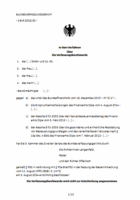
Germany vs “Steel Construction GmbH”, August 2024, Constitutional Court, Case No 2 BvR 2002/20
In 2005, Steel Construction GmbH and a Polish subsidiary agreed on a debt write-off, which Steel Construction GmbH deducted for tax purposes. However, the tax authorities issued an assessment denying the write-off as a tax-deductible expense. According to the tax authorities, independent third parties would have agreed to some form of security, and the absence of this was a violation of the arm’s length principle. “Steel Construction GmbH” brought the assessment to court, and in February 2019 the Federal Fiscal Court (I R 73/16) ruled that the tax authorities’ assessment was lawful. This decision was appealed to the Constitutional Court, where Steel Construction GmbH alleged a violation of the general principle of equality, as well as a violation of its fundamental procedural rights. Decision The Constitutional Court ruled that the complaint was inadmissible because it lacked the necessary constitutional substantiation. According to the court the complaint lacked the necessary constitutional substantiation. The complainants had not demonstrated in a coherent, constitutionally grounded way how the decision violated the principle of equality or any other fundamental right. Their arguments remained at the level of general legal disagreement with the interpretation of the Foreign Tax Act, failing to address the constitutional standards required for a successful challenge. The decision of the Federal Fiscal Court was therefore final. Click here for English translation Click here for other translation

US vs Coca Cola, August 2024, US Tax Court, Docket No. 31183-15
In TC opinion of November 18, 2020 and TC opinion of November 8, 2023, the US Tax Court agreed with the US tax authorities (IRS) that Coca-Cola’s US-based income should be increased by $9 billion in a dispute over royalties from its foreign-based licensees. The principal holding was that the Commissioner did not abuse his discretion in reallocating income to Coca-Cola using a “comparable profits method” (TNMM) that treated independent Coca-Cola bottlers as comparable parties. However, one question remained. Coca-Colas’s Brazilian subsidiary paid no actual royalties to Coca-Cola during 2007–2009. Rather, it compensated Coca-Cola for use of its intangibles by paying dividends of $886,823,232. The court held that the Brazilian subsidiary’s arm’s-length royalty obligation for 2007–2009 was actually about $1.768 billion, as determined by the IRS. But the court held that the dividends remitted in place of royalties should be deducted from that sum. This offset reduces the net transfer pricing adjustment to petitioner from the Brazilian supply point to about $882 million. Thus, the issue to be decided is whether this $882 million net transfer-pricing adjustment is barred by Brazilian law. During 2007–2009 Brazil capped the amounts of trademark royalties and technology transfer payments (collectively, royalties) that Brazilian companies could pay to foreign parent companies. Coca Cola contended that Brazilian law blocked the $882 million net transfer-pricing adjustment. IRS contended that the Brazilian legal restriction should be given no effect in determining the arm’s-length transfer price, relying on what is commonly called the “blocked income” regulation (Treas. Reg. § 1.482-1(h)(2)). According to tax authorities the “blocked income” regulation generally provides that foreign legal restrictions will be taken into account for transfer-pricing purposes only if four conditions are met, including the requirement that the restrictions must be “applicable to all similarly situated persons (both controlled and uncontrolled).” Judgment Pursuant to its previous opinions, the Court ordered and decided that there were deficiencies in income tax due from Coca-Cola for FY 2007, 2008, and 2009 in the amounts of $930,822,089; $865,202,130; and $932,972,594, respectively. An appeal has later been filed by Coca-Cola with the 11th US Circuit Court of Appeals.

Belgium – Request for preliminary ruling, July 2024, European Court of Justice, Case No C-623/22
A request for a preliminary ruling under Article 267 TFEU was made from the Constitutional Court of Belgium concerning the assessment of the validity of Article 8ab(1), (5), (6) and (7) of Council Directive 2011/16 as later amended by Directive 2018/822. The request from the Belgian Court was made in the context of a number of proceedings between, inter alia, on the one hand, the de facto association, the Belgian Association of Tax Lawyers and others (‘the BATL’), the Ordre des barreaux francophones et germanophone (French- and German-speaking Bar Association; ‘the OBFG’), the Orde van Vlaamse Balies (Association of Flemish Bars) and others (‘the OVB’) and the Instituut van de Accountants en de Belastingconsulenten (Institute of Accountants and Tax Consultants) and others (‘the ITAA’) and, on the other, Premier ministre/Eerste Minister (Prime Minister, Belgium) concerning the validity of certain provisions of the Law of 20 December 2019 transposing Directive [2018/822] (Moniteur belge of 30 December 2019, p. 119025). The request to the European Court of Justice asked five questions: ‘(1) Does [Directive 2018/822] infringe Article 6(3) [TEU] and Articles 20 and 21 of the [Charter] and, more specifically, the principles of equality and non-discrimination as guaranteed by those provisions, in that [Directive 2018/822] does not limit the reporting obligation in respect of [reportable] cross-border arrangements to corporation tax, but makes it applicable to all taxes falling within the scope of [Directive 2011/16,] which include under Belgian law not only corporation tax, but also direct taxes other than corporation tax and indirect taxes, such as registration fees? (2) Does [Directive 2018/822] infringe the principle of legality in criminal matters as guaranteed by Article 49(1) of the [Charter] and by Article 7(1) of the [European Convention for the Protection of Human Rights and Fundamental Freedoms, signed in Rome on 4 November 1950 (‘the ECHR’)], the general principle of legal certainty and the right to respect for private life as guaranteed by Article 7 of the [Charter] and by Article 8 of the [ECHR], in that the concepts of ‘arrangement’ (and therefore the concepts of ‘cross-border arrangement’, ‘marketable arrangement’ and ‘bespoke arrangement’), ‘intermediary’, ‘participant’, ‘associated enterprise’, the terms ‘cross-border’, the different ‘hallmarks’ and the ‘main benefit test’ that [Directive 2018/822] uses to determine the scope of the reporting obligation in respect of [reportable] cross-border arrangements, are not sufficiently clear and precise? (3) Does [Directive 2018/822], in particular in so far as it inserts Article 8ab(1) and (7) into [Directive 2011/16], infringe the principle of legality in criminal matters as guaranteed by Article 49(1) of the [Charter] and by Article 7(1) of the [ECHR], and infringe the right to respect for private life as guaranteed by Article 7 of the [Charter] and by Article 8 of the [ECHR], in that the starting point of the 30-day period during which the intermediary or relevant taxpayer must fulfil its reporting obligation in respect of a [reportable] cross-border arrangement is not fixed in a sufficiently clear and precise manner? (4) Does Article 1(2) of [Directive 2018/822] infringe the right to respect for private life as guaranteed by Article 7 of the [Charter] and by Article 8 of the [ECHR], in that the new Article 8ab(5) which it inserted in [Directive 2011/16], [and which] provides that, where a Member State takes the necessary measures to give intermediaries the right to a waiver from filing information on a reportable cross-border arrangement where the reporting obligation would breach legal professional privilege under the national law of that Member State, that Member State is obliged to require the intermediaries to notify, without delay, any other intermediary or, if there is no such intermediary, the relevant taxpayer, of their reporting obligations, in so far as the effect of that obligation is to oblige an intermediary bound by legal professional privilege subject to criminal sanctions under the national law of that Member State to share with another intermediary, not being his client, information which he obtains in the course of the essential activities of his profession? (5) Does [Directive 2018/822] infringe the right to respect for private life as guaranteed by Article 7 of the [Charter] and by Article 8 of the [ECHR], in that the reporting obligation in respect of [reportable] cross-border arrangements interferes with the right to respect for the private life of intermediaries and relevant taxpayers which is not reasonably justified or proportionate in the light of the objectives pursued and which is not relevant to the objective of ensuring the proper functioning of the internal market?’ Judgment of the Court The European Court of Justice upheld the validity of Council Directive 2011/16, as amended by Council Directive 2018/822, finding that no factor had been disclosed in the request that would affect the validity of the Directive and its subsequent amendment. “1. The examination of the aspect to which the first question referred relates has disclosed no factor of such a kind as to affect the validity of Council Directive 2011/16/EU of 15 February 2011 on administrative cooperation in the field of taxation and repealing Directive 77/799/EEC, as amended by Council Directive (EU) 2018/822 of 25 May 2018, in the light of the principles of equal treatment and non-discrimination, and of Articles 20 and 21 of the Charter of Fundamental Rights of the European Union. 2. The examination of the aspects to which the second and third questions referred relate has disclosed no factor of such a kind as to affect the validity of Directive 2011/16, as amended by Directive 2018/822, in the light of the principle of legal certainty, the principle of legality in criminal matters enshrined in Article 49(1) of the Charter of Fundamental Rights and the right to respect for private life guaranteed in Article 7 of that Charter. 3. The invalidity of Article 8ab(5) of Directive 2011/16, as amended by Directive 2018/822, in the light of Article 7 of the Charter of Fundamental Rights, declared by the Court in the judgment of 8 December 2022, Orde van Vlaamse Balies and Others (C-694/20, EU:C:2022:963), applies only to

Czech Republic vs BEAS SUN s.r.o., July 2024, Supreme Administrative Court, Case No 6 Afs 255/2023 – 65
The tax authorities chose the cost plus method for determining the arm’s length price for low value-added intra-group services provided between related parties (Cost+). It took the parent company’s wage costs as the basis, to which it added a mark-up of 7 %, the maximum mark-up under Guideline D-10. On that basis, they concluded that the applicant had obtained services from the parent company that were different from the price at which an unrelated person would have provided the services. An appeal was filed with the regional court where BEAS SUN s.r.o. argued that the tax authorities should have chosen the comparable uncontrolled price (CUP) method, rather than the Cost plus method, to determine the reference price. The Regional Court stated that the CUP method is not superior to the other methods resulting from Guideline D-10 and the Transfer Pricing Guidelines for Multinational Enterprises and Tax Administrations issued by the Organisation for Economic Cooperation and Development (‘the OECD Guidelines’). The CUP method is preferred only if it can be used reliably. According to the Regional Court, the superiority of the CUP method is not apparent from the case-law of the Supreme Administrative Court. The case-law merely implies an obligation to state the reasons why the CUP method cannot be applied, on the ground that there are no independent transactions which are at least in substance comparable to the transaction under examination. According to the Regional Court, the tax authorities complied with that requirement. The tax authorities duly explained that the applicant purchased services which BEAS, a.s. supplied only to it or only to its subsidiaries. The tax authorities could not identify similar external independent transactions where services were provided in a similar content, scope and quality, given the wide range of activities provided. The Regional Court therefore confirmed that the tax authorities had sufficiently justified why they applied the Cost+ method instead of the CUP method. BEAS Sun then appealed to the Supreme Administrative Court. Judgment of the Court. The Supreme Administrative Court upheld the decision of the Regional Court. Excerpt in English “[31] The comparable independent price (CUP) method is a direct method and can be applied in a case in which an independent transaction that is comparable to the controlled transaction under examination can be found. This method is the simplest in terms of applicability, but it requires a high degree of comparability of the transactions being compared, which is also its weakness. Since there is no similar independent transaction for many of the transactions between related entities, this direct method cannot always be applied and one of the indirect methods must be used (cf. the judgment of the Supreme Administrative Court of 23 January 2013, No 1 Afs 101/2012-31). [32] The ‘cost plus’ method is an indirect method. It is based on the costs incurred by the supplier in a dependent transaction for the purchase of assets or services provided to the related undertaking by an independent seller. An appropriate mark-up is then added to these costs. It is applied to low value-added service cases using a gross profit mark-up. The advantage of the Cost+ method is that it does not require as much attention to the comparability of the product or service as the CUP method. Thus, this method must analyse the differences between the controlled and independent transactions which have an impact on the amount of the mark-up in order to determine which adjustments should be made to the relevant mark-up of the independent transaction (cf. Supreme Administrative Court judgments of 23 January 2013, 1 Afs 101/2012-31, and 29 January 2020, 9 Afs 232/2018-63). [33] On the basis of this case law, the Supreme Administrative Court finds that the tax authorities and the Regional Court did not err in relying on the OECD Directive and the guidelines issued by the General Tax Directorate, specifically Guideline D-10. The legal basis for their application was precisely Section 23(7) of the Income Tax Act. This was confirmed by the case law of the Supreme Administrative Court, which predated the decision of the tax authorities. The complainant disagreed, but did not put forward any opposing argumentation that would call into question the case-law referred to above.” Click here for English Translation Click here for other translation
Bulgaria vs Yazaki Bulgaria, July 2024, Supreme Administrative Court, Case no 9194 (2294-2023)
The Administrative Court had annulled an income assessment issued by the tax authorities to Yazaki Bulgaria in FY 2014, 2015 and 2016. An appeal was filed by the tax authorities with the Supreme Administrative Court for annulment of the judgment. In the assessment, the tax authorities had accepted the comparability analysis carried out by Yazaki Bulgaria in respect of transactions relating to the manufacture of automotive products, including the calculated interquartile range of market values established on the basis of data for 25 comparable companies. According to the benchmark study the Net Cost Plus margins of the comparable companies for the three-year period were as follows: 2014 weighted average Net Cost Plus – lower quartile 2.27%, median 4.16% and upper quartile 7.02%; 2015 weighted average Net Cost plus 2015 – lower quartile 1.68%, median 4.31% and top quartile 6.80%; 2016 weighted average Net Cost plus for 2016 – lower quartile – 2.22%, median 3.95% and top quartile 7.66%; The actual Net Cost Plus margins realized by Yazaki Bulgaria for the periods were outside of the established range (-1.02% for 2014, 1.43% for 2015 and 0.46% for 2016) but by “adjusting” the cost basis, Yazaki Bulgaria’s net profit margin were within the interquartile range: 2.34% for 2014, 4.3% for 2015 and 2.56% for 2016. The tax authorities considered that there were no basis for the adjustments made by Yazaki Bulgaria to the actual net profit margins and since the actual results had been outside of the interquartile range, the profit was set to the lower quartile for each year. Judgment of the Supreme Administrative Court The Supreme administrative court allowed the appeal of the tax authorities and set aside the decision of the Administrative Court. Excerpts in English “In the present case, the audited company alleges the existence of losses from new projects during the audited periods that are specific only to the controlled transactions in the manufacture of automotive products, which were not found in the comparator companies. The impact of group-specific events on the profitability of the examined and compared businesses and the reliability of the comparability analysis is identified as a feature of TNMM in the OECD Handbook, 2010 (paragraph 2.72) and in the NRA Handbook on Transfer Pricing, Fact Sheet 10 (paragraph 6.2). These interpretative sources should be taken into account in the interpretation and application of the substantive law – Article 15 of the Tax Code and Article 46 of Regulation N-9/14.08.2006.” “According to paragraph 1.70 of the OECD Guidelines, 2010, related enterprises may incur real losses due to large initial costs, including inefficiencies or other legitimate business reasons, but under market conditions the losses would be temporary. Paragraph 1.72 states that losses such as those in the trial from unforeseen start-up labour costs can be expected for a limited period of time in order to increase profits in the long term. Such circumstances are also reflected in the transfer documentation prepared by the company, where the comparability analysis on the 2014, 2015 and 2016 automotive transactions indicates that YBE’s long-term projections are that for future periods the Renault Edison and Ford Transit projects, respectively the Renault Edison and Mercedes MFA2 projects will be more efficient and better revenue generating, but the case has not established that such results have been achieved. The valuation of the Renault Edison project in 2017 as a loss-maker and its discontinuation in 2017 is aimed at overcoming losses in accordance with paragraph 1.72 and the arm’s length principle. For the remaining projects, the case does not establish, including from the conclusion of the forensic economic expert, that the losses from the difference between the reported low productivity and the budgeted productivity during the periods at issue, resulting from higher labour costs at start-up, have been overcome in the long term in view of the life cycle effects of the products and that the profitability of the net profit indicator used, net cost plus, has been achieved in accordance with the arm’s length principle. Therefore, it cannot be assumed that the company’s elimination of the impact of labour cost losses for additional staff employed in 2014, 2015 and 2016 in connection with new production projects, when comparing the net profit indicators within the meaning of Articles 43 and 44(2) of Regulation N-9/2006, is in line with the objectives set out in Articles 4, 12 and 14 of the Regulation and with the arm’s length principle.” “Reasonably in this respect in the audit act it is accepted that the losses assumed by the audited company do not correspond to the functions, responsibilities and risks of the controlled transactions, which it has assumed according to the data in documentation for transfer pricing. According to the documentation, market and price risk is borne by the related party in the group (CSC) and not by the manufacturer. In view of the above, it is to be held that the increase in the financial results of a company for the year 2014-16 made by the revision order on the basis of section 15 of the Income-tax Act to the lower quartile of the range of market values found in comparable independent companies is lawful. In holding to the contrary, the court rendered a judgment contrary to the evidence in the case and in violation of substantive law, which should be set aside and another judgment entered dismissing the appeal in its place.” Click here for English translation Click here for other translation

France vs Howmet SAS, July 2024, Conseil d’État, Case No 474666 (ECLI:FR:CECHR:2024:474666.20240723)
Howmet, a société par actions simplifiée (SAS), is the head of a tax group in which its subsidiary, Alcoa Holding France, now Arconic Holding France (AHF), is integrated. Following an audit of the accounts of these two companies, the tax authorities corrected their taxable profits for the 2011 and 2012 financial years by disregarding the consequences of a contribution made to the Belgian company Alcoa Wheels Product Belgium (AWPB), now Alcoa Finance and Services Belgium (AFSB), of sums borrowed from the Swiss permanent establishment of a Luxembourg company belonging to the same economic group. It also reinstated the management fees paid by AHF to the group’s American parent company, Alcoa Inc., in AHF’s profits for the 2010 and 2011 financial years. In a ruling handed down on 19 November 2020, the Montreuil Administrative Court upheld Howmet’s claim for discharge of the additional corporate tax resulting from the adjustments based on abuse of rights and the corresponding surcharges, and dismissed the remainder of its claim. In a judgment of 31 March 2023 the Paris Administrative Court of Appeal, on appeal by the tax authorities set aside Articles 1 and 2 of that judgment and ordered Howmet to pay the tax, and dismissed its cross-appeal. An appeal was then filed by Howmet to annul this Judgment. Judgment The Conseil d’Etat rejected the appeal and upheld the decision of the Court of Appeal, ruling that this was an artificial arrangement whose sole purpose was to allow the deduction of interest in taxable income and thereby avoid taxation. Excerpt in English “9. In deducing from all of these circumstances the existence of an artificial arrangement whose sole purpose, by financing the Belgian company through a capital increase rather than through a loan, was to exempt AHF from having to record, as compensation for the interest deducted, income corresponding to interest from the Belgian company, thereby constituting an abuse of rights, the Court, which gave sufficient reasons for its judgment, neither erred in law nor incorrectly characterised the facts of the case. It was therefore able to deduce that the tax authorities were right to add back to the taxable profits of Howmet and AHF interest equivalent to the amounts deducted. 10. Finally, it follows from the foregoing that the Court was also able, without giving insufficient reasons for its judgment or committing an error of law, to reject the argument raised before it to the effect that the tax authorities could, without rejecting the acts described above, have made the same reassessment on the basis that the interest rate on the loans taken out was excessive, in the light of normal commercial management, in order to call into question in part the deductibility of the related interest. In addition, the applicants’ argument that, in the absence of an increase in the capital of the Belgian company AFSB, the main shareholder of the French companies had demanded the distribution of the unused cash which they had allegedly had at their disposal, and which was in any event unjustified, was in any event inoperative, as the disputed rectification stemmed from the fact that, once the acts constituting abuse of rights had been set aside, these sums had to be regarded as having directly financed the Spanish company AIESL.” Click here for English translation Click here for other translation
Italy vs Costa Crociere SpA, July 2024, Supreme Court, Case No 20228/2024
One of the issues in this case was the arm’s length nature of an agency agreement between Costa Crociere and its Brazilian subsidiary, Costa Cruzeiros Agencia Maritima e Turismo Ltda. The tax authorities had reclassified the said agency agreement between Costa Crociere and its Brazilian subsidiary as a loan. According to the tax authorities, the funds transferred under this agreement, amounting to approximately €40 million, were in fact a long-term loan and, on this basis, interest income was added to Costa Crociere’s taxable income on the basis of transfer pricing adjustments using a LIBOR interest rate adjusted for country risk. In the appeal to the Supreme Court, Costa Crociere argued that the tax authority had no right to recharacterise the transaction as a loan and, if permissible, had incorrectly calculated the interest due. Judgment The Supreme Court disagreed that the tax authorities were bound by the agreement between Costa Crociere and its Brazilian subsidiary. However, the Court agreed with Costa Crociere that the lower courts had not adequately analyzed the economic substance of the transaction, the actual risks borne by both parties, or the parent company’s own financial records. As a result, the case was sent back to the Liguria Regional Tax Commission for further review, with instructions to conduct a detailed analysis based on these legal principles. Excerpts in English “7.5. The case law of the Court, on the subject of transfer pricing, relating to non-interest-bearing financing (most recently Supreme Court of Cassation 20/05/2021, no. 13850; Supreme Court of Cassation 15/11/2017, no. 27018), holds that ‘the assessment “based on the normal value” is irrespective of the original capacity of the transaction to produce income and, therefore, of any negotiating obligation of the parties relating to the payment of the consideration (see OECD Transfer Pricing Guidelines for Multinational Enterprises and Tax Administrations, paragraph 1.2). It is, in fact, a matter of examining the economic substance of the transaction that has taken place and comparing it with similar transactions carried out, in comparable circumstances, in free market conditions between independent parties and assessing its conformity with these>>. Paragraphs 1.121 et seq. of the OECD Guidelines (in the 2017 version) envisage the possibility of disallowing or substituting the transaction between the parties, but under very strict conditions and, above all, after all the necessary steps have been taken to accurately delineate the actual transaction between the parties, which is a preliminary operation in any transfer pricing analysis; to this end, it is necessary to start from the content of the contract, examine the actual economic substance of the transaction, its commercial rationality and always with reference to the need to compare it with similar transactions between independent enterprises. Para. 1.122 provides that <>; while para. 1.123 provides that <>. 7.6. In light of these considerations, it must therefore be held, firstly, that the CTR did not make any assertion in breach of the principle of allocation of evidentiary burdens but examined the merits of the respective deductions; secondly, it must be noted that the decision of the case did not exclusively pose a problem of interpretation of the contract (as the Attorney General’s Office held, in order to support the inadmissibility of the plea); thirdly, it should be noted that the office, and therefore the CTR, was not precluded in the abstract from re-qualifying the contract (thus proving unfounded the first complaint of the first plea, which highlighted the absolute inadmissibility of a re-qualification); However, it must be held that the appeal judges erred, in disallowing and replacing the transaction between the parties, in giving relevance solely to the accounting data of the subsidiary, which had included those items in medium- and long-term debts, without actually examining in the least the content of the contract, its economic substance, the risks contractually assumed and the accounting carried out by the parent company (which carried out a careful analysis and explanation of its own accounting) and, above all, in making a comparison with similar situations. The plea should therefore be upheld in the terms set out above, and the judgment should be set aside on this point, with a reference back to the Court of Tax Appeals at second instance for it to carry out a new examination in the light of the aforementioned principles. 9. In conclusion, the third plea in the main appeal must be upheld, the first plea absorbed and the others dismissed; the first plea in the cross-appeal must also be upheld, the second dismissed and the third dismissed. The judgment should be set aside in relation to the grounds upheld, with reference back to the Court of Second Instance of Liguria, in a different composition, which will have to rule on the basis of the aforementioned principles of law, and to which the task of ruling on the costs of the proceedings of legitimacy is assigned.” Click here for English translation Click here for other translation
Peru vs “DCF S.A.”, July 2024, Tax Court, Case No 06856-1-2024 (2320-2022)
The case concerned the determination of the arm’s length value of shares transferred between related parties. The tax authorities had assessed the value using the discounted cash flow (DCF) method and issued an adjustment based on that valuation. DCF S.A. challenged the assessment before the Tax Court, arguing that the DCF method was not among the transfer pricing methods recognized under Peruvian law for the 2017 fiscal year. Judgment The Tax Court ruled in favor of DCF S.A., finding that the tax authorities had neither applied an approved method nor correctly interpreted the transfer pricing regulations applicable in 2017. Since the DCF method was not implemented in Peruvian law at the time, it could not be used to determine the arm’s length value. The Court held that the Comparable Uncontrolled Price (CUP) method should have been applied instead. Excerpt in English “It is important to note that in Request No. and in the appealed resolution (pages 943, 945/reverse and 1354/reverse), the Administration states that the most appropriate transfer pricing method for the transaction under analysis is the CUP and that the financial valuation technique used to determine the assigned value of the shares is the DCF. In this regard, in accordance with the provisions of paragraph 1 of subsection e) of Article 32-A of the Income Tax Law, the CUP method consists of ‘determining the market value of goods and services between related parties considering the price or amount of the consideration that would have been agreed with or between independent parties in comparable transactions’. Likewise, paragraph 1 of subsection a) of Article 113 of the Income Tax Law Regulations indicates that the CUP ‘is compatible with transactions involving the sale of goods for which there are prices on national or international markets and with the provision of relatively simple services.’ Furthermore, the OECD Guidelines14 in paragraph 6.157 indicate that DCF ‘consists of calculating the value of an intangible asset based on the estimated value of the cash flows that the intangible asset can generate during its expected useful life.’ It adds that ‘this value can be estimated by calculating the present value of the expected cash flows.’ It also warns that ‘according to this approach, the valuation requires, among other things, a realistic and reliable definition of financial forecasts, growth rates, discount rates, the useful lives of intangible assets, and the tax consequences of the transaction.’ That according to the Income Tax Law and the OECD Guidelines, while the CUP method seeks to determine market value by comparing prices agreed with or between third parties, the DCF technique is a valuation technique that consists of determining the present value of future cash flows, the soundness of which requires ‘realistically and reliably defining’ various elements that support the assumptions that, in turn, determine the estimated final value, which leads to the conclusion that they are not equivalent methods. From the observations made, it does not appear that the Administration correctly applied the CUP method, since it bases its objection on the observation of certain elements used in the DCF methodology, without establishing a ‘comparable transaction’ in itself, given that this DCF does not seek comparable transactions but, in order to obtain the value of the company, as outlined above, calculates the current value of its funds using an appropriate discount rate, based on the level of risk and historical volatility, among other elements. Therefore, it is understood that the method used by the Administration to determine the market value of the transaction under analysis is the DCF[15]. Therefore, contrary to the Administration’s assertion, it has not been proven that it carried out an analysis in accordance with transfer pricing regulations, as established in Article 32-A(e) of the Income Tax Law, applicable in the present case, and the objection is therefore not duly substantiated[16], it should be lifted, the contested determination resolution should be set aside, and the appealed resolution should be revoked. That, in accordance with the ruling, there is no point in issuing a ruling on the other arguments intended to challenge the determination of the objection.” Click here for English Translation Click here for other translation
Peru vs “Mineral Export SA”, July 2024, Tax Court, Case No 06796-3-2024
In 2020 “Mineral Export SA” received a tax assessment for FY 2010 after the Peruvian tax authorities (SUNAT) had made two large transfer pricing adjustments: (i) an uplift of the remuneration it had received for its business activities (export of mineral concentrates to related parties), and (ii) an uplift of the price at which it had sold a controlling shareholding to a another group company. “Mineral Export SA” appealed to the Peruvian Tax Court. Judgment The Court partially upheld the adjustment concerning remuneration of the activities carried out, but it set aside the adjustment related to the price of the shares it had sold. In determining the remuneration for the activities carried out, the tax authorities had disallowed five comparability adjustments, discarding most of the taxpayer’s comparables, and recalculated the profit margins. The Court agreed that the comparability adjustments made by “Mineral Export SA” were unsupported and that the tax authorities could restrict the sample to two comparables. But according to the Court the tax authorities had been wrong to force a conversion into local currency when calculating the margins. Because the functional currency is the US dollar and that unit best reflects economic reality, the tax authorities would have to redo the TNMM analysis in dollars and re-issue the assessment. The adjustment to the price of the shares sold by “Mineral Export SA” to a another group company was nullified. In 2010 Peruvian law allowed only the six transfer-pricing methods listed in article 32-A(e); the discounted-cash-flow technique used by the tax authorities was not among them until 2017. Other methods was first formally embraced by Peru in 2017, and for prior years the tax authorities could therefore not impose valuations derived from a discounted-cash-flow method. Click here for English Translation Click here for other translation

Switzerland vs “A-Sub AG”, Juli 2024 , Federal Supreme Court, Case No 9C_690/2022
In 2013 B AG granted a credit limit of up to CHF 1,000,000,000 to its subsidiary “A-Sub AG”, which was subject to limited tax liability due to its permanent establishments in the Canton of Zurich. Based on the loan agreement, the two companies agreed on an unsecured loan of CHF 500,000,000 with a fixed term of 61 months and an overdraft facility with a credit limit of CHF 1,000,000,000 less the fixed loan amount. The interest rate for the loan was set at 2.5% p.a. and for the current account 3% p.a. In 2019, the Tax Office set the market interest rate for both the loan and the current account at 1.08 % (equal to B AG’s actual borrowing costs of 0.83% + a margin of 0,25%) with regard to the taxable net profit of A-Sub AG for FY 2014 and 2015. The difference was considered a hidden distribution to A-Sub AG. A-Sub AG lodged an appeal against the assessment, which the Tax Appeals Court dismissed in 2021. In a ruling in 2022, the Administrative Court partially upheld the appeal lodged by A-Sub AG against the decision of the Tax Appeal Court. It only consider the difference between the agreed interest rates (2.5 % and 3 %) and the maximum safe harbour interest rates for property loans of 2 % for 2014 and 1.5 % for 2015 to be at issue. Accordingly, it referred the matter back to the Tax Appeal Court for a new decision in line with the considerations, ordering that the additional tax be set in the amount of CHF 600,195 for 2014 and CHF 556,674 for 2015 should be taken into account. The Tax Office filed an appeal with the Federal Court requesting that the ruling of the Administrative Court be set aside and the decision of the Tax Appeal Court upheld. Judgment The Federal Court ruled mostly in favour of of the tax office. According to Swiss case law, the tax authority must in principle adhere to the “safe harbour” interest rates set out in the FTA circulars. However, this only applies as long as the taxable person himself adheres to them and does not use interest rates that are higher than the maximum interest rates. If the taxable person deviates from the safe harbour rates and is unable to prove that the agreed interest rate is at arm’s length, there is no apparent reason why the tax authority should continue to be bound by this and not be allowed to provide proof of conformity with the arm’s length principle and set an interest rate accordingly. Excerpt “7.2.1. The interest rate agreed between the debtor and B.________AG was 2.5 % for the loan and 3 % for the current account. The considerations of the lower court show that, in addition to a reference interest rate of 0.75 %, the loan interest rate includes a credit commission of 0.25 % for the settlement of “transactional and technical tasks” and an “individual market risk premium” of 150 basis points. The lower court came to the conclusion that it had not been possible to prove that the risk premium and the credit commission were in line with the market. With regard to the risk premium, it considered that the liable party had not disproved that it had an – at least de facto – state guarantee. The tax office, on the other hand, assumes a relevant interest rate of 1.08 %, whereby 0.83 % was taken into account as a component for the refinancing of B._______ AG by means of a bond and 0.25 % as an additional “margin”. 7.2.2. In this context, it is undisputed that B._______ AG had to bear actual average borrowing costs of 0.83 % in 2014 and 2015. The tax office added an additional 0.25 % to these borrowing costs as a “margin” based on the category “Advances to participants or related third parties” of the FTA circular. The lower court has not yet commented on the question of the “margin” – in view of the legal opinion it represents. It will have to make up for this in the second instance, whereby it should be pointed out that the issue at hand is not “advances to parties or related third parties”, but rather the determination of what interest rate would be customary in the market from the borrower’s perspective. 7.3. In summary, the appeal – insofar as it is upheld – must be partially upheld and the contested judgment of 25 May 2022 must be set aside.” Click here for English translation Click here for other translation
Luxembourg vs “A IGF s.a.r.l.”, July 2024, Administrative Tribunal, Case No 46975 (ECLI:LU:TADM:2024:46975)
The factual circumstances of the case revolve around a dispute between “A IGF s.a.r.l.”, a Luxembourg entity, and the tax authorities regarding the existence and recognition of a permanent establishment (PE) in the United States. “A IGF s.a.r.l.” contended that it had a fixed place of business in the USA, which qualified as a PE under Article 5 of the tax convention between Luxembourg and the USA. This recognition would affect the taxation of certain financial activities, potentially allowing for adjustments to taxable income in Luxembourg. The tax authorities disagreed. Judgment The court analyzed whether the activities carried out by “A IGF s.a.r.l.”’s “USA branch” met the criteria for a PE, which requires not only a fixed place of business but also real and effective activity. Despite providing evidence of a physical location and certain management activities, the court found that the proof of genuine and substantial activity through the branch was lacking. Thus, the court sided with the tax authorities, concluding that “A IGF s.a.r.l.” had not demonstrated that it met the criteria for recognizing a PE in the USA. Furthermore, the court found that no formal advance ruling or consistent assurances had been given that would bind the tax authorities to a particular interpretation. Ultimately, the court upheld the Director’s decision, rejecting the claim and maintaining the tax assessments for the disputed years. Click here for English translation Click here for other translation
Italy vs Convergys Italy S.R.L, July 2024, Supreme Court, Case No 19512/2024
Convergys Italy Srl had provided call centre services to a related Dutch company for which it received a 5% mark-up on costs. Following an audit, the tax authorities found that the benchmark study on which the 5% was based included loss-making companies. After removing the loss-making companies, the median mark-up of the benchmark study was 7.42%. A tax assessment was issued adding the additional income to the taxable income. Convergys Italy Srl appealed, but the Provincial Tax Commission and the Regional Tax Commission later ruled in favour of the tax authorities. An appeal was then lodged with the Supreme Court. Judgment of the Court The Supreme Court ruled in favour of Convergys Italy Srl, stating that loss-making companies should only be excluded from the benchmark study if the losses are due to exceptional – not comparable – circumstances. Excerpt in English “…The company then proceeded to determine the mark-up applied to call-center services through the preparation of two transfer pricing studies, namely the Foundation Report, prepared at group level prior to the notice of the tax audit, and the National Transfer Pricing Documentation, prepared pursuant to Art. 26 of Decree-Law No. 78 of 31 May 2010, converted by Law No. 122 of 30 July 2010, as well as the Provision of the Director of the Revenue Agency of 29 September 2010; the latter documentation includes the benchmark analysis made by the company using the AIDA database, which collects data only from domestic companies. On the basis of these results, it can be inferred that the 5% value applied by the taxpayer company is positioned within the arm’s length range, being in the upper part of that range. Instead, the Office applied a higher normal value (7.42%), using different criteria, and in particular eliminating from the price analysis, for each tax year concerned, a number of companies with no accounting data or with negative operating results in at least two out of three tax years. The contested judgment found this methodology to be correct, and it must nevertheless be observed that such further criteria do not appear to be consistent with the OECD Guidelines and do not find any justification for the purpose of selecting (as envisaged by the aforementioned Guidelines) a sample of companies comparable to Stream Italy, since it is not possible to exclude in advance certain potentially comparable companies merely because they have recorded reduced and/or negative results in some years. In fact, it is normal that in a market of free competition there are also loss-making companies, or in any case companies lacking certain accounting data. In fact, the OECD guidelines themselves, in paragraph 1.59 et seq. admit that one of the factors determining comparability are company strategies, and therefore provide for the inclusion in the benchmark analysis of those companies that, in order to penetrate a given market or to increase their share in the same market, set a price for their products that is lower than the price charged on the market for comparable products, or temporarily incur higher costs and therefore make lower profits than other taxpayers operating in the same market. The OECD Guidelines do not provide for the elimination tout court of loss-making companies or companies with low or no book values, if these results are achieved in order to obtain better results in future years; according to para. 3.43, certain companies may be excluded when they are in ‘special situations’, such as start-ups, bankrupt companies, etc., if it is clear that these special situations do not represent appropriate comparisons. It was precisely this analysis that was completely omitted by the C.T.R., which apodictically considered the Office’s criterion to be valid, without making any assessment of the situation of the companies excluded from the comparison. Moreover, the appellant had pointed out that the Office, in the process of forming the sample of companies for the benchmark analysis, had included companies that for size and/or activity carried out could not have been comparable with Stream Italy s.r.l., and on this point the C.T.R. did not make any factual analysis. With specific reference, then, to the costs relating to the management services “Executive”, “Facilities” and “IT”, provided by the parent company Stream Europe, it should be noted that the costs incurred by a company for the purchase of services, on the basis of a contract entered into with other entities belonging to the same group, satisfy the conditions set forth in Article. 109 of Presidential Decree No. 917/1986 (inherence, objective determinability, certainty and effectiveness), which allow their deduction, if the group company documents the contracts in which the services received are provided for and regulated. In the present case, the appellant produced, at first instance, a contract for intra-group services, detailing the types of services that Stream Europe provided to Stream Italy s.r.l. and illustrating the manner in which those services were remunerated. Consequently, the C.T.R. should have analysed this contract in order to verify whether or not the conditions for the deduction of such costs were actually met.” Click here for English translation Click here for other translation
Netherlands vs “Agri B.V.”, July 2024, Court of Appeal, Case No 22/2419 (ECLI:NL:GHAMS:2024:1928)
“Agri B.V.” is a Dutch subsidiary of an international group active in the processing of agricultural products. Following a restructuring in 2009, Agri B.V. had declared taxable profits of €35 million, including €2 million in exit profits. This amount was adjusted to more than €350 million. According to the tax authority an ongoing business had effectively been transfered to a Swiss affiliated company as a result of the restructuring of the group, and profits from the transfer had not been declared by “Agri B.V.” for tax purposes. “Agri B.V.” then filed an appeal and in 2022, the District Court ruled largely in favour of the tax authorities. But the Court significantly reduced the value on the basis of an expert valuation report. An appeal was then filed with the Court of Appeal. Judgment The Court of Appeal largely upheld the judgment of the District Court. The Court ruled that the tax authority had made it plausible that something of additional value had been transferred to the Swiss affiliated company for which they had wrongly not stipulated any remuneration that the inspector (also in view of the minimum value calculated by an expert of what was transferred in total) was right for that reason to make a transfer price adjustment, and that he had also made it plausible that the interested party had not filed the required return as referred to in Section 27e AWR, so that the burden of proof should be reversed and increased. Click here for English translation Click here for other translation

India vs Samsung India Electronics Pvt. Ltd., July 2024, High Court of Delhi, Case No ITA 40/2018
Samsung India, a subsidiary of Samsung Korea, manufactures and sells mobile phones in India and overseas. Under a technology licence agreement Samsung India paid royalties of 8% to Samsung Korea. Following an audit, the tax authorities determined that Samsung India was a contract manufacturer and therefore the payment of royalties on its sales to group companies was not considered to be at arm’s length. Deductions for the royalty payments were disallowed and an assessment of additional taxable income was issued. Samsung India appealed to the Income Tax Appellate Tribunal, which overturned the assessment, finding that the royalty payments were at arm’s length as Samsung India was not acting as a contract manufacturer but rather as a full-fledged licensed manufacturer. The tax authorities then appealed to the High Court. Judgment The Delhi High Court upheld the ITAT’s decision and ruled in favour of Samsung India. The court found that the royalty payments were at arm’s length as the subsidiary was acting as a full-fledged licensed manufacturer rather than a contract manufacturer. It undertook the manufacturing activities on its own. Samsung Korea did not determine the volume of production or the terms of sale, and no assurances were given to Samsung India that its production would be purchased.

Poland vs D. Sp. z oo, July 2024, Supreme Administrative Court, Case No II FSK 1228/22
D. Sp. z oo had deducted interest expenses on intra-group loans and expenses related to intra-group services in its taxable income for FY 2015. The loans and services had been provided by a related party in Delaware, USA. Following a inspection, the tax authority issued an assessment where deductions for these costs had been denied resulting in additional taxable income. In regards to the interest expenses the authority held that the circumstances of the transactions indicated that they were made primarily in order to achieve a tax advantage contrary to the object and purpose of the Tax Act (reduction of the tax base by creating a tax cost in the form of interest on loans to finance the purchase of own assets), and the modus operandi of the participating entities was artificial, since under normal trading conditions economic operators, guided primarily by economic objectives and business risk assessment, do not provide financing (by loans or bonds) for the acquisition of their own assets, especially shares in subsidiaries, if these assets generate revenue for them. In regards to support services (management fee) these had been classified by the group as low value-added services. It appeared from the documentation, that services concerned a very large number of areas and events that occurred in the operations of the foreign company and the entire group of related entities. The US company aggregated these expenses and then, according to a key, allocated the costs to – among others – Sp. z o.o. The Polish subsidiary had no influence on the amount of costs allocated or on the verification of such costs. Hence, according to the authorities, requirements for tax deduction of these costs were not met. An appeal was filed by D. Sp. z oo with the Administrative Court requesting that the tax assessment be annulled in its entirety and that the case be remitted for re-examination or that the proceedings in the case be discontinued. The Administrative Court dismissed the complaint of D. Sp. z oo and upheld the assessment issued by the tax authorities. An appeal was then filed with the Supreme Administrative Court where the decision of the Administrative Court and the tax assessment were set aside. Click here for English Translation

Ukrain vs Dniproazot, July 2024, Supreme Administrative Court, Case № 160/3387/22
Following an audit, the tax authority determined that prices for controlled transactions had been below the arm’s length price and issued an assessment of additional taxable income. According to the tax authority, the correct application of the arm’s length principle in this case required the price of the controlled transaction to be compared with the prices (price range) of comparable uncontrolled transactions on the basis of the information available on the date closest to the date of the controlled transaction – and not on the date where the controlled contract had been concluded. An appeal was filed by Dniproazot with the Administrative Court of Appeal, which was later dismissed. An appeal was then filed with the Supreme Court. Judgment The Supreme Court upheld the decision of the Administrative Court of Appeal. The Court agreed with the conclusions of the tax authority that the information regarding commodity exchanges could not be applied, since the exchange is used for transactions with derivative financial instruments, rather than agreements for the supply of real goods. The Court altso supported the tax authority’s position that the arm’s length price should be determined at the date of the controlled transaction (the date of the transfer of ownership of the goods) and not at the date of the conclusion of the controlled contract. Click here for English translation Click here for other translation
Chile vs CINTAC Chile S.A., July 2024, Court of Appeal, Case N° Rol: 379-2023
CINTAC Chile S.A. had reported an operating loss for FY2018, but later received an assessment of additional taxable income from the tax authorities. In the assessment, a royalty rate of 2% determined by CINTAC Chile for the provision of know-how to a related party was instead set at 5% by the tax authorities. The royalty in question was received by CINTAC Chile S.A. from a related party under a know-how agreement. CINTAC Chile S.A. appealed, arguing that the tax authorities had not explained how they had determined the 5% royalty rate or why they had rejected the 2% rate determined by the parties to the transaction, and that the tax authorities had confused the provision of services with a know-how contract. Judgment of the Court of Appeal The court rejected CINTAC Chile S.A.’s claim regarding the arm’s length royalty rate under the know-how contract. “10°) That the sentence in its twenty-sixth to thirty-ninth recitals analyses this Item 1, examining in particular the know-how contract with TUPEMESA (Peru) accompanied by the claimant, which shows that 2% of the annual net sales were agreed; and also the transfer pricing report carried out by Hill Consultores Ltda, which used information from 10 comparable contracts selected with qualitative and quantitative filters, i.e., type of industry and markets in which it is developed, object of the contract, royalty calculation basis, functions, assets and risks, concluding that some of them (5) did not meet the sufficient conditions of independence and comparability, with the Service correctly establishing a new market rate, according to the mathematical calculation that has not been objected to. 11°) That, in particular, regarding the associated cost structure, which given its non-existence would imply the lower percentage of 2% and which would make the most important difference, the truth is that the taxpayer does not explain how it would have accredited this aspect to be considered, especially because the accompanying contract -and its addendum- clearly state in clause one, point 1.3 that ‘[…] the LICENSEE has implemented the contract with the LICENSEE and the LICENSEE, in the first clause, point 1.2. the LICENSEE has successfully implemented various manufacturing processes for the production of cold-rolled, hot-rolled and galvanised pipes, as well as different types of profiles used in the most varied sectors of the economy […] that the LICENSEE is interested in using and applying in its production process in order to obtain greater efficiency and quality in its products. In the second stipulation, point 3.1 that ‘[t]he LICENSEE undertakes to provide the LICENSEE with the KNOW HOW and all information on the above mentioned processes and to communicate to the LICENSEE its experiences, as well as the methods it applies, including manufacturing secrets’. It is specified in points 3.2, 3.3, 3.4 and 3.5 that these obligations of the licensor include the delivery of manuals, catalogues and internal standards, timely communication of all complementary information, supervising the correct application and use of know-how until the manufacturing processes are implemented, instructing and training the licensee’s workers in its own facilities or from its offices, which is carried out by employees or other natural persons for up to 183 days in a period of twelve months. 12°) That from this description it follows that it is not only a question of the delivery of manuals or documents relating to the processes, but that, in effect, there is a direct supervision and through specialised personnel at the place of manufacture, with which the claimant’s thesis that minimises the execution of this contract must be refuted. Therefore, the appeal lodged by the complainant must be dismissed. Click here for English translation Click here for other translation
Germany vs “Consulting GmbH”, July 2024, Bundesfinanzhof, Case No I R 4/21
“Consulting GmbH” sold consulting services in Russia and Romania, where it also had fixed places of business. The income from these permanent establishments was declared as exempt under the double tax treaties with Russia and Romania. The tax authority, did not grant the tax relief under the exemption method. It found that German activity reservations applied to the income, due to the involvement of a person with unlimited tax liability in Germany in the activities of the PE’s. An appeal was filed with the Administrative Court, which later ruled in favour of the tax authorities. Judgment The Supreme Administrative Court confirmed the decision of the Administrative Court and upheld the decision of the tax authorities. Click here for English translation Click here for other translation
Mauritius vs Avago Technologies Trading Ltd, July 2024, Assessment Review Committee, Case No ARC/IT/602/15 ARC/IT/145-16 ARC/IT/265-17
Avago Technologies Trading Ltd is active in the semiconductor industry and licenses intellectual property under a licence agreement with GEN IP, a related party in Singapore. This agreement allows Avago to sublicense the manufacture of Avago products to both related and unrelated parties. The issue was whether the royalty payments made by Avago to GEN IP were at arm’s length. The tax authorities determined that the payments were not at arm’s length and issued an assessment of additional taxable income. In order to determine the arm’s length royalty payments, the tax authorities disregarded the TNMM method used by Avago and instead used the CUP method. Avago filed an appeal with the Assessment Review Committee. Decision. The Assessment Review Committee upheld the tax assessment and dismissed Avago’s complaint. Click here for other translation
Israel vs Sandisk Israel Ltd (Western Digital Israel Ltd), June 2024, Tel Aviv District Court, Case No AM 49933-03-20 etc
In 2014, Sandisk Israel Ltd sold its intangible assets to Sandisk US for 35 million US dollars. “Sale by SDIL to SDUS of all intellectual property (IP) related to Error Correction Code Technology (hereinafter ‘ECC Technology’), including any associated trademarks and the related know how and patents in the ECC Technology … that was developed prior to December 31, 2007.” An audit was conducted by the tax authorities. This resulted in a valuation of 136 million US dollars and an assessment of additional taxable income for the difference. Sandisk Israel then appealed to the District Court. Judgment The court set the value at $62 million. Click her for English translation

Canada vs Dow Chemicals, June 2024, Supreme Court, Case No. 2024 SCC 23
In 2022 the Federal Court of Canada ruled in favour of the Revenue Agency and dismissed Dow Chemicals’ appeal regarding the Tax Court’s jurisdiction to make a downward adjustment. The Federal Court held that the Tax Court could not overturn the Revenue Agency’s (Minister’s) opinion that a requested downward adjustment was inappropriate because the Tax Court’s jurisdiction is only to set aside, vary or remit an assessment to the Minister, whereas an opinion is not an assessment. According to the Federal Court, the jurisdiction to judicially review an opinion lies with the Federal Court. Following the Federal Court’s decision, Dow Chemicals filed an application for leave to appeal to the Supreme Court. In a judgment of 23 February 2023, the application for leave to appeal was granted and the question of the Tax Court’s jurisdiction would therefore be considered by the Supreme Court. Judgment of the Supreme Court The Supreme Court dismissed the appeal of Dow and confirmed that a taxpayer’s challenge to a discretionary decision of the Minister of National Revenue should be brought before the Federal Court, as the Tax Court does not have jurisdiction to review the Minister’s discretionary decision. “when the Minister has exercised her discretion under section 247(10) of the ITA to deny a taxpayer’s request for a downward pricing adjustment, that decision falls outside of the jurisdiction of the Tax Court in respect of an appeal of the taxpayer’s assessment. The Minister’s discretionary decision is not part of the assessment. The meaning of “assessment” is settled in law, and the Minister’s opinion formed under section 247(10) is qualitatively distinct from that concept. As there is no express right of appeal to the Tax Court, the proper forum to challenge the Minister’s discretionary decision under section 247(10) is the Federal Court, pursuant to its exclusive jurisdiction in judicial review under section 18(1) of the Federal Courts Act. Only the Federal Court has the jurisdiction to apply the appropriate standard of review and access to the appropriate range of administrative law remedies.” Click here for translation
France vs SA Engie, June 2024, CAA Paris, Case No 21PA01277
SA Engie, the holding company of an international group formed from the merger of the Gaz de France and Suez groups and carrying on an active operational activity in the field of energy sales to private and business customers, had, until 2018, a division dedicated to the management of liquefied natural gas (LNG), incorporating SA Engie then called GDF Suez and its American (GDF Suez Gas North America LLC, known as GSGNA) and its Luxembourg subsidiary (GDF Suez LNG Supply SA, known as GSLS), whose business consisted of purchasing, transporting by means of LNG carriers and selling volumes of this resource, based on long-term supply contracts and medium- and long-term sales contracts held by each of the group’s three entities. In addition, in order to manage unforeseen and unpredictable events at the time of deliveries and to dispose of residual volumes, a ‘single voice’ arrangement had been formalised by three intra-group contracts or ‘service agreements’, including a ‘scheduling’ service contract, relating to the organisation and monitoring of LNG loading, unloading and transport, a ‘shipping’ service contract, relating to the organisation and monitoring of the maintenance, repair and compliance of the fleet of LNG carriers, and a ‘cargo purchase and sale’ service contract relating to the purchase or sale transactions carried out on the spot market by SA Engie as sole intermediary for its subsidiaries. The tax authorities found that SA Engie had not been remunerated at arm’s length for services relating to spot purchases and sales of liquefied natural gas (LNG) performed for the benefit of its subsidiaries and issued an assessment of additional taxable income for the years 2011 – 2014. SA Engie lodged two appeals with the Administrative Court, which resulted in the partial annulment of the assessment. An appeal was then lodged with the Administrative Court of Appeal to overturn the reminder of the assessment. Judgment The Administrative Court of Appeal ruled in favour of SA Engie and annulled the assessment notice. Excerpts in English “13. As a result, SA Engie is entitled to maintain that the tax authorities have not provided the proof it is required to provide of a transfer of profits to the American and Luxembourg subsidiaries in question, within the meaning of the aforementioned Article 57 of the General Tax Code, resulting from the absence of valuation of the asset represented by the existence of a standardised framework agreement (‘MSPA’), concluded by GDF Suez with a view to carrying out transactions on the spot market with a large number of producers or customers, whereas, moreover, the administration, which did not determine the share of the profit that it considered should accrue to GDF Suez directly as a function of the profit derived from the purchase or sale transactions carried out on the spot market, did not make any comparison between the share of the profit thus likely to be attributed, in particular by way of commission, to an independent intermediary, and the share resulting from the application of the margin on costs of 10% attributed to GDF Suez.” “16. In these circumstances, the administration does not demonstrate, as it is required to do in order to establish the existence of an indirect transfer of profits, that SA Engie carried on an activity on the spot market, on behalf of its subsidiaries, that is fundamentally distinct from the activity that an arm’s length broker would carry on there. It follows that it was not entitled to apply the provisions of Article 57 of the General Tax Code to rectify the prices at which SA Engie provided the services at issue to its subsidiaries. Consequently, SA Engie is entitled to request that its tax bases for corporation tax and the additional contributions to that tax, as well as the tax bases for the business value added contribution and the additional tax on that contribution, in respect of the financial years ending in 2011, 2012, 2013 and 2014, be reduced by the respective sums of EUR 8,702,050, EUR 52,122,432, EUR 44,078,541 and EUR 19,863,924, disregarding, in respect of the 2014 financial year, the increase in the loss carried forward and the reduction in the business value added tax referred to in paragraph 4 of this judgment. As a result, the withholding tax payable by SA Engie in respect of the profits deemed to have been distributed to the American company GSGNA should also be discharged on the basis of the combined provisions of Articles 119 bis 2 and 187 of the French General Tax Code and the Franco-American tax treaty, in the respective amounts of EUR 1 051 181 in respect of 2012, EUR 593 410 in respect of 2013 and EUR 502 422 in respect of 2014, and the corresponding penalties should also be discharged.” Click here for English translation Click here for other translation
![Australia vs PepsiCo, Inc., June 2024, Full Federal Court, Case No [2024] FCAFC 86](https://tpguidelines.com/wp-content/uploads/Australia-vs-PepsiCo-Full-Federal-Court-June-2024-Case-No-2024-FCAFC-86-pdf-image-141x200.jpg)
Australia vs PepsiCo, Inc., June 2024, Full Federal Court, Case No [2024] FCAFC 86
At issue was the “royalty-free” use of intangible assets under an agreement whereby PepsiCo’s Singapore affiliate sold concentrate to Schweppes Australia, which then bottled and sold PepsiCo soft drinks for the Australian market. As no royalties were paid under the agreement, no withholding tax was paid in Australia. The Australian Taxation Office (ATO) determined that the payments for “concentrate” from Schweppes to PepsiCo had been misclassified and were in part royalty for the use of PepsiCo’s intangibles (trademarks, branding etc.), and an assessment was issued for FY2018 and FY2019 where withholding tax was determined on that basis. The assessment was issued under the Australian diverted profits tax provisions. The assessment was appealed to the Federal Court, which in November 2023 found in favour of the tax authorities. PepsiCo then appealed to the Full Federal Court. Judgment In a split decision, the Full Federal Court overturned the decision of the Federal Court and found in favour of PepsiCo. Excerpts “In summary, we conclude that the payments made by the Bottler to the Seller were for concentrate alone and did not include any component which was a royalty for the use of PepsiCo/SVC’s intellectual property. The payments were in no part made in ‘consideration for’ the use of that intellectual property and they did not therefore include a ‘royalty’ within the definition of that term in s 6(1) of the ITAA 1936. Further, the payments were received by the Seller on its own account and they cannot be said to have been paid to PepsiCo/SVC. The Commissioner’s attempts to bring PepsiCo/SVC to tax under s 128B(2B) therefore fails for two interrelated reasons: there was no ‘royalty’ as required by s 128B(2B)(b) and the payments made to the Seller by the Bottler cannot constitute ‘income derived’ by PepsiCo/SVC within the meaning of s 128(2B)(a).” “PepsiCo/SVC’s appeals in the royalty withholding tax proceedings should be allowed, the orders made by the trial judge set aside and in lieu thereof there should be orders setting aside the notices of assessment for royalty withholding tax. The Commissioner’s appeals in the Part IVA proceedings should be dismissed. PepsiCo/SVC should have their costs in both sets of appeals as taxed, assessed or otherwise agreed. The parties should bring in a minute of order giving effect to these conclusions within 14 days.” Click here for translation
Norway vs PRA Group Europe AS, June 2024, Supreme Court, Case No HR-2024-1168-A
PRA Group Europe AS was financed with a loan from the parent company in Luxembourg, but only received a deduction for part of the interest expenses. The tax authorities applied the interest limitation rule for intra-group loans in the Norwegian Tax Act, as it read in 2015. The company argued that the rule could not be applied because it was contrary to the freedom of establishment in the EEA, i.e. Norwegian groups could avoid the limitation by receiving group contributions, which companies in foreign groups could not. The case was submitted to the EFTA Court, which in a judgment issued in June 2022 interpreted the EEA Agreement in accordance with the company’s view. The State challenged the EFTA Court’s view before the Norwegian Supreme Court. Judgment In its judgment the Supreme Court follows the EFTA Court and rules in favour of PRA Group Europe AS. The Supreme Court agrees with the EFTA Court that the Norwegian interest limitation rule in combination with the group contribution rules constitutes a special restriction on the freedom of establishment in the EEA. The Supreme Court also follows the EFTA Court in its assessment of the proportionality of the restriction, given the weight of the EFTA Court’s opinions. The consideration of securing Norwegian tax authority and preventing tax evasion cannot justify maintaining the rule without the company being given the opportunity to prove that the loan transaction was commercially motivated. Click here for English translation. Click here for other translation

Czech Republic vs ESAB CZ, s. r. o., June 2024, Supreme Administrative Court, Case No 1 Afs 80/2023 – 64
Following an audit, the tax authorities concluded that ESAB CZ, a Czech contract manufacturer, had improperly excluded certain costs from the cost base used to calculate its profit margin on controlled transactions. By adjusting the cost base, ESAB CZ had effectively reduced its tax base. As a result, the tax authorities issued an assessment where they had increased the taxable income for the company. ESAB CZ appealed, arguing that the cost in question – an accounting write-off of the valuation difference in the annual amount of CZK 68 455 846 – should not be included in the cost base when calculating its arm’s length margin (TNMM, ROTC). The Regional Court dismissed the appeal and the case ultimately ended up in the Supreme Administrative Court. Judgment of the Court. The Supreme Administrative Court upheld the decision of the Regional Court and dismissed the appeal. Excerpt in English “[47] The complainant has never disputed that the assets to which the valuation difference relates are not related to contract manufacturing or that the valuation difference is related to any of its other activities. The complainant argued that the valuation difference (as an item resulting from the conversion) was not related to contract manufacturing within the meaning of transfer pricing terminology, since the amortisation of the valuation difference was not, from the perspective of manufacturing, an operating expense that should be included in the cost base under the OECD Guidelines. [48] However, the transaction in question and the related adjustments to the tax base cannot be viewed from a purely accounting perspective, but rather from a transfer pricing perspective. Transactions between related parties must be examined in terms of the functional and risk profile, the relationship of costs and benefits to the controlled transactions between related parties. Thus, the costs in the form of the amortisation of the valuation difference should have entered into the calculation of the complainant’s profitability as they affect transfer prices, because of their relationship to the assets related to the complainant’s production activities. [49] For the sake of clarity, the SAC summarises that, in the present case, the depreciation of the valuation difference related to assets whose transfer resulted from the Project and was the essence of the division by spin-off (a part of the assets related to the production activity was split off, while a part of the assets related to the business activity was retained in the company being divided). This resulted in a valuation difference of approximately CZK 1 billion on the acquired assets. It corresponded to the difference between the expert valuation of the assets transferred to the complainant and the sum of the values of the individual assets and liabilities in ESAB VAMBERK’s accounts. The resulting difference in the revaluation of the assets and the subsequent depreciation of the revaluation of those assets could not have been influenced by the complainant. Through the Manufacturing Agreement, the complainant was assured a profit determined on the basis of the Benchmarking Analysis and the resulting market spread. The Complainant’s business was primarily group-driven (99 % of its production was directed to related parties and 93 % of the Complainant’s production was directed to the group). The consequences of decisions taken by another company in the group cannot be passed on to the complainant, thereby reducing its profits by those items excluded from the cost base. The Regional Court’s conclusion that the costs in the form of depreciation on the difference in the revaluation of assets should be included in the calculation of the complainant’s profitability is therefore entirely correct, since the main reason is precisely the relationship of that depreciation to the assets relating to the operating and production activities of the complainant which were transferred to it. [50] It is apparent from the administrative file that the complainant had no control over its position as a manufacturer or over the fact that this activity would be its only source of profit. The view of the tax authorities, with which the Regional Court agreed, that the consequences of decisions taken by another company in the group could not be passed on to the complainant, thereby reducing its profits by those items excluded from the cost base, is therefore entirely unsound. [51] The SAC, like the Regional Court, is convinced that the amortisation of the valuation difference should have been included in the cost base for calculating the contractual mark-up in accordance with point 2.83 of the OECD Guidelines. The complainant’s objection that the tax authorities should have followed point 2.84 of that Directive cannot be accepted. The cost in question relates to a dependent transaction. Neither the tax authorities nor the Regional Court erred in examining the amortisation of the valuation difference in direct relation to the controlled transaction. The items at issue relating to the amortisation of the valuation difference are operational in nature (similar to accounting depreciation) and relate to contract manufacturing. Therefore, in accordance with the arm’s length principle, they should have been included in the cost base in the calculation of the profit margin under the TNMM. In the present case, neither the depreciation should have been excluded from the operating result nor from the cost base for calculating the contractual mark-up; on the contrary, the relevant mark-up should have been due to the complainant. This is because the profit generated by the complainant from the production activity under assessment was significantly affected by this cost accounting item (the amortisation of the valuation difference).” Click here for English Translation Click here for other translation
Malaysia vs Keysight Technologies Malaysia, June 2024, Court of Appeal, Case No W-01(A)-272-05/2021
The Revenue raised an additional assessment on gain received from the transfer of technical know-how by Keysight Technologies to Agilent Technologies International for the amount of RM821,615,000.00 being income under section 4(f) of the Income Tax Act 1967 (ITA 1967) together with the penalty under section 113(2) ITA 1967. The Revenue contended that subsection 91(3) of the ITA 1967 provided that the Revenue may issue an assessment after the expiration of the time period of 5 years on grounds of fraud or willful default or negligence. The findings of negligence on the part of Keysight Technologies include failure to support the claim that the gain from the transfer of technical knowhow (i.e. the marketing and manufacturing intangibles) by Keysight Technologies to Agilent Technologies International was an outright sale and failure to furnish the document and information as requested by the Revenue in the audit letter on the valuation of the marketing and manufacturing intangibles. The Revenue found that there was no proof of outright sale of the technical know-how as the Intellectual Property (IP) Agreement and Manufacturing Services (MS) Agreement showed no evidence that the legal rights had been transferred to ATIS since the agreements merely stated of the transfer of beneficial rights. Further, facts have shown that the technical know-how was still used by Keysight Technologies in a similar manner prior to and post the IP Agreement and MS Agreement. Instead, the gain of RM821,615,000.00 million was proven to represent the future income that would have been received by Keysight Technologies for the years 2008-2015 should Keysight Technologies continue to carry out its function as a full-fledged manufacturing company of which the function had subsequently changed to being a contract manufacturing company due to the group’s global restructuring exercise. As such, the gain was taxed as other income under section 4(f) ITA 1967. Keysight Technologies argued that the Revenue was time-barred under section 91(1) ITA 1967 from issuing the Notice of Additional Assessment for YA 2008. Keysight Technologies also argued that the sale of marketing and manufacturing intangibles by Keysight Technologies to Agilent Technologies International was capital in nature and therefore should not subject to tax under section 4(f) ITA 1967. The “badges of trade test” would be applicable in determining whether the income was revenue or capital in nature. Judgment The Court of Appeal overturned the SCIT and the High Court dicisions and allowed Keysight Technologies’ appeal. The Court of Appeal affirmed the application of the “badges of trade” test as argued by Keysight Technologies in determining whether the income was capital or revenue in nature and the test was not confined to disposal of land. The “Badges of Trade test” considers several factors; Subject matter of the transaction, Period of ownership, Frequency of transactions, Alteration of property to render it more saleable, Methods employed in disposing of property, Circumstances responsible for sale. The Court of Appeal held that Keysight Technologies was not in the business of buy and sell of IP and the IP was not its stock in trade. No special effort had been made by Keysight Technologies to attract purchasers. The transfer of technical know-how was due to global restructuring of the group of the company. The Court of Appeal further held that there had been an actual sale by way of agreement. The title to technical know-how was not registrable due to protection of confidential information. The outright sale test thus was not a proper test and the valuation report as requested by the Revenue was irrelevant. There was no failure on the part of Keysight Technologies to adduce valuation report as it was not requested during audit. Thus, there was no negligence and hence the additional assessment was time-barred. Keysight Technologies’ appeal was allowed with cost of RM20,000 to be paid by the Revenue to Keysight Technologies. Click here for translation

Korea vs “Poly Corp”, June 2024, Seoul Administrative Court, Case no 선고 2022구합83335 판결
“Poly Corp”, a manufacturer of polypropylene products, had an export marketing contract with an group company for overseas sales. The products were sold to unrelated third parties or foreign group companies through this arrangement. Following an audit, the tax authority claimed that “Poly Corp” sold its products to foreign group companies below the arm’s length price. An assessment of additional taxable income was issued and the amount was treated as dividends to the foreign group companies. “Poly Corp” appealed. Judgment The Administrative Court determined that even though the transfer prices were agreed upon by shareholders without special relationships, they did not automatically qualify as arm’s length prices. For transactions with certain group companies, the tax authority failed to account for sales volume in their comparability analysis, rendering the assessments invalid. However, for transactions with another related companies, the criteria applied were deemed reasonable, and using a single comparable transaction to determine the arm’s length price was sufficient. The court concluded that the tax assessments related to transactions with certain group companies were invalid due to lack of comparability, while those for another group companies were upheld as lawful. Click here for English translation Click here for other translation
Denmark vs EET Group A/S, June 2024, Court of Appeal, Case No SKM2024.506.ØLR (BS-6035/2021-OLR)
In 2016, the tax authorities made a discretionary assessment of EET Group’s taxable income for 2010-2012, in which they increased the income by a total of DKK 128,810,000. The increase was based on the fact that EET Group had not acted at arm’s length in relation to a number of foreign sales companies, which had been overcompensated for their limited risk distribution activities. By decision of 28 October 2020, the National Tax Tribunal reduced the assessment of additional taxable income to DKK 29,587,135. The tax authorities appealed against this decision. Judgment The Court of Appeal found that EET Group A/S had rightly used a comparison of the sales companies’ gross profits in relation to the comparable companies selected by the company as the basis for their arm’s length analysis, and that the company’s transfer pricing documentation was not otherwise deficient to such an extent that it could be equated with missing documentation. EET Group A/S’ taxable income in the tax years 2010-2012 could therefore not be assessed on a discretionary basis pursuant to section 3 B(8), cf. section 5(3), of the current Tax Control Act. After an overall assessment, the Court also found no basis for setting aside the National Tax Tribunal’s assessment that the arm’s length intervals in this case could not constitute the full intervals for the comparable companies’ key figures, but should be narrowed down to the interquartile intervals. The High Court also found no basis for setting aside the National Tax Tribunal’s judgment according to which the income of the sales companies whose gross margin was outside the interquartile ranges for the individual income years 2010, 2011 and 2012 should be adjusted to the closest point in the arm’s length interval, i.e. to the third quartile. Accordingly, and as the High Court did not find any other basis for setting aside the National Tax Tribunal’s discretionary assessment of the income, the Court agreed that the income assessment for the income years in question was as determined by the National Tax Tribunal. The judgment has later been appealed to the Supreme Court by the Ministry of Taxation. Excerpt in English “The question is then whether the Ministry of Taxation has demonstrated that EET Group’s transactions with the sales companies were not at arm’s length. In support of this, the Ministry of Taxation has in particular stated that EET Group has used a transfer pricing method which is not one of the five methods recognised in the OECD Transfer Pricing Guidelines. The Ministry of Taxation has furthermore stated that EET Group has not acted on arm’s length terms when the sales companies’ earnings fall outside the interquartile range. For the reasons stated by the National Tax Tribunal, the Court of Appeal accepts that EET Group in its transfer pricing documentation has rightly used a comparison of the sales companies’ gross margins in relation to the comparable companies selected by the company as the basis for the arm’s length analysis. The Court of Appeal has also emphasised that the company sets its prices according to a cost plus method, which is based on gross profit, and that the company’s gross profitbased test method therefore ensures a higher degree of proximity to the transactions than the TNM method used by the tax authorities, which is based on net profit, see Transfer Pricing Guidelines 2010, section 2.10. The fact that EET Group itself states in the transfer pricing documentation that a comparison is made according to the TNM method cannot lead to a different assessment. Even if the reference to the TNM method cannot be considered correct, the actual method used is thus stated in the transfer pricing documentation. As regards the applied arm’s length intervals, the Court of Appeal finds, after an overall assessment, no basis for setting aside the National Tax Tribunal’s assessment that the intervals in this case cannot constitute the full intervals for the comparable companies’ key figures, but must be narrowed down to the interquartile ranges, see Transfer Pricing Guidelines 2010, paragraph 3.57. In particular, the Court of Appeal emphasised that the database studies carried out contained certain comparability defects, e.g. because in 2010 and 2011 comparisons were made with companies with inventories of between 5 and 25% of turnover and intangible assets of up to 5% of turnover, even though most of the sales companies had no inventories, and even though none of the sales companies had booked intangible assets. The Court of Appeal also emphasised that in 2012, without further explanation, the selection criteria were changed, and that this meant that none of the companies that were comparable in 2010 and 2011 were comparable in 2012. Under these circumstances, the information provided by EET Group, including the statements from Professor Mogens Steffensen and appraiser Søren Feodor Nielsen, cannot lead to a different result. Finally, the Court of Appeal finds no basis for setting aside the National Tax Tribunal’s assessment according to which the income of the sales companies whose gross margin lies outside the interquartile ranges for the individual income years 2010, 2011 and 2012 must be adjusted to the closest point in the arm’s length interval, i.e. to the third quartile. What the Ministry of Taxation has argued before the Court of Appeal regarding this element of the National Tax Tribunal’s decision cannot lead to a different result. Accordingly, and as the Court of Appeal finds no other basis for setting aside the discretionary assessment of the income by the National Tax Tribunal, the Court of Appeal accepts that the income assessment for the income years in question is as determined by the National Tax Tribunal.” Click here for English translation Click here for other translation

Czech Republic vs. Eli Lilly ČR, s.r.o., June 2024, Supreme Administrative Court, No. 3 Af 7/2022- 71
A Czech subsidiary, ELI LILLY ČR, s.r.o., had deducted costs purportedly relating to marketing services it had provided to a group company in Switzerland, Eli Lilly Export S.A. The costs were of a nature that would normally not be deductible for tax purposes. Following an audit, the tax authorities disallowed the tax deductibility of the costs in question on the basis that the company had failed to demonstrate a direct relationship between the costs and the income. An appeal was lodged by ELI LILLY ČR, in which the company argued that the costs were directly related to the income, since the income from the services had been determined under the arm’s length principle using the cost-plus method. Judgment of the Court The Court dismissed the appeal and ruled in favour of the tax authorities. Excerpt in English “55. The Supreme Administrative Court thus concluded in the cited decision that a direct link between expenses and income cannot be inferred solely from the taxpayer’s financing model. This conclusion of the Supreme Administrative Court is also respected in other decisions of administrative courts and was also followed by the Municipal Court in Prague in its judgment of 15 December 2023, No 3 Af 4/2020-48, in which it ruled in the case of the same parties concerning income tax for the tax years 2013 and 2014. The court now deciding did not find any rational reason to depart from the constant case-law. The defendant did not err in following the conclusions of that judgment in the present case. The defendant concluded, in full accordance with the legal opinion of the Supreme Administrative Court in paragraph [94] of the contested decision, that ‘in order to apply section 24(2)(a)(i)(ii) of the VAT Act, the defendant must not apply the provisions of section 24(2)(a) of the VAT Act . zc) of the ITA, it is not sufficient that the increase in revenue is conditional on a proportionate increase in costs, and that the direct link must be understood in such a way that the costs in question had the possibility of influencing the amount of revenue, not merely by being incurred and subsequently charged to other members of the group, but in such a way that their incurrence contributed to the achievement of specific revenue in a way other than by automatically increasing it. (…) Thus, the billing model can only be inferred from a direct proportionality, i.e. whatever the increase in costs, the higher the price for the service provided (revenue). All revenues in the billing model are directly proportional to costs, i.e. they are seemingly directly related. However, in this case, direct proportionality does not equate to a direct link within the meaning of Section 24(2)(zc) of the ITA’. Indeed, the applicant itself does not dispute the conclusion that the chosen method of financing does not give rise to tax costs (i.e. directly related to the income earned). In this connection, the applicant submits that Oriflame’s situation was different from the facts of the applicant’s case, that the costs incurred by it were incurred efficiently directly in the provision of marketing services and that it fulfilled the condition expressed by the Supreme Administrative Court in the Oriflame judgment. However, the applicant’s argument is contradictory. On the one hand, it submits that the Oriflame judgment is not relevant, on the other hand, it claims that it has fulfilled the conditions expressed therein. However, according to the Court, the applicant has not established a direct link between the expenses claimed and the income, as explained above. 56. The Court also examined the applicant’s claim that there was an administrative practice of the defendant as regards the interpretation of Article 24(2)(zc) of the ITA. As the applicant itself points out, it had already raised the claim regarding the existence of an administrative practice in the context of its action against the defendant’s previous decision (of 24 June 2005). The applicant also argued that the change in interpretation was first applied by the defendant in the decision of 24 October 2016 No 46544/16/5200-11434-701858, which was related to the amendment of the ITA effective from 1 January 2015. At the same time, the applicant added that the existence of an administrative practice was not doubted even by the Municipal Court in its judgment of 1 February 2021, No 8 Af 82/2016-81. However, the situation in the proceedings under Case No 8 Af 82/2016 was different in that respect from the present proceedings. 57. In the previous decision of 24.10.2016, No 46544/16/5200-11434-701858, the defendant took the view that only a direct over-invoicing (recharging) of costs is capable of establishing a direct link between income and expenditure. This narrow interpretation of Section 24(2)(zc) of the ITA was rejected by the Municipal Court in Prague in its judgment of 1 February 2021, No. 8 Af 82/2016-81, when it stated in paragraph 30 of the judgment: ‘It is clear from the foregoing that the narrow interpretation of the condition of a direct link between expenses and income held by the defendant does not hold up. In the present case, the plaintiff provided certain services to Eli Lilly Export S.A. pursuant to a Service Contract dated 1.11.2010, for which it received fees under the contract. The costs which the applicant had to incur in order to provide the contracted services could certainly have included several items; (…) The defendant’s view that such an item could only be what could be separately ‘invoiced’ (i.e. the specific performance provided to the beneficiary of the services), or what could be separately re-invoiced to the beneficiary of the services, is therefore inappropriate. That conclusion is confirmed by the earlier administrative practice of the tax authorities to which the applicant referred’. At the same time, the Municipal Court in Prague stated in paragraph 35 of its judgment on the application of Section 24(2)(zc) of the ITA: “If the plaintiff wishes to claim certain expenses in connection with this contractual relationship, then it must – to the extent required by
Norway vs Eni Norge AS, June 2024, Court of Appeal, Case No LG-2023-156824
Eni Norge AS was a wholly owned subsidiary of Eni International B.V., a Dutch company. Both companies were part of the Eni Group, which was headquartered by the Italian company Eni SpA. Eni Norway had deducted costs related to the purchase of “technical services” from Eni SpA. Following an audit, the tax authorities reduced these deductions in accordance with Section 13-1 of the Tax Act (arm’s length provision). As a result, Eni Norge’s income was increased by NOK 32,673,457 in FY2015 and NOK 16,752,728 in FY2016. The tax assessment issued by the tax authorities was later confirmed by a decision of the Petroleum Tax Appeal Board. The Tax Appeal Board found that there were price differences between the internal hourly rates for technical services and the external hourly rates. The price differences could be due to errors in the cost base and/or lack of arm’s length in the allocation of costs. Eni Norge applied to the District Court for a review of the decision based on a previous decision of the Norwegian Supreme Court HR-2020-1130-A (the Shell R&D decision). The District Court issued its decision in September 2023. It did not find, that the decision of the Appeals Board was based on incorrect facts or an incorrect application of the law and upheld the decision. Eni Norge AS then appealed to the Court of Appeal. Judgment The Court of Appeal dismissed Eni Norge’s appeal and upheld the tax authority’s assessment. Excerpts in English “The Court of Appeal cannot see that it is not possible to determine the arm’s length price for the services between ENI and Eni SpA without viewing the transactions in the context of the onward charge to the licence recipients. It is stated in the OECD Guidelines, para. 3.9 of the OECD Guidelines states that this alternative method should be used ‘when it is impractical to determine pricing for each individual product or transaction’. In the Court of Appeal’s view, there are no particular difficulties associated with distinguishing and valuing the various services provided by the parent company. ENI has ordered all the services provided, and these have been invoiced separately with reference to the orders. The relationship between ENI S.p.A. and ENI Norge is regulated in a separate co-operation agreement, ‘Service agreement’. Under the agreement, ENI has all the rights and obligations in the agreement. No rights have been allocated to the other participants in the licence, and the agreement does not state that it has been entered into on behalf of the licence community. According to the agreement, it is also ENI that will order all services and will be invoiced for these, as has been done. The parties have also realised that there are two separate transactions. There is no evidence in either the orders or the invoices that ENI has ordered goods/services and placed them on behalf of the licence community. Furthermore, there is no difference in the treatment of services that the Appellant has not passed on to the licence community and services that have been passed on. The hourly rates claimed by ENI S.p.A. from the licence participants are charged to the joint account in gross amounts and the transactions are accounted for as separate transactions in different general ledger accounts. During the assessment process, ENI has provided somewhat different information about which time rates are used. During the Oil Tax Office’s processing of the case, ENI submitted two sets of hourly rates: a set of hourly rates for transactions between ENI and the parent company and a set of hourly rates that form the basis for the output charge to the licence partners. The Complaints Board found that the licence partners were charged a different hourly rate than the hourly rate charged to the Appellant by Eni S.p.A. The Appellant has changed its explanations about this during the hearing of the case. The lack of clarity surrounding this issue indicates that two transactions are involved, although this is not decisive for the Court of Appeal’s assessment. Taken together, these factors support the view that there is no necessary connection between the costs incurred and the charges made on the licence partners. Real considerations also favour treating the transactions as two separate transactions and that they cover the entire purchase of services. The tax law consequence is that ENI can deduct the entire purchase, but must recognise the payments from the licence partners as income. This arrangement allows the tax authorities to control the entire transfer pricing, which is of great importance for the taxation and management of the state’s petroleum resources. The solution ENI wants will reduce the authorities’ ability to control the transfer pricing of services between the companies and thus entails a risk that income will be evaded from taxation under the Petroleum Tax Act. Based on an overall assessment, the Court of Appeal has come to the conclusion that the assessment should not take into account the part of the costs that have been passed on to the licence partners. The majority of the Appeals Board and the District Court’s application of the law on this point is correct.” “It is ENI that conducts the extraction of oil and gas on the Norwegian shelf in its capacity as operator. This activity clearly falls within the scope of Section 5 of the Petroleum Tax Act. The consideration paid by licence partners to ENI is directly linked to the extraction activity in that they pay their share of the costs associated with extraction. The remuneration from the licence partners is thus directly caused by ENI’s activities as operator on the field. In addition, the payments are anchored in the cooperation and accounting agreement that regulates the relationship between the licence holders and the operators. According to the Court of Appeal’s assessment, there is therefore no doubt that the income falls under the special tax obligation in the Petroleum Tax Act. The appeal has therefore not been successful. Pursuant to Section 20-2, first paragraph, of the Dispute Act, ENI is

Panama vs Puma Energy Bahamas SA, June 2024, Supreme Court, N° 849112020
Puma Energy Bahamas SA is engaged in the wholesale of petroleum products, accessories and rolling stock in general in Panama. Following a thorough audit carried out by the Tax Administration in Panama, where discrepancies and inconsistencies had been identified between the transfer pricing documentation and financial reports and other publicly available information, an assessment was issued for FY 2013 and 2014 of additional taxable income of $39 million resulting in additional taxes and surcharges of approximately $ 14 millions. Puma Energy Bahamas SA disagreed with the assessment and brought the case before the Administrative Tribunal. In 2020 the Administrative Tribunal decided in favor of the tax authorities with a minor adjustment in the calculations for 2014. “…we consider that the Tax Administration adhered, in this case, to the powers conferred by law, and that there is no defenselessness, since it was verified that, in the course of the audit, several requests for information were made (as evidenced in the minutes of the proceedings in the background file), and then, in the governmental channel, after notification, the evidence requested by the plaintiff was admitted and practiced, in the first instance, having carried out the corresponding procedural stages.” “In view of the above, we consider that the taxpayer should have been consistent in the handling of the financial information used, and calculate the gross margin in accordance with the guidelines established in our legislation…” “In this sense, it is noteworthy that a method was chosen that weighs the margins, rather than the price of the product, when the part analysed is exclusively dedicated to the distribution of oil, a product that has a public market price, and in the Panamanian case, there is a suggested price for its purchase and sale to the consumer.” “Based on the calculations described in the previous point, no adjustment would be necessary to the calculation of the additional settlement for the period 2013, as it coincides with the work carried out by the tax authorities (see Table n.). 40 to sheet 309 of the background file). Therefore, we will only proceed with the adjustment of the taxpayer’s financial information for the 2014 period, specifically the cost of sales, in order to bring it to the median of the interquartile range, reflecting, for clarity, a comparative analysis of the adjustment made in the first instance, with the findings described in this resolution” An appeal was then filed by Puma Energy Bahamas SA with the Supreme Court. Notice The Supreme Court upheld the decision of the Administrative Tribunal and ruled in favour of the tax authorities. Consequently, ruling TAT-RF-062 of the Tax Administrative Court (TAT) of September 10, 2020, on the transfer pricing adjustment for purchases made with its related parties abroad for $39 million corresponding to the periods 2013 and 2014, is confirmed. Click here for English translation Click here for other translation

Switzerland vs “Kraftwerke A. AG”, June 2024 , Federal Supreme Court, Case No 9C_37/2023
In the case of Kraftwerke A AG, the issue was whether taxes should be included in the cost base when applying the cost-plus method to determine whether Kraftwerke A AG had invoiced its services to the shareholders/partners in accordance with the arm’s length principle (pursuant to Art. 58 para. 3 DBG). Judgment The Federal Supreme Court ruled that taxes should be included in the cost base when applying the cost plus method pursuant to Art. 58 para. 3 DBG. Excerpt in English “3.4.4 Despite all deductibility, the fact remains that taxes are actually incurred and are to be borne by the partner organisation at the expense of the income statement. As can be seen from the annual financial statements, the taxpayer recognised profit taxes of CHF 4,288,000 (2009), CHF 3,186,000 (2010) and CHF 2,220,000 (2011) in the three tax periods (facts, lit. A.d). A fundamental difference to other expenses or costs – such as interest on borrowed capital – is not apparent. Consequently, it is clear from Art. 6 para. 2 lit. b of the partner agreement of 17 March 2008 that taxes are also considered part of the “annual costs charged to the partners”. If all expenses are to be covered, this must also include taxes. It is not only clear from business management theory, but also from the judgment 2C_495/2017 / 2C_512/2017 of 27 May 2019, that the full costs must be sought. This is because the cost basis pursuant to Art. 58 para. 3 DBG is made up of the “respective production costs” (“coût actuel de production”, “prezzo di costo”; see E. 2.3.1 above). These are based on a clear economic concept that places the “cost price” or “full costs” at the centre. In this way, the legislator indicates that all items relating to the generation of electricity, including taxes, should be included in the cost base. As explained above, the same is already apparent from the partner agreement of 17 March 2008, to which the taxpayer must adhere. 3.4.5 In summary, the interpretation of Art. 58 para. 3 DBG shows that the recognised and accrued taxes must be included in the cost base. The previously rather unclear “Swiss practice” (see E. 3.4.2 above) must be confirmed. 3.4.6 Non-operating expenses and extraordinary operating expenses, on the other hand, are not included in the cost base (NADIG, loc. cit., p. 5; case 4).” Statement issued by the Swiss tax authorities A statement has later been issued by the Swiss tax authorities (FTA) clarifying that the Supreme Court judgment does not apply to arm’s length pricing of international transactions, but only for the specific purposes of the case. Excerpt in English “The hypothetical/calculatory approach applied by the Federal Supreme Court in the above-mentioned judgment does not correspond to the comparison with actual transactions that is fundamentally provided for in the OECD Transfer Pricing Guidelines (OECD-TPG). Therefore, different requirements must be set for the comparability of the cost base in a national or international context. In this context, the same standards for comparability of the cost base cannot be applied as in international situations, where comparative values are typically available from benchmarking studies. The FTA’s view is based on the following considerations: Article 58(3) DBG as a (special) rule of purely unilateral law: Article 58(3) DBG is a rule of purely unilateral law which – as also considered by the Federal Supreme Court in its judgment 9C_37/2023 of 11 June 2024 – is not designed for international situations. This is because the hypothetical arm’s length principle under Article 58(3) of the DBG concerns an aspect of unilateral federal law, which is to be interpreted and applied in accordance with the rules applicable to a federal law (see judgment of the Federal Supreme Court 9C_37/2023 of 11 June 2024, E. 2.3.6). Clear rules in the OECD TPG for controlled transactions in an international context: According to the OECD TPG, the cost-plus method compares the gross profit (see OECD TPG 202 2, para. 2.54 and para. 2.59), which related parties realise in an intra-group transaction, with the gross margin that unrelated parties would realise in a comparable transaction. Conceptually, the OECD-TPG assume that only costs that are closely related to the provision of services can be passed on to the recipient. Therefore, a fundamental distinction must be made between operating costs, i.e. expenses that a company incurs on a regular basis to keep business processes and systems running and to provide services that generate value, and non-operating costs (operating costs that are not part of a company’s core business). Tax expenses are not related to the functions to be tested and must therefore be excluded from the relevant assessment base for determining the cost mark-up. Comparability of the cost base – methodological aspects of applying the arm’s length principle: Applying the cost plus method requires that comparable cost mark-ups be applied to comparable cost bases. For the arm’s length use of transfer pricing studies in the context of transactions in which Swiss companies are involved, the cost base must be determined according to the same principles (identical profit level indicator), since otherwise the comparability of the determined ranges is not given. If, in line with the Federal Supreme Court’s ruling, the recorded and deferred taxes are included in the cost base, this has a decisive effect on the comparability of benchmark studies in which the tax burden is not taken into account in the calculation methodology. Moreover, such a restriction on the comparability of benchmark studies cannot be meaningfully remedied by adjustment calculations. In the opinion of the FTA, any prejudicial effect of the judgment of the Federal Supreme Court 9C_37/2023 of 11 June 2024 that goes beyond the scope of Article 58 paragraph 3 DBG should be rejected. The practice applied by the Federal Supreme Court in this judgment regarding the formation of the cost base is not in line with the OECD-TPG and will not be applied by the FTA in international matters. Therefore, the Federal Supreme Court’s practice for
Bulgaria vs “Steel Industry”, June 2024, Supreme Administrative Court, Case no 7035 (3011/2024)
“Steel Industry” had priced each of its controlled transactions on a separate basis. The tax authorities disagreed with this approach and instead priced all controlled transactions on an aggregated basis using the TNMM with ROA as the profit level indicator. On this basis, an assessment of additional taxable income was issued. An appeal was lodged by the steel industry, which eventually went to the Supreme Administrative Court. Judgment The Supreme Administrative Court ruled in favour of “Steel Industry”. According to the Court, the tax authorities had failed to provide sufficient evidence that the approach adopted by “Steel Industry” did not lead to an arm’s length result. Click here for English translation Click here for other translation
Colombia vs Sanofi-Aventis De Colombia S.A., June 2024, Counsil of State, Case No. 25000-23-37-000-2017-00330-01 (27402)
Sanofi-Aventis De Colombia S.A. filed a tax return for FY2013 in which it concluded that its related party transactions had been conducted at arm’s length. Transfer prices had been determined using a TNMM with the operating margin over operating costs and expenses (ROTC) as the profit level indicator (PLI). Following an audit, the Colombian tax authorities issued a notice of additional taxable income. The notice was based on an assessment, where the CUP method had been used instead of the TNMM. An appeal was filed with the Administrative Court, which later ruled in favour of Sanofi-Aventis. The tax authorities then appealed to the Council of State. Judgment of the Court The Counsel of State upheld the decision of the Administrative Court and dismissed the tax authorities’ appeal. Excerpts in English “…the Chamber states that, although in the case analysed the application of the CUP method cannot be completely ruled out, the DIAN applied it incorrectly because it did not make the necessary and sufficient adjustments to eliminate the differences in the operations between foreign related parties and those entered into with independent parties, as it limited itself to comparing products and quantities sold, making some adjustments in the official review liquidation, which were not sufficient, as will be explained below.” “Another comparability criterion for transactions between foreign related parties and independent third parties has to do with the geographic market and level of the market (wholesale or retail). In the case under consideration, it is an undisputed fact that the independent third parties are retail distributors in the domestic market (hospitals, drugstores and department stores), while the related parties are wholesale distributors abroad, a fact proven in the file(20). Although the DIAN maintains that there are no differences in this aspect, given that the products sold are the same and the quantities negotiated are similar, the truth is that there are differences that require some type or degree of adjustment. This is because a retail distributor sells the products to the final consumer, while the wholesaler generally sells to the retailer, i.e. intermediates between the producer and the retail distributor, according to the following distribution scheme…” “In that regard, the defendants’ actions did not duly justify the appropriateness of the CUP method, it is applicable in the case of comparable transaction between independent parties in comparable situations. Although they the same products sold to independent third parties in the local market and in similar quantities, there were differences in terms of functions, assets, risks, geographic market, subjects (retail distributors in the case of internal purchasers and wholesale distributors in the case of economic links) and price control in Ecuador, which made economic operations not comparable. These differences were not completely eliminated, since only those related to functions, assets and price control were eliminated, but not the others, which also influence prices, as mentioned in the reference to transfer pricing rules. Note how, after having made some adjustments in the official review liquidation in order to eliminate the differences due to price control of medicines in Ecuador and those effects that the plaintiff incurs to sell its products in the local market and that are not incorporated in the sale to its related parties abroad (functions and assets), the proposed addition of income of the special requirement had a significant reduction, going from $4.442.041.000 to $1.600.880.918. Therefore, had the adjustments been completed to take into account the other differences (risks assumed, the geographic market, the level of the market, subjects and business objectives), the DIAN would probably have concluded, through the CUP method, that the TNM method used by the plaintiff was reliable. The appeal is unsuccessful and it is not necessary to consider the merits of the inaccuracy penalty.” Click here for English translation Click here for other translation

Colombia vs Omar, June 2024, Supreme Administrative Court, Case No. 11001-03-27-000-2020-00029-00 (25411)
At issue was whether the Most Favoured Nation (MFN) clause in the DTAs with Spain, Switzerland, and Chile were activated by the DTA with the United Kingdom, which excluded payments for technical services, technical assistance, and consultancy from the definition of royalties, treating them instead as business profits. Judgment The court concluded that the MFN clauses in the DTAs with Spain and Switzerland were conditional on Colombia agreeing to a lower tax rate with a third state, which did not occur with the United Kingdom DTA. Therefore, the treatment of these services as royalties remained unchanged. For the DTA with Chile, the court determined that the MFN clause required an express agreement on an exemption or a lower rate, which was not met by the DTA with the United Kingdom. Consequently, the MFN clause was not activated, and the services continued to be treated as royalties. The court upheld the decision of the tax authorities, denying the claims of the applicant and concluding that the entry into force of the DTA with the United Kingdom did not activate the MFN clauses in the DTAs with Spain, Switzerland, and Chile. Click here for English translation Click here for other translation

Korea vs “No Royalty Corp” June 2024, Tax Tribunal, Case no 조심2023서9625
“No Royalty Corp” had a trademark registered in its own name. The trademark was used by other companies in the group, but no royalties or licence payments were received. Following an audit, the tax authorities issued a notice of assessment in which royalties had been added to the taxable income of the company in accordance with the arm’s length principle. “No Royalty Corp” filed an appeal claiming that the trademark was developed and owned by all companies in the group and therefore no payments should be made for there use of the trademark. Decision The Court upheld the assessment issued by the tax authorities. According to the court, it lacked economic rationality for the owner of the trademark to allow other companies to use its trademark without receiving any compensation. Click here for English translation Click here for other translation
Greece vs Enet Solutions Logicom S.A., May 2024, Supreme Administrative Court, Case No A770/2024 (ECLI:EL:COS:2024:0529A770.17E3552)
Logicom S.A., which, during the legal year (2010), had as its business the trade of computers, software and mobile telephony equipment, submitted to the Tax Office of Athens an income tax return, with which, after a tax adjustment of the results, it declared a loss of €204,115. Following an audit, the tax authority issued an assessment where accounting differences had been added to the declared loss, various items, totaling €22,796,437, which it did not recognize for deduction. The majority of these amounts corresponded to expenses for the purchase of goods, amounting to €22,450,180, which were sent directly to the respondent by the foreign suppliers (Cisco Systems International BV and Intel Corporation UK Ltd), with their invoicing, however, being carried out by Logicom S.A.’s parent company (Logicom Public Ltd), which had its headquarters in Cyprus, a country with a preferential tax regime. Since the price for the purchase of these goods was paid by Logicom S.A. to the parent company, whose activity, with regard to the specific transactions, was limited to their invoicing, while the delivery of the goods was made by third-party foreign companies, based in the United Kingdom (Cisco and Intel), the tax authority characterized these transactions as triangular and considered that the relevant expenses could not, by an irrefutable criterion, be recognized for deduction from Logicom S.A.’s gross income. Logicom S.A.’s appeal ended up in the Administrative Court of Appeal where the court set aside the tax authority’s assessment. An appeal was then filed by the tax authority with the Supreme Administrative Court. Judgment of the Court The Supreme Administrative Court dismissed the appeal of the tax authorities and upheld the decision of the Administrative Court of Appeal. Excerpts in English “…On the basis of the above interpretative assumptions and taking further into account that the respondent had indeed submitted the aforementioned distribution contracts and the invoices issued in that regard, but not a legal translation thereof, the trial court issued the preliminary ruling (1714/2016), in which it ordered the respondent to produce the legally translated contracts, together with the annexes, as well as the documents issued for the contested transactions. After the execution of the preliminary ruling and on the basis of the evidence submitted by the respondent, the final decision of the Administrative Court of Appeal of Athens (4674/2017) was published, in which the appeal was upheld on the grounds that the content of the contracts submitted by the respondent “proves that the first company [i.e. the parent company], as a non-exclusive distributor of the products and services of the other two international companies [i.e. the parent company], as a non-exclusive distributor of the products and services of the other two international companies [i.e. the parent company], is not the sole distributor of the products and services of the other two international companies [i.e. the parent company]: suppliers], within the EMEA (countries located in Europe, the Middle East, Africa, etc.), negotiates and transacts alone and on its own behalf with these companies, assuming all the obligations arising from the contracts referred to’ and that, therefore, ‘its mediation in the transactions at issue, which concern products of the above-mentioned supplier companies sent directly to its subsidiary and the applicant [i.e. the parent company], is not justified: the respondent], was not limited to their invoicing’. In the light of the foregoing, the Court of First Instance, after reiterating the main argument of the judgment under appeal, concluded that, in the present case, the condition laid down in Article 31(1)(b) of the Directive was not satisfied. 1(c)(1)(c)(final) of the Tax Code for the disallowance of the relevant expenditure and that, therefore, the tax authority unlawfully refused to deduct from the appellant’s gross income the relevant expenditure, totalling EUR 22 450 180, from the appellant’s gross income. On the basis of those findings, the Administrative Court of Appeal annulled the implied rejection of the appellant’s appeal and, after recognising the abovementioned expenditure as deductible, determined the taxable profits of the appellant for the tax year in question at the amount of €142 141, by reforming the contested act of correction. “…On the contrary, the right to deduct (in principle deductible) costs is not recognised where the activity of the undertaking is limited to invoicing the transactions concerned. Accordingly, the judgment under appeal’s finding that the deduction of the contested costs was not precluded solely on the ground that they related to triangular transactions is lawful, irrespective of the specific reasons given, as is the further finding of the Court of First Instance that the appellant was legally entitled to overturn the factual basis of the tax audit’s finding that the conditions laid down in Article 31(1)(b) of the Tax Code were met. 1(c), final subparagraph of Article 31(1)(c) of the Tax Code, by demonstrating that the parent company’s activity was not limited to invoicing the goods supplied, but made a substantial economic contribution to the performance of the transactions at issue. In other respects, the appellant is wrong to challenge the correctness of the substantive factual assessment of the Court of First Instance as to the nature of the activities carried out by the parent company as not being limited to invoicing the transactions corresponding to the deductible costs of the respondent.” Click here for English translation Click here for other translation
Portugal vs J… – GESTÃO DE EMPRESAS DE RETALHO SGPS. S.A., May 2024, Tribunal Central Administrativo Sul, Case 1169/09.4BELRS
A tax assessment had been issued to J – G Retalho, SGPS, S.A., regarding an arrangement whereby ownership to intangibles had been transferred to an related party in Switzerland and subsequent royalty payments for use of the intangibles had been deducted in the taxable income. “With regard to the costs of royalties paid by the controlled companies F… and P… to the Swiss entity – J… – with which they are in a situation of special relations, as defined in article 58.4 of the IRC Code, it was found that the costs of royalties were not recognised. In the course of the general external inspections carried out on the accounts of each of these companies, it was concluded that the costs in question derive respectively from a contract for the use of the F… brand, sold to that entity for a period of no less than 30 years, and from a contract for the use of the P… brand, also sold to the same Swiss entity. brand, also sold to the same Swiss entity, for a period of no less than 30 years, with F… and P… continuing to deduct from their income, costs directly related to the management, promotion and development of the brands they transferred, as well as holding all the risks inherent to them. Given that F… and P… have transferred their brands, through an operation that could not be carried out between independent entities, and that they continue to bear the costs associated with managing and developing them, as well as all the risks inherent to them, while additionally bearing a royalty for the use of an asset that in practice remains theirs, we proceed under the terms of article 58 of the CIRC and Portaria do Brasil. Under the terms of article 58 of the CIRC and Ministerial Order 1446-C/2001 of 21 December, a positive adjustment is made to the taxable profit of the controlled company F… in the amount of €4,219,631.00 and a positive adjustment to the taxable profit of the controlled company P… in the amount of €5,383,761.00 (…)’.” The company filed an appeal with the Supreme Administrative Court against a 2023 decision of the Administrative Court of Appeal which upheld the assessment. This appeal was referred to the Administrative Court of Appeal. Judgment The appeal was dismissed by the court. The court first addressed the company’s claim that the judgment was invalid due to a lack of reasoning, concluding that mere insufficient justification does not constitute nullity; instead, an absolute lack of reasoning would be necessary to void the judgment. The court upheld the Tax Authority’s use of the profit split method to analyze the royalty payments, as it deemed this the appropriate method for calculating arm’s-length pricing when dealing with intangible assets. The court agreed with the Tax Authority that these payments were inconsistent with conditions that would have existed between independent parties and thus warranted corrections. Excerpt in English “With regard to determining the price that would be charged between non-bound entities for an operation with the exact contours of the one that was found, the inspection report stated (see page 801 of the instructor’s appendix): ‘The remuneration due by the user of an intangible asset to its holder, in order to ensure that values are obtained that safeguard the legitimate interests of both parties, in compliance with the Principle of Full Competition, is usually calculated using the Profit Split Method (MFL). This is considered the appropriate method whenever there are intangible assets whose value and specificity make it impossible to establish comparability with unrelated operations, as is the case here’. And after explaining the applicability of the method, the tax inspectorate concludes that ‘If the method described had been used in the situation in question, as would have been the case between independent entities, due to the lack of any other suitable method, there would never have been any royalty payable by P… to J…’. And it adjusted its profits accordingly. The profit splitting method is one of the methods for determining transfer prices in accordance with the arm’s length principle – which determines that the terms and conditions contracted in operations between related entities must be identical to those that would normally be practised between independent entities, thus reflecting market conditions – provided for in Ministerial Order no. 1446-C/2001, of 21 December, article 9.1 of which states: ‘The profit splitting method is used to apportion the overall profit derived from complex operations or series of linked operations carried out in an integrated manner between the intervening entities.’ And, in line with what the judgment under appeal states, as the AT rightly understood, in the case of intangible assets, the other methods provided for do not make it possible to obtain the most reliable measure of the terms and conditions that independent entities would normally agree to, accept or practise, as stipulated in the last part of paragraph b) of no. 3 of article 58 of the CIRC, considering the value and specificity of these assets, which make it impossible to establish comparability with linked operations. As stated in the Supreme Administrative Court judgment of 05/12/2021 in case 0766/11.2BEAVR, ‘The determination of the situation of special conditions, different from those that would normally be agreed between independent companies, may be made by the AT with a certain margin of technical discretion provided that it adopts a legitimate and duly substantiated method, and that such a situation falls within the concept of special relationships provided for in article 9(1)(b) of the OECD Model Convention’. To this extent, the choice of transfer pricing method in accordance with the arm’s length principle cannot be validly questioned, unless it is proven to be unreliable or that the method chosen by the taxable person is weak, which was not achieved in the case file by the appellant. Lastly, it should be noted that there is no inconsistency between the above statement that the circumstances of the business described as anomalous by the tax authorities

India vs Progress Rail Locomotive Inc., May 2024, High Court of Delhi, W.P.(C) 12405/2019
Progress Rail Locomotive Inc. is a US-based manufacturer and supplier of railway equipment. It had a wholly-owned subsidiary in India which carried out manufacturing activities and also provided various support services to Progress Rail Locomotive Inc. Following an audit, the tax authorities issued a notice of assessment concluding that Progress Rail Locomotive Inc. had a PE in India and that income attributable to the PE was taxable in India. An appeal ended up in the High Court of OF Delhi. Judgment The High Court ruled in favour of India vs. Progress Rail Locomotive Inc. and held that the mere existence of a subsidiary in India does not constitute a PE. In order to establish the existence of a PE, the conditions set out in the applicable treaty must be met on the basis of the actual facts of the case. These conditions were not met in the present case.
Greece vs “B Electro Ltd”, May 2024, Administrative Tribunal, Case No 1632/2024
“B Electro Ltd” is a wholly owned subsidiary of the “B Electro group” “which is one of the leading worldwide suppliers of technology and services with 468 subsidiaries and agencies in 60 countries around the world. In order to document the pricing of purchases and sales of goods from/to related companies, “Electro Ltd” had applied the net transaction margin method (TNMM), using itself as tested party and selected external comparative data using the TP Catalyst database and used ROS as PLI. An audit of intra-group transactions for the tax year 2018 was carried out, inter alia, and accounting differences were identified due to non-compliance with the arm’s length principle in the invoicing of intra-group transactions, and in particular the invoicing of the category of transactions involving purchases and sales of goods from/to related companies. The tax authorities found that 6 out of the 10 comparables were not sufficiently comparable and conducted a benchmark that showed that the return on sales for “B Electro Ltd” was out side of the interquartile range. On that basis an assessment of additional income was issued where the income had been adjusted to the median. A complaint was filed by “B Electro Ltd” with the Administrative Tribunal claming that the tax authority had misapplied the chosen transfer pricing method. Decision The Tribunal upheld the assessment of the tax authorities and rejected the appeal of “B Electro Ltd”. Excerpts in English “Because, in the present case, in order to achieve the intra-group transaction and in order to ensure that the nature and terms thereof do not deviate unduly from the terms of a transaction between independent undertakings, comparability factors are taken into account, referring in principle to the contractual terms, the prevailing economic conditions, the specific strategy of each undertaking, but also the specific characteristics of the goods and services provided, such as their quality, availability and volume of supply on the market, which largely determine the quality, availability and volume of supply of the goods and services. Since the sales volume of the auditee is not of a similar size to the sales volume of the companies in the audit sample, the audit selects the value which respects the principle of equidistance as the median value. Moreover, this choice is suggested by the OECD Guidelines (last updated version, July 2010) which, in paragraph 1.1, suggest that the audit should be carried out in accordance with the principle of proportionality. 3.57, state that: “It may be the case that, although every effort has been made to reject items that have a lower degree of comparability, the end result is a range for which, given the process used to select the comparable items and the limitations in the information available on the comparable items, some comparability flaws remain that cannot be identified or even quantified and are therefore not adjustable. In such cases, if the range includes a sufficient number of observations, statistical tools of central tendency to limit the range (e.g., the interquartile range, or other percentiles) can help improve the reliability of the analysis. “ In addition, in para. 3.61, they state that: “If the relevant condition of the controlled transaction (e.g., the price or margin) is outside the equidistance range calculated by the tax authority, the taxpayer should have the opportunity to present arguments that the price or margin of the controlled transaction adheres to the equidistance principle and that the result is within the equidistance range (i.e., that the equidistance range is different from that calculated by the tax authority). If the taxpayer is unable to demonstrate this fact, the tax authority should determine the point within the equidistance range at which the adjustment of the price or profit margin of the controlled transaction’, read in conjunction with paragraph 1. 3.62 of the OECD Guidelines, “In determining the point of adjustment where the range includes results of relatively equal and high reliability, any point in the range may be considered to comply with the principle of equidistance. Where comparability deficits remain, as discussed in paragraph 3.57, it may be appropriate to use measures of central tendency to determine this point (for example, the median, simple or weighted mean, etc., depending on the specific characteristics of the data sample) in order to minimise the risk of incorrectly selecting sixths of unknown or unquantifiable comparability deficits remaining.” Because, in the present case, the audit justified the calculation of the adjustment of the applicant company’s intra-group transactions by relying on the Greek and international context, while quoting the instructions of the tax authority and the critical passages of the OECD international guidelines, and the factual data of the case. Furthermore, he set out his reasoning in a clear manner, described the factual data and subordinated them to the provisions of the OECD Guidelines and the provisions of the Greek institutional framework on which he relied, while the audit report in question sets out in detail and accurately the procedure followed (rejection of the applicant’s sample, creation of a new comparable sample and calculation of the applicant’s net profit margin indicators for the application of the Net Transaction Profit Method (TNMM). Since, the findings of the audit, as recorded in the relevant partial income tax audit report of the C.E.M.E.P. dated 28/12/2023, on which the impugned act is based, are held to be valid, admissible and fully reasoned.” Click here for English translation Click here for other translation
Greece vs “Exchange Services Ltd”, May 2024, Administrative Tribunal, Case No 1555/2024
“Exchange Services Ltd” main activity is provision of foreign exchange services. Intra-group transactions had been carried out for FY 2018 and 2019 where it had granted loans to a related company. An audit was carried out by the tax authority, and transfer pricing documentation for the controlled transactions was requested. However, no documentation was submitted. Fines were therefore imposed. Furthermore, various costs that had been deducted was not considered sufficiently documented and tax deductions were therefore denied. An appeal was filed with the Administrative Tribunal. Decision The Tribunal upheld the assessment and rejected the appeal. Click here for English translation Click here for other translation
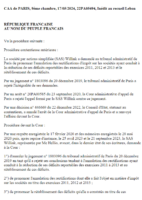
France vs Willink SAS, May 2024, CAA Paris (remanded), Case No 22PA05494
In 2011, Willink SAS issued two intercompany convertible bonds with a maturity of 10 years and an annual interest rate of 8%. The tax authorities found that the 8% interest rate had not been determined in accordance with the arm’s length principle. Willink appealed, but both the Administrative Court and later the Administrative Court of Appeal sided with the tax authorities. The case was then appealed to the Conseil d’Etat which in December 2022 overturned the decision and ruled predominantly in favour of Willink SAS finding that RiskCalc could be used to determine a company’s credit rating for transfer pricing purposes in a sufficiently reliable manner, notwithstanding its shortcomings and the differences in the business sectors of the comparables. On that basis the case was remanded to the Administrative Court of Appeal. Judgment After re-examination of the case, the Administrative Court of Appeal annulled the tax assessment and ruled in favour of Willink SAS. “12. It follows from the foregoing that SAS Willink provides the evidence incumbent on it that the interest rate applicable to the transactions at issue could not have been lower than that which would have been applicable to borrowing transactions of the same nature entered into by independent undertakings. It is therefore entitled to request the cancellation of the corporation tax adjustments that led to the reduction of its losses carried forward for the 2011, 2012 and 2013 financial years, and the reinstatement of those losses.” Click here for English translation Click here for other translation

Sweden vs “X-IP AB”, May 2024, Administrative Court of Appeal, Case No 2294-22 and 2295-22
“X-IP AB” was part of an international group. In 2012 and 2013, a major restructuring was carried out within the group, including a decision to centralise and streamline the group’s management and development of intangible assets in Luxembourg. In 2012, the company registered a branch in Luxembourg, which was given responsibility for managing and developing the intangible assets held by the company. The branch employed staff with expertise in the field and the intangible assets were allocated to the branch at a book value of EUR 1. In the second half of 2013, a company was incorporated in Luxembourg (hereafter LUX). In September 2013, the branch transferred the intangible assets to LUX through a business disposal for a market consideration in the form of shares in LUX. In its tax return for 2013, “X-IP AB” claimed a deduction of notional tax in Luxembourg of just over SEK 660 million, i.e. tax that would have been paid in Luxembourg if there had been no legislation there as referred to in the Merger Directive 2009/113/EC (cf. Chapter 38, Section 19 and Chapter 37, Section 30 of the Income Tax Act). The notional tax was calculated on the basis of the difference between the market value at the time of the sale to LUX and the book value, i.e. on the basis that Luxembourg would tax the entire profit. The Swedish tax authorities decided not to allow a credit for the notional tax. They considered that the intangible assets were allocated to the permanent establishment in Luxembourg and that the conditions for allowing a deduction for fictitious tax existed to the extent that tax would have been payable in Luxembourg if the Merger Directive had not been implemented. However, the tax authorities were of the opinion that the company was not entitled to a credit for fictitious Luxembourg tax because there was no Luxembourg tax to credit. They considered that guidance should be taken from the OECD’s 2008 profit allocation report when interpreting the tax treaty between Sweden and Luxembourg. Since the intangible assets had been transferred from the company’s head office in Sweden to the branch office in Luxembourg and the branch office performed the relevant key functions regarding the intangible assets after the transfer, they considered that an internal transaction, a so-called dealing, corresponding to a sale of the assets had taken place from the company to the branch office. Accordingly, such a sale should have been made at market value to be arm’s length. The same market value should be used both at the time of allocation in December 2012 and at the time of transfer in September 2013, since no increase in value had occurred during the time the branch was the economic owner of the assets. The calculation of the capital gain on the branch’s sale of the assets was then SEK 0. The notional tax that would have been payable in Luxembourg if the provisions of the Merger Directive had not been implemented thus amounted to SEK 0. An appeal was filed by “X-IP AB” that ended up in the Administrative Court of Appeal. Judgment The Court of Appeal found in favour of “X-IP AB”. It held that legal guidance in the interpretation of the tax treaty between Sweden and Luxembourg could be obtained from the OECD’s 2008 profit allocation report. The branch would thus be deemed to have acquired the intangible assets from the company at arm’s length through the allocation. The Administrative Court found that the arm’s length price was the same at the time of the allocation in December 2012 as at the time of the disposal in September 2013. According to the Administrative Court, there was thus no value for Luxembourg to tax and the company was consequently not entitled to a deduction of notional foreign tax. According to the court internal Luxembourg law would have meant that a gain from the divestment would have been taxable in Luxembourg (but for legislation introduced as a result of the provisions of the Merger Directive) and that the internal taxing right was not limited by the tax treaty between Sweden and Luxembourg. The Administrative Court of Appeal held that what was known about the history and impact of the profit allocation report did not, in any event, mean that there were sufficient reasons to depart from the application of the tax treaty that followed from the tax assessment notice from the Luxembourg authority. According to the Court of Appeal, this meant that the tax treaty between Sweden and Luxembourg in this case should be applied in such a way that the input value of the intangible assets should be considered to be taxable values and that a profit thereby arose in Luxembourg at the time of the sale of the business in September 2013. The taxation of the profit was deemed to have been deferred in accordance with the Merger Directive. According to the Court of Appeal, there were thus conditions for applying Chapter 38, Section 19 and Chapter 37, Section 30 of the Income Tax Act and allowing a deduction for fictitious tax in the amount claimed by the company. Click here for English translation Click here for other translation
Costa Rica vs Unilever De Centroamérica S.A., May 2024, Supreme Court, Case No 00472 – 2024
The tax authorities had audited Unilever’s controlled transactions for FY 2009 and concluded that the prices charged for sales to related parties were unrealistically low. As a result, the tax authorities adjusted Unilever’s taxable income. Unilever challenged the tax adjustment, arguing that the tax authorities did not conduct a proper transfer pricing study in accordance with recognized methodologies. The Tax Administration applied the Comparable Uncontrolled Price (CUP) method, comparing Unilever’s prices to independent third parties. However, Unilever contended that the Transactional Net Margin Method (TNMM) was more appropriate, as it considered the functional, economic, and risk differences between its transactions with affiliates and third parties. The lower court ruled against Unilever, stating that the documentation was not properly authenticated, as it lacked a signature and a preparation date. Additionally, the expert witness from Deloitte who testified did not assume authorship of the report, which led the court to discount its probative value. Without this evidence, the court found that Unilever failed to prove that the tax authorities’ CUP-based adjustments were incorrect. Unilever’s appeal to the Supreme Court raised multiple grievances, including procedural errors, lack of motivation in the ruling, and incorrect assessment of the evidence. Judgment of the Supreme Court The Supreme Court upheld the lower court’s decision, emphasizing that Unilever bore the burden of proving that the transfer pricing adjustment was unjustified, which it failed to do. The judges reaffirmed the validity of the CUP method used by the tax administration and ruled that Unilever’s argument for applying TNMM was not substantiated by admissible evidence. Furthermore, the court rejected Unilever’s claim that the tax authorities had overstepped its discretion in selecting the CUP method, concluding that tax authorities acted within the framework of OECD guidelines. Click here for English translation Click here for other translation
Luxembourg vs “EQ LUX”, May 2024, Administrative Tribunal, Case No 47267 (ECLI:LU:TADM:2024:47267)
“EQ LUX” had classified its interest-free intra-group contributions as loans for tax purposes and treated a Malaysian branch with very limited substance as a permanent establishment. The tax authorities reclassified the loans as equity and denied permanent-establishment status to the branch. “EQ LUX” appealed to the Administrative Tribunal. Dicision of the Tribunal The Administrative Tribunal dismissed the appeal of “EQ LUX” and ruled in favour of the tax authorities. Click here for English translation Click here for other translation

Netherlands vs “Real Estate Loan B.V.”, May 2024, Court of Appeal, Case No 22/358 to 22/361, ECLI:NL:GHAMS:2024:1920.
“Real Estate Loan B.V.” had deducted 10% interest on loans from its shareholder in its taxable income. The tax authorities found that the 10% interest rate was not at arm’s length. Furthermore, according to the tax authorities the loans were “non-businesslike” and the deductibility of the interest was therefore limited. The district court upheld the assessment. Not satisfied, “Real Estate Loan B.V.” appealed to the Court of Appeal. Judgment The Court of Appeal ruled largely in favour of the tax authorities, concluding that a significant portion of the interest was not deductible and was therefore deemed to be a dividend to the shareholders. The court found that the tax authorities had been able to prove that the loan was “non-businesslike”, as a third party would not have been willing to make a loan on similar terms to Real Estate Loan B.V. Applying the deemed guarantee approach, the court ruled that the interest rate should be set at 3.09%. Excerpts in English “5.3.6.11. The foregoing leads to the conclusion that the Inspector has made it plausible that no arm’s length interest rate can be determined under which an independent third party would have been willing to grant the same loan to the interested party, on otherwise the same terms and conditions, without stipulating an interest rate that is so high that the AHL would essentially become profit-sharing. If so, it must be assumed – barring special circumstances – that the lenders accepted this risk with the intention of serving the interest of the interested party. Special circumstances in the aforementioned sense have, in the opinion of the Court, neither been stated nor proved. 5.3.6.12. Since no arm’s length interest rate can be found in the market, and the AHL thus qualifies as a so-called impractical loan for all years, in accordance with the impractical loan jurisprudence, an interest rate must then be determined as if the AHL had been provided by a third party under surety (cf. HR 25 November 2011, ECLI:NL:HR:2011:BN3442, BNB 2012/37, r.o. 3.3.4: “(…) The default risk assumed by a company in granting an imprudent loan is comparable to the risk assumed by a company that stands surety for a loan taken directly from a third party under similar conditions by an associated company. In view of this, in the case of an imprudent loan, the company’s taxable profit will have to be determined as far as possible in the same way as if it had guaranteed a loan taken out directly from a third party under comparable conditions by an associated company. In view of the above and also for reasons of simplicity, the rule of thumb is that the interest on the unsecured loan is set at the interest that the affiliated company would have to pay if it borrowed from a third party with the group company’s guarantee under otherwise identical conditions. This will also prevent a difference in the earnings of the affiliated company with respect to the interest expense depending on whether it borrows under a guarantee from a third party or directly from the group company.”) On the basis of the so-called guarantee analogy included in the aforementioned judgment, the inspector determined the interest rate for the present case at a maximum of 2.59%. In doing so, he assumed the AHL but without taking into account the default risk. Furthermore, in connection with the surety analogy, the inspector pointed to the credit rating of [company 9] Ltd. as the holding company of its three subsidiaries that are shareholders/creditors in the interested party with a total interest of 85% (see section 2 of the court ruling). [Company 9] Ltd. could therefore be a guarantor in this regard, according to the inspector, if the AHL were sourced from an independent third party. 5.3.6.13. The Court considers that the inspector correctly used the escrow analogy as a starting point to determine the interest payment. The Court considers that in that regard, it has been made plausible by the inspector that [company 9] Ltd. would qualify as a guarantor. However, in the opinion of the Court, neither party has made the interest rate to be taken into account sufficiently plausible. For instance, the inspector indicated in his primary statement that, given the term of the loan, there is reason to take into account a somewhat higher interest rate, while – in the opinion of the Court of Appeal – he completely ignores this when applying the guarantee analogy. Also the interested party has not made the interest rate it defends plausible since in the reports and analyses on which it is based, the AHL has not been taken into account without default risk. Therefore, taking everything into consideration, the Court, applying the bailment analogy in good justice, will set the interest rate on the AHL at 3.09%.” Click here for English translation Click here for other translation
Norway vs DHL Global Forwarding (Norway) AS, May 2024, District Court, Case No TOSL-2023-55231
The case concerns the validity of the tax office’s decision of 18 October 2022 regarding DHL Global Forwarding (Norway) AS (DGF Norway). The decision increases the company’s taxable income for the years 2014 to 2019 by a total of NOK 242,870,750. The core of the dispute is whether DGF Norway’s income has been reduced due to a community of interest with companies in the same group, so that there is a basis for a discretionary assessment pursuant to section 13-1 of the Tax Act. DGF Norway made losses for 22 years from 1998 to 2019. The tax authorities claims that the business has been maintained for strategic reasons related to the group’s need for representation in Norway, and that the company has not been sufficiently compensated for the continuation of the loss-making activities seen in isolation. In the tax authorities’ view, a ‘service charge’ would have been agreed between independent parties, cf. the OECD TPG (2017), Chapter I, D.3. ‘Losses’, paragraphs 1.129 and 1.130. DGF Norway submitted a claim that the decision is invalid and should be cancelled. The company was of the opinion that no discretionary power has been demonstrated pursuant to section 13-1 first paragraph of the Taxation Act. In the alternative, it was argued that the discretionary power has not been exercised in line with the provision’s third paragraph, and that the decision to review the case was incorrect and insufficiently justified, cf. section 12-1 of the Tax Administration Act. In addition, the right to review for the years 2014 to 2016 is considered to have expired. Decision of the District Court The court found in favour of DGF Norway, ruling that the tax authorities had not demonstrated a sufficient causal link between the company’s losses and its community of interest with other group companies, nor had it adequately identified or analyzed the supposed transaction that would justify a service charge. The court criticized the abstract and imprecise nature of the tax authorities’ assumptions and underlined that no comparable transaction or clear counterparty had been identified. It also pointed out that the company turned a profit from 2020 onwards following management and operational changes, not a shift in transfer pricing. The court concluded that the prerequisites for a discretionary income adjustment under section 13-1 of the Tax Act were not met. Excerpts in English “In this case, there is no formalised agreement or terms on which to base an analysis of the transaction. No specific counterparty has been identified, but it is claimed that it is the network as a whole that must compensate DGF Norway. In addition, the factors that the state believes illustrate the benefit that the company creates for the Group and which should provide a basis for additional remuneration, are to a small extent concretised and documented. It has been argued that the presence in Norway creates direct ‘business’ in foreign group companies, as well as indirectly by advertising that GFF is present in most countries in the world. The extent to which this is true is unclear. In particular, the government has highlighted the shipping of seafood, including the round-the-world flights in connection with the export of live crab from Northern Norway in 2017 to 2018, which the government claims benefited other parts of the Group through more favourable prices for transport to or from Asia. The exact effects have not been clarified. Access to evidence here was a topic in the latter part of the case preparation, but was not emphasised. The parties’ handling of this issue does not provide a basis for reversing the burden of proof, as argued by the state. The uncertainty surrounding the alleged deviations from the arm’s length principle is well illustrated by the fact that the government has referred to the group’s principles for pricing and allocation as almost impenetrable, and that the decision states that the tax office lacks a basis for evaluating whether purchases and sales of intra-group services have been determined at arm’s length. The latter was stated in the decision after referring to the draft decision, where the group’s benefit from the company’s presence in Norway is mentioned as one of several factors that may have caused the reduction in income. Nor does the government have any idea of the reasons for the later profits from 2020, other than that it may be due to factors such as reorganisation of pricing, allocation of costs, changes in the tripartite relationship Starbroker/DGF Norway/external airlines or extraordinary gross margin due to the corona pandemic. The result is that the alleged transaction that forms the basis for a service charge is not specified and analysed as required by the transfer pricing rules. Nor does it make it possible to identify comparable uncontrolled transactions or to compare with such transactions. In the court’s opinion, it is therefore not reasonable and justifiable to apply the service charge approach in point 1.130 of the OECD Guidelines, as the state has done. The mainstay of the State’s argumentation in favour of discretionary power is the persistent deficits. The Court does not agree that a special utility value for the Group is the only plausible explanation for why DGF Norway’s operations have been maintained, at least not during the six-year control period, the first years of which were characterised by restructuring after a major restructuring, an oil crisis that resulted in poor market conditions and crab shipping as a failed business project. An equally plausible explanation is that the company and the Group have been convinced that it is possible to make a profit, but that unexpected costs, market conditions, poor management or combinations of such factors have stood in the way of succeeding with what have basically been business strategies and decisions that do not deviate from the arm’s length principle. The company made large profits from 2020, the year after the control period and after significant operational changes had been implemented. […] In the decision, neither the restructuring from 2014 nor the challenges faced by the company during
![UK vs Kwik-Fit, May 2024, Court of Appeal, Case No [2024] EWCA Civ 434 (CA-2023-000429)](https://tpguidelines.com/wp-content/uploads/UK-vs-Kwik-fit-3-May-2024-Case-No-CA-2023-000429-pdf-image-141x200.jpg)
UK vs Kwik-Fit, May 2024, Court of Appeal, Case No [2024] EWCA Civ 434 (CA-2023-000429)
At issue was an intra-group loan that arose out of a reorganisation designed to accelerate the utilisation of tax losses and thereby generate tax savings for the Kwik-Fit group. According to the tax authorities the loan had an unallowable purpose under the rule in section 441 CTA 2009 and, on this basis, interest deductions on the loan were disallowed. Kwik-Fit´s appeals to the First-tier Tribunal and the Upper Tribunal were unsuccessful and an appeal was then filed with the Court of Appeal. Judgment The Court found that the unallowable purpose rule in section 441 CTA 2009 applied to the interest deductions and upheld the decisions of the First-tier and Upper Tribunals. Excerpt 35. The FTT then made the following findings: “101. We find, based on the evidence of Mr Ogura,that: (1) the decision to implement the reorganisation was made as a whole group; the Appellants were part of that group so they understood and cooperated in that decision; (2) the June 2013 Memorandum sets out what the directors of each company wanted to achieve, both for themselves and for the other members of the Kwik-Fit Group. That group purpose (as set out in that memorandum) was to create net receivables within Speedy 1, to enable utilisation of the losses in Speedy 1, and tax deductions for the interest expense of each debtor. That outcome was considered to be good for the whole group; (3) an additional group purpose of thereorganisation was to simplify the intercompany balances within the Kwik-Fit Group; (4) each of the Appellants knew the full details of the reorganisation which was being implemented, the steps they were required to take to implement that reorganisation, whether for themselves or as shareholder of another company involved in the reorganisation and understood as a matter of fact that the reorganisation had the effect of assigning the receivables under the Pre-existing Loans to Speedy 1. They understood that this was “for the benefit of the whole group”; and (5) each of the Appellants had a choice as to whether or not to participate in the reorganisation, and if they had decided not to do so then the Pre-existing Loans to which they were party would have been left out of the reorganisation. The only potential reason for not participating given by Mr Ogura was if they had not wanted to pay the increased interest rate on those loans. (…) “88. In this case, the FTT’s conclusions were based on very particular factual features: a)The “group purpose” of the reorganisation, which the Appellants willingly adopted, was to achieve the tax benefits that I have already described: para. 101 of the FTT Decision, set out at [] above. b)There was an additional group purpose of simplifying intercompany balances (para. 101(3)), but that was clearly not considered by the FTT to be material. Further, the long-term aim of reducing the number of dormant companies was “merely part of the background noise”: para. 104 ([] above). c)The Appellants had a choice as to whether or not to participate in the reorganisation, the only reason given for not doing so being if they had not wanted to pay the increased rate of interest (para. 101(5)). d)The Pre-existing Loans were repayable on demand and the Appellants had little capacity to repay them, but there was no threat to call for their repayment. Instead, the Appellants understood that the increased interest rate “directly fed into the tax benefit for the group”. (See para. 102, set out above; the points are reiterated at para. 112.) In other words, the Appellants willingly agreed to take on the obligation to pay significant additional interest without any non-tax reason to do so. In contrast, if payment of interest at a commercial rate on a loan is the alternative to being required to repay it in circumstances where funds are still required, then that may well provide a commercial explanation for the borrower’s agreement to the revised rate. e)The increase in rate also had nothing to do with any recognition on the part of the Kwik-Fit group that it needed to make the change to avoid falling foul of the transfer pricing rules. There was no such recognition. The interest rate on the relevant loans was not set at LIBOR plus 5% because of a concern that the transfer pricing rules would otherwise be applied to adjust the rate upwards. Rather, the rate was set at LIBOR plus 5% to maximise the savings available while aiming to ensure that it was not objected to by HMRC as being excessive because it was above an arm’s length rate. Setting the rate at a level that sought to ensure that it did not exceed what would be charged at arm’s length i) meant that it could be accepted by the borrowers and ii) reduced the risk that the rate would be adjusted downwards for tax purposes, which would reduce the benefits available. The assumption was that the transfer pricing rules would not otherwise be applied to increase the interest rate. f)Mr Ghosh frankly acknowledged that the transfer pricing rules did not motivate the increase in rate, but the point is also made very starkly by the FTT’s findings that the Appellants could have chosen not to participate and that the interest rate would not have been increased on the Pre-existing Loans if they had not done so (paras. 101(5) and 102(4)), and by the group’s decision not to increase the rate of interest on other intra-group debt, including the Detailagent Loan (paras. 30 and 115; see [] and [32.] above). g)The result was that, although the commercial purpose for the Pre-existing Loans remained, the only reason for incurring the additional interest cost on the Pre-existing Loans was to secure tax advantages: para. 113 ([] above). The new rate was “integral” to the steps taken: para. 116 ([37.] above). h)As to the New Loans, the FTT found at paras. 103 and 117 that KF Finance and Stapleton’s did not have their own commercial purpose in taking them on and that the intended tax advantages were the main purpose for which KF Finance and Stapleton’s were party to them ([] and [37.] above).” Click here for translation
France vs Apex Tool Group SAS, April 2024, CAA de PARIS, Case No 22PA00072
An intercompany loan was granted within the Apex Tool group at an interest rate of 6%. A tax assessment was issued by the tax authorities contesting the amount of interest deducted. The case ended up at the Conseil d’Etat, where it was referred back to the CAA. Following the referral of the case, Apex Tool Group asked the CAA to refund the amounts of €58,598, €50,099 and €653 corresponding to the excess corporation tax and social security contributions and to increase the balance of the interest deductions carried forward under the French thin cap rules from €1,435,512 to €2,401,651. Judgment of the Court The Court dismissed Apex Tool Group’s application. It found that the company had failed to provide evidence that the 6% interest rate on the loan was at arm’s length. Excerpts (Unofficial English translation) “8. It follows from the foregoing that the applicant company, which does not provide any further evidence enabling it to verify the characteristics and risk profile of Cooper Industrie France, the company to which the loan was granted, at the date on which the loan was granted, cannot be regarded as providing evidence that institutions or organisations would have been likely, given the specific characteristics of ATHF1 and in particular the risk profile it presented on the date the loan was issued, to grant it a loan with the same characteristics in July 2010 on an arm’s length basis. Consequently, the appellant company cannot be deemed to have provided the proof required of it that all of the disputed interest paid at the rate of 6% is deductible, in accordance with the provisions of I of Article 212 of the French General Tax Code referred to above. As a result, it is not entitled to claim repayment of the corporation tax and social security contributions it paid in respect of the 2011 and 2012 financial years. On the claims based on the provisions of II of Article 212 of the French General Tax Code: 9. Under the terms of 1 of II of Article 212 of the General Tax Code: “When the amount of interest paid by a company to all of its directly or indirectly affiliated companies within the meaning of 12 of Article 39 and deductible in accordance with I simultaneously exceeds the following three limits in respect of the same financial year: / a) The product corresponding to the amount of the said interest multiplied by the ratio existing between one and a half times the amount of shareholders’ equity, assessed at the company’s discretion at the beginning or end of the financial year, and the average amount of the sums left or made available by all of the directly or indirectly affiliated companies within the meaning of Article 12 of 39 during the financial year, b) 25% of the current profit before tax previously increased by the said interest, depreciation taken into account in determining that same profit and the share of lease payments taken into account in determining the sale price of the asset at the end of the contract, /c) The amount of interest paid to this company by companies that are directly or indirectly linked within the meaning of Article 12 of 39, / the fraction of interest exceeding the highest of these limits may not be deducted in respect of that financial year, unless that fraction is less than €150,000. / However, this fraction of interest that is not immediately deductible may be deducted in respect of the following financial year up to the amount of the difference calculated in respect of that financial year between the limit mentioned in b and the amount of interest deductible under I. The balance not deducted at the end of this financial year is deductible in respect of subsequent financial years under the same conditions, less a discount of 5% applied at the start of each of these financial years”. 10. It is common ground that SAS Apex Tool Group reported an amount of EUR 1,380,069 in respect of its stock of interest subject to deferred deduction at the close of the 2013 financial year, pursuant to the provisions of II of Article 212 of the General Tax Code, in respect of the loan of EUR 22,656,211.20 owed to the parent company ATG LLC. The applicant, who has requested a recalculation of the excess interest, maintains that it is entitled, firstly, to request that the interest be carried forward pursuant to the provisions of Article 212-I of the French General Tax Code and, secondly, to file an amended tax return showing a balance of interest remaining to be carried forward of 2,401,651 euros as at 31 December 2013. 11 As a result of the investigation, SAS Apex Tool Group, believing that it was entitled to deduct all of the interest on the loan in question from its taxable income on the basis of Article 212(I) of the French Tax Code, consequently recalculated its stock of deferred interest. However, as stated in paragraphs 6 to 8 of this judgment, the applicant did not prove that it met the conditions laid down by the provisions of Article 212-I of the General Tax Code and was therefore able to deduct the loan interest that it had incurred. In these circumstances, the tax authorities were right not to accept the company’s recalculation of its excess interest and the stock of deferred interest. Consequently, the company’s claims in this respect can only be rejected.” Click here for English translation Click here for other translation
Peru vs “Lender SA”, April 2024, Tax Court, Case No 04064-3-2024 (Exp 6739-2020)
“Lender SA” had received funds from related parties abroad which were classified as equity and therefore no interest was paid. The tax authorities classified the funds as loans and a notice of assessment was issued where interest on the loan had been determined using the CUP method and where withholding taxes on the interest had been determined. Decision of the Tax Court . The Tax Court agreed that the funds were loans and that the most appropriate method of determining the arm’s length interest rate was the CUP method. However, the court overturned the adjustment due to the lack of a sufficient comparability analysis. Excerpt in English “That in relation to the determination of the market value, numeral 5.14 states that “… the tax administration will have to arrive at an arm’s length transfer price even when the available information is incomplete, highlighting the importance of having documentation that supports both the transaction under analysis and the comparable ones. That according to Annexes 1 and 2 to Request No. ……….(folios 257/reverse to 265), once the transactions analysed had been identified, the Administration selected the CUP method, indicating that it confirmed that the appellant did not receive financing from independent third parties under similar conditions to those received from its related parties abroad, and therefore ruled out the use of internal comparables. Subsequently, having ruled out this possibility, in order to determine the interest at market value for the loans made, the Administration used as comparable the annual lending rates of transactions in national and foreign currency of the national financial system, taking as a reference the information published by the SBS regarding the interest rates of financing transactions carried out by banking institutions in the local market (I). That the Administration added that in order to select the external comparables it considered, among others, factors such as the debtor’s country of origin, currency, date, term and amortization period, selecting interest rates of financing granted to medium-sized companies, inasmuch as the appellant did not present income and maintained a debt of S/ 350,963,018.00, according to its Financial Statements. In the case of the loans it considered that they had similar characteristics to a revolving credit line, insofar as they were disbursements at the appellant’s request for indeterminate terms, for which reason it selected the market interest rates at the beginning of each month throughout the 2013 financial year for terms ranging from 360 days to more. With regard to the loans received…..de …………. indicated that they had the characteristics of commercial loans, and therefore considered the interest rates published at the beginning of the 2013 financial year for terms of 360 days to maturity. That on this basis, the Administration worked out the interquartile ranges of the interest rates selected as comparable ( Table 5 – folio 261/reverse) and determined the interest on the free loans received by the appellant from its non-domiciled related parties, in national and foreign currency (Tables No 6 to 8 – folios 260 and 260/reverse), establishing the amounts of the analysed repair. Being that, in accordance with what was stated, the amount of the repaired omission was adjusted in the claim instance to the amount of S/. 8,252,788.00. In the case under analysis, it can be seen that in order to find the market value of the transaction observed, the Administration used the CUP method, which is based exclusively on the price or amount of the consideration that would have been agreed with or between independent parties in comparable transactions.” … “…the administration did not select financial transactions of similar amounts to those made by the appellant and the lenders, limiting itself to presenting the sum of all loans granted by the banks to all medium-sized enterprises as at December 2013, no analysis of the interest rate applicable to companies that have requested financing for amounts equivalent to those that were the subject of loans from related companies. Similarly, it did not analyse which entities of the Peruvian financial system had sufficient funds to make a loan for a similar amount to the appellant or which companies comparable to the appellant had chosen to apply for revolving or commercial credit from local banks. Therefore, it is noted that management did not carry out an adequate analysis of this element. Likewise, it did not take into account elements such as the economic functions or activities of the parties involved in the operation; Thus, it has not taken into account that the mutuantes were not companies dedicated to the placement of credit, being that in the banking activity the main business consists, precisely, in receiving money from the public in deposit or under any other contractual modality, and in using that money, its own capital and that obtained from other sources of financing, to grant credit in various forms, or to apply them to operations subject to market risks , and for the placements they make they must constitute generic or specific provisions for credit risk according to the classification of the debtor.” Click here for English Translation Click here for other translation
Czech Republic vs AHI Oscar s. r. o., April 2024, Supreme Administrative Court, Case No 2 Afs 27/2023 – 41
A Czech real estate company, AHI Oscar, had deducted the cost of intra-group services received from a related foreign service company. The price of the services had been calculated at a flat rate of 75% of the wages of the employees providing the support services, plus overhead costs. The tax authority found that the overhead costs included in the calculation did not correspond to the actual costs and excluded these costs from the calculation. According to the tax authority, it was irrelevant to consider the arm’s length principle under Section 23(7) of the ITA. AHI Oscar appealed to the Municipal Court, which upheld the tax authority’s assessment. AHI Oscar then appealed to the Supreme Administrative Court. Judgment of the Court. The Supreme Administrative Court overturned the decision of the Municipal Court. It was undisputed that AHI Oscar had actually incurred the declared costs and received the services from the related foreign service company. According to the court, the tax authority’s position on the taxpayer’s obligation to prove the actual basis of calculation is not supported by Section 24(1) of the ITA. However, this does not mean that the service charge should automatically be a fully deductible expense. Given the facts, it was therefore necessary to apply the transfer pricing rules under section 23(7) of the ITA, which the tax administrator did not do. As the case concerned 2012 and the 10-year general limitation period for tax assessment had expired, there would be no further assessment of the arm’s length amount from a transfer pricing perspective. Click here for English Translation Click here for other translation
Korea vs “Fiber Corp” June 2024, High Court, Case no 조심 2024 서 2059
“Fiber Corp” was established on November 3, 1966, and engages in the manufacture, processing, sales, import, export, and agency services of chemical fiber products. The tax authoritieis conducted a comprehensive corporate tax audit from May 29, 2013, to October 10, 2013, and determined that: “Fiber Corb” did not collect royalties for use of its trademarks from domestic and overseas related parties for the fiscal years 2008 to 2012. “Fiber Corb” also did not collect royalties for technology/knowhow used by its overseas subsidiary in China for the fiscal years 2010 to 2012. Based on these findings, the tax authorities issued a tax assessments for the fiscal years 2003 to 2012 where an arm’s length royalty had been added to the taxable income of “Fiber Corp”. A complaint was filed that ended up in court. Decision The Court upheld the assessment issued by the tax authorities. According to the court, the affiliated companies benefited from using the trademarks, leading to increased revenue and profit and the claimant corporation did not present sufficient evidence to justify the non-collection of royalties. Click here for English translation Click here for other translation

Hungary vs “Auto-Eletronics KtF”, April 2024, Supreme Court, Case No Kfv.VI.35.024/2024/7
“Auto-Eletronics KtF” is a member of a multinational group headquartered in Germany, whose main activity is the manufacture of electronic components for the automotive industry, in addition to which it carries out research and development activities, both for related and unrelated parties. The controlled transactions under review included the manufacturing and delivery of finished goods between “Auto-Eletronics KtF” and related parties. The audit examined whether the remuneration of “Auto-Eletronics KtF” for its manufacturing activities and services complied with the arm’s length principle, and whether the transfer pricing documented had been sufficient. At the end of the audit an assessment of additional income for FY 2018 was issued to the company. An appeal had been filed with the court of first instance, which ruled in favour of the tax authorities. In its decision, the court referred to The OECD TPG(2017), paragraphs 1.122, 1.33-1.36, 1.65. An appeal was then filed by “Auto-Eletronics KtF” with the Supreme Court. Judgment of the Supreme Court The Supreme Court set aside the previous judgment and ordered the first-instance court to conduct new proceedings and issue a new judgment. In the new judgment the court must (1) Establish clear facts regarding the applicant’s transactions and activities, (2) Assess and compare evidence from both parties, and (3) Apply relevant legal provisions, including the OECD Guidelines and national tax laws. Excerpt in English “[66] The case-law of the Curia is consistent on the point that, in the case of an application for review based on a breach of the law on the establishment of the facts and the weighing of evidence, a final judgment may be set aside only if the facts are not in the record, or if the court has not assessed the evidence as a whole when considering it, or if the facts as established are manifestly incomplete, unreasonable or contain a material logical inconsistency. On the basis of the errors and deficiencies found, it can be concluded that the court of first instance did not comply with the requirements of the Code of Civil Procedure. In the absence of specific facts, specific evidence and specific legal applications relating to them, the final judgment cannot be reviewed. The reasons given for the judgment, which is incomplete in terms of the facts of the case to an extent that could affect the merits of the case, does not contain any indication of the evidence and thus does not include any assessment of the evidence and does not include any comparison of the evidence, do not comply with the statutory provisions. [67] In view of the above, the Curia has set aside the judgment of the court of first instance in the judgment of the Court of Cassation and Justice of the Republic of Hungary of 18 December 2007. 121 (1) a) , and ordered the court of first instance to conduct new proceedings and issue a new decision. [68] In the repeated proceedings, the court of first instance must, subject to the provisions of the order of the Curia, decide on the legality of the decision of the second instance, after having established the facts, and after having referred to, reasonably evaluated and contradicted the evidence found in the administrative proceedings and the lawsuit, by indicating, interpreting and applying the applicable legal provisions.” Click here for English translation Click here for other translation
Italy vs ING Bank SPA, April 2024, Court, Case No 10574/2024
ING Bank SPA received interest on a loan granted to a Dutch group company, Ing Lease Interfinance B.V.. The tax authorities considered that the interest rate on the loan was significantly lower than an arm’s length interest rate and issued a notice of assessment, changing the interest rate from 3.90% to 6.81%, resulting in additional taxable income. ING Bank disagreed with the assessment and appealed to the Provincial Tax Commission and later to the Regional Tax Commission, which ruled in favour of the tax authorities. ING Bank then appealed to the Supreme Court. Judgment of the Court The Supreme Court referred the case back to the Regional Tax Commission for a more detailed explanation of why the tax authorities’ arguments for an upward adjustment of the interest rate were considered decisive for the decision issued. “6.7. In the present case, both parties pointed to evidence supporting the correctness of the loan interest rate as stated by them. Neither party has rigorously proved what the normal interest rate would have been in the free market between independent operators. 6.7.1. The CTR, however, did not clarify why the arguments put forward by the tax administration to estimate the correct interest rate should be considered decisive, while the additional ones acquired at the trial (rate recorded by the Bank of Italy, coeval intra-group financing rate, etc.) should be considered without any doubt recessive. 6.8. The reasoning proposed by the CTR therefore appears to be so incomplete and lacking in several passages as to be merely apparent. The second and third grounds of appeal are therefore well founded and must be allowed.” Click here for English translation Click here for other translation
Slovakia vs Marelli PWT Kechnec Slovakia s.r.o., April 2024, Administrative Court, Case No. KE-7S/148/2020
Marelli Slovakia’s main business is the manufacture of automotive engine and transmission components and that its main products are throttle bodies, throttle position sensors and high-pressure fuel pumps. The parent company is Magneti Marelli S.p.A., Italy, which owns 100 % of the shares of the company, and the parent company of the entire group is Fiat S.p.A. In an audit of corporate income taxes for FY 2012 the tax authorities compared the resale price method, the cost plus method and the net margin method, and stated the reasons why it had chosen the net margin method as the most appropriate method for assessing the arm’s length pricing of the controlled transactions relating to the intra-group sale of Marelli Slovakia’s products. In comparing the terms and conditions agreed in the commercial relationships, it took into account the activities carried out by Marelli Slovakia in production, purchasing and sales, as well as the extent of the business risks, the contractual terms and conditions agreed, etc. The tax authorities carried out a functional and risk analysis, evaluated the functions performed by Marelli Slovakia and those performed by the parent company or other companies of the Magneti Marelli group and found that Marelli Slovakia bore risks over which it had no control or decision-making power, the control and decision-making in significant activities being largely the responsibility of the parent company, Magneti Marelli S.p.A. According to the tax authorities Marelli Slovakia performed the functions and activities of a production plant and had the profile of a contract manufacturer, or a manufacturer with limited functions and risks, which generally produces on demand and is supposed to have all costs paid and, since it does not bear high risks, has only a small profit. According to the tax authorities, assessing the various individual transactions separately would not provide a comprehensive view of Marelli Slovakia’s activities and their interrelationship with the main manufacturing activity. The tax authority used the Amadeus database to search for independent comparable companies and carried out a quantitative and qualitative analysis, finding that Marelli Slovakia had achieved a profit margin of -6,01 % for the tax year under review, which was not within the established range of independent comparable profit margins of 3,62 % to 7,49 % (median 5,85 %). For that reason, the tax authorities adjusted Marelli Slovakia’s profit margin to the median value, i.e. 5,85 %, thereby increasing the tax base by EUR 2 458 414,42. Judgment of the Administrative Court The administrative court annulled the assessment made by the tax authorities. The case was sent back to the tax authorities for further proceedings, with instructions to correct the procedural and substantive legal issues identified by the court. Click here for English translation Click here for translation
Colombia vs Industria Nacional de Gaseosas S.A. – INDEGA, April 2024, Counsil of State, Case No. 25000-23-37-000-2014-00372-01 (26674)
INDEGA filed a tax return for FY20110 in which it concluded that its related party transactions had been conducted at arm’s length. Transfer prices had been determined using a TNMM with the operating margin over operating costs and expenses (ROTC) as the profit level indicator (PLI). Following an audit, the Colombian tax authorities issued a notice of additional taxable income. The notice was based on an assessment, where they had used return on capital employed (ROCE) instead of ROTC as the PLI. An appeal was filed with the Administrative Court, which later ruled in favour of INDEGA. The tax authorities then appealed to the Council of State. Judgment of the Court The Counsel of State upheld the decision of the Administrative Court and dismissed the tax authorities’ appeal. Excerpt in English “The adjustments that may be made in the context of the application of the transfer pricing regime do not entail disregarding the accounting reality of the applicant as the tested party, since the adjustment does not modify its accounting, but is rather the result of an exercise of a numerical and conceptual nature, carried out in order to establish whether the economic reality of the tested party’s transactions with its related parties was or was not in line with the conditions that could have been found by non-related parties when carrying out the transactions analysed. The foregoing leads the Chamber to conclude that, in the specific case, both the conditions that gave rise to the adjustment made by the plaintiff and its reasonableness are fully demonstrated and justified, insofar as such adjustment allowed to obtain better levels of comparability between the conditions of the transactions carried out by Indega S.A. with its related parties and the comparable companies, as it helped to overcome a regulatory difference that distorted the comparative exercise. It must then be considered sufficiently demonstrated that the plaintiff adjusted its operations with related companies to the transfer pricing regime, according to the analysis presented based on the method of transactional profit margins (TU) and the profitability indicator of operating margin on operating costs and expenses (ROTC), initially proposed, as the adjustment proposed to support such conclusion was found to be reasonable. It should be added that the DIAN did not contradict the claimant’s assertion that Indega S.A. also complied with the arm’s length principle, even using the ROCE indicator proposed by the DIAN in the contested act. In view of the foregoing, the charge raised by the defendant in its appeal does not succeed, and the Chamber will therefore uphold the judgment under appeal, without addressing the other grounds for annulment raised in the application.” Click here for English translation Click here for other translation
Colombia vs Sociedad de Fabricación de Automotores S.A., April 2024, Supreme Administrative Court, Case No. 25000-23-37-000-2016-01484-01 (27618)
The tax authority had issued an assessment of additional taxable income for FY2011 due to non-arm’s length pricing of transactions with foreign associated enterprises – purchase of inventory for distribution (CBU) and inventory for production (CDK). With regard to goods for distribution, the tax authority disagreed with the use of comparables from 2008 to 2010 and the screening criteria applied. With regard to inventory for production, the tax authority also disagreed with the transfer pricing method and some of the comparability adjustments made by Fabricación de Automotores S.A. Fabricación de Automotores S.A. appealed to the Administrative Court, which later ruled in its favour. The tax authority then appealed to the Supreme Administrative Court. Judgment The Supreme Administrative Court upheld the decision of the Administrative Court and ruled in favour of Fabricación de Automotores S.A. The Court found that the use of data from previous years was acceptable and that the transfer pricing method, benchmark study and comparability adjustments applied by Fabricación de Automotores S.A. were reasonable. Click here for English translation Click here for other translation
Italy vs UFI Filters, April 2024, Supreme Court, Case No 10499/2024
UFI Filters SpA had paid two related companies in China for the supply of filters in 2009 and deducted the costs from its taxable income. Following an audit, the tax authorities found, on the basis of a benchmark study of six comparable companies, that the mark-ups applied by the Chinese companies (39.77% and 17.2%) under the cost-plus method were not at arm’s length and issued a tax assessment of additional taxable income resulting from the reduction in the price and, consequently, the deductions. UFI Filters SpA appealed, arguing that the six companies were not comparable. The Provincial Tax Commission ruled against UFI Filters SpA, but the Regional Tax Commission later ruled in favour of UFI Filters SpA An appeal was then filed by the tax authorities with the Supreme Court. Judgment of the Court The Supreme Court upheld the decision of the Regional Tax Commission, and dismissed the appeal of the tax authorities. Excerpts in English “2.4. In indicating the criteria for the selection of the traditional transaction-based methods, the OECD Guidelines focus, as far as may be relevant here, on the cost-plus method. In particular, Section D of Part II of Chapter II of the 2017 OECD Guidelines – as well as the same guidelines in the 2010 edition – governs this method, which (see Section 2.45 et seq. OECD Guidelines) ‘considers first the costs incurred by the supplier of goods (or services) in a transaction between associated enterprises for goods transferred or services provided to a related buyer. An appropriate mark-up on the cost of production (cost plus mark-up) is then added to that cost in order to obtain an appropriate profit taking into account the functions performed and market conditions. The result of this transaction can be regarded as the arm’s length price of the original transaction between the associated enterprises. This method is most useful where the semi-finished products are sold between associated parties, where they have concluded agreements for the pooling of plant or long-term purchase-supply agreements, or where the transaction between the associated enterprises consists in the provision of services. The percentage mark-up on the supplier’s production costs in the course of a transaction between the associated enterprises shall be established by reference to the mark-up percentage which the same supplier obtains in the course of comparable transactions with independent third parties (‘internal comparables’). The percentage that would have been obtained in comparable transactions by an independent undertaking (‘external comparable’) may also be used as a benchmark”, stating in para. 47 that ‘(…) a transaction between independent parties is comparable with a transaction between associated enterprises for the purposes of the cost-plus method, if either of the following two conditions is met: (a) no differences (if any) between the compared transactions or between the enterprises entering into those transactions materially affect the mark-up percentage on the free market or (b) appropriate adjustments can be made to eliminate the substantial effects of those differences’. (…) 4.1. The Lombardy Regional Tax Commission extensively reconstructed the case examined on the basis of the allegations made by the parties, in particular highlighting that the six Chinese companies had been selected from a group of 44 companies as comparable third parties, substantially on the basis of the following characteristics, indicated by the Administration in the notice of assessment: they have the same activity code even if they do not produce the same goods, they do not own ‘Intangible fixed assets’, they belong to the same geographical area as the Chinese subsidiaries, and they have achieved an equivalent turnover. 4.2. It then observed (judgment, p. 13) that it was not possible ‘to find in the findings in the file, and consequently had to reject, the decisive ruling of the first judges who, in rejecting the taxpayer’s appeal, stated that the cost-plus methodology adopted by the Office – after identifying 6 companies selected to make up the sample of reference and comparison – for the verification of transfer priclng with the subsidiaries Ufi Filters Shanghai Ltd and Sofima Automotive Filter Shanghai Ltd ‘does not presuppose the identity of goods and services object of/activity, but requires the comparability of functions, risks or investments, affirming the entirely unproven circumstance that the 6 companies selected for comparison appear suitable for the purpose given the functional similarity with regard to design, production, assembly, research and provision of services, purchasing, distribution, marketing, management etc.. ‘’. 4.3. In this regard, the Regional Commission (judgment, p. 14) held that the Administration had not correctly identified the parameter against which it had identified the ‘normal’ price from which the taxpaying company would deviate, noting in particular that ‘In the present case, not only does the typology of the six companies chosen to make up the reference sample present unexceptionable inconsistencies at least with reference to the inconsistent type of production – e.g. cabins, tanks, gears and the like vs. high-tech filters – and to the geographic location – also considering the remote location of the companies of the sample within China in comparison with the location of the two subsidiaries located directly in the same port area of Shanghai – but above all no demonstration and/or evidence of the comparable ‘functions, risks or investments’ of the six companies of the selected sample appears to have been given, since any specific description relating to design, production, assembly, research, purchasing, distribution and marketing is absent, given that the only data made available are those of the balance sheet. The Commission then observes the erroneousness of the Office’s statement (see page 15 of the counter-deductions to the appeal on file) that would have the ‘almost totality of the sales’ of the subsidiaries as ‘occurring in favour of the parent company Ufi Filters spa’, while contradictorily the same Office affirms and highlights, as to the subsidiary Sofima Automotive Filter Shanghai Ltd. (…) 6. The ground of appeal is therefore unfounded and, moreover, manifestly inadmissible where it is, in truth, intended to call for a reassessment of the preliminary investigation compendium, albeit in the face of a coherent statement of reasons expressing a plausible outcome of the analysis
![UK vs Hargreaves Property Holdings Ltd, April 2024, Court of Appeal, Case No [2024] EWCA Civ 365 (CA-2023-001517)](https://tpguidelines.com/wp-content/uploads/HMRC-vs-HPH-Ltd-April-2024-CA-2023-001517-2024-EWCA-Civ-365-pdf-image-141x200.jpg)
UK vs Hargreaves Property Holdings Ltd, April 2024, Court of Appeal, Case No [2024] EWCA Civ 365 (CA-2023-001517)
Hargreaves Property Holdings Ltd paid interest on certain loans between 2010 and 2015. HMRC formed the view that Hargreaves should have deducted and accounted for withholding tax on the interest. Hargreaves disagreed and appealed to the First-tier Tribunal on four grounds. All four grounds were rejected ([2021] UKFTT 390 (TC). Hargreaves then appealed on similar grounds to the Upper Tribunal. Hargreaves’ appeal was dismissed ([2023] UKUT 120 (TCC)). An appeal was filed with the Court of Appeal where two of the four grounds were pursued: whether interest payments made from 2012 onwards to a UK tax resident company, Houmet Trading Limited (“Houmet”), fell within the exception from withholding tax in s.933 Income Tax Act 2007 (“ITA 2007”); and whether interest paid on loans the duration of which was less than a year, but which were routinely replaced by further loans from the same lenders, was “yearly interest” within s.874 ITA 2007. Judgment The Court of Appeal dismissed the appeal and upheld the decision of the Upper Tribunal. Excerpts “(…) 81. In conclusion on ground 1, I would dismiss Hargreaves’ appeal. The FTT and UT correctly concluded that Houmet was not beneficially entitled to the interest assigned to it. (…) 86. In this case the FTT found that the loans fulfilled an important commercial need for the business, and (being raised from connected parties) both left the borrower’s assets free from security and could be raised quickly and at minimal cost (para. 78 of the FTT’s decision). They were also repayable on demand (para. 79). However, there was a pattern under which loans were routinely replaced by a further loan from the same lender in the same or a larger amount. The FTT found that the enquiries made of lenders as to whether they wished to carry on lending were formalities, and a new loan was never declined (para. 87). 87. In my view the FTT and UT applied the correct legal approach. The FTT made no legal error in concluding that the interest was yearly interest because the loans were in the nature of long-term funding, were regarded by the lenders as an investment and formed part of the capital of the business, with a permanency that belied their apparent shortterm nature (paras. 79, 81 and 82). It makes no difference to this whether an individual loan happened to last for less than a year. On a business-like assessment, those loans could not be viewed in isolation as short-term advances. In reality, as the FTT concluded at para. 86, the lenders provided attractive long-term funding in the nature of an investment. 88. In conclusion, I would dismiss Hargreaves’ appeal on both grounds. Houmet was not “beneficially entitled” to the interest assigned to it for the purposes of s.933 ITA 2007, and the interest on the loans was yearly interest even if the loan in question had a duration of less than a year.” EWCA Civ 365″]

Colombia vs TECNA Estudios y Proyectos de Ingeniería S.A., April 2024, Supreme Administrative Court, Case No. 25000-23-37-000-2016-00896-01 (26634)
The tax authorities had amended TECNA Estudios y Proyectos de Ingeniería S.A.’s tax return for FY 2010, disallowing certain costs that it could not be allocated to TECNA. TECNA appealed the decisions, arguing that branches cannot enter into contracts with their head offices and that the costs in question were not for technical services but for payroll costs allocated by the head office. The Administrative Court ruled in favor of TECNA, declaring the nullity of the tax authorities decisions and reinstating TECNA’s original tax return. The tax authorities appealed. Judgment The Supreme Administrative Court reviewed the case, focusing on whether the cost derived from the operation between TECNA and its head office could be deducted without registering the technology import contract. The Council concluded that, for tax purposes, branches must comply with the same requirements as independent entities, including the registration of technology import contracts. Therefore, the cost was not deductible, and tax authorities’s decision to reject the cost was upheld. However, the penalty for inaccuracy was lifted, as TECNA’s error was based on a reasonable interpretation of the law. Click here for English translation Click here for other translation
Romania vs “A Manufacturing S.R.L.”, April 2024, Supreme Administrative Court, Case No 2177/2024
A Manufacturing S.R.L. manufactures lifting and handling equipment and pays royalties to its French parent company B for the use of the group’s intangible assets – trademarks, etc. The arm’s length nature of the royalty payment had been determined indirectly using the TNMM to demonstrate that, even after paying the royalties, its profit was comparable to that of independent comparable companies. At the request of the tax authority, A SRL then submitted an additional analysis using the CUP method, which involved identifying and comparing royalty rates from supposedly similar licence agreements in a commercial database. During the following audit, the tax authority rejected four of the licence agreements that A S.R.L. had used as comparables. According to the tax authority, the four agreements in question did not meet the comparability criteria for two main reasons. First, the industry covered by these agreements was different from A S.R.L’s core business of manufacturing lifting and handling equipment, so they did not reflect similar economic circumstances. Secondly, the basis for calculating the royalties in these agreements was different from that of A. S.R.L. (they used cash flow, purchase price or another revenue measure), whereas A. S.R.L. paid royalties calculated as a percentage of net turnover. As a result, the tax authority did not consider these contracts to be comparable for the purpose of establishing an arm’s length range. Based on the revised benchmark, the tax authorities determined that the royalties (9% and later 11%) paid by A S.R.L. to B SRL exceeded the arm’s length range and the royalty rate was adjusted and a tax assessment issued. A S.R.L. challenged the assessment and in September 2022 the Court of Appeal annulled the tax assessment. The tax authorities appealed to the Supreme Administrative Court, arguing that the first instance court had not fully addressed their objections and had relied almost exclusively on a court-appointed expert’s report, Judgment The Supreme Administrative Court set aside the decision of the Court of Appeal and ruled in favour of the tax authorities. According to the court, the first instance court did not engage in a detailed analysis of the core transfer pricing issues. Specifically, it did not thoroughly examine whether the royalties were truly arm’s length over the relevant years, nor did it address all the tax authorities’ defenses and objections. As a result, the High Court set aside the lower court’s judgment and sent the case back for a thorough rehearing. Click here for English translation Click here for other translation
![UK vs BlackRock, April 2024, Court of Appeal, Case No [2024] EWCA Civ 330 (CA-2022-001918)](https://tpguidelines.com/wp-content/uploads/BlackRock-HoldCo-5-LLC-v-HMRC-Judgment-pdf-image-141x200.jpg)
UK vs BlackRock, April 2024, Court of Appeal, Case No [2024] EWCA Civ 330 (CA-2022-001918)
In 2009 the BlackRock Group acquired Barclays Global Investors for a total sum of $13,5bn. The price was paid in part by shares ($6.9bn) and in part by cash ($6.6bn). The cash payment was paid by BlackRock Holdco 5 LLC – a US Delaware Company tax resident in the UK – but funded by the parent company by issuing $4bn loan notes to the LLC. In the years following the acquisition Blackrock Holdco 5 LLC claimed tax deductions in the UK for interest payments on the intra-group loans. The tax authorities (HMRC) denied tax deductions for the interest costs on two grounds: (1) HMRC claimed that no loans would have been made between parties acting at arm’s length, so that relief should be denied under the transfer pricing rules in Part 4 of the Taxation (International and Other Provisions) Act 2010. (2) HMRC also maintained that relief should be denied under the unallowable purpose rule in section 441 of the Corporation Tax Act 2009, on the basis that securing a tax advantage was the only purpose of the relevant loans. An appeal was filed by the BlackRock Group with the First Tier Tribunal, which in a decision issued in November 2020 found that an independent lender acting at arm’s length would have made loans to LLC5 in the same amount and on the same terms as to interest as were actually made by LLC4 (the “Transfer Pricing Issue”). The FTT further found that the Loans had both a commercial purpose and a tax advantage purpose but that it would be just and reasonable to apportion all the debits to the commercial purpose and so they were fully deductible by LLC5 (the “Unallowable Purpose Issue”). An appeal was then filed with the Upper Tribunal by the tax authorities. According to the judgment issued in 2022, the Upper Tribunal found that the First Tier Tribunal had erred in law and therefore allowed HMRC’s appeal on both the transfer pricing issue and the unallowable purpose issue. The First Tier Tribunal’s Decision was set aside and the tax authorities amendments to LLC5’s tax returns were confirmed. An appeal was then filed by BlackRock with the Court of Appeal. Judgment The Court of Appeal found that tax deductions for the interest on the Loans were not restricted under the transfer pricing rules (cf. ground 1 above) but instead disallowed under the unallowable purpose rule in section 441 of the Corporation Tax Act 2009 (cf. ground 2 above). Excerpt regarding application of transfer pricing rules “34. Paragraph 1.6 of both the 1995 and 2010 versions of the OECD guidelines explains that what Article 9 of the model convention seeks to do is to adjust profits by reference to “the conditions which would have obtained between independent enterprises in comparable transactions and comparable circumstances” (a comparable “uncontrolled transaction”, as opposed to the actual “controlled transaction”). The 2010 version adds that this comparability analysis is at the “heart of the application of the arm’s length principle”, while explaining at para. 1.9 that there are cases, for example involving specialised goods or services or unique intangibles, where a comparability analysis is difficult or complicated to apply. 35. In its discussion of comparability analysis, para. 1.15 of the 1995 version states: “Application of the arm’s length principle is generally based on a comparison of the conditions in a controlled transaction with the conditions in transactions between independent enterprises. In order for such comparisons to be useful, the economically relevant characteristics of the situations being compared must be sufficiently comparable. To be comparable means that none of the differences (if any) between the situations being compared could materially affect the condition being examined in the methodology (e.g. price or margin), or that reasonably accurate adjustments can be made to eliminate the effect of any such differences. In determining the degree of comparability, including what adjustments are necessary to establish it, an understanding of how unrelated companies evaluate potential transactions is required. Independent enterprises, when evaluating the terms of a potential transaction, will compare the transaction to the other options realistically available to them, and they will only enter into the transaction if they see no alternative that is clearly more attractive. For example, one enterprise is unlikely to accept a price offered for its product by an independent enterprise if it knows that other potential customers are willing to pay more under similar conditions. This point is relevant to the question of comparability, since independent enterprises would generally take into account any economically relevant differences between the options realistically available to them (such as differences in the level of risk or other comparability factors discussed below) when valuing those options. Therefore, when making the comparisons entailed by application of the arm’s length principle, tax administrations should also take these differences into account when establishing whether there is comparability between the situations being compared and what adjustments may be necessary to achieve comparability.” Similar text appears at paras. 1.33 and 1.34 of the 2010 version. 36. As can be seen from this, it is essential that the “economically relevant characteristics” are “sufficiently comparable”, in the sense of any differences either not having a material effect on the relevant condition (term) of the transaction, or being capable of being adjusted for with reasonable accuracy so as to eliminate their effect. 37. Paragraph 1.17 of the 1995 version expands on the concept of differences as follows: “… In order to establish the degree of actual comparability and then to make appropriate adjustments to establish arm’s length conditions (or a range thereof), it is necessary to compare attributes of the transactions or enterprises that would affect conditions in arm’s length dealings. Attributes that may be important include the characteristics of the property or services transferred, the functions performed by the parties (taking into account assets used and risks assumed), the contractual terms, the economic circumstances of the parties, and the business strategies pursued by the parties…” Again, this is reflected in the 2010 version, at

Sweden vs Meda AB, April 2024, Administrative Court of Appeal, Case No 6754-6759-22
Meda AB, the parent company of a Swedish pharmaceutical group, had established a subsidiary in Luxembourg. The subsidiary was the contractual owner of intangible assets that was acquired from external parties following its establishment. Licensing and distribution agreements had then been entered into, according to which the subsidiary would receive the residual profit from the ownership of the intangible assets, while Meda AB and other group companies would only receive routine compensation for services rendered in connection with the intangible assets. The tax authorities found that the contractual terms of the agreements did not reflect the actual transactions. According to the tax authorities, Meda AB had been the actual decision maker and had controlled the significant risk related to the intangible assets. On this basis, it was concluded that the subsidiary in Luxembourg should only be compensated on a cost-plus basis for providing administrative services, while the remaining profits should be allocated 60% to Meda AB and 40% to other group companies. Meda AB appealed to the Administrative Court, arguing that an arm’s length assessment could only be based on the contractual terms and that the consideration of risk control and the delineation of actual transaction was contrary to the Swedish arm’s length provisions and the version of the OECD Transfer Pricing Guidelines in force for the tax years in question. The Administrative Court agreed with Meda AB and annulled the assessment. The tax authorities then appealed to the Court of Appeal. Judgment The Court of Appeal overturned the decision of the Administrative Court and upheld the assessment of the tax authorities. The Court found that the agreed terms between the related parties had not been at arm’s length. Therefore, there was a basis for adjusting Meda AB’s results under the Swedish arm’s length provisions. On the issue of the OECD transfer pricing guidelines, the Court clarified that later versions of the guidelines could be applied. The Court also stressed the importance of taking into account all relevant circumstances when examining transactions between related parties. The Court found that the Luxembourg subsidiary had only been the formal owner of the intangible assets, while Meda AB and other group companies had performed all the valuable functions and controlled the main risk related to the intangibles. Meda AB subsequently applied to the Supreme Administrative Court for permission to appeal, which was denied. Excerpts in English “The Supreme Administrative Court has stated that the OECD’s Transfer Pricing Guidelines for Multinational Enterprises and Tax Administrations provide a good and well-balanced explanation of the problems surrounding transfer pricing issues and that the guidelines can serve as a guide in the application of the correction rule, even if they are not binding (RÅ 1991 ref. 107 and HFD 2016 ref. 45). In the opinion of the Administrative Court of Appeal, the guidelines can also be used as guidance for tax years before they were issued, provided that they do not change what applied according to previous versions and do not conflict with the Swedish correction rule. The Administrative Court of Appeal notes that there are differences between the 2017 version and previous versions. However, using the 2017 version in a case such as the present one does not mean that what is to be assessed is changed or expanded in relation to what would have applied if guidance had instead been taken from the previous guidelines. There is therefore no obstacle to using the 2017 Guidelines as guidance in the Court of Appeal’s assessment.” “The Administrative Court of Appeal notes that a review under the correction rule is about assessing what independent parties would have agreed if they were in a similar situation. It is thus a matter of assessing how independent parties would have acted if they had had the same contractual relationship as the related parties have. In order to identify what constitutes an equivalent situation, i.e. a comparable transaction under comparable circumstances, it is necessary, in the Court of Appeal’s opinion, to take into account all the related parties’ dealings and actual behaviour, as well as other economically relevant circumstances associated with their contractual relationship. This means that circumstances other than the actual contractual terms also need to be taken into account in the assessment under the correction rule (HFD 2016 ref. 45 and OECD Guidelines, paragraphs 1.33, 1.36, 1.43 and 1.45). In transactions between independent parties, compensation is normally paid that reflects the functions performed by each party, the assets used and the risks borne (OECD Guidelines, paragraph 1.51). The Swedish Tax Agency argues that it is the allocation of the functions and risks in the acquisition of the product rights that must be analysed in order to identify and map the transactions actually undertaken between the company and the subsidiary. It is therefore these questions that the Administrative Court of Appeal will examine in the following. According to the Court of Appeal, this examination is not about the actual meaning of the legal acts.” “According to the OECD guidelines, the right of return belongs to the party that performs or controls the more important functions and risks associated with intangible assets. Mere legal ownership does not give the right to compensation (cf. paragraphs 6.42, 6.47-6.49 and 6.54). The Administrative Court of Appeal is of the opinion that the Swedish Tax Agency’s investigation shows that the most value-creating and risky function of the product rights has been the acquisitions themselves. Since the purchases have amounted to very large amounts, the acquisition risks have been significant. The return for having controlled these risks should therefore, in the Court of Appeal’s opinion, have accrued to the company, which has not been reflected in the terms of the agreement between the company and the subsidiary.” “The Administrative Court of Appeal then makes the following assessment regarding the compensation that, according to the Tax Agency’s decision, is to accrue to the subsidiary. As regards the risk-free return on the subsidiary’s investments, the Administrative Court of Appeal makes no other assessment than that the investment is risk-free
France vs GEII Rivoli Holding, April 2024, Conseil d’État, Case No 471139 (ECLI:FR:CECHR:2024:471139.20240405)
Following an audit of GEII Rivoli Holding’s accounts for FY 2013 and 2014, the tax authorities questioned the deductibility, beyond what resulted from the application of a “safe harbor” rate of 2,79% corresponding to the value mentioned in 3° of 1 of Article 39 of the French General Tax Code, of the interest paid to its parent company, at a rate of 5.08%, in return for a loan that the latter had granted it with a view to acquiring a building, and subjected it to additional corporate income tax assessments in respect of these two years. To justify the arm’s-length nature of this intragroup interest rate, the company provided two different methods. One method where the borrower’s credit risk (Baa1) was determined using a scoring model developed by Moody’s Analytics (RiskCalc) and another method where the credit risk of the borrower had been determined using based on the corporate bond yield curves provided by the S&P database. Both analyses were rejected by the tax authority and later the Administrative Court and the Administrative Court of Appeal. An appeal was then filed with the Conseil d’Etat. Judgment The Conseil d’Etat rejected the first method but accepted the second method and on that basis set aside the assessment of the tax authority. Excerpt in English “…in order to justify the validity of the rate it had chosen, the company submitted a new evaluation to the court, based on the calculation of two financial ratios, one of which, One of these ratios, known as the “loan-to-value” (LTV) ratio, relates the level of debt to the value of the company’s real estate assets, and in this case, by comparison with the ratios of listed French and European real estate companies, led to the conclusion that the financial rating it could have obtained would not have exceeded BBB. In order to justify that the rate of 5.08% paid to its parent company did not exceed the arm’s length rate, GEII Rivoli Holding argued, on the basis of bond market data taken from the Standard & Poor’s Capital IQ financial database, that at the date when the loan in dispute had been contracted, for euro-denominated transactions, the 10-year market interest rate for BBB-rated non-financial companies was 5.21%.9. In the first place, by rejecting this method, insofar as it made it possible to determine the company’s level of risk, on the sole ground that the LTV ratio in this case had been calculated by taking into account a financial debt corresponding exclusively to the loan whose rate had to be assessed, the court committed a first error of law.10. Secondly, in rejecting the rate resulting from the application of this method, the Court relied on the fact that GEII Rivoli Holding, in comparing its situation with that of larger real estate companies already present on the bond market, did not justify that a bond issue would have constituted a realistic alternative to an intra-group loan. By ruling out on this ground any possibility of comparison based on the rates charged on the bond market, when the size of a company is not in itself such as to hinder access to this market and when the realistic nature, for a company having recourse to an intra-group loan, of the alternative hypothesis of a bond issue can only be assessed in the light of the specific characteristics of the company and the transaction, with the rates observed on this market having to be adjusted where necessary to take account of the specific features of the company in question, the court committed a second error of law.11. Lastly, in rejecting the rate resulting from the application of this method, the court also relied on the fact that it had not been provided with any precisely identified comparables whose relevance it would have been able to assess. In so ruling, despite the fact that the arm’s length rate put forward by GEII Rivoli Holding as corresponding to its level of risk was based on the use of rate curves established on the basis of all the transactions recorded in the Standard & Poor’s Capital IQ financial database for loans of the same duration contracted by companies with the same risk profile, and that it was not argued that the transactions recorded in this database were unreliable, the court committed a final error of law.” Click here for English translation Click here for other translation
Israel vs eBay Marketplace Israel Ltd., April 2024, District Court, Case No AM 47399-04-18, AM 54654-05-19
An assessment was issued by the tax authorities in Israel where they had determined the income of eBay Israel based on the TNMM method using the operating margin as the profit level indicator. eBay Marketplace Israel Ltd. disagreed with the assessment and filed an appeal. Judgment of the District Court The court decided to return the case to the tax authorities for a reassessment. “…b. The new assessments will be issued on the basis of the assumption that the appellant is a Low risk distributor, as stipulated in the canceled assessments, but this while adjusting them for the profitability cycles relevant to managed sellers only. c. In addition, the new assessments must be adjusted for revised and updated transfer pricing work that you take into account the issues discussed above. This means: the “double” transactions of Israeli sellers and buyers must be reduced; Consideration must be given to the issue of double taxation considering the taxation that may be imposed for the same transaction in another country; The increase in transactions that originates from an increase in value must be considered the platform, which is not related to the activity of the business department as well as to the contribution of external bodies to the appellant; The various parameters for choosing the comparable companies must be re-examined; And finally, manual filtering should be performed as required…” Click here for English translation
Argentina vs Oleaginosa Oeste SA, April 2024, Supreme Court, Case No. CAF 040430_2016_CS001
Following an audit, the tax authorities found that the transfer prices used by Oleaginosa Oeste SA for the export of agricultural commodities (soya bean oil and sunflower seed oil) to a related party in Switzerland were not at arm’s length. Oleaginosa Oeste SA appealed and the Tax Court partially annulled the assessment. This decision was later upheld by the Court of Appeal. The tax authorities then appealed the decision to the Supreme Court. Judgment of the Supreme Court. The Supreme Court partially overturned the decision of the lower court and remitted the case for reconsideration. The Court considered that the question of whether the transactions were sufficiently comparable for the application of the CUP method was of a factual and evidentiary nature and should be resolved by the judges. The Court found that the previous instances had not adequately addressed the lack of reliable evidence provided by Oleaginosa Oeste SA regarding the date of the sales to the related party in Switzerland, which led it to establish prices based on the date of invoicing. Click here for English Translation Click here for other translation

France vs SAP France, March 2024, CAA de VERSAILLES, Case No. 22VE02242
SAP AG (now SAP SE) is a German multinational software corporation that develops enterprise software to manage business operations and customer relations. The company is especially known for its ERP software. SAP France, a 98% subsidiary of SA SAP France Holding, itself wholly owned by the German group, had deposited funds under a Cash Management Agreement as sight deposits carrying an interest of 0%. Following an audit for the financial years 2012 and 2013, two assessment proposals were issued in December 2015 and November 2016, relating in particular to the 0% interest rate charged on the cash deposits. The tax authorities had added interest to SA SAP France’s taxable income calculated by reference to the rate of remuneration on sight deposits. SAP France contested the adjustments and furthermore requested the benefit of the reduced rate of corporation tax on income from industrial property, pursuant to Article 39 of the French General Tax Code, with regard to the royalties from the licensing agreements relating to Business Object products and Cartesis solutions. In regards to added interest on the deposited funds under a Cash Management Agreement the Court of Appeal decided in favor of the tax authorities. An appeal was then filed by SAP France with the Supreme Court, which by decision no. 461642 of 20 September 2022 set aside the decision and referred the case back to the Court of Appeal. Judgment The Court of Appeal ruled in favour of the tax authorities. Excerpts – English translation. “4. The investigation has shown that SA SAP France has made its surplus cash available to the German company SAP SE, which indirectly holds it as described above, in very large amounts ranging from €132 million to €432 million, under a cash management agreement entered into on 17 December 2009. Under the terms of the agreement, these sums were remunerated on the basis of an interest rate equal to the Euro OverNight Index Average (EONIA) interbank reference rate less 0.15 points. The French tax authorities do not dispute the normal nature of the agreement when it was entered into in 2009, or the rate that was thus defined between the parties. During 2012 and 2013, despite the application of this formula, which resulted in negative remuneration due to changes in the EONIA, the parties agreed to set the rate at 0%. As a result, there was no remuneration at all on the sums made available to the cash centre by SAP France from August 2012. The tax authorities compared this lack of remuneration to the remuneration that SA SAP France could have received by investing its money in financial institutions, based on the average rate of remuneration on sight deposits over the period. It then considered that the difference between the two sums constituted a transfer of profits within the meaning of the aforementioned provisions. Contrary to what the company maintains, such an absence of remuneration makes it possible to establish a presumption of transfer of profits for the transactions in question. 5. The company argues that the investment of the funds with SAP SE is particularly secure and that it enables its subsidiary to obtain immediate and unconditional financing from the central treasury. However, it does not deny, as the French tax authorities point out, that its subsidiary’s software marketing business generates structural cash surpluses and that the subsidiary has never had recourse to financing from the central treasury since its inception. Nor does it report any difficulty in investing surplus cash in secure financial products. In addition, it appears from the investigation that the cash flow agreement does not provide for a defined term and stipulates, in paragraph 2 of section IX, that, subject to compliance with a one-month time limit, the parties may terminate the agreement, without condition or penalty. Section XII of the same agreement also states that it has no effect on the independence of each of its co-contractors or on their autonomy of management and administration. SA SAP France therefore had no contractual obligation to remain in the central cash pool beyond a period of one month. Furthermore, the company does not dispute that the rate of interest on advances, which results from the terms of the agreement, is not fixed, even if the aforementioned 2009 agreement does not contain a review clause, and that the parties may agree on a different rate, as they did in 2012. In addition, by simply arguing that the comparable rate used by the authorities is not relevant, when sight deposits, contrary to what it claims, do not exclude any immediate withdrawal of funds, the company, which does not offer any other comparable rate, does not seriously criticise the rates used by the authorities, between 0.15% and 0.18% over the period, which correspond to the remuneration that SA SAP France could have obtained from a financial institution and which, contrary to what it claims, are not negligible, given the amounts of cash surpluses made available. Lastly, although the company argues that the rates used by the authorities could, in any event, only be reduced by 0.15%, which corresponds to the margin of the central treasury that was applied in the 2009 agreement, this discount cannot be accepted since the comparables used by the authorities necessarily include the margin of the financial institutions. The fact that this rate has never been questioned by the authorities since the agreement was signed in 2009 has no bearing on the present analysis, which relates to different years in dispute. In these circumstances, and while SA SAP France persisted in investing its cash, without remuneration, with an affiliated company, the applicant company did not establish that the advantages it granted to the German company SAP SE were justified by the obtaining of quid pro quos favourable to its business or, at the very least, by quid pro quos at least equivalent to the revenue forgone granted. It follows that the tax authorities were right to reinstate in the results of SA SAP France the advantage granted to

Netherlands vs “Holding B.V.”, March 2024, Supreme Court, Case No 21/01534, ECLI:NL:HR:2024:469
The case concerned interest payments of €15,636,270 on loans granted to finance the acquisition of shares in X-Group. In its corporate income tax return for FY2011, “Holding B.V.” had deducted an interest expense of €2,478,638 from its taxable profit, considering that the remaining part of its interest expenses were excluded from tax deductions under the interest limitation rule in Article 10a of the Corporate Income Tax Act. The tax authority disallowed tax deductions for the full amount refering to both local interest limitation rules and general anti-avoidance principles. It found that the main motive of the complex financial arrangement that had been set up to finance the acquisition of shares in the X-Group was to obtain tax benefits. An appeal was filed in which “Holding B.V.” now argued that the full amount of interest on the loans could be deducted from its taxable profits. It also argued that a loan fee could be deducted from its taxable profits in a lump sum. The District Court and the Court of Appeal largely ruled in favour of the tax authorities. An appeal and cross-appeal was then filed with the Supreme Court. Judgment of the Supreme Court. The Supreme Court found the principal appeal by “Holding B.V.” well-founded and partially reversed the judgment of the Court of Appeal. Excerpts in English “4.3.3 Article 10a(1) opening words and (c) of the Act aims to prevent the Dutch tax base from being eroded by the deduction of interest due on a debt incurred arbitrarily and without business reasons. This is the case if, within a group of affiliated entities, the method of financing a business-based transaction is prompted to such an extent by tax motives – erosion of the Dutch tax base – that it includes legal acts that are not necessary for the realisation of those business-based objectives and that would not have been carried out without those tax motives (profit drain). 4.3.4 In the genesis history of section 10a of the Act, it has been noted that the scope of this section is limited to cases of group profit drainage. Here, it must be assumed that an entity does not belong to the taxpayer’s group if that entity is not considered to be an associated entity under section 10a(4) of the Act.8 This means that Article 10a(1) chapeau and (c) of the Act lacks application in the case where, although the debt incurred by the taxpayer is related to the acquisition or expansion of an interest in an entity subsequently related to him (the taxpayer), that debt was incurred with another entity not related to him (the taxpayer). This is therefore the case even if this other entity has a direct or indirect interest in the taxpayer, or if this other entity is otherwise related to the taxpayer. This applies even if, in that case, the debt is not predominantly based on business considerations. As a rule, this situation does not fall within the scope of Section 10a(1) opening words and (c) of the Act. 4.3.5 The circumstance that, in the case referred to above in 4.3.4, Article 10a(1) opening words and (c) of the Act does not, as a rule, prevent interest from being eligible for deduction when determining profit, does not, however, mean that such deduction can then be accepted in all cases. Deduction of interest, as far as relevant here, cannot be accepted if (a) the incurring of the debt with the entity not related to the taxpayer is part of a set of legal transactions between affiliated entities, and (b) this set of legal transactions has been brought about with the decisive purpose of thwarting affiliation within the meaning of Section 10a(4) of the Act. Having regard to what has been considered above in 4.3.3 and 4.3.4 regarding the purpose of Section 10a(1) opening words and (c) of the Act, the purpose and purport of that provision would be thwarted if such a combination of legal acts could result in the deduction of that interest not being able to be refused under that provision when determining profits. 4.4 With regard to part A of plea II, the following is considered. 4.4.1 Also in view of what has been set out above in 4.3.1 to 4.3.5, the circumstances relevant in this case can be summarised as follows. (i) The loans referred to above in 2.5.3 are in connection with the acquisition of an interest in an entity that is subsequently a related entity to the interested party (the top holder). (ii) Sub-Fund I is a related entity to interested party within the meaning of section 10a(4) of the Act (see above in 2.3.1). (iii) Sub-Fund V is not such a related entity (see above in 2.3.2 and 2.3.5). (iv) All investors who participate as limited partners in LP 1 also and only participate as limited partners in LP 1A, so that sub-fund I and sub-fund V are indirectly held by the same group of investors. (v) In relation to both sub-funds I and V, the Court held – uncontested in cassation – that they are subject to corporation tax in Guernsey at a rate of nil. 4.4.2 The circumstances described above in 4.4.1 mean that the part of each of the loans granted by sub-fund V to the interested party does not, in principle, fall within the scope of section 10a(1)(c) of the Act. However, based on the same circumstances, no other inference is possible than that, if this part of each of the loans had been provided by sub-fund I and not by sub-fund V, this part would unquestionably fall within the purview of Section 10a(1)(c) of the Act, and the interested party would not have been able to successfully invoke the rebuttal mechanism of Section 10a(3)(b) of the Act in respect of the interest payable in respect of that part. 4.4.3 As reflected above in 3.2.2, the Court held that, in view of the contrived insertion of LP 1A into the structure, the overriding motive for the allocation
![Australia vs Mylan Australia Holding Pty Ltd., March 2024, Federal Court, Case No [2024] FCA 253](https://tpguidelines.com/wp-content/uploads/2024FCA0253-pdf-image-141x200.jpg)
Australia vs Mylan Australia Holding Pty Ltd., March 2024, Federal Court, Case No [2024] FCA 253
Mylan Australia Holding is a subsidiary of the multinational pharmaceutical company Mylan Group. Mylan Australia Holding is the head of the Australian tax consolidated group, which includes its subsidiary Mylan Australia Pty. In 2007, Mylan Australia Pty acquired the shares of Alphapharm Pty Ltd and a substantial loan (A$923,205,336) was provided by a group company in Luxembourg to finance the acquisition. In subsequent years the interest expense was deducted from the taxable income of Mylan’s Australian tax group. The Australian Taxation Office (ATO) issued amended assessments to Mylan Australia Holding disallowing approximately AUD 589 million of interest deductions claimed for the 2007 to 2017 tax years. The ATO had initially pursued the structure as a transfer pricing issue, but ultimately argued that the deductions should be disallowed under the general anti-avoidance rule. Mylan Australia Holding appealed to the Federal Court. Judgment of the Court The Federal Court decided in favour of Mylan Australia Holding and set aside the amended assessment issued by the tax office. Excerpts “The conclusions I have reached on the principal issues are as follows: (a) MAHPL did not obtain a tax benefit in connection with the primary scheme that may be calculated by reference to the primary counterfactual; (b) had none of the schemes been entered into or carried out, the most reliable — and a sufficiently reliable — prediction of what would have occurred is what I have termed the “preferred counterfactual”; (c) the principal integers of the preferred counterfactual are as follows: (i) MAPL would have borrowed the equivalent of AUD 785,329,802.60 on 7 year terms under the SCA (specifically the term applying to Tranche B), at a floating rate consistent with the rates specified in the SCA; (ii) MAPL would otherwise have been equity funded to the extent necessary to fund the initial purchase of Alphapharm and to stay within the thin capitalisation safe harbour ratio from time to time; (iii) Mylan would have guaranteed MAPL’s borrowing under the SCA; (iv) Mylan would not have charged MAPL a guarantee fee; (v) interest on the borrowing would not have been capitalised; (vi) MAPL would have been required to pay down the principal on a schedule consistent with that specified in the SCA and would have made voluntary repayments to reduce its debt as necessary to stay within the thin capitalisation safe harbour, from time to time; (vii) MAPL would not have taken out hedges to fix some or all of its interest rate expense; (viii) MAPL would have taken out cross-currency swaps into AUD at an annual cost of 3.81% per annum over AUD 3 month BBSW; and (ix) if MAPL’s cashflow was insufficient to meet its interest or principal repayment obligations, Mylan would have had another group company loan MAPL the funds necessary to avoid it defaulting on its obligations, resulting in MAPL owing those funds to that related company lender by way of an intercompany loan, accruing interest at an arm’s length rate; (d) MAHPL did (subject to matters of calculation) obtain a tax benefit in connection with the schemes, being the difference between the deductions for interest obtained in fact, and the deductions for interest that would be expected to be allowed on the preferred counterfactual; and (e) MAHPL has discharged its onus in relation to the dominant purpose enquiry specified by s 177D of the ITAA36 and so has established that the assessments issued to it were excessive.” “Conclusions on dominant purpose I do not consider that, having regard to the eight matters in s 177D(b), it would be concluded that Mylan or any other of the persons who entered into or caried out the schemes or any part of the schemes did so for the purpose of enabling MAHPL to obtain a tax benefit in connection with the schemes. Of the numerous topics addressed above in relation to those eight matters, only one supports a contrary conclusion: the failure to refinance PN A2 or otherwise revisit the interest rate paid on PN A2. Nevertheless, the authorities recognise that not all matters need to point in one direction, whether the conclusion is that that there was the requisite dominant purpose, or the converse: see, eg, Sleight at [67] (Hill J). Other matters addressed are neutral, or point to purposes other than obtaining a tax benefit in connection with the schemes. It must be recalled that merely obtaining a tax benefit does not satisfy s 177D: Guardian at [207] (Hespe J, Perry and Derrington JJ agreeing). Nor does selecting, from alternative transaction forms, one that has a lower tax cost of itself necessarily take the case within s 177D. It is, as the plurality explained in Spotless Services (at 416), only where the purpose of enabling the obtaining of a tax benefit is the “ruling, prevailing, or most influential purpose” that the requisite conclusion will be reached. In my assessment, MAHPL has established that, assessed objectively (and keeping in mind that the question is not what Mylan’s actual, subjective purpose was), the facts of this case do not attract that conclusion.” Click here for translation
Italy vs Sadepan Chimica S.R.L., March 2024, Supreme Court, Sez. 5 Num. 7361 Anno 2024
Following an audit of Sadepan Chimica S.R.L., the Italian tax authorities issued an assessment of additional taxable income relating to non-interest bearing loans and bonds granted by Sadepan Chimica S.R.L. to its subsidiaries. The tax authorities considered that, in the financing relationship between the subsidiaries and the foreign associates – Polena S.A., based in Luxembourg, and Sadepan Chimica N.V., based in Belgium – the former had applied interest rates that did not correspond to the arm’s length value referred to in Article 9, paragraph 3, of the Italian Income Tax Code. U.I.R. As a result, the authorities issued separate tax assessments for the year 2013 claiming the higher amounts of interest income, calculated by applying an average rate of 3.83% for loans and 5.32% for bonds. Not satisfied with the assessment, Sadepan Chimica S.R.L. filed an appeal. The Regional Tax Commission (C.t.r.) confirmed the assessments and Sadepan Chimica S.R.L. filed an appeal with the Supreme Court. In the appeal Sadepan Chimica S.R.L. and its subsidiaries stated that the C.t.r. judgment were ‘irrelevant’ for not having analysed the general and specific conditions in relation to which the loans had been granted, and in so far as it held that it was for the taxpayer to provide evidence that the agreed consideration corresponded ‘to the economic values that the market attributes to such transactions. First of all, they claimed that the rules on the allocation of the burden of proof have been infringed; secondly, they complained of the failure to assess the evidence; they also claimed that the Office had used as a reference a market rate extraneous to the case at hand in that it was applicable to the different case of loans from financial institutions to industrial companies whereas it should have sought a benchmark relating to intra-group loans of industrial companies. They added that they had submitted to the judge of the merits, in order to determine in concrete terms the conditions of the financing, a number of elements capable of justifying the deviation from the normal value and, precisely a) the legal subordination of the financing b) the duration, c) the absence of creditworthiness, d) the indirect exercise of the activity through the subsidiaries; that, nevertheless, the C.t.r. had not assessed the economic and commercial reasons deduced. Judgment of the Supreme Court The Court ruled in favour of Sadepan Chimica S.R.L. and annulled the judgment under appeal on the grounds that it had failed to take account of the specific circumstances (solvency problems of the subsidiaries) relating to the transactions carried out by the related parties. Excerpts (English translation) “In fact, it still remains that a non-interest-bearing financing, or financing at a non-market rate, cannot be criticised per se, since it is possible for the taxpayer to prove the economic reasons that led it to finance its investee in the specific manner adopted. The rationale of the legislation is to be found in the arm’s length principle set forth in Article 9 of the OECD Model Convention, which provides for the possibility of taxing profits arising from intra-group transactions that have been governed by terms different from those that would have been agreed upon between independent companies in comparable transactions carried out in the free market. It follows from this conceptual core that “the valuation ‘at arm’s length’ disregards the original capacity of the transaction to produce income and, therefore, any negotiating obligation of the parties relating to the payment of consideration (see OECD Transfer Pricing Guidelines for Multinational Enterprises and Tax Administrations, paragraph 1.2). It is, in fact, a matter of examining the economic substance of the transaction that has taken place and comparing it with similar transactions carried out, in comparable circumstances, in free market conditions between independent parties and assessing its compliance with these (Cass. 20/05/2021, no. 13850 Cass. 15/04/2016, no. 749) Moreover, it is not excluded that intra-group gratuitous financing may have legal standing where it can be demonstrated that the deviation from the arm’s length principle was due to commercial reasons within the group, connected to the role that the parent company assumes in support of the other companies in the group (Court of Cassation 20/05/2021, no. 13850).” “In the OECD report published on 11/02/2020, on financial transactions, it is reiterated (as already stated in the OECD Commentary to Article 9 of the Model Convention) that, in intercompany financing transactions, the proper application of the arm’s length principle is relevant not only in determining the market value of the interest rates applied, but also in assessing whether a financing transaction is actually to be considered a loan or, alternatively, an equity contribution. It is also emphasised that, in order to distinguish a loan from an equity injection, among other useful indicators, the obligation to pay interest is of independent relevance. With reference to Italy, however, based on the application practice of the Agenzia delle Entrate (Circular No. 6/E of 30 March 2016 on leveraged buy-outs), the requalification of debt (or part thereof) into an equity contribution should represent an exceptional measure. Moreover, it is not ruled out that intra-group free financing may have legal standing where it can be demonstrated that the deviation from the arm’s length principle was due to commercial reasons within the group, related to the role that the parent company plays in supporting the other group companies. The Revenue Agency itself, already in Circular No. 42/IIDD/1981, had specified that the appropriateness of a transfer pricing method must be assessed on a case-by-case basis. “9.6. That being stated, this Court has clarified that, the examination by the court of merit must be directed along two lines: first, it must verify whether or not the office has provided the proof, which is due to it, that the Italian parent company has carried out a financing transaction in favour of the foreign subsidiary, as a legitimate prerequisite for the recovery of the taxation of the interest income on the loan, on the basis of the market rate observable in relation to loans

France vs SARL Electro Brest, March 2024, CAA de NANTES, Case No 23NT00421
SARL Electro Brest had deducted a loss in its taxable income as a result of a debt waiver grranted to a related party. Following an audit the tax authorities disallowed the deduction which they found to be an abnormal act of management and not in compliance with arm’s length principle contained in Article 57 of the General Tax Code. SARL Electro Brest applied to the Administrative Court for a discharge, but in December 2022, the Administrative Court dismissed its application. An appeal was then filed by SARL Electro Brest with the CAA. Judgment of the Administrative Court of Appeal The CAA upheld the assessment of the tax authorities and dismissed the appeal of SARL Electro Brest. Excerpt “5. On the one hand, it is clear from the investigation that SARL Electro Brest holds the entire capital of its subsidiary, but has no commercial relations with it. Although the two companies use some of the same suppliers, they do not have any customers in common. However, the applicant company argues that the debt waiver granted is of a commercial nature on the grounds that a default in payments by its German subsidiary, or even its receivership, would expose it to the risk of severing its commercial relations with its suppliers and in particular Siemens AG. However, neither the alleged default by this subsidiary in the absence of aid, nor the existence of a risk of deterioration in commercial relations with the suppliers of SARL Electro Brest are established by the documents in the file, while it is clear from the investigation that at the date of the assignment of the claim, the main common supplier of the applicant and its subsidiary represented only 11.5% and 9.8% respectively of their respective turnover. It is also clear from the terms of the agreement of 31 March 2017 that the debt waiver was motivated by financial considerations relating to SARL Electro Brest’s desire to balance its subsidiary’s balance sheet with its customers and suppliers. Lastly, although the company alleges that the aid in dispute was granted with regard to its subsidiary’s development prospects, it has not produced any evidence to establish that, at the date on which the debt waiver was recognised, it was intended to safeguard the prospects of an increase in its own sales. In these circumstances, the tax authorities were right to consider that the debt waiver at issue did not constitute deductible commercial assistance within the meaning and for the application of the provisions of Article 39(13) of the French General Tax Code. Consequently, the department was right to reinstate the disputed debt waiver in the applicant company’s results for the purposes of determining corporation tax for the year ended 2016. 6. Secondly, SARL Electro Brest is not entitled to rely, on the basis of Article L. 80 A of the Book of Tax Procedures, on the administrative instruction BOI-BIC-BASE-50-10 relating in particular to the tax treatment of debt waivers, which cannot be regarded as containing an interpretation of tax law different from that applied above. 7. It follows from the foregoing that SARL Electro Brest has no grounds for claiming that, by the judgment under appeal, the Rennes Administrative Court wrongly refused to grant its application. As a result, its application, including its submissions seeking application of the provisions of Article L. 761-1 of the Code of Administrative Justice, must be dismissed.” Click here for English translation Click here for other translation
Peru vs Empresa Minera Los Quenuales S.A., April 2024, Supreme Court Court, CASACIÓN N° 31608-2022
Empresa Minera Los Quenuales S.A. had used the transactional net margin method to determine the arm’s length price for its controlled transactions consisting of sales of zinc concentrates to a related party, Glencore International AG, domiciled in Switzerland. The tax authorities disagreed with the choice of method and instead applied a CUP method, on the basis of which an assessment of additional taxable income was issued. Not satisfied with the assessment, Empresa Minera Los Quenuales S.A. appealed to the Tax Court. The Tax Court ruled mostly in favour of Empresa Minera Los Quenuales S.A. According to the Tax Court, the tax authorities had not taken into account various comparability factors in determining the arm’s length price of the zinc concentrate under the chosen method – such as weight, percentage of humidity, loss, ore grade, recovery factor, etc. The tax authorities then appealed. Judgment The Supreme Court overturned the Tax Court’s decision and decided in favour of the tax authorities. According to the Supreme Court, the tax authorities had analysed the relevant components of the zinc concentrate price and not only a single component consisting of the “international zinc quotation”, as the Tax Court erroneously stated. The Tax Court had also failed to analyse Article 32-A of the Income Tax Law, which states that in export transactions with a known quotation on the international market, or with prices that are fixed by reference to the quotations of the specified markets, the market value shall be determined on the basis of such quotations. Although the Tax Court assessed the evidence in the case, it did not rule on the merits of the case by determining the appropriate method for calculating market value under the transfer pricing rules. For these reasons, the judgment of the Tax Court was declared null and void. Click here for English Translation Click here for other translation

Netherlands, March 2024, European Court of Justice – AG Opinion, Case No C‑585/22
The Supreme Court in the Netherlands requested a preliminary ruling from the European Court of Justice to clarify its case-law on, inter alia, the freedom of establishment laid down in Article 49 TFEU, specifically whether it is compatible with that freedom for the tax authorities of a Member State to refuse to a company belonging to a cross-border group the right to deduct from its taxable profits the interest it pays on such a loan debt. The anti-avoidance rule in question is contained in Article 10a of the Wet op de vennootschapsbelasting 1969. The rule is specifically designed to tackle tax avoidance practices related to intra-group acquisition loans. Under that legislation, the contracting of a loan debt by a taxable person with a related entity – for the purposes of acquiring or extending an interest in another entity – is, in certain circumstances, presumed to be an artificial arrangement, designed to erode the Netherlands tax base. Consequently, that person is precluded from deducting the interest on the debt from its taxable profits unless it can rebut that presumption. The Dutch Supreme Court (Hoge Raad) asked the European Court of Justice to clarify its findings in its judgment in Lexel, on whether such intra-group loans may be, for that purpose, regarded as wholly artificial arrangements, even if carried out on an arm’s length basis, and the interest set at the usual market rate. “(1) Are Articles 49 TFEU, 56 TFEU and/or 63 TFEU to be interpreted as precluding national legislation under which the interest on a loan debt contracted with an entity related to the taxable person, being a debt connected with the acquisition or extension of an interest in an entity which, following that acquisition or extension, is a related entity, is not deductible when determining the profits of the taxable person because the debt concerned must be categorised as (part of) a wholly artificial arrangement, regardless of whether the debt concerned, viewed in isolation, was contracted at arm’s length? (2) If the answer to Question 1 is in the negative, must Articles 49 TFEU, 56 TFEU and/or 63 TFEU be interpreted as precluding national legislation under which the deduction of the interest on a loan debt contracted with an entity related to the taxable person and regarded as (part of) a wholly artificial arrangement, being a debt connected with the acquisition or extension of an interest in an entity which, following that acquisition or extension, is a related entity, is disallowed in full when determining the profits of the taxable person, even where that interest in itself does not exceed the amount that would have been agreed upon between companies which are independent of one another? (3) For the purpose of answering Questions 1 and/or 2, does it make any difference whether the relevant acquisition or extension of the interest relates (a) to an entity that was already an entity related to the taxable person prior to that acquisition or extension, or (b) to an entity that becomes an entity related to the taxpayer only after such acquisition or extension?” Opinion of the Advocate General The Advocate General found that the Dutch anti-avoidance rule in Article 10a was both justified, appropriate and necessary – and therefore not in conflict with Article 49 of the TFEU – irrespective of the Court’s earlier judgment in the Swedish Lexel Case. Excerpts “(…) 71. In my view, the approach suggested by the intervening governments and the Commission is the correct one. Consequently, I urge the Court to revisit the approach it took in the judgment in Lexel on the matter at issue. 72. Freedom of establishment, as guaranteed by Article 49 TFEU, offers quite a wide opportunity for tax ‘optimisation’. The Court has repeatedly held that European groups of companies can legitimately use that freedom to establish subsidiaries in Member States for the purpose of benefiting from a favourable tax regime. (30) Thus, as X submits, A could legitimately choose to establish the internal bank of its group, C, in Belgium for that very purpose. Similarly, C may well grant loans to other companies of the group established in other Member States, like X in the Netherlands. Cross-border intra-group loans are not, per se, objectionable. (31) Certainly, such a loan may entail a reduction of the corporate tax base of the borrowing company in the Member State where it is established. Indeed, by deducting the interest on that loan from its taxable profits, that company reduces its tax liability with respect to that Member State. In effect, some of the profits made by the borrowing company are shifted, in the form of interest charges, from the Member State where it is established to the Member State where the lender company has its seat. However, that is something that the Member States must, in principle, accept in an integrated, single market such as the internal market of the European Union. 73. Nevertheless, the Court recognised a clear limit in that regard. It is a general legal principle that EU law, including freedom of establishment, cannot be relied on for abusive ends. The concept of ‘wholly artificial arrangements’ must be read in that light. Pursuant to the settled case-law of the Court, it is abusive for economic operators established in different Member States to carry out ‘artificial transactions devoid of economic and commercial justification’ (or, stated differently, ‘which do not reflect economic reality’), thus fulfilling the conditions to benefit from a tax advantage only formally, ‘with the essential aim of benefiting from [that] advantage’.(32) 74. Furthermore, in its judgment in X (Controlled companies established in third countries), (33) the Court has specified, with respect to the free movement of capital guaranteed by Article 63 TFEU, that ‘the artificial creation of the conditions required in order to escape taxation in a Member State improperly or enjoy a tax advantage in that Member State improperly can take several forms as regards cross-border movements of capital’. In that context, it held that the concept of ‘wholly artificial arrangement’ is capable of covering ‘any
India vs Mercer Consulting India Pvt Ltd., March 2024, High Court of New Delhi, ITA 217/2017
The tax authorities had disallowed deductions for administrative services paid by Mercer Consulting to a related party. However, Mercer Consulting was remunerated on a cost plus basis for providing intra-group IT-services and payments for the administrative services were included in the cost basis on which the cost plus remuneration was determined. The Income Tax Appellate Tribunal set aside the assessment in a Judgment issued 25 July 2016. “As a corollary to the ALP of the intra group services received by the assessee being treated as NIL, the price paid for these intra group services is required to be taken out from the computation of remuneration receivable in respect of IT enabled services rendered by the assessee. This is so for the reason that the pricing of IT enabled services is on the cost plus 20% basis, which. has been upheld to be at arm’s length price by the DRP, and, therefore, anything removed from the cost will also have to be removed from the computation of amount receivable for the IT enabled services rendered by the assessee. […] Once DRP deletes the adjustment in the mark-up rate on cost plus basis, such a possibility ceases to exist. Therefore, in the present circumstances, any ALP adjustment in the consideration for intra group service, which is includible in the cost base, paid by the assessee will actually result in erosion of tax base. […] Viewed in this perspective, when we examine the facts of the present case, we find that the determination of ALP of the intra group service at NIL value does lower the profits of the assessee inasmuch as the revenue of the assessee from the IT enabled services will reduce correspondingly, and infact 20% more than the adjustment- as a result of loss of mark up as well. The ALP adjustment of Rs 8,40,95,610 by the revenue authorities is, therefore, essentially required to be coupled with reduction of 10,09,14,732.” An appeal was then filed by the tax authorities with the High Court. Judgment of the High Court The High Court dismissed the appeal and upheld the judgment of the Income Tax Appellate Tribunal.The Court agreed with this reasoning of the Tribunal and held that applying the ALP principle in this case would erode the Indian tax base rather than enhance it. Under Section 92(3) of the Income Tax Act, transfer pricing adjustments are not permitted if they result in a reduction of taxable income or an increase in reported loss. Since the tax authorities did not dispute that the adjustment would reduce taxable income, the Court found no substantial question of law and dismissed the appeal as misconceived. Click here for other translation
Argentina vs Productos Roche S.A., March 2024, Supreme Court, Case No CAF 56807/2017/1/RH1
The tax authorities had set aside the resale price method applied by Productos Roche S.A. and instead applied the TNMM to determine the arm’s length income for FY 1999. This resulted in a tax assessment being issued to Productos Roche S.A. where the taxable income had been adjusted upwards. Not satisfied with the assessment Productos Roche S.A. filed a complaint. Both the Tax Court and later the National Court set aside the assessment and decided in favour of Productos Roche S.A. An appeal was then brought by the tax authorities before the Supreme Court. Judgment of the Supreme Court The Supreme Court upheld the decision of the National Court and decided in favour of Productos Roche S.A. Excerpt in English “Indeed, the Chamber took into account that the said administrative court had ratified the validity of the RPM method used by the taxpayer, the results of which it had considered corroborated by the reports submitted as Annexes III and IV in the defence attached to pages 331/481 of the administrative file O.I. 2746/4, which demonstrated – in its opinion – that the prices of the transactions entered into by the plaintiff company during 1999 were in line with the market prices stipulated between independent parties for the performance of similar activities. From this perspective, and contrary to the appellant’s contention, I consider that the Chamber cannot be blamed for its silence or omission to rule on the most appropriate method (RPM or TNM) to determine transfer prices, nor on the validity of the use of additional statistical tools to determine them, since it considered that such issues had been resolved by the Tax Court with sufficient factual and evidentiary grounds, outside the scope of the limited review provided for in section 86, paragraph b), of Law 11.683. On the other hand, I think that the appellant’s arguments, aimed at questioning the statements of the expert report on the validity of the prices declared by the plaintiff and their correspondence with those agreed between independent parties, as well as the correctness of the calculations contained in Annex III – submitted by the taxpayer in administrative proceedings, when the measure for better provision ordered therein was substantiated -, inescapably refer to questions of fact and evidence, which are matters for the judges in the case and outside – as a rule and by their nature – the remedy of art. 14 of Law 48, especially when the judgment has sufficient grounds that, regardless of whether it is right or wrong, support it as a jurisdictional act (WE DECIDE: 341:688, among many others). In these circumstances, it is clear to me that the tax authorities’ complaints, aimed at defending the validity of its adjustment, which was rejected by both the Tax Court and the Chamber, only reflect a mere disagreement with the assessment of the evidentiary material used by the judges in the case, which is not covered by the charge of arbitrariness that supports the federal remedy” Click here for English Translation Click here for other translation
Argentina vs Bayer Argentina S.A., March 2024, Supreme Court, Case No CAF 34007/2019/1/RH1
The tax authorities had applied the TNMM and used the interquartile range and median to determine the arm’s length income of Bayer Argentina S.A. for FY 1999 and this resulted in a tax assessment being issued where the taxable income had been adjusted upwards. Not satisfied with the assessment Bayer Argentina S.A. filed a complaint. Both the Tax Court and later the National Court set aside the assessment and decided in favour of Bayer Argentina S.A. An appeal was then brought by the tax authorities before the Supreme Court. Judgment of the Supreme Court The Supreme Court upheld the decision of the National Court and decided in favour of Bayer Argentina S.A. According to the Court, the application of the interquartile range used by the tax authorities to support the assessment of additional taxable income for FY 1999 was inadmissible, since the median and interquartile range was not applicable in the period and a contrary conclusion would seriously undermine legal certainty and would imply disregarding the need for the State to clearly prescribe the taxes and exemptions, so that taxpayers can easily adjust their respective conduct in tax matters. Click here for English Translation Click here for other translation
Italy vs Gru Comedil s.r.l., March 2024, Supreme Court, Case No 6584/2024
The tax authorities had issued a tax assessment disallowing the deductibility of intra-group service costs charged to Gru Comedil s.r.l. because, in the opinion of the tax authorities, the company had not provided sufficient documentation and proof of the benefits of the alleged services received (management services). Gru Comedil, and later the tax authorities, appealed the decision, which eventually reached the Supreme Court. Judgment The court overturned the tax authorities’ assessment and ruled in favour of Gru Comedil s.r.l. Excerpts in English “According to an approach widely shared by this Court, in the matter of so-called intra-group costs, in order for the consideration paid to the parent company or to the company entrusted with the service for the benefit of another subsidiary to be deductible by the company receiving it, it is necessary that the subsidiary derives an actual utility from the remunerated service and that this utility is objectively determinable and adequately documented (Court of Cassation, n. 26/01/2023, n. 26/01/2023, n. 1795, followed by many others, including recently Supreme Court, n. 1921, 06/07/2021, n. 1919). 30/01/2023, no. 2689; Cass. 27/01/2023, no. 2599; Cass. 04/03/2020, no. 6820; Cass. 14/12/2018, no. 32422; Cass. 04/10/2017 no. 23164; Cass. 23/11/2015, no. 23027; Cass. 18/07/2014, no. 16480; Cass. 21/12/2009, no. 26851), even if those costs do not directly correspond to revenues in the strict sense (Cass. 05/12/2018, no. 31405; previously Cass. 01/08/2000, no. 10062). Moreover, the administrative practice (C.M. no. 32/9/2267 of 22 September 1980) that, beyond the flat-rate percentage of the costs charged by the parent company to the subsidiaries, subordinates the deductibility of costs deriving from contractual agreements on services to the actuality and inherent nature of the expense to the business activity carried out by the subsidiary and to the real advantage derived by the latter (Cass. 11/11/2015, no. 23027); it should be noted that the same circular expressly specifies that the control on the utility (and on the inherence) is prejudicial to the assessment of the normal value (and therefore the appropriateness of the consideration). This approach is in line with the OECD guidelines, according to which, on the subject of intra-group provision of services, it is necessary to proceed to the so-called. benefit test, i.e., to verify whether the activity in question confers on the enterprise an advantage aimed at improving its economic or commercial position (OECD Guidelines, 18 July 2010, Chapter VII), and with the rigorous approach, on the subject of OECD-derived arbitrages, of which there is ample – and not contradicted – trace in the sectional jurisprudence (Cass. 06/07/2021, no. 19001). The existence of the cost, its pertinence and usefulness, and finally its determinability are therefore different issues and all preceding its adjustment according to the normal value.” (…) “The first complaint relates to the profile of inherence, which must be understood as set out in the preamble; On this point, it is untrue that the CTR did not assess the existence of a benefit for the company, holding instead explicitly that the management fees charged by the foreign parent company to the Italian subsidiary are deductible where they result from a written agreement containing the details of the services and specifying a congruous allocation criterion, << more if the subsidiary’s organisational structure does not appear to be suitable for the performance on its own of the services received from controllante>>, correctly pointing out that the inherent nature did not derive from a connection between costs and revenues but it was necessary to assess whether the former were functional to the business activity. The second objection, relating to the possible presence of non-deductible cost items, is inadmissible because it does not relate to the specific rationale of the decision on this point, the CTR having expressly pointed out the groundlessness of this objection since <<non is a mere reversal of costs incurred by the parent company on behalf of Gru Comedil but the cost of a management service whose quantification must be objectively determinabile>>. The third ground of appeal is unfounded, in that the CTR did not attribute any effect of reliance to the independent auditors’ report, indeed expressly stating that it did not even determine a relative presumption of the truthfulness of the records, and recalling this Court’s orientation according to which expenses and other negative components (costs) are allowed as deductions, if and to the extent that they are charged to the profit and loss account for the year in which they are incurred, which, which, especially when it is a matter of ascertaining facts that cannot be analytically proven, constitutes, as part of the financial statements, a relevant source of information and may be verified by the tax authorities in accordance with the criteria of congruity and consistency, also taking into account the auditor’s report, itself a relevant means of proof, because of the public control profiles and the auditor’s civil and criminal liability, and may only be rebutted by producing documents demonstrating the auditor’s error or breach (Cass. 12/03/2009, no. 5926; Cass. 26/02/2010, no. 4737). Above all, however, the CTR did not at all use the auditor’s report as the sole source of its own conviction, attributing overall relevance to the entire compendium of evidence produced by the company, and in particular acknowledging the examination of the cost-sharing agreement, the invoices issued by the parent company, the statements of account, the specifications of the criteria for the allocation of corporate charges the auditing firm’s annual report and also the auditing firm’s certification and the accounting records, which, according to the defence, had been produced with the indication of the name of each employee to whom the disputed services were to be referred, evidently in order to overcome the first, and indeed only, explicit ground of dispute contained in the notice of assessment. After examining these documents, the CTR, with reasons, albeit concise, that were certainly sufficient and consistent, found that they showed the nature of the services rendered, the allocation criteria, and the reality of the costs incurred by the parent company, making
Chile vs Walmart Chile S.A., March 2024, Court of Appeal, Case No 272-2023
In its 2014 and 2015 tax returns, Walmart Chile S.A. (later D&S S.A.) had deducted costs for various inter-group services and interest payments on an inter-group loan. Following an audit, the tax authorities disallowed these deductions. An appeal was made to the Tax Court, which largely ruled in favour of the tax authorities. Walmart – and the tax authorities – then appealed to the Court of Appeal. Judgment The Court of Appeal upheld the decision of the Tax Court. Click here for English translation Click here for other translation
![Australia vs Minerva Financial Group Pty Ltd, March 2024, Full Federal Court, Case No [2024] FCAFC 28](https://tpguidelines.com/wp-content/uploads/2024FCAFC0028-pdf-image-141x200.jpg)
Australia vs Minerva Financial Group Pty Ltd, March 2024, Full Federal Court, Case No [2024] FCAFC 28
The Australian Tax Office (ATO) had determined that Minerva had received a “tax benefit” in connection with a “scheme” to which Part IVA – Australian GAAR – applied. Minerva appealed to the Federal Court, which upheld the assessment of the ATO. Mylan then appealed the decision to the Full Federal Court. Judgment of the Full Federal Court The Full Federal Court found in favour of Minerva. Excerpts “121 The s 177D factors are to be considered in light of the counterfactual or other possibilities and the outcomes resulting from the scheme. Part of the difficulty in the present case is that the same commercial outcome for the parties would not have been achieved by a distribution of income to the special unitholder as was achieved by the distribution of income to the ordinary unitholder, putting aside the Australian income tax consequences. Jupiter was indebted to LF and the distributions from MFGT enabled the repayment of that debt. Vesta increased its capital investment in MFGT and increased MFGT’s equity capital base. The premise of the Commissioner’s case was that the failure to distribute to LF deprived LF of retained earnings. That “commercial” outcome was different from the commercial outcome in fact achieved. To adopt the language of Hely J in Macquarie Finance Ltd v Commissioner of Taxation [2005] FCAFC 205; (2005) 146 FCR 77 at [243], the fallacy in this case is that — contrary to the direction in s 177D(2) — it confines attention to the tax consequences of the actual and “counterfactual” transactions and leaves out of account the commercial advantages and consequences obtained by parties connected with the appellant and flowing from what was done. 122 As has been explained, the Commissioner’s case rested upon a comparison between the way in which the finance business was structured in 2007 and the way in which income flows occurred in the relevant years. It assumed, in effect, that there was no objective reason for the change in income flows other than a desire to secure a tax advantage. A case of that kind failed to engage with the unchallenged finding that the restructure in 2007 was not a scheme to which Part IVA applied and the evidence as to the changed commercial circumstances, including the business need for further sources of capital. Those changes had consequences for the role of LF, including as to its sources of income. The appellant was entitled to point to these matters as part of the context in which the objective reasons for the distributions of income from MHT were to be evaluated. 123 At the end of the day, the appellant as trustee of MHT made a distribution of distributable income in accordance with the terms of the MHT trust constitution and the terms on which the units in MHT had been issued. The making of that distribution resulted in MFGT being able to make a distribution to its unitholders which resulted in a real benefit to those unitholders. It was not disputed that a tax benefit had been obtained by the appellant. If distributions had been made differently more Australian tax would have been payable. But the identification of a tax benefit does not answer the question posited by s 177D. Nothing in the surrounding context objectively supports a conclusion that any party to any of the schemes either entered into or carried out any of the schemes for a dominant purpose of enabling the appellant to obtain a tax benefit.” Click here for translation
![Australia vs Singapore Telecom Australia Investments Pty Ltd, March 2024, Full Federal Court of Australia, Case No [2024] FCAFC 29](https://tpguidelines.com/wp-content/uploads/2024FCAFC0029-pdf-image-141x200.jpg)
Australia vs Singapore Telecom Australia Investments Pty Ltd, March 2024, Full Federal Court of Australia, Case No [2024] FCAFC 29
Singapore Telecom Australia Investments Pty Ltd entered into a loan note issuance agreement (the LNIA) with a company (the subscriber) that was resident in Singapore. Singapore Telecom Australia and the subscriber were ultimately 100% owned by the same company. The total amount of loan notes issued to the Participant was approximately USD 5.2 billion. The terms of the LNIA have been amended on three occasions, the first and second amendments being effective from the date the LNIA was originally entered into. The interest rate under the LNIA as amended by the third amendment was 13.2575%. Following an audit, the tax authorities issued an assessment under the transfer pricing provisions and disallowed interest deductions totalling approximately USD 894 million in respect of four years of income. In the view of the tax authorities, the terms agreed between the parties deviated from the arm’s length principle. Singapore Telecom Australia appealed to the Federal Court, which in a judgment published on 17 December 2021 upheld the assessment and dismissed the appeal. An appeal was then made to the Full Federal Court which, in a judgment published on 8 March 2024, dismissed the appeal and upheld the previous decision. Click here for translation
Italy vs Heidelberg Italia S.R.L., March 2024, Supreme Court, Case No 5859/2024
Heidelberg Italia S.R.L. sold goods at a lower mark-up (4% instead of a more appropriate 10%) to a subsidiary located in an Italian region enjoying certain tax advantages. According to the taxpayer the reduced mark-up served legitimate economic goals and furthermore the Italian transfer pricing rules in Article 110 did not apply to purely domestic transactions. The tax authorities disagreed and issued an assessment where the price of the goods sold to the subsidiary had been adjusted upward to a 10% mark-up. On appeal the court of first instance ruled in favour of Heidelberg and set aside the assessment of the tax authorities. However, this decision was later overturned by the Regional Tax Commission and the case then ended up in the Supreme Court. Judgment The Supreme Court held that the principles embodied in Article 9 TUIR require comparing the transaction to normal market conditions, even domestically, to ascertain whether the price deviates from the arm’s length standard. Although a later legislative decree clarified that Article 110 TUIR on transfer pricing does not apply to domestic transactions, it did not affect Article 9 TUIR, which remained fully applicable. The Court found that the Regional Tax Commission correctly used economic indicators—particularly the subsidiary’s profits while benefiting from tax breaks, and the subsequent incorporation of that subsidiary—to conclude that the low mark-up had no adequate economic justification. It also rejected the taxpayer’s additional arguments relating to insufficient reasoning and the alleged applicability of a more lenient penalty regime, ultimately dismissing the appeal and ordering the taxpayer to pay costs. Excerpt in English “Under these conditions, the reference to the verification of ‘price manoeuvres’ for the consequent tax audits remains valid, also with reference to the relationships between associated companies all resident in the national territory. Therefore, with regard to the arm’s length principle, which undoubtedly underlies the provisions of art. 9 TUIR, as mentioned, not involved by the subsequent interpretation legislation and subject to the principle of law, the evaluation of the normal value – indispensable for verifying the transaction’s compliance with competitive logic and its correspondence or not to the price manipulation – pertains to the ‘economic substance’ of the operation that must be compared with similar operations stipulated in free market conditions between ‘independent’ parties (Cass. 27/04/2021, n. 11053). In this perspective, therefore, in the case of ‘internal transfer pricing’, the assessment of the ‘uneconomic’ nature of the conduct must be evaluated, which constitutes a valid assumption of analytical-inductive assessment pursuant to art. 39, paragraph 1, letter d, of Presidential Decree 600/1973, in that it is based on the praesumptio hominis according to which anyone carrying out an economic activity should direct their conduct towards reducing costs and maximising profits. 600/1973, in that it is based on the praesumptio hominis whereby anyone carrying out an economic activity should direct their conduct towards reducing costs and maximising profits (in this sense the aforementioned Cass. no. 11093/2021 and also Cass. 10422/2023). From this point of view, the evaluation of the so-called ‘group interest’ also comes to the fore, which cannot ignore the safeguarding of the profitability and value of the individual companies that are part of it (in this sense again Cass. no. 11093/2021). To elaborate on what has already been said, although the interests of individual group companies may be sacrificed in order to pursue the collective interest of the group, this presupposes that the subsidiaries are granted the compensatory advantages referred to in Art. 2497 of the Civil Code and Art. 2634, paragraph 3, of the Civil Code. Therefore, if the act is prejudicial to the individual company of the group, it is up to those who invoke the group interest to justify the conduct of that company, to demonstrate that such prejudice is compensated by the unitary interest of the group itself (Cass., sez. un., 18 March 2010, n. 6538). It follows that an operation that takes place outside of market prices, moreover within a situation of corporate control – which is not that referred to in art. 2359 of the Italian Civil Code, but consists of the ability of one company to influence the commercial strategies of another – ordinarily constitutes an anomaly, which justifies tax assessment, with the consequent burden on the taxpayer to demonstrate that it does not exist. 1.2. Applying the above principles to the case in question, it emerges that the legal principle stated by this Court, in the terms indicated, remains valid and that the CTR (Regional Tax Commission) complied with it, when it focused its judgment on the uneconomic nature of the intra-group transfers, on the basis of a factual assessment based on the elements already reported above, to finally deduce such unprofitability and therefore reach the acceptance of the appeal proposed by the Agency.” Click here for English translation Click here for other translation
![UK vs Haworth and Lenagan, March 2024, Upper Tribunal, Case No. [2024] UKUT 00058 (TCC)](https://tpguidelines.com/wp-content/uploads/Haworth_v_HMRC_Final_Decision-Upper-Tribunal-4-March-2024-pdf-image-141x200.jpg)
UK vs Haworth and Lenagan, March 2024, Upper Tribunal, Case No. [2024] UKUT 00058 (TCC)
This is an appeal against a decision of the First-tier Tribunal which had found the place of effective management (POEM) of Mauritius trusts to be in the UK. The first and second appellants are the settlors of separate family trusts which engaged in a tax planning arrangement known as the “round the world” scheme. They hoped that the trustees of the family trusts would avoid capital gains tax on disposals of shares on the flotation of a company called TeleWork Group Plc. It is now common ground that the scheme was effective to achieve the capital gains tax savings if, amongst other things, the family trusts became resident in Mauritius by the time of disposal. The scheme would only be effective if the place of effective management (the “POEM”) of the trusts was in Mauritius. Judgment of the Court The Court upheld the decision of the First-tier Tribunal and decided in favour of the tax authorities. Excerpts: “We have described above the test for POEM applied by the FTT. The FTT stated that it was applying the general approach of the SpC in Smallwood, without reference to the test for central management and control described in Wood v Holden. We are satisfied that the FTT applied the test for POEM described by the SpC at [130]. It considered “in which state the real top level management (or the realistic, positive management) of the trustee qua trustee is found”. In applying that test the FTT did not use the tool of Wood v Holden and in light of the judgment of Hughes LJ in Smallwood it was entitled to take that approach. We are satisfied therefore that the FTT made no error of law in the test it applied. The FTT at [361] found that the POEM of the trusts was the UK in the relevant period. It based that conclusion on its findings of fact summarised at [362]. Those findings mirror the findings which Hughes LJ held entitled the SpC in Smallwood to find that the POEM of the trust in that case was the UK. Mr Rivett accepted that if the FTT did apply the right test then the appeal must be dismissed. The application of the test is acutely fact sensitive and there was no Edwards v Bairstow challenge on this appeal. Conclusion For the reasons given above we are satisfied that the FTT made no error of law in the test it applied to identify the POEM of the trusts. The appeals must therefore be dismissed.”
Poland vs “C. sp. z o.o.”, February 2024, Supreme Administrative Court, Case No II FSK 1466/23
In the course of a customs and tax inspection conducted against C. sp. z o.o., it was established that, despite its obligation, it had failed to calculate, collect and pay withholding tax on the interest paid on loans granted in 2017 – 2018 to C. B.V. in the Netherlands. Due to the Company’s failure to submit a correction to the tax return, the completed customs and tax audit was transformed into tax proceedings. The tax authorities determined the amount due for uncollected withholding tax on interest paid to the Dutch Company for the individual months from January to December 2017 and from February to August and for October 2018. (a total of PLN 3,787,862.00) as well as ruled on the tax liability of the Company, as payer of the withholding tax, for the aforementioned amount of uncollected tax. In the decision in question, it was acknowledged that the funds which were the subject of the loan granted to the Company and allocated by it for the purchase of the real estate, originated from entities related to it from the B. Group with registered offices in the USA and Canada, then through a number of entities registered in France and Luxembourg were transferred in the form of subsequent loans to F. S.a.r.l., then to C. S.a.r.l., and finally to the Dutch Company which finally concluded the loan agreement with C. sp. z o.o.. In view of this, it was assumed that the aforementioned companies only acted as intermediaries in the transfer of funds for the purchase of real estate in Poland by the Company and, consequently, it was concluded that the Dutch Company was not the actual owner of the interest paid and capitalised by the Complainant in 2017 – 2018 on the loan granted and, therefore, the income received by the Dutch Company on this account was not subject to exemption from taxation, pursuant to Art. 21(3) of the Corporate Income Tax Act of 15 February 1992 (Journal of Laws 2016, item 1888, as amended, in the wording relevant to the case, hereinafter as: ‘u.p.d.o.p.”). “C. sp. z o.o.” disagreed and appealed to the Administrative Court, where the court overturned the decision. An appeal was then filed with the Supreme Administrative Court. Judgment The Supreme Administrative Court overturned the decision of the Administrative Court and remanded the case for reconsideration. Excerpts “In the absence of a definition of the term ‘beneficial owner’ in the regulations of the Polish-Dutch Convention, it is reasonable to refer to the interpretative guidance contained in the Organisation for Economic Co-operation and Development Model Convention (hereinafter: the ‘OECD MTC’) and its official commentary approved by the OECD Council. Although the MTC does not constitute a source of law, the views expressed therein are generally accepted in case law, as the OECD MTC constitutes a model for the construction of double taxation treaties, and at the same time, the use of the commentary to it ensures a situation in which the entities which are the addressees of the norms contained in these treaties will interpret them in a similar manner. According to the wording of the above commentary, the term ‘beneficial owner’ is not used in a narrow, technical sense, but should be understood in its context, in light of the object and purposes of the convention, including tax avoidance and tax evasion (circumvention). In 2003, it was supplemented by comments on ‘intermediary companies’, i.e. companies which, although formally owners of income, have in practice only very limited powers, making them mere trustees or administrators acting for the benefit of the parties concerned and therefore cannot be considered as owners of that income. Paragraph 8 of the commentary to Article 11, as it resulted from the 2003 revision, provides in particular that: ‘the term ‘owner’ is not used in a narrow and technical sense, but is to be understood in its context and in the light of the object and purpose of the Convention, in particular to avoid double taxation and to prevent tax evasion and tax fraud’. Paragraph 8.1 of the same version of the Commentary indicates that: ‘it would be contrary (…) to the object and purpose of the Convention for the source State to grant a reduction in or exemption from tax to a resident of a Contracting State who acts, other than in an agency or other representative relationship, as a mere intermediary on behalf of another person who actually benefits from the income in question’, and that “an intermediary company cannot in principle be regarded as a beneficial owner if, although it is formally the owner of the income, in practice it has only very limited powers, making it only a mere fiduciary or manager, acting on behalf of the parties concerned”. Transferring the above considerations to the present case, the allegations of violation of substantive law formulated in point I, sub-points 1, 2 and 3 of the cassation appeal should be considered fully justified. In the opinion of the Supreme Administrative Court, the Court of First Instance, contrary to its claim, did not interpret Article 21(3)(4)(a) of the u.p.d.o.p. taking into account the Directive or the Polish-Dutch Convention, and at the same time erroneously assumed that the decision of the authority was based on the content of the provision in the wording which became effective only as of 1 January 2019, i.e. it applied the Act retrospectively. Meanwhile, the legal basis for the contested decision was the provision of Article 21(3) in conjunction with Article 4a(29) of the u.p.d.o.p., in the wording in force in 2017 and 2018, correctly interpreted taking into account the interpretation of international tax law, including Directive 2003/49/EC, the CJEU judgment of 26 February 2019 ref. C-115/16, C-118/16, C-119/16, C-299/16, as well as the Model Convention of the Organisation for Economic Co-operation and Development and its official commentary. In the opinion of the Supreme Administrative Court, the authority was therefore right to assume that the concept of ‘beneficial owner’ had been operating in various normative systems for
Czech Republic vs Avon Cosmetics s.r.o., February 2024, Supreme Administrative Court, Case No 4 Afs 63/2022 – 48 (ECLI:CZ:NSS:2024:4.Afs.63.2022.48)
Avon Cosmetics s.r.o. paid 6% of its net sales in royalties/licences for the use of intangible assets to a Group company in Ireland. The Irish company in turn was contractually obliged to pay 5.68% of Avon Cosmetics s.r.o.’s net sales as royalties to its US parent company. In the opinion of the tax authorities, the beneficial owner of the royalties was not the Irish company but the US parent and therefore the royalty payments were not exempt from withholding tax. An assessment of additional withholding tax was therefore issued. Decision of the Supreme Administrative Court The Supreme Administrative Court upheld the decision of the tax authorities and found that the US parent company was the beneficial owner of the royalties. Excerpt in English “[32] The interpretation of the concept of beneficial owner, including in the context of the OECD Model Tax Treaty relied on by the complainant, was dealt with by the Municipal court in the judgment referred to in N Luxembourg 1 and Others, which, although it dealt with preliminary questions relating to the exemption of interest from income tax, its conclusions can be applied without further ado to royalties, given the similarity of the legislation. In that judgment, the CJEU stated: “The concept of ‘beneficial owner of interest’ within the meaning of the Directive must therefore be interpreted as referring to the entity which actually benefits from the interest paid to it. Article 1(4) of the same directive supports this reference to economic reality by specifying that a company of a Member State is to be regarded as the beneficial owner of interest or royalties only if it receives them for itself and not for another person as an intermediary, such as an agent, trustee or principal. [paragraph 88] … It is clear from the development of the OECD Model Tax Treaty and the related commentaries, as described in paragraphs 4 to 6 of this judgment, that the concept of ‘beneficial owner’ excludes conduit companies and cannot be understood in a narrow and technical sense, but in a sense which makes it possible to avoid double taxation and prevent tax avoidance and evasion. [… Article 1(1) of Directive 2003/49, read in conjunction with Article 1(4) of that directive, must be interpreted as meaning that the exemption from any tax on interest provided for therein is reserved only to the beneficial owners of such interest, that is to say, to the entities which actually benefit economically from that interest and are therefore entitled to determine freely how it is used. [paragraph 122]’. [33] The Supreme Administrative Court reached similar conclusions in its judgment of 12 November 2019, no. 10 Afs 140/2018-32. In doing so, it also relied on the commentary to Article 12(4.3) of the OECD Model Tax Treaty cited by the complainant. In that judgment, the Supreme Administrative Court concluded that “the recipient of the (sub)royalties is the beneficial owner of the royalties only if it can use and enjoy them without restriction and is not obliged by law or contract to pass the payments on to another person”. In the present case, the Supreme Administrative Court finds no reason to depart from those conclusions in any way. [34] The answer to the question whether the complainant meets the statutory conditions for the exemption of royalty income from income tax therefore depends on an assessment of whether the complainant is the beneficial owner of the royalties, i.e. whether it actually benefits economically from them, is free to determine how they are used and is not obliged by law or contract to pass the payments on to another person. [35] At this point, the Supreme Administrative Court recalls that the administrative proceedings concerned the applicant’s application for a decision granting an exemption from the royalty income paid exclusively by ACS. The complainant attached to that application an extract from the commercial register, according to which she is the sole shareholder of ACS. In support of its application, the complainant attached a trademark and trade name use agreement dated 9 October 1993 between API and ACS, under which ACS, as licensee, is obliged to pay, as remuneration for the licensed rights (trademarks, trade names, copyrights and patents of AVON), a royalty of 6 % of the net sales of products, in US dollars, within 30 days of the last day of each calendar quarter of the term of the agreement. The Complainant also submitted a license agreement dated June 30, 2016, which it entered into with API and AIO as licensors. By this agreement, the Complainant licensed the use and exercise of API’s proprietary rights (API’s rights relating to technical information, patent rights and commercial rights – trademarks, industrial designs, trade names, copyrights) and the right to receive royalties under the current license agreements (including the aforementioned agreement with ACS) and agreed to pay a royalty of 5.68% of its and its sublicensees’ net sales, in U.S. dollars, within 60 days of the last day of each calendar quarter of the term of this agreement. These findings of fact were made by both the defendant and the municipal court. [36] It follows from the foregoing that the plaintiff, by entering into the agreement with API and AIO, acquired both the authority and the obligation to collect royalties from ACS, while contractually obligating itself to pay royalties to AIO for the same licensed rights. Thus, within 30 days of the end of each calendar quarter, the Complainant collects royalties from ACS at the rate of 6% of its net sales, and if it receives payment from ACS only on the last day, it then has 30 days to pay AIO royalties including an amount equal to 5.68% of ACS’s net sales. The complainant therefore pays 94.6667% of the royalties it collects from ACS to AIO. In essence, this is a contractual obligation to pass on the vast majority of the royalty payment received to another party. [37] The Supreme Administrative Court agrees with the Municipal court and the defendant that the
Ukrain vs Olympex Coupe International LLC, February 2024, Supreme Court, Case № К/990/675/24
Following a tax audit, the tax authorities concluded that the most appropriate method for determining Olympex’s income was the Transactional Net Margin Method (TNMM). However, in addition to the search criteria used by Olympex, the tax authorities added geographical and company size criteria. This resulted in higher margins for the comparables in the benchmark and an assessment of additional taxable income was made on this basis. Olympex disagreed with the assessment and appealed. The District Court upheld the appeal and quashed the assessment. The tax authorities appealed to the Court of Appeal, which in part overturned the decision of the District Court. Both parties then appealed to the Supreme Court, which remitted the case to the Court of Appeal for reconsideration. After re-examining the case, the Court of Appeal found largely in favour of Olympex, and the tax authorities then appealed to the Supreme Court. Final Judgment The Supreme Court upheld the decision of the Court of Appeal and dismissed the appeal of the tax authorities. Click here for English translation Click here for other translation

Ireland vs “Service Ltd”, February 2024, Tax Appeals Commission, Case No 59TACD2024
The Irish tax authorities considered that the cost of employee share options (stock-based compensation) should have been included in the cost basis when determining the remuneration of “Service Ltd” for services provided to its US parent company and issued an assessment of additional taxable income for FY2015 – FY2018. Service Ltd lodged an appeal with the Tax Appeals Commission. Decision The Tax Appeals Commission ruled in favour of “Service Ltd” and overturned the tax authorities’ assessment. Excerpts “271.The Commissioner notes that the nature of the comparability analysis performed for purposes of applying the TNMM necessitates comparing “like with like”. Paragraph 1.6 of the OECD Guidelines refers to the comparability analysis as “an analysis of the controlled and uncontrolled transactions”. The Commissioner notes paragraph 1.36 of the OECD Guidelines provides that: “…in making these comparisons, material differences between the compared transactions or enterprises should be taken into account. In order to establish the degree of actual comparability and then to make appropriate adjustments to establish arm’s length conditions (or a range thereof), it is necessary to compare attributes of the transactions or enterprises that would affect conditions in arm’s length transactions.” 272.Paragraph 3.2 of the OECD Guidelines provides that that: “[a]s part of the process of selecting the most appropriate transfer pricing method (see paragraph 2.2) and applying it, the comparability analysis always aims at finding the most reliable comparables”. 273.Paragraph 3.4 of the OECD Guidelines describes the typical process that can be followed when performing a comparability analysis. It states that: “This process is considered an accepted good practice but it is not a compulsory one, and any other search process leading to the identification of reliable comparables may be acceptable as reliability of the outcome is more important than process (i.e. going through the process does not provide any guarantee that the outcome will be arm’s length, and not going through the process does not imply that the outcome will not be arm’s length).” 274.The Commissioner observes that step 8 in the process is the “Determination of and making comparability adjustments where appropriate”, with the OECD Guidelines setting out guidance around such adjustments in paragraphs 3.47-3.54. 275.The Commissioner notes the Respondent’s correspondence to the Appellant dated 30 September 2021, which under a heading “Consideration of Comparability Adjustment”, it states that: “The OECD guidance indicates that comparability adjustments may only be made if appropriate to the results of the comparables identified and does not refer to adjustments to the financial results of the tested party. As a result, it is not appropriate to adjust the financial results of [the Appellant] in its statutory financial statements for the purposes of comparing with the NCP results of the comparables which are obtained from their statutory financial statements.” 276.The Commissioner observes that the Appellant in subsequent correspondence asserts that an adjustment to the financial results of the Appellant as the tested party to exclude the SBAs expense from its cost base is reasonable and enhances the reliability of the comparability analysis. The Respondent in its correspondence dated 30 September 2021, refers to paragraphs 3.47, 3.50 and 3.51 of the OECD Guidelines.” (…) “349. Having carefully considered all of the evidence, inter alia the viva voce evidence of the witnesses, the expert evidence, the case law and legal submissions advanced by Senior Counsel for both parties, in addition to the written submissions of the parties including, both parties’ statement of case and outline of arguments, the Commissioner has taken her decision on the basis of clear and convincing evidence and submissions in this appeal. In summary and having regard to the issues in this appeal, the Commissioner is satisfied that the answer to the issues as set out above in this determination, under the heading “the issues”, is as follows: (i) Was the Appellant correct to exclude in the calculation of its costs of providing the intercompany services, the expenses identified in the statutory financial statements of the Appellant in respect of the SBAs granted by the parent company to employees of the Appellant – Yes; (ii) If the Appellant was incorrect to exclude in the calculation of its costs of providing the intercompany services, the expenses identified in the statutory financial statements of the Appellant in respect of the SBAs granted by the parent company to employees of the Appellant, what, if any, adjustment is required – Not relevant, having regard to (i); (iii) The interpretation of section 835C and 835D TCA 1997 – An adjustment to profit rather than consideration is required; (iv) With respect to FY15, whether the Respondent was precluded from raising an amended assessment having regard to sections 959AA and 959AC TCA 1997 – Yes. 350. As set out, the Commissioner is satisfied that the Appellant has shown on balance that it was correct to exclude in the calculation of its costs of providing the intercompany services, the expenses identified in the statutory financial statements of the Appellant in respect of the SBAs granted by the parent company to employees of the Appellant. Hence, the appeal is allowed.”
